Topic Summary
Free Zones Offer Full Foreign Ownership
UAE free zones allow 100% foreign ownership with no local sponsor required, making them a popular first step for Saudi founders. Licenses at Dubai South Business Hub start from AED 12,500, and most applications complete within one working day.
Corporate Tax Rules You Need to Know
The UAE applies a 9% corporate tax on profits above AED 375,000, but qualifying free zone companies can access a 0% rate under Federal Tax Authority conditions. Understanding which structure qualifies can significantly affect your bottom line.
Saudi Businesses Benefit from GCC Frameworks
GCC nationals enjoy simplified residency and business setup rights across member states, reducing friction when expanding into the UAE. Saudi companies can also use their existing compliance history to support UAE branch applications and bank account approvals.
Mainland Licenses Unlock Direct Consumer Access
A UAE mainland license gives full direct access to the country's 10 million residents and government contracts, which free zone entities cannot achieve without a distributor. Setup typically takes 2 to 4 weeks, and 100% foreign ownership is permitted for most activities under 2021 law reforms.
Branch Setup Keeps Saudi Parent in Control
Opening a UAE branch of your Saudi company means no new shareholders are needed, and liabilities remain with the parent entity. This route suits established Saudi businesses that want a UAE presence without restructuring their ownership.
Geography Makes Cross-Border Operations Practical
Dubai is a 2-hour flight from Riyadh, and a direct GCC highway road link makes it feasible for founders to split their time between both markets. Bilateral Saudi-UAE trade exceeds AED 100 billion annually, reflecting just how commercially integrated the two economies already are.
Investor Visas Process in Under Three Weeks
A UAE investor visa typically takes 7 to 15 working days to process after a license is issued. Visa allocations vary by free zone and package.
In 2026, over 40,000 Saudi-owned or Saudi-linked companies operate across the UAE, making Saudi Arabia one of the top source markets for new business registrations in Dubai. The UAE ranked 16th globally in the World Bank Ease of Doing Business index (World Bank, 2020). Free zone licenses at Dubai South Business Hub start from AED 12,500 [1]. Bilateral trade between Saudi Arabia and the UAE has exceeded AED 100 billion annually [2]. A UAE investor visa takes 7 to 15 working days to process after license issue [3]. Corporate tax of 9% applies to profits above AED 375,000, with a 0% rate available for qualifying free zone companies (Federal Tax Authority, 2023) [4]. Dubai is a 2-hour flight from Riyadh [5].
This guide covers what you need to know about expanding your business to the UAE from Saudi Arabia: the legal structures on offer, the costs, the tax rules, the steps to register, and how to pick the right setup for your goals.
What Is Expanding Your Business to the UAE from Saudi Arabia and Why It Matters
Expanding your business to the UAE from Saudi Arabia means registering a company, branch, or free zone entity in the UAE while operating from or alongside your Saudi base. The UAE offers 0% personal income tax, full foreign ownership in free zones, and access to global trade routes that Saudi Arabia alone cannot provide.
Why Saudi Founders Choose the UAE
The practical case is strong. Dubai is a 2-hour flight from Riyadh, and a direct road link via the GCC highway makes back-and-forth operations workable for founders who split their time.
UAE free zone companies allow 100% foreign ownership. No local sponsor is needed.
The UAE dirham is pegged to the US dollar, removing currency risk on Saudi riyal-to-dollar trade.
The UAE serves 10 million residents as a direct consumer base.
The country sits within a 4-hour flight of 2 billion people, making it a true logistics centre.
A Saudi logistics firm setting up a trading license at Dubai South gains direct access to Al Maktoum International Airport and Jebel Ali Port, cutting regional shipping times from day one.
How the GCC Framework Helps Saudi Businesses
GCC nationals enjoy simplified residency and business setup rights across member states, including the UAE (u.ae, 2024). That means less friction when you cross the border to expand.
Saudi companies can open a UAE branch using their existing compliance history.
Bilateral Saudi-UAE trade has exceeded AED 100 billion annually [2]. Cross-border operations are commercially logical at that scale.
GCC Common Market rules reduce some barriers to capital and labour movement between the two countries.
A Saudi retail brand opening a UAE branch can use its existing Saudi trade record to support UAE bank account applications. That is a real advantage over founders with no regional track record.
Free Zone vs Mainland vs Branch: Quick Comparison for Saudi Businesses
Feature | Free Zone (e.g. DSBH) | Mainland (DET) | UAE Branch |
|---|---|---|---|
Foreign ownership | 100%, no local sponsor needed | 100% for most activities under 2021 law reforms | Owned by Saudi parent, no new shareholders needed |
UAE mainland sales | Requires mainland distributor or second license for direct retail | Full direct access to UAE consumers and government contracts | Can trade on mainland; liabilities sit with Saudi parent |
Office requirement | Flexi-desk accepted for most license types | Physical office required; flexi-desk not accepted | Physical presence typically required in the relevant emirate |
Corporate tax rate | 0% if FTA Qualifying Free Zone Person conditions are met; 9% otherwise | 9% on profits above AED 375,000 | 9% on UAE branch profits above AED 375,000 |
Visa quota | Visa allocations vary by free zone and package. | Quota tied to office size; typically higher than free zone entry packages | Visa quota depends on branch office size and emirate rules |
Setup timeline | 5 to 10 working days for most free zone applications | 2 to 4 weeks including DET approvals and office registration | 2 to 6 weeks depending on document attestation from Saudi Arabia |
What Legal Structures Are Available When Expanding Your Business to the UAE from Saudi Arabia
Saudi businesses expanding to the UAE can choose between a mainland company licensed by the Dubai Department of Economy and Tourism, a free zone entity with full foreign ownership, or a UAE branch of the existing Saudi company. Each structure suits a different commercial goal and carries different cost and compliance rules.
Free Zone Company
A free zone company gives you 100% ownership with no UAE national sponsor. That alone makes it the most popular choice for Saudi founders expanding to the UAE.
Zero personal income tax applies. Corporate tax is 0% if you meet the FTA's Qualifying Free Zone Person conditions.
Best suited for businesses selling to international clients or other free zones, not directly to UAE consumers on the mainland.
Dubai South Business Hub free zone sits next to Al Maktoum International Airport. It is a strong fit for Saudi logistics, trading, and services companies.
License types cover trading, services, and industrial activities. Check the list of business activities before you apply to confirm your activity is approved.
Free zone licenses at DSBH start from AED 12,500 for a single activity with a flexi-desk.
A Saudi e-commerce company can set up at DSBH, ship goods through Jebel Ali Port, and sell to customers across Europe and Asia without needing a UAE local partner.
Mainland Company
A mainland license lets you trade directly with UAE consumers and bid for government contracts. That is the key difference from a free zone setup.
Licensed by the Dubai Department of Economy and Tourism (DET) or the relevant emirate authority.
100% foreign ownership is now permitted for most mainland activities, following reforms under the 2021 UAE Commercial Companies Law.
Physical office space is required. Flexi-desk options are not accepted for most mainland license types.
Better suited if your revenue comes from UAE retail, hospitality, or government-facing services.
A Saudi food and beverage brand opening UAE restaurants needs a mainland license to trade directly with UAE consumers and meet local health authority rules.
UAE Branch of a Saudi Company
A branch is not a new legal entity. It is an extension of the Saudi parent, which means UAE liabilities sit with your Saudi company.
Requires a local service agent in some emirates, but not a profit-sharing partner.
Faster to set up if the Saudi parent has audited accounts and a strong compliance record.
Corporate tax applies to branch profits at the same 9% rate as other UAE entities above AED 375,000.
Branch registration for foreign companies is processed through the UAE Ministry of Economy (moet.gov.ae).
A Saudi engineering consultancy opens a Dubai branch to bid on UAE infrastructure projects, using its Saudi balance sheet to satisfy tender financial requirements.
7 Steps to Expanding Your Business to the UAE from Saudi Arabia
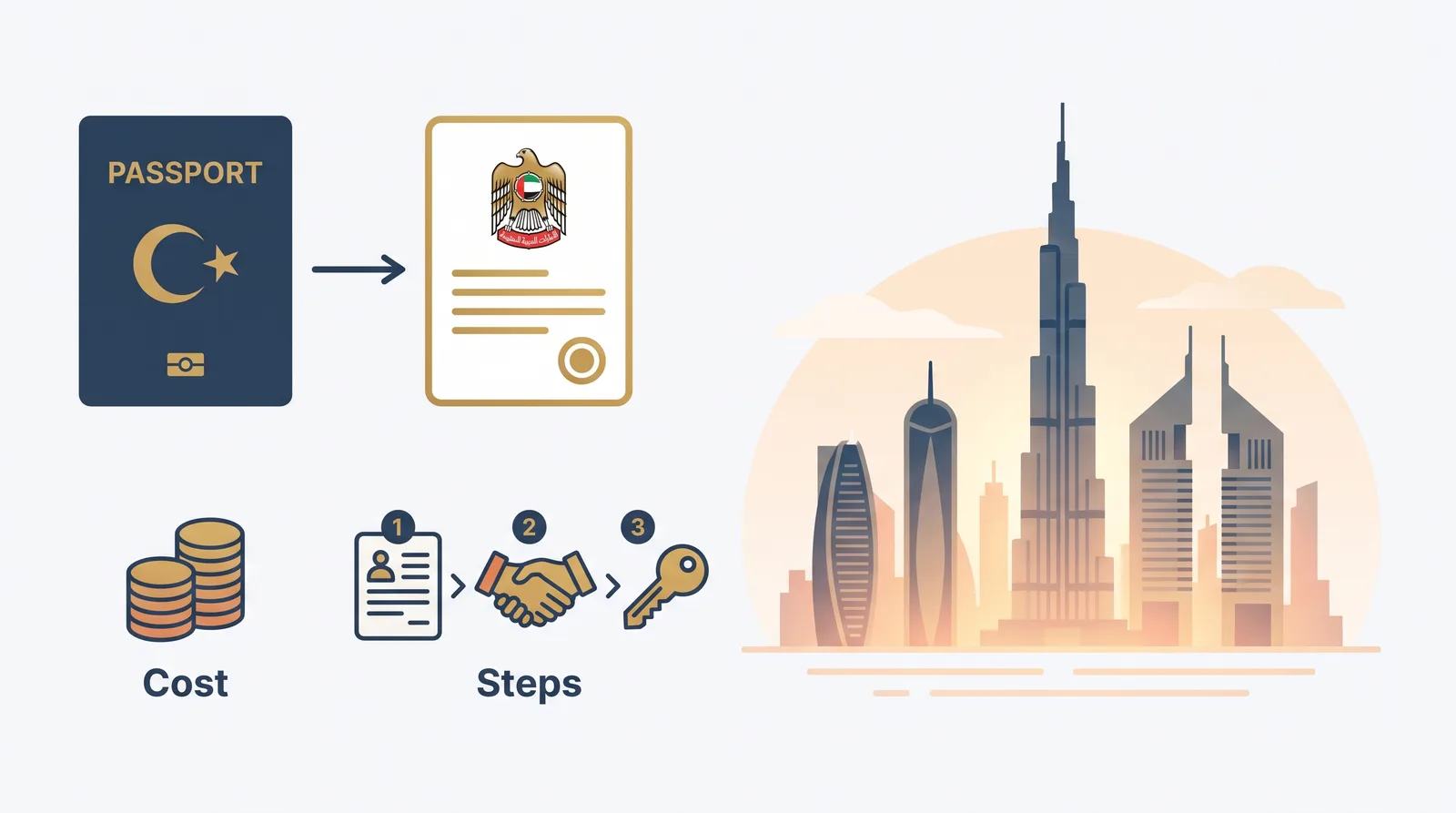
To expand your business to the UAE from Saudi Arabia, follow 7 steps: choose your structure, pick your emirate and zone, select your business activity, reserve your trade name, submit your application and documents, pay your license fee, and apply for your UAE residency visa. The full process takes 5 to 15 working days.
Step 1: Choose Your Structure and Zone
Start by deciding who your customers are. That one question tells you which structure fits.
For logistics, trading, and services targeting international markets, a free zone like DSBH is the practical choice.
For UAE retail or government contracts, mainland via DET is the right path.
Use the business setup cost calculator to compare costs before you commit. The gap between free zone and mainland can be AED 5,000 to AED 30,000 depending on office type and activity.
Steps 2 to 4: Name, Activity, and Documents
Step 2, check your trade name: Names must not copy existing UAE companies or use restricted words. The check is free on most zone portals, including DSBH.
Step 3, confirm your activity code: Some activities need extra approval from bodies like the Central Bank of the UAE or MOHAP. Regulated activities can add 2 to 4 weeks to your timeline.
Step 4, gather your documents: You need passport copies, a passport photo, proof of Saudi company registration if opening a branch, and a bank reference letter if the zone asks for one.
A Saudi trading company checks name availability online, confirms its activity code covers general trading, and submits a notarised copy of its Saudi commercial registration as part of the branch application.
Steps 5 to 7: Apply, Pay, and Get Your Visa
Step 5, submit your application: Most free zones accept online submissions. You do not need to visit Dubai in person for most DSBH license types.
Step 6, pay your license fee: Free zone licenses at DSBH start from AED 12,500, including your first year of registration.
Step 7, apply for your investor visa: The visa is tied to your company license. It gives you the right to live and work in the UAE. Apply through DSBH residency services once your license is active.
The full process takes 7 to 15 working days after license issue (ICP, 2024). Emirates ID follows the visa stamp.
Costs of Expanding Your Business to the UAE from Saudi Arabia
The cost ranges from AED 12,500 for a basic free zone license to AED 50,000 or more for a mainland license with physical office space. Residency visa packages add AED 3,000 to AED 7,000 per person. Costs vary by zone, activity, and office type.
Free Zone License Costs
Free zone licenses at DSBH start from AED 12,500 for a single activity with a flexi-desk. Your actual cost depends on what you add.
Package element | Typical cost (AED) |
|---|---|
Single-activity free zone license (DSBH) | From 12,500 |
Flexi-desk workspace | Included in entry packages |
Investor residency visa (per person) | 3,000 to 7,000 |
Additional activity | Varies by zone rules |
Annual renewal | Similar to year-one cost |
A Saudi consultancy taking a single-activity free zone license with a flexi-desk and 2 visa quotas pays roughly AED 18,000 to AED 22,000 in year one including government fees. Use the cost calculator to get a figure based on your exact setup.
Mainland and Branch Costs
Mainland costs are higher. The license alone is AED 10,000 to AED 20,000 before you add office rent.
Office rent in Dubai starts from AED 15,000 per year for a small unit and rises to AED 100,000 or more for prime commercial space.
Branch registration adds Ministry of Economy fees on top of the license cost.
Arabic documents from Saudi Arabia need certified English translation for UAE authority submissions.
A Saudi engineering firm registering a Dubai mainland branch budgets AED 25,000 for the license and local agent fee, plus AED 40,000 for a small office, totalling roughly AED 65,000 in year one.
Tax and Compliance Rules You Need to Know
The UAE has a 9% corporate tax on profits above AED 375,000, introduced in June 2023. Free zone companies may qualify for a 0% rate if they meet the Qualifying Free Zone Person conditions the Federal Tax Authority sets. VAT is 5% and applies to most UAE business transactions above the AED 375,000 registration threshold.
Corporate Tax for Saudi-Owned UAE Companies
UAE corporate tax at 9% applies to taxable profits above AED 375,000 from June 2023 (Federal Tax Authority, 2023). Every UAE company must register with the FTA after incorporation, regardless of turnover.
Free zone companies can pay 0% corporate tax if they meet the FTA's Qualifying Free Zone Person conditions, which include earning qualifying income and keeping real substance in the UAE.
Saudi Arabia has its own corporate tax rules covering zakat and income tax for non-Saudi shareholders. Get cross-border tax advice before you set up your UAE entity.
A Saudi-UAE double tax treaty exists. Get advice on how it applies to your profits before you file in either country.
A Saudi-owned free zone trading company earns AED 2 million from international clients. If it meets the FTA's Qualifying Free Zone Person rules, it pays 0% corporate tax on that income. If it does not, it pays 9% on profits above AED 375,000.
VAT and Other Compliance Duties
UAE VAT is 5%. It applies once your taxable turnover exceeds AED 375,000 in a 12-month period. Saudi VAT is 15%, so the UAE rate is lower. But both apply if you trade in both countries.
Register for VAT with the FTA before you hit the threshold, not after.
Free zone companies selling into the UAE mainland must charge 5% VAT on those sales.
Sales between designated zones or to international buyers may be zero-rated, depending on the goods and the zone's VAT status.
Keep financial records for at least 5 years. The FTA can audit at any time.
What does "qualifying income" mean for free zone companies?
Qualifying income covers income from transactions with other free zone companies and from international trade. Income from UAE mainland clients generally does not qualify. You must also have real operations in the UAE, not just a registered address. Check the FTA's published guidance at tax.gov.ae before you file.
Visas and Residency When Expanding Your Business to the UAE from Saudi Arabia
The company license grants you the right to apply for an investor or partner residency visa. This visa lets you live and work in the UAE, sponsor dependants, and open a UAE bank account. Visa quotas depend on your office size and license type.
Investor Visa and Emirates ID
The investor visa is tied to your UAE company license. It is issued once the license is active, and it is valid for 2 to 3 years.
Emirates ID is issued after visa stamping. You need it to open a UAE bank account, sign contracts, and access government services.
GCC nationals, including Saudi citizens, benefit from simplified entry under GCC rules. But a UAE residency visa is still needed for long-term stays and company operations.
Emirates ID processing takes 5 to 10 working days after
Frequently Asked Questions