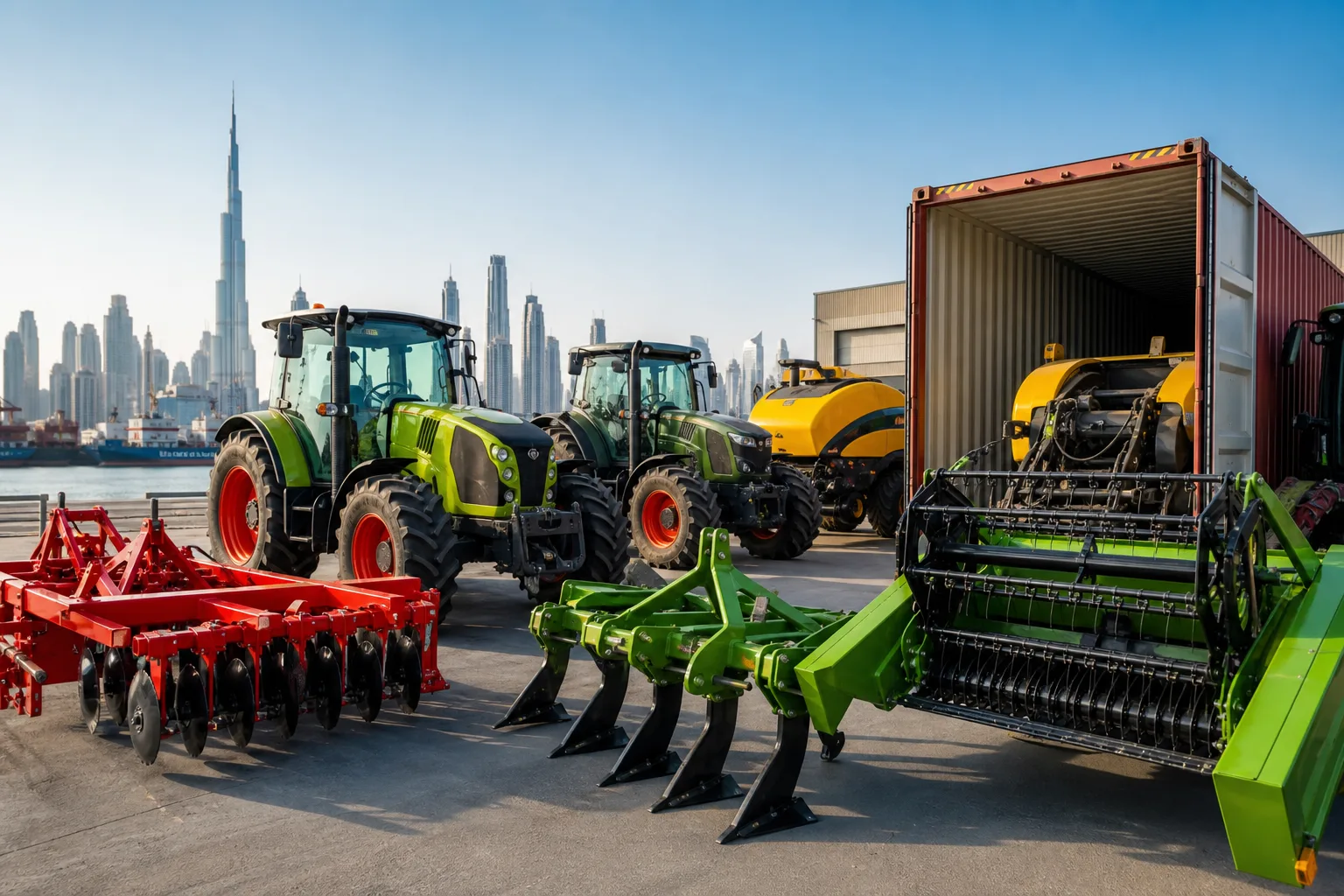
Start a Agricultural Machinery Wholesale Trading Business in Dubai

Topic Summary
Dubai's Location Unlocks Global Trade Routes
Sitting at the crossroads of Asia, Africa, and Europe, Dubai gives agricultural machinery traders direct access to GCC, East African, and South Asian markets. Jebel Ali Port, the Middle East's largest, handles millions of TEUs annually to keep supply chains moving efficiently.
Strong Market Demand Drives Import Opportunities
GCC governments are prioritising food security and investing heavily in tractors, harvesters, and precision irrigation systems. Government-backed farm modernisation schemes across Saudi Arabia, Egypt, and East Africa are creating significant bulk procurement opportunities.
Mainland Setup Suits Direct UAE Market Trading
A mainland licence through Dubai Economy and Tourism allows you to sell directly to UAE retailers, farms, and government entities, including bidding on public tenders. Foreign investors now enjoy 100% ownership rights under the updated UAE Commercial Companies Law.
Free Zones Offer Major Advantages for Re-Export
Free zone licences provide customs duty exemptions, simplified cargo clearance, and full profit repatriation — all critical for import-and-re-export wholesale models. Dubai South Business Hub Free Zone is a strong option, offering proximity to Al Maktoum International Airport and key logistics corridors.
Choosing the Correct Licence Is Essential
Agricultural machinery wholesale traders require a Commercial Trading Licence that covers buying and selling goods in bulk, including equipment and spare parts. Selecting the correct business activity code from the outset prevents costly compliance delays down the line.
Zero Duties and Free Capital Flow Reduce Costs
Free zone structures impose zero import duties on most machinery categories, significantly lowering the cost of stocking and redistributing heavy equipment. There are no restrictions on currency transfers or profit repatriation, making financial management straightforward for international operators.
Dubai sits at the crossroads of Asia, Africa, and Europe. This makes it one of the world's most powerful re-export gateways for heavy equipment and industrial goods. Agricultural machinery traders benefit directly from this position.
Goods flow efficiently through Dubai to the GCC, East Africa, and South Asia. World-class infrastructure supports every stage of the supply chain — from port arrival to last-mile delivery.
Jebel Ali Port handles millions of TEUs annually — the largest port in the Middle East
DP World operates advanced cargo and logistics facilities at Jebel Ali
Free zone structures offer zero import duties on most machinery categories
No restrictions on currency transfers or profit repatriation
Market Opportunity at a Glance
Food security is a top priority across the GCC. Governments are investing heavily in modern farming, irrigation, and mechanised agriculture. This is driving strong import demand for tractors, harvesters, and precision irrigation systems.
The UAE government's agricultural modernisation programmes are accelerating this trend. According to the World Bank, developing regions in the Middle East and Africa are rapidly increasing spending on agricultural technology. The Dubai Chamber of Commerce also highlights agri-trade as a growing sector within Dubai's non-oil economy.
Rising food production targets across Saudi Arabia, Egypt, and East Africa
Government-backed farm modernisation schemes creating bulk procurement opportunities
Growing middle-class demand for food pushing commercial farming investment
Choosing the Right Business Structure and Jurisdiction
Before applying for a licence, you need to choose between a mainland setup and a free zone setup. Each has distinct advantages for wholesale trading. Your choice affects where you can sell, how goods are stored, and what taxes apply.
Mainland Setup via DET
A mainland company lets you trade directly within the UAE domestic market. You register through Dubai Economy and Tourism (DET), which oversees all commercial licences on the mainland.
100% foreign ownership is now permitted under the updated UAE Commercial Companies Law
You can supply directly to UAE-based retailers, farms, and government entities
A physical office or warehouse address in Dubai is required
Mainland companies can bid for government tenders and local contracts
The mainland option suits traders who want to serve the UAE market directly. It requires slightly more compliance overhead, including Emiratisation rules for larger teams.
Free Zone Setup
A free zone licence is ideal if your primary model is import, storage, and re-export. Free zones offer customs duty exemptions and simplified cargo clearance — both critical for wholesale machinery trading.
100% foreign ownership with no local sponsor required
Customs duty exemptions on goods stored within the free zone
Full profit repatriation with no currency restrictions
Streamlined import and export documentation
Check the Dubai Trade portal for customs procedures and trade facilitation details relevant to free zone operators. If you plan to sell into the UAE mainland from a free zone, standard import duties will apply at the point of entry.
For those looking to start a business in Dubai, Dubai South Business Hub Free Zone offers a strong option for agricultural machinery wholesale traders. It combines free zone benefits with proximity to Al Maktoum International Airport and key logistics corridors.
Licensing, Registration, and Legal Requirements
Getting the right licence is the most important step. For agricultural machinery wholesale trading, you need a Commercial Trading Licence. This covers the buying and selling of goods in bulk — including machinery, equipment, and spare parts.
You also need to select the correct business activity code. This determines what you are legally permitted to trade. Choosing the wrong code can cause delays or compliance issues later. You can explore business activities in Dubai to identify the correct category for agricultural machinery wholesale.
Step-by-Step Licence Application
Step 1 – Choose your trade name. Check availability and confirm it complies with UAE naming rules. You can check company name availability before submitting your application.
Step 2 – Submit incorporation documents. These include passport copies, application forms, and your chosen business activity. Submit to DET (mainland) or your chosen free zone authority.
Step 3 – Secure a tenancy contract. Mainland businesses require an Ejari-registered office or warehouse. Free zone businesses use authority-approved premises.
Step 4 – Pay licence fees and receive your trade licence certificate. Timelines vary by authority but typically range from 3 to 10 working days.
Once licensed, register with the Dubai Chamber of Commerce. This adds credibility when dealing with international suppliers and regional buyers.
Tax and Customs Obligations
The UAE introduced VAT at 5% in 2018. If your annual turnover exceeds AED 375,000, VAT registration is mandatory. Visit the Federal Tax Authority to register and manage your VAT obligations.
Some agricultural machinery categories may qualify for zero-rated VAT — confirm with the FTA
Understand the correct HS (Harmonised System) tariff codes for tractors, irrigation systems, and harvesters
Incorrect HS codes can cause customs delays and financial penalties
Use a licensed customs broker for accurate classification
Free zone businesses benefit from customs duty exemptions within the zone. Duties apply when goods enter the UAE mainland market.
Visa and Workforce Requirements
Your trade licence entitles you to apply for an investor visa. This is processed through the ICP portal. The visa is linked to your company and allows you to live and work in the UAE.
Employment visas for staff are governed by MOHRE regulations
Mainland businesses above certain headcount thresholds must comply with Emiratisation (Nafis) rules
Free zone companies have separate visa allocation limits based on office or warehouse size
Residency visa packages are often bundled with company formation. UAE residency visa services at Dubai South Business Hub Free Zone can simplify this process for new investors.
Operations: Sourcing, Logistics, and Storage
Running a successful agricultural machinery wholesale business depends on reliable sourcing and efficient logistics. You need competitive pricing from manufacturers and smooth cargo movement through Dubai's ports.
Major sourcing regions include China, Germany, the United States, Italy, and Japan. Each market offers different price points and product specialisations. Chinese manufacturers dominate budget-friendly tractors and irrigation equipment. European brands lead in precision farming technology.
Negotiate OEM or authorised distributor agreements for exclusive pricing
Request product certifications relevant to target markets (CE marking for Europe-origin goods)
Vet suppliers through trade platforms and on-site factory audits
Supply Chain and Customs Clearance
Jebel Ali Port is the backbone of Dubai's import and re-export trade. It is the largest port in the Middle East and one of the busiest globally. DP World manages cargo operations and offers dedicated services for heavy and oversized equipment.
Register on the Dubai Trade portal for streamlined customs declarations
Appoint a licensed customs broker to handle HS code classification and duty calculations
Sea freight from China or Southeast Asia averages 20–35 days transit time
Air freight is available for spare parts and urgent orders via Al Maktoum International Airport
Plan your inventory cycles around these lead times. Seasonal demand peaks — such as planting seasons in Africa and South Asia — require advance stock positioning.
Storage and Inventory Management
Agricultural machinery is bulky and heavy. Your warehouse must accommodate forklifts, racking systems, and open yard space for oversized equipment.
Industrial zones such as Al Quoz, Dubai Investment Park (DIP), and free zone warehousing areas are popular choices
Ensure sufficient yard space for tractors, combine harvesters, and irrigation rigs
Implement inventory management software to track stock levels, serial numbers, and order status
Maintain spare parts inventory to support after-sales service — a key differentiator in this market
Warehouse lease terms vary by zone. Free zone warehouses often include built-in customs clearance benefits. Mainland warehouses offer more flexibility for local deliveries.
Sales Strategy and Growing Your Client Base
Agricultural machinery wholesale is a relationship-driven business. Buyers want reliable suppliers, consistent quality, and responsive after-sales support. Your sales strategy should reflect this.
Target customers include agri-businesses, government-run farms, agricultural cooperatives, rural retailers, and NGOs running food security programmes. These buyers operate across the GCC, East Africa, South Asia, and North Africa.
Attend SIAL Middle East and Agra Middle East — Dubai's leading agri-trade exhibitions
Join the Dubai Chamber of Commerce to access buyer networks and trade missions
Build a B2B website optimised for search terms used by procurement managers
Use LinkedIn and industry directories to reach decision-makers in target markets
A trading business license in Dubai gives you the legal foundation to operate across these markets. Pair it with strong digital visibility and active trade show participation to build your pipeline quickly.
Export and Re-Export Opportunities
Dubai's re-export model is one of its biggest commercial advantages. You import machinery globally, store it in a free zone, and sell regionally — often without paying customs duties until the goods reach their final destination.
Key export markets: Saudi Arabia, Egypt, Kenya, Ethiopia, Pakistan, and India
East Africa is a fast-growing market for affordable tractors and drip irrigation systems
South Asia demands large volumes of harvesters and soil preparation equipment
The UAE has signed free trade agreements with several key markets. These agreements reduce or eliminate tariffs on goods exported from the UAE. Visit the UAE Ministry of Economy to review active trade agreements and export support programmes relevant to your target markets.
Working with a business setup specialist can help you structure your company to maximise these trade agreement benefits from day one. Understanding your business setup cost in Dubai upfront also helps you plan capital allocation across licensing, warehousing, and initial stock procurement.
Conclusion
Starting an agricultural machinery wholesale trading business in Dubai puts you at the centre of a fast-growing global trade corridor. The combination of strong regional demand, world-class logistics, and a transparent regulatory environment makes Dubai one of the best locations for this business model.
With the right licence, the right jurisdiction, and a clear sourcing and sales strategy, you can build a profitable operation that serves markets across the GCC, Africa, and beyond.
Ready to launch your agricultural machinery trading company in Dubai? Speak with a business setup specialist at Dubai South Business Hub Free Zone today. Get your licence approved fast and start trading with confidence.
Citations
Frequently Asked Questions