Air-Condition Trading License in Dubai

Topic Summary
Why Dubai's AC Market Never Slows Down
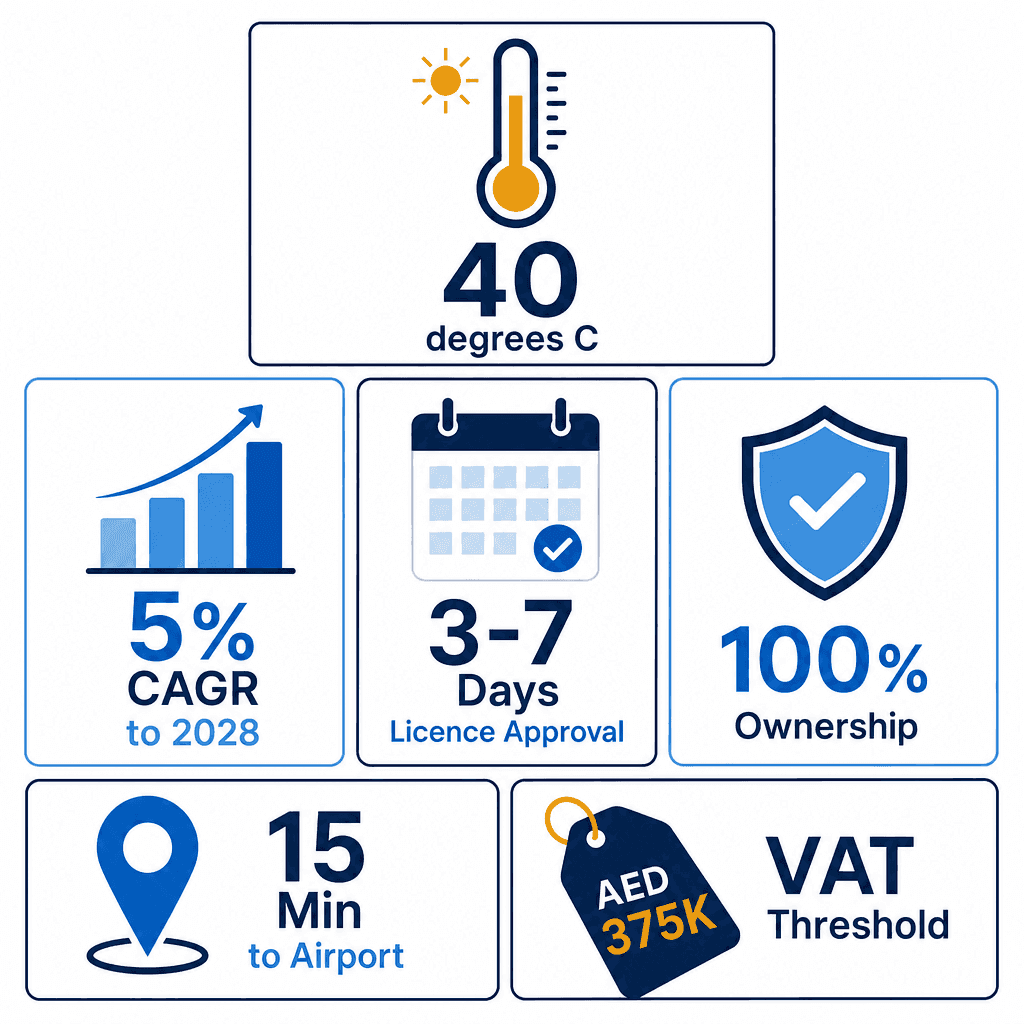
Temperatures regularly exceeding 40°C and a booming construction sector create year-round, structural demand for cooling equipment. Unlike seasonal markets, Dubai's trading cycle for air-conditioning runs continuously across all twelve months.
What Activity Code 4759.89 Actually Permits
This license authorizes the import, export, re-export, and distribution of AC units and components, including split systems, ducted units, compressors, and control units. It covers both wholesale and retail trade but does not extend to installation or maintenance services.
Dubai South Free Zone's Strategic Advantages
Located within 15 minutes of Al Maktoum International Airport, Dubai South offers traders direct access to major air freight corridors into Asia, Africa, and Europe. Zero import duties within the free zone further reduce overhead for businesses focused on re-export.
Full Foreign Ownership With No Local Sponsor
Dubai South Free Zone regulations permit 100% foreign ownership, removing the traditional requirement for an Emirati business partner. License holders can also repatriate all profits to any country without restriction.
Fast License Approval and Clear Cost Thresholds
Standard license approval takes just three to seven working days, making it one of the faster routes to market in the region. Businesses only need to register for VAT once taxable supplies exceed AED 375,000, keeping early-stage compliance straightforward.
GCC Infrastructure Spending Fuels Long-Term Demand
Government programmes tied to UAE Vision 2031 and Saudi Arabia's Vision 2030 are directing billions into new residential, commercial, and hospitality projects across the region. Every new build requires cooling infrastructure, sustaining demand well into the next decade.
Who Benefits Most From This License
HVAC importers, international manufacturers seeking a regional distribution base, and re-export entrepreneurs all find the Dubai South structure advantageous. The free zone's logistics connectivity makes it especially effective for serving East Africa, South Asia, and the broader Middle East from a single operating point.
Dubai's year-round heat and rapid urban expansion make air-conditioning one of the most consistently in-demand traded commodities in the region. With temperatures regularly exceeding 40°C and a construction sector that shows no sign of slowing, the demand for cooling equipment is structural rather than cyclical. Obtaining an air-condition trading license (Activity Code 4759.89) at Dubai South Business Hub Free Zone gives entrepreneurs a cost-effective, strategically located base to supply, import, and re-export cooling equipment across the GCC and beyond.
Key Market Stats at a Glance
UAE HVAC market projected to grow at a CAGR of over 5% through 2028
Dubai South Free Zone is located within 15 minutes of Al Maktoum International Airport
Activity Code 4759.89 covers wholesale and retail trade of AC units and components
100% foreign ownership permitted under Dubai South Free Zone regulations
Standard license approval: 3 to 7 working days
VAT registration threshold: AED 375,000 in taxable supplies
Zero import duties on goods traded within the free zone
Dubai's Air-Conditioning Market: Why the Opportunity Is Strong
The UAE's construction pipeline remains one of the most active in the world, with large-scale residential, commercial, and industrial projects driving sustained demand for air-conditioning systems. Government-backed infrastructure programmes, including those aligned with UAE Vision 2031 and Saudi Arabia's Vision 2030, are channelling billions of dirhams into new buildings, hospitality venues, and industrial facilities across the GCC, all of which require reliable cooling infrastructure.
Beyond new builds, the replacement and maintenance market adds a further layer of demand. Older systems require upgrades to meet evolving energy efficiency standards, and building owners across the region are investing in modern inverter and smart-cooling technologies.
Dubai's geographic position amplifies the commercial opportunity further. Sitting at the crossroads of Asia, Africa, and Europe, the emirate functions as a global re-export hub. Traders based in Dubai can source equipment from manufacturers in China, South Korea, Japan, and Europe, then redistribute it efficiently to markets across East Africa, South Asia, and the wider Middle East. With no seasonal slowdown in cooling demand, the trading cycle runs twelve months of the year, making air-conditioning one of the most resilient product categories available to UAE-based traders.
What an Air-Condition Trading License Covers
Activity Code 4759.89 sits within the trading category and permits the wholesale and retail trade of air-conditioning units and related components. Under this license, a business is authorised to import, export, re-export, and distribute a broad range of cooling products. These include split-unit systems, central air-conditioning systems, ducted units, portable coolers, evaporative coolers, and associated spare parts such as compressors, filters, condensers, and control units.
The trading license category is distinct from a service or contracting license. It does not cover installation or maintenance work, but it does allow the holder to buy and sell AC equipment at both wholesale and retail levels. Within the Dubai South Free Zone framework, license holders also benefit from 100% foreign ownership with no requirement for a local Emirati sponsor, as well as full profit repatriation to any country without restriction.
Who This License Is Suited For
This license is well suited to a wide range of business profiles. HVAC equipment importers and distributors targeting GCC markets will find the free zone structure particularly advantageous due to its duty-free import environment and proximity to major logistics corridors. International manufacturers looking to establish a UAE distribution base can use a Dubai South entity to manage regional stock and fulfil orders across multiple markets from a single point.
Entrepreneurs focused on re-exporting branded or generic AC units to Africa and South Asia will benefit from the port and airport access that Dubai South provides. Existing mainland UAE businesses may also consider establishing a free zone trading arm under this license to optimise their tax position and ring-fence their import-export operations from their local service activities.
Setup Costs and Steps at Dubai South Business Hub Free Zone
The total cost of setting up an air-condition trading license at Dubai South Business Hub Free Zone varies depending on the package selected. License fees typically begin at approximately AED 12,500 to AED 15,000 per year for a basic trading license, with registration and establishment card fees adding a further AED 2,000 to AED 4,000. Visa allocation packages are available depending on the office or facility type chosen, with each visa adding to the overall cost.
Facility options range from flexi-desk arrangements, which provide a registered address and shared workspace, through to dedicated offices and warehousing units for businesses that need to hold physical stock. Warehousing within Dubai South is competitively priced given its proximity to logistics infrastructure, and units can often be leased on short-term arrangements to suit early-stage businesses.
The standard application process follows these steps:
Submission of the license application form along with required documents
Document attestation and verification by the authority
Payment of license and registration fees
License issuance and establishment card activation
Emirates ID and visa processing for shareholders and dependants
Key Documents Required
Applicants will need to prepare the following documents before submitting their application:
Passport copies and current visa status documentation for all shareholders and directors
A business plan or activity description aligned with Activity Code 4759.89
A no-objection certificate (NOC) from a current employer if the applicant is already a UAE resident on an employment visa
A Memorandum of Association and share structure declaration confirming ownership percentages
Licensing, Compliance, and Regulatory Requirements
The Dubai South Free Zone authority oversees the issuance and annual renewal of licenses. Businesses must renew their license each year and maintain an active registered address within the zone to remain in good standing. Failure to renew on time can result in fines and, ultimately, license cancellation.
Air-conditioning products sold or distributed within the UAE must comply with UAE.S standards and the conformity requirements set by the Emirates Authority for Standardisation and Metrology (ESMA). Electrical goods including AC units require ESMA product registration before they can be placed on the UAE market, and importers must ensure their products carry the appropriate conformity mark.
All import and re-export shipments are subject to Dubai Customs clearance procedures, and traders must maintain accurate commercial documentation including invoices, packing lists, and certificates of origin. Once a business's taxable supplies exceed AED 375,000 in a twelve-month period, VAT registration with the Federal Tax Authority becomes mandatory. The standard VAT rate in the UAE is 5%, though exports outside the GCC may qualify for zero-rating subject to specific conditions.
Why Dubai South Is the Right Base for AC Trading
Dubai South's location is one of its most compelling commercial advantages. The free zone sits adjacent to Al Maktoum International Airport, which is planned to become the world's largest airport upon full completion, and is within close reach of Jebel Ali Port, the largest container port in the Middle East. This dual access to air and sea freight significantly reduces logistics costs and transit times for businesses importing from Asia and exporting to Africa or Europe.
The free zone framework offers zero corporate tax on qualifying income under the UAE's 9% corporate tax regime for free zone entities that meet the relevant conditions, along with zero import duties on goods brought into the zone. Dubai South's integrated logistics ecosystem supports the full supply chain, from warehousing and freight forwarding through to last-mile delivery across the UAE.
The UAE's strong bilateral trade agreements and its reputation as a politically neutral trading hub make it easier for businesses to access markets that might otherwise be difficult to reach. For AC traders, this translates into smoother customs procedures, reliable banking infrastructure, and a business environment that is recognised and trusted by suppliers and buyers worldwide.
Related Activities
Musical Instruments & Requisites Trading Trading License
Chandeliers Trading Trading License
Light Fitting & Fixtures Trading Business
Frequently Asked Questions