How to Get a Antennas Trading License in Dubai

Topic Summary
Understand What the License Covers
An Antennas Trading License under activity code 4759.9 authorises you to import, export, distribute, and re-export antenna products and related equipment across the UAE. Covered goods include satellite, terrestrial, and mobile antennas, plus accessories like mounts, cables, and signal boosters.
Choose Dubai South Free Zone for Key Advantages
Dubai South Business Hub Free Zone offers 100 per cent foreign ownership, zero corporate and personal income tax, and full profit repatriation with no local sponsor required. Its location next to Al Maktoum International Airport gives antenna traders direct access to major air freight infrastructure.
Leverage Dubai's Strategic Re-Export Position
The UAE's geography puts traders within hours of the GCC, South Asia, East Africa, and Eastern Europe, making it a powerful base for multi-region antenna distribution. Free zone status also enables international re-export alongside domestic supply, creating a dual revenue stream.
Know Who This License Is Best Suited For
The license fits a wide range of operators, from international antenna manufacturers wanting a UAE distribution hub to entrepreneurs entering the satellite and broadcasting supply chain. Logistics companies looking to add electronics trading and re-exporters targeting Africa or South Asia are also strong candidates.
Plan Your Budget Around Key Cost Components
License registration fees typically range from AED 5,750 to AED 15,000, with total costs varying based on visa requirements and whether physical office or warehouse space is needed. Requesting a tailored package quote early helps avoid unexpected expenses during setup.
Expect a Fast and Streamlined Setup Timeline
The typical license setup timeline at Dubai South Business Hub Free Zone runs between three and seven working days. Single-person visa packages are available, making the process accessible even for solo entrepreneurs or small trading operations.
Tap Into a Growing UAE Antenna Market
The UAE has one of the highest 5G coverage rates in the world, and ongoing smart city projects in Dubai and Abu Dhabi are driving sustained demand for advanced antenna infrastructure. The country also functions as a major electronics re-export hub, amplifying commercial opportunities for licensed antenna traders.
Global demand for antenna technology is accelerating, driven by the rapid rollout of 5G networks, satellite communications, and smart infrastructure. Dubai sits at the centre of this growth, connecting suppliers across Asia, Europe, and Africa through one of the world's most business-friendly regulatory environments. If you are looking to trade antennas commercially in the UAE, obtaining a dedicated trading license under activity code 4759.9 at Dubai South Business Hub Free Zone is one of the most efficient routes available to you.
This guide covers everything you need to know: what the license covers, who it suits, how much it costs, and how to complete the setup process from start to finish.
What Is an Antennas Trading License?
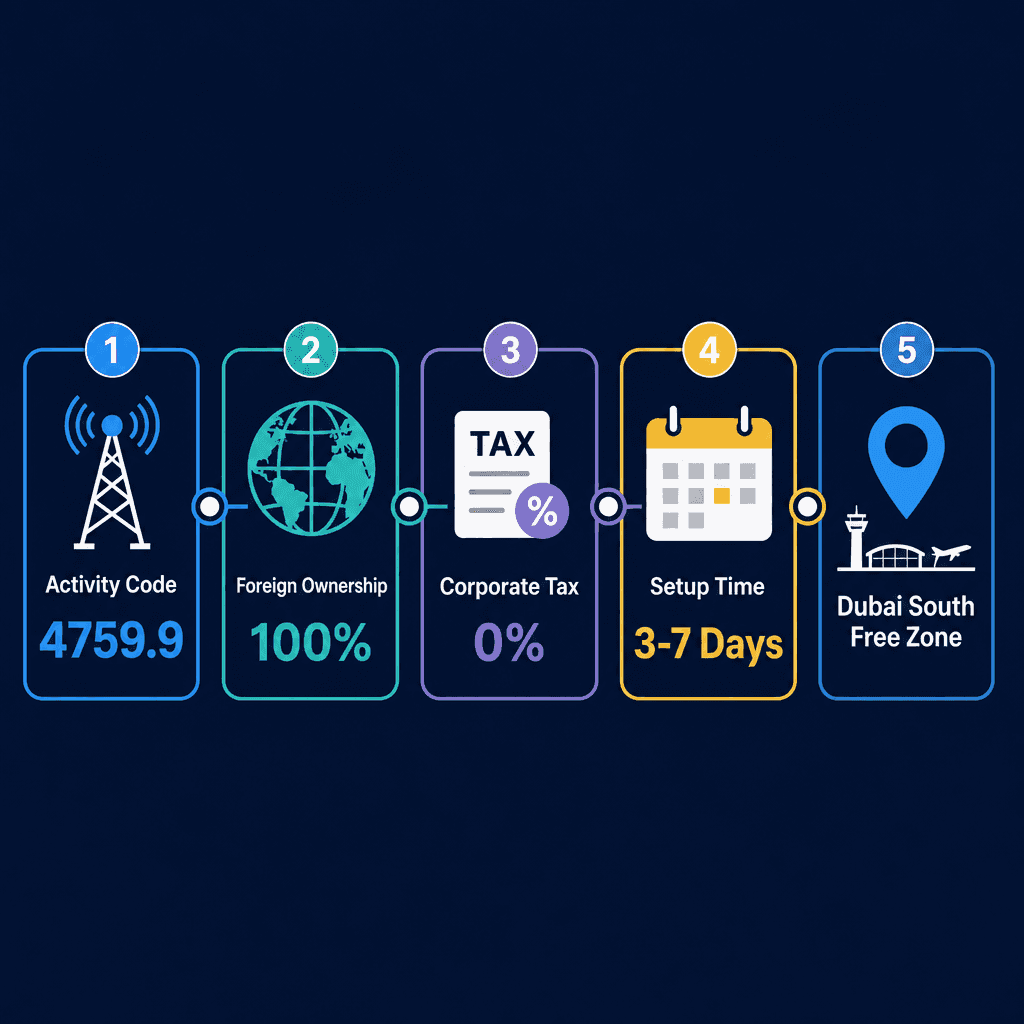
An Antennas Trading License is a commercial trading license issued under activity code 4759.9. It authorises the holder to import, export, distribute, and re-export antenna products and related equipment within and through the UAE. The license falls under the Trading category and is issued as a Trading License type.
Covered activities typically include:
Wholesale and retail trading of antenna systems and components
Import and re-export of satellite, terrestrial, and mobile antennas
Distribution of antenna hardware to telecom operators, broadcasters, and system integrators
Supply of antenna accessories such as mounts, cables, and signal boosters
Why Dubai South Business Hub Free Zone?
Dubai South is a purpose-built economic zone centred around Al Maktoum International Airport, one of the largest cargo hubs in the world. For traders dealing in electronics and communications equipment, proximity to air freight infrastructure is a significant operational advantage.
Key benefits of setting up at Dubai South Business Hub Free Zone include:
100 per cent foreign ownership with no local sponsor required
Zero per cent corporate and personal income tax
Full repatriation of profits and capital
Streamlined customs procedures for import and re-export
Access to a growing ecosystem of logistics, technology, and trade companies
The UAE's strategic location means goods can reach markets in the GCC, South Asia, East Africa, and Eastern Europe within hours, making it an ideal base for antenna distribution businesses targeting multiple regions simultaneously.
UAE Market Context
The UAE telecommunications sector continues to expand at pace. The country's 5G coverage is among the highest in the world, and ongoing smart city projects across Dubai and Abu Dhabi are generating consistent demand for advanced antenna infrastructure. The UAE also serves as a re-export hub for electronics, with a significant proportion of imported communications equipment redistributed to neighbouring markets. For antenna traders, this creates a dual revenue opportunity: supplying the domestic market while leveraging free zone status for international re-export.
Key Stats at a Glance
Activity Code: 4759.9
License Type: Trading License
Category: Trading
Free Zone: Dubai South Business Hub
Foreign Ownership: 100 per cent permitted
Corporate Tax: 0 per cent (within free zone qualifying income thresholds)
Typical License Setup Timeline: 3 to 7 working days
Minimum Visa Package: Available from single-person setups
Who Should Apply?
This license is well-suited to a broad range of operators, including:
International antenna manufacturers seeking a UAE distribution base
Entrepreneurs entering the satellite and broadcasting supply chain
Logistics companies looking to add electronics trading to their portfolio
Re-exporters targeting Africa, South Asia, or the broader Middle East
Setup Costs and Fees
Costs vary depending on the package selected, the number of visas required, and whether you need physical office or warehouse space. Typical cost components include:
Cost Component | Indicative Range (AED) |
|---|---|
License registration fee | 5,750 to 15,000 |
Establishment card | Included in most packages |
Visa allocation (per person) | 3,000 to 5,000 |
Flexi-desk or office space | 10,000 to 25,000 per annum |
Medical and Emirates ID | 1,500 to 2,500 per person |
Annual renewal fees apply and are generally comparable to initial registration costs. It is advisable to request a detailed quotation based on your specific visa and facility requirements.
Step 1: Choose Your Business Structure
Most applicants register as a Free Zone Establishment (FZE) for single shareholders or a Free Zone Company (FZC) for multiple shareholders. Both structures permit 100 per cent foreign ownership.
Step 2: Reserve Your Trade Name
Submit your preferred company name for approval. The name must comply with UAE naming conventions and must not conflict with existing registered entities.
Step 3: Submit Your Application
Provide the required documentation, which typically includes passport copies, a completed application form, and proof of address. No minimum share capital is generally required for trading licenses at this free zone.
Step 4: Obtain Initial Approval
The free zone authority reviews your application and issues initial approval, usually within two to three working days.
Step 5: Sign the Lease Agreement
Select your workspace option, whether a flexi-desk, serviced office, or warehouse unit, and sign the relevant lease agreement.
Step 6: Receive Your License
Upon payment of fees and completion of documentation, your Antennas Trading License is issued. The full process typically takes three to seven working days.
Step 7: Apply for Visas and Open a Bank Account
Once the license is active, you can process residency visas for shareholders and employees, and open a corporate bank account with a UAE-registered bank.
Compliance and Regulatory Requirements
Antenna traders operating from Dubai South must observe the following:
Goods must comply with UAE import regulations and any applicable TDRA (Telecommunications and Digital Government Regulatory Authority) standards for communications equipment
Re-export activities must follow UAE customs procedures and applicable trade controls
Annual license renewal is mandatory to maintain trading rights
Corporate tax registration may be required depending on revenue thresholds under the UAE Corporate Tax Law effective from June 2023
Profit Margins and Commercial Outlook
Antenna trading margins vary by product segment. Commodity antenna components typically yield margins of 10 to 20 per cent, while specialised or proprietary antenna systems for 5G, satellite, or defence applications can command margins of 30 per cent or more. The re-export model adds a further layer of profitability by enabling traders to source competitively from Asian manufacturers and distribute across the wider region without incurring the overhead costs of a full manufacturing operation.
Get Started
Use the cost calculator for a tailored quote.
Verify your business name with the company name check.
Browse the full business activities directory.
Get in touch to start your application.
Frequently Asked Questions