Coffee Trading License in Dubai

Topic Summary
Dubai's Strategic Position in Global Coffee Trade
Dubai sits at the crossroads of fast-growing coffee markets spanning the Middle East, Africa, and South Asia. Its role as both a major importer and re-export hub makes it one of the most commercially valuable locations for coffee traders worldwide.
What Activity Code 4721.75 Actually Permits
This Trading License covers wholesale and retail trading of coffee, tea, cocoa, and related products, including importing, exporting, re-exporting, and local distribution. It is designed for businesses buying and selling these commodities rather than manufacturing or processing them.
Key Compliance Obligations Beyond the License
Processing or roasting activities require a separate license category on top of the standard trading license. Traders handling physical stock must also meet food safety and labelling requirements set by emirate-level authorities and national standards bodies.
Unmatched Logistics Infrastructure at Dubai South
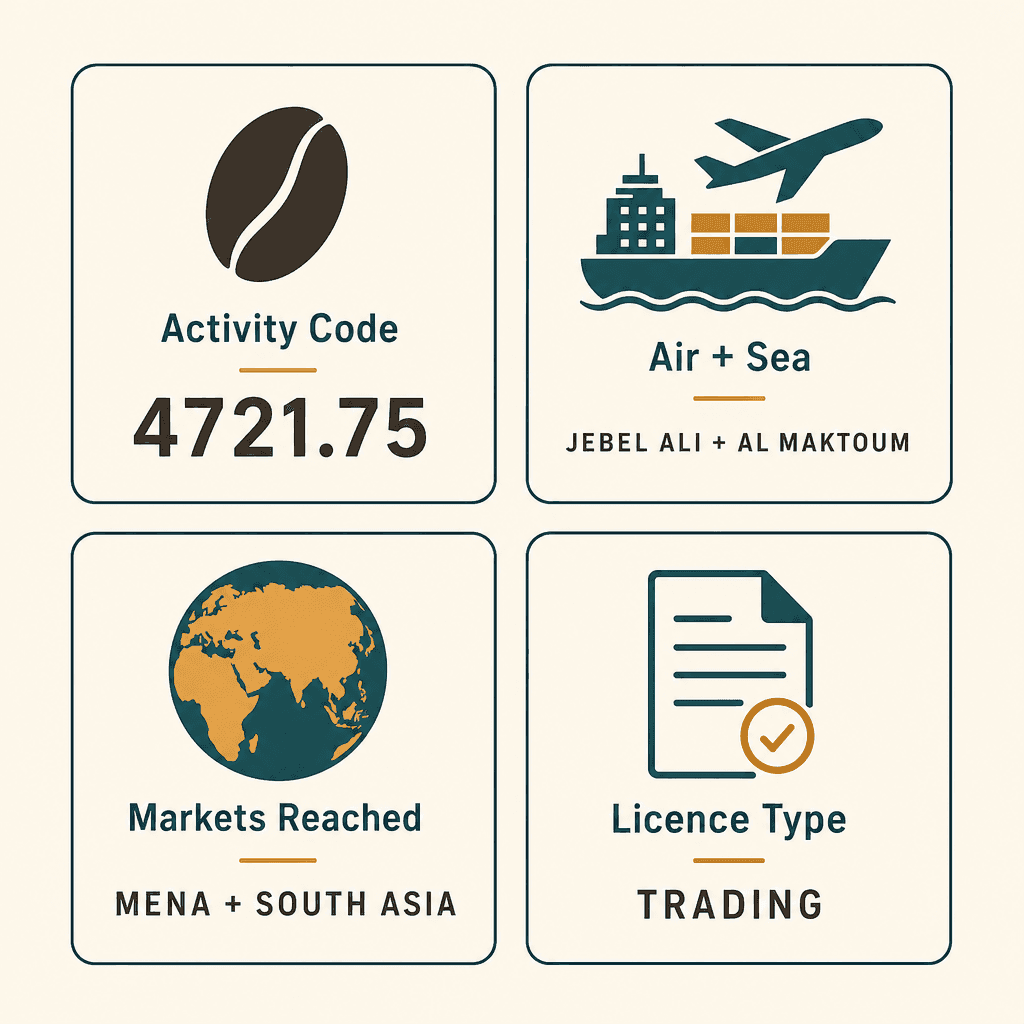
Dubai South's proximity to Al Maktoum International Airport and Jebel Ali Port — the largest container port in the Middle East — gives traders efficient access to both air and sea freight networks. This combination is particularly valuable for time-sensitive or high-value coffee shipments.
Full Foreign Ownership With No Local Sponsor
The Dubai South Business Hub Free Zone allows international businesses to establish a presence in the Middle East without requiring a UAE national sponsor. This structure is especially attractive for coffee importers, exporters, and international brands seeking a tax-efficient regional base.
One License as a Regional Trading Hub
Specialty roasters and green bean traders can use a single Dubai South license to access Gulf and wider MENA markets without setting up multiple entities across different countries. This simplifies operations and reduces administrative overhead for businesses targeting several markets simultaneously.
Growing Consumer Demand Drives Upstream Opportunity
The UAE's young, urban, and increasingly coffee-literate population has fuelled consistent market growth, with independent cafés, boutique roasteries, and international chains all competing for share. This sustained retail demand creates direct commercial opportunity for traders operating earlier in the supply chain.
Dubai sits at the crossroads of the world's fastest-growing coffee markets, making it one of the most strategically valuable locations for coffee traders targeting the Middle East, Africa, and South Asia. Whether you are an established importer, a specialty roaster, or an entrepreneur entering the café supply chain, the right jurisdiction can define your competitive position. This guide explains how to obtain a Coffee Trading License under Activity Code 4721.75 at Dubai South Business Hub Free Zone, covering costs, compliance requirements, and why this jurisdiction gives traders a measurable edge.
Dubai's Coffee Market: Why It Matters Now
The UAE coffee market has demonstrated consistent growth over the past decade, driven by a young, urban, and increasingly coffee-literate population. The country is both a significant importer of green and roasted coffee and a re-export hub, channelling product flows from producing nations in Africa and Latin America to consumers across the MENA region and South Asia. According to the International Coffee Organisation, global coffee trade volumes continue to rise, and the Gulf Cooperation Council remains one of the most commercially attractive destination markets for premium and specialty products.
Dubai's specialty coffee scene has expanded rapidly, with independent cafés, boutique roasteries, and international chains all competing for market share. This sustained demand at the consumer level translates directly into commercial opportunity for traders operating upstream in the supply chain.
From a logistics perspective, Dubai South occupies a uniquely advantageous position. Its proximity to Al Maktoum International Airport, the world's largest airport by design capacity, and its connectivity to Jebel Ali Port, the largest container port in the Middle East, means that goods can move efficiently across air and sea freight networks. For time-sensitive or high-value coffee shipments, this infrastructure combination is difficult to replicate elsewhere in the region.
What a Coffee Trading License Covers
Activity Code 4721.75 covers the wholesale and retail trading of coffee, tea, cocoa, and related products. Issued as a Trading License under the Trading category, this license is designed for businesses whose primary commercial activity involves buying and selling these commodities rather than manufacturing or processing them.
Under this license, the holder is permitted to import coffee and allied goods into the UAE, export and re-export to international markets, and distribute products locally within the terms set by the free zone and applicable UAE regulations. This breadth of permitted activity makes it particularly well suited to businesses operating across multiple channels simultaneously, from bulk commodity supply to branded retail distribution.
It is important to note what the license does not automatically cover. Processing or roasting activities would require a separate or additional license category. Furthermore, because coffee is a food commodity, traders handling physical stock may need to satisfy food safety and labelling requirements imposed by emirate-level authorities and national standards bodies. These are compliance obligations that sit alongside the trading license rather than being replaced by it.
Who This License Is Suited For
The Coffee Trading License at Dubai South Business Hub Free Zone is well suited to a broad range of business profiles. Coffee importers and exporters seeking a tax-efficient base with full foreign ownership will find the free zone structure highly compatible with their operational model. Specialty roasters and green bean traders who want to access Gulf and wider MENA markets without establishing multiple entities across different countries can use a single Dubai South license as their regional trading hub.
International coffee brands looking to establish a presence in the Middle East without the requirement for a UAE national sponsor will benefit from the 100% foreign ownership provisions available within the free zone. Entrepreneurs entering the café supply chain, whether supplying equipment, consumables, or commodity coffee, or those exploring commodity brokerage, will also find Activity Code 4721.75 a natural fit for their intended activities.
Setup Costs, Steps, and Compliance Requirements
Setting up a coffee trading company at Dubai South Business Hub Free Zone involves a structured application process. License and registration fees depend on the specific package selected, the type of workspace arrangement chosen (such as a flexi-desk or dedicated office), and the number of visa allocations required. Prospective applicants are advised to request a current fee schedule directly from the free zone authority, as pricing is subject to periodic revision.
The general process follows these steps. First, the applicant reserves a trade name that complies with UAE naming conventions. Second, a formal application is submitted to the free zone authority along with the required documentation. Third, fees are paid and the memorandum of association or equivalent constitutional document is prepared. Finally, the license is issued, typically within a few working days to two weeks from the point at which a complete application and full payment have been received.
Under UAE free zone regulations, 100% foreign ownership is permitted, meaning there is no requirement for a UAE national partner or local sponsor. On the tax side, qualifying free zone businesses may benefit from a 0% corporate tax rate on qualifying income under the UAE Corporate Tax Law introduced in 2023. Independent tax advice should be sought to confirm eligibility and ensure ongoing compliance with the qualifying conditions set out by the Federal Tax Authority.
Key Documents and Approvals
A standard trading license application at Dubai South Business Hub Free Zone will typically require the following documentation: passport copies of all shareholders and directors, a completed application form, trade name approval confirmation, a memorandum of association, and proof of registered address within the free zone.
Because coffee is classified as a food commodity, traders should also be aware of potential requirements from the relevant emirate-level food control authority and the Emirates Authority for Standardisation and Metrology (ESMA). ESMA sets labelling and product standards for food items sold or distributed in the UAE, and compliance with these standards is a legal obligation for any business handling coffee products intended for end consumers. Businesses focused exclusively on re-export may face different requirements, and early engagement with the relevant authorities is recommended.
Why Dubai South Is the Right Base for Coffee Traders
Dubai South is not simply a licensing address; it is a purpose-built logistics and business district designed around the movement of goods. Its position adjacent to Al Maktoum International Airport places it within one of the most active air cargo corridors in the world, while its integration with the broader Dubai South logistics corridor connects businesses to Jebel Ali Port and major sea freight infrastructure for consolidation and onward distribution.
UAE free zones offer favourable customs duty structures, and goods transiting through or being re-exported from free zone entities benefit from arrangements that reduce the cost burden compared with mainland trading structures. This makes Dubai South particularly attractive for businesses whose model depends on efficient transshipment to markets across Africa, South Asia, and the broader MENA region.
Beyond logistics, Dubai offers a stable regulatory environment, world-class infrastructure, and a large, affluent expatriate consumer base that supports local sales alongside international distribution. For coffee traders, this combination of physical connectivity, regulatory clarity, and market depth is difficult to find in a single location anywhere else in the region.
Key Facts at a Glance: Coffee Trading License in Dubai
Activity Code: 4721.75
License Type: Trading License
Category: Trading
Free Zone: Dubai South Business Hub Free Zone
Foreign Ownership: 100% permitted, no local sponsor required
Corporate Tax: 0% on qualifying free zone income (UAE Corporate Tax Law, 2023)
Permitted Activities: Import, export, re-export, and local distribution of coffee, tea, cocoa, and related products
Typical License Issuance Timeline: A few working days to two weeks from complete submission
Key Infrastructure: Al Maktoum International Airport and Jebel Ali Port
Personal Income Tax: None in the UAE
Get Started
Use the cost calculator for a tailored quote.
Verify your business name with the company name check.
Browse the full business activities directory.
Get in touch to start your application.
Frequently Asked Questions