Flour Trading License in Dubai

Topic Summary
Dubai Dominates UAE Food Re-Export Trade
Dubai handles over 70% of the UAE's food re-exports, making it the primary gateway for flour and grain products reaching the Middle East, Africa, and South Asia. This unmatched distribution reach makes a Dubai flour trading license exceptionally commercially valuable.
One License Covers Multiple Flour Products
Activity Code 4721.95 authorises trading in wheat flour, wholegrain flour, speciality flours like rice and chickpea flour, and fortified or blended flour products. The license covers both local UAE sales and international re-export, giving holders maximum commercial flexibility.
UAE Imports 1.2 Million Metric Tonnes Annually
The UAE imports virtually all of its wheat and flour requirements, totalling approximately 1.2 million metric tonnes each year according to the FAO. The country's food and beverage sector is also projected to grow at over 6% CAGR through 2028, sustaining strong demand.
Dubai South Offers Unbeatable Logistics Access
Dubai South Business Hub Free Zone sits adjacent to Al Maktoum International Airport and has direct access to Jebel Ali Port, one of the ten busiest container ports in the world. This positions flour traders within a single economic corridor for seamless import, storage, and re-export.
Zero Tax and Full Foreign Ownership Allowed
License holders at Dubai South benefit from 100% foreign ownership, zero corporate and personal income tax on qualifying income, and full repatriation of profits and capital. These conditions make the free zone one of the most investor-friendly environments globally.
Setup Is Fast and Relatively Affordable
A flour trading license at Dubai South can typically be established within 3 to 7 working days, with annual license costs ranging from AED 12,000 to AED 20,000 depending on the package selected. This low barrier to entry suits both first-time entrepreneurs and established milling companies.
Wide Range of Businesses Can Qualify
The license suits international flour mills, food importers, bakery suppliers, commodity traders, and re-export businesses targeting GCC and African markets. Its broad applicability makes it a practical entry point for anyone looking to participate in the regional food commodity trade.
Dubai has quietly become one of the world's most strategic hubs for food commodity trading, and flour is no exception. With a rapidly growing population, a booming food manufacturing sector, and world-class logistics infrastructure, the emirate offers flour traders an unrivalled platform to reach markets across the Middle East, Africa, and South Asia. Whether you are an established milling company looking to expand your distribution network or an entrepreneur entering the commodity trade for the first time, obtaining a flour trading license in Dubai is a straightforward and commercially rewarding step.
This guide covers everything you need to know about securing a flour trading license under Activity Code 4721.95 at Dubai South Business Hub Free Zone, including costs, compliance requirements, and why this location gives your business a genuine competitive edge.
The UAE Flour and Food Commodity Market
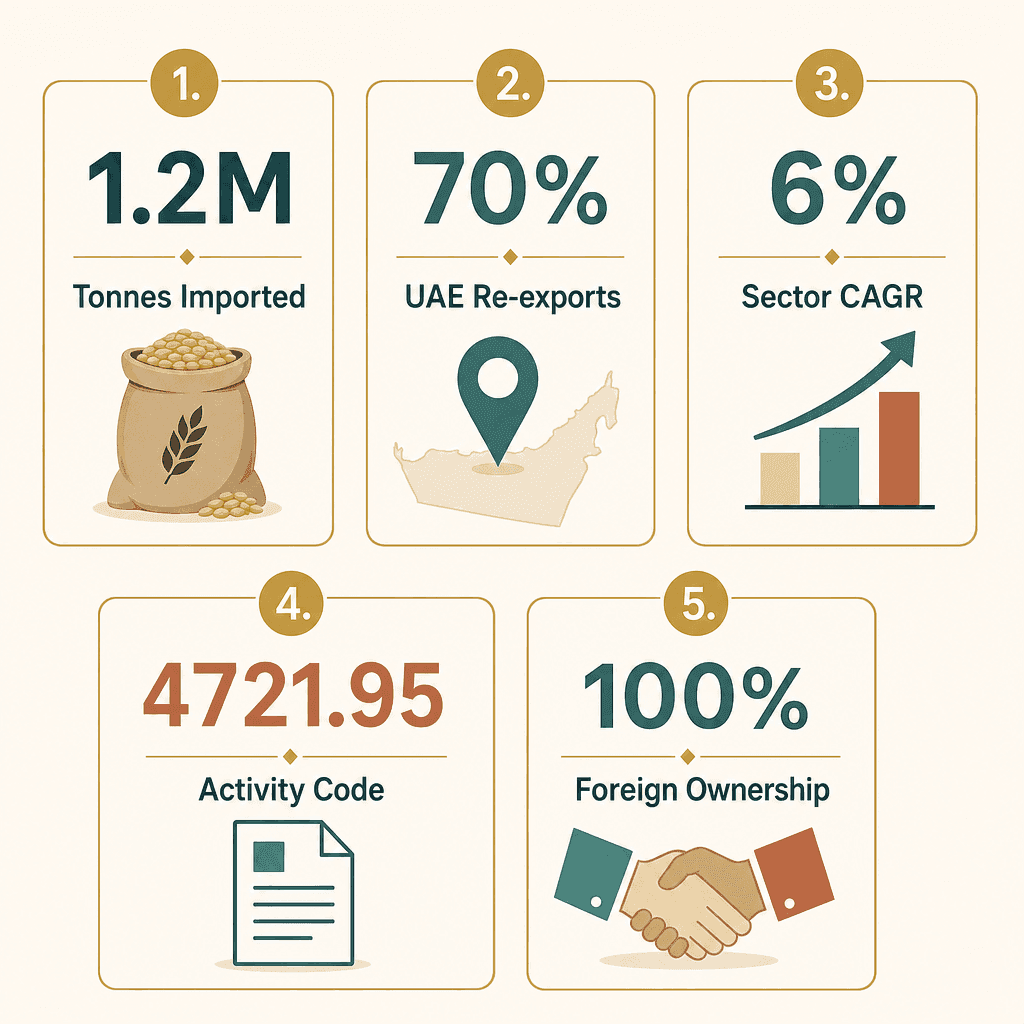
The UAE imports virtually all of its wheat and flour requirements, making it one of the most import-dependent food markets in the world. According to the Food and Agriculture Organisation, the UAE imports approximately 1.2 million metric tonnes of wheat and wheat flour annually. The country's food and beverage sector is projected to grow at a compound annual growth rate of over 6% through 2028, driven by population growth, tourism, and an expanding hospitality industry.
Dubai specifically handles more than 70% of the UAE's food re-exports, positioning it as the primary gateway for flour and grain products destined for regional markets. This combination of domestic demand and re-export opportunity makes a flour trading license in Dubai exceptionally valuable.
What the Flour Trading License Covers
A flour trading license under Activity Code 4721.95 authorises the holder to buy, sell, import, export, and distribute flour and related milled grain products. This includes, but is not limited to:
Wheat flour (all grades and varieties)
Wholemeal and wholegrain flour
Speciality flours such as rice flour, chickpea flour, and barley flour
Blended and fortified flour products
Flour intended for industrial food manufacturing
The license falls under the Trading category and is issued as a Trading License. It permits both local market sales within the UAE and international re-export activities, giving license holders maximum commercial flexibility.
Who This License Suits
The flour trading license is well suited to a wide range of business profiles, including:
International flour mills seeking a UAE distribution base
Food importers and commodity traders diversifying their product portfolio
Bakery and food manufacturing suppliers
Entrepreneurs entering the wholesale food trade
Re-export businesses targeting GCC, African, and South Asian markets
Dubai South Business Hub Free Zone: Why This Location
Dubai South Business Hub Free Zone sits adjacent to Al Maktoum International Airport, which is planned to become the world's largest airport by cargo capacity. The free zone offers direct access to Jebel Ali Port, the UAE's primary seaport and one of the ten busiest container ports globally. For flour traders, this means seamless import, storage, and re-export logistics within a single economic corridor.
Additional advantages include 100% foreign ownership, zero corporate and personal income tax, full repatriation of profits and capital, and a business-friendly regulatory environment designed to minimise bureaucratic delays.
Key Stats at a Glance
Activity Code: 4721.95
License Type: Trading License
Category: Trading
Foreign Ownership: 100% permitted
Corporate Tax: 0% (within free zone qualifying income)
UAE Annual Flour/Wheat Imports: Approximately 1.2 million metric tonnes
Dubai Share of UAE Food Re-exports: Over 70%
Typical License Setup Timeline: 3 to 7 working days
Estimated License Cost: From AED 12,000 to AED 20,000 per year (depending on package)
Setup Costs and Steps
Setting up a flour trading company at Dubai South Business Hub Free Zone involves a clear and manageable process:
Choose your business activity: Confirm Activity Code 4721.95 and the trading license type.
Select a company structure: Free zone limited liability company (FZ-LLC) is the most common structure for trading businesses.
Prepare documentation: Passport copies of shareholders and directors, a business plan summary, and proof of address.
Submit the application: Applications are processed digitally through the free zone authority.
Pay license and registration fees: License fees typically start from AED 12,000 annually, with additional costs for visa packages and office or flexi-desk arrangements.
Receive your license: Approval and license issuance generally takes 3 to 7 working days.
Licensing and Compliance Requirements
Flour trading in the UAE is subject to food safety and import regulations overseen by the UAE Ministry of Climate Change and Environment and the Dubai Municipality Food Safety Department. Key compliance considerations include:
All flour products must meet UAE.S GSO standards for food safety and labelling
Import shipments require a certificate of conformity and a health certificate from the country of origin
Products must comply with UAE fortification standards (flour is typically required to be fortified with iron and folic acid)
Storage facilities must meet food-grade hygiene standards if the trader operates a warehouse
Annual license renewal with the free zone authority is mandatory
Why Dubai Is Well-Positioned for Flour Trading
Dubai's geographical position places it within an eight-hour flight of approximately 4.5 billion consumers. Its free trade agreements, including the Comprehensive Economic Partnership Agreements with India and several other nations, reduce tariff barriers for commodity traders. The UAE's cold chain and dry storage logistics networks are among the most sophisticated in the region, ensuring flour quality is maintained throughout the supply chain. Furthermore, the UAE dirham's peg to the US dollar eliminates currency risk for traders dealing in dollar-denominated commodities, providing financial predictability that is rare in emerging markets.
Get Started
Use the cost calculator for a tailored quote.
Verify your business name with the company name check.
Browse the full business activities directory.
Get in touch to start your application.
Frequently Asked Questions