Forfaiting Services Business License in Dubai
Topic Summary
What Forfaiting Actually Means for Exporters
Forfaiting lets exporters sell medium to long-term receivables, such as bills of exchange or promissory notes, to a forfaiter at a discount. The exporter receives immediate cash with no recourse, while the forfaiter takes on all credit, political, and transfer risks.
Why Dubai South Is the Ideal Base
Dubai South Business Hub Free Zone sits adjacent to Al Maktoum International Airport and connects directly to Jebel Ali port, placing forfaiters inside one of the world's busiest re-export corridors. Its position along Asia-Africa-Europe trade routes makes it operationally strategic for international receivables businesses.
Key License Details at a Glance
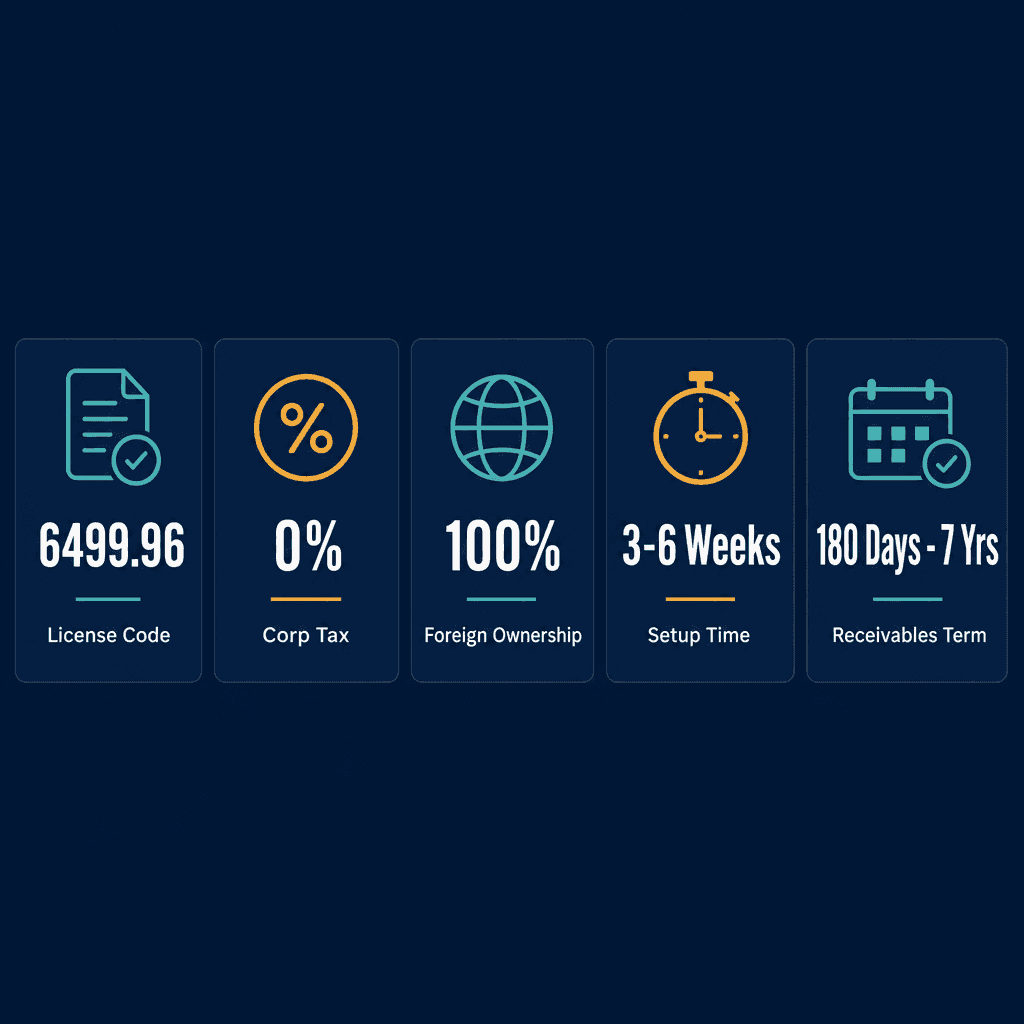
The Forfaiting Services license operates under activity code 6499.96 and is classified as a Financial Business License within Dubai South. Setup typically takes three to six weeks, with options for a flexi-desk or dedicated office depending on activity approval.
Significant Tax and Ownership Advantages
License holders benefit from 100% foreign ownership, zero corporate and personal income tax within free zone parameters, and full repatriation of capital and profits. These conditions make Dubai South highly competitive compared to many other regulated financial jurisdictions.
Exactly What the License Permits You to Do
The license covers purchasing trade receivables at a discount, assuming associated risks, and trading those receivables on secondary markets. Holders may also provide advisory services on forfaiting structures and arrange or syndicate transactions with banks and financial institutions.
Who Benefits Most from This License
Export finance specialists, trade finance boutiques, international banks establishing a regional desk, and private equity groups targeting trade receivable portfolios are all strong candidates. Consultants advising exporters in Africa, South Asia, or Central Asia on non-recourse finance solutions are equally well served.
Forfaiting vs. Factoring: A Critical Distinction
Unlike factoring, which typically covers short-term receivables, forfaiting focuses on capital goods transactions with payment terms ranging from 180 days to seven years. This longer horizon and the full assumption of risk by the forfaiter make it a distinct and more specialised instrument.
Global trade finance is evolving rapidly, and forfaiting has emerged as one of the most effective instruments for exporters seeking immediate liquidity without retaining credit risk. As cross-border commerce between Asia, Africa, and Europe continues to flow through the UAE, Dubai has positioned itself as a natural hub for specialised financial intermediaries. Obtaining a Forfaiting Services Business License in Dubai, specifically through Dubai South Business Hub Free Zone under activity code 6499.96, gives financial professionals a regulated, strategically located base from which to operate at the heart of international trade corridors.
What Is Forfaiting and Why Does It Matter?
Forfaiting is a trade finance mechanism whereby an exporter sells medium to long-term receivables, typically in the form of bills of exchange, promissory notes, or letters of credit, to a forfaiter at a discount. The forfaiter assumes all credit, political, and transfer risks associated with the underlying trade transaction. Unlike factoring, forfaiting generally covers capital goods transactions with payment terms ranging from 180 days to seven years.
For exporters, the benefit is straightforward: immediate cash flow without recourse. For forfaiters, the opportunity lies in acquiring quality receivables at a discount and either holding them to maturity or selling them on the secondary market. This secondary market activity makes forfaiting particularly attractive in a region where re-export and triangular trade are commonplace.
Dubai South Business Hub Free Zone: The Right Address
Dubai South is the UAE's largest single urban development and home to Al Maktoum International Airport, which is projected to become the world's largest airport by capacity. The Business Hub Free Zone within Dubai South offers a business-friendly regulatory environment, 100% foreign ownership, zero corporate and personal income tax, and full repatriation of capital and profits.
For forfaiting businesses, the free zone's proximity to logistics infrastructure, port connectivity via Jebel Ali, and its position within one of the world's busiest re-export corridors makes it an operationally sound choice. The zone supports financial services activity under a Business License categorised within the Financial sector.
Key Infographic: Forfaiting License at a Glance
Activity Code: 6499.96 - Forfaiting Services
License Type: Business License
Category: Financial
Free Zone: Dubai South Business Hub
Foreign Ownership: 100% permitted
Corporate Tax Rate: 0% (within free zone parameters)
Typical Setup Timeline: 3 to 6 weeks
Minimum Office Requirement: Flexi-desk or dedicated office (subject to activity approval)
UAE VAT: 5% standard rate applies where applicable
What the License Covers
The Forfaiting Services license under activity code 6499.96 permits the holder to purchase medium and long-term trade receivables from exporters at a discount, assume the associated credit and political risk, and manage or trade those receivables in secondary markets. Licensed entities may also provide advisory services related to forfaiting structures, assist clients in preparing receivable documentation, and engage with banks and financial institutions to arrange or syndicate forfaiting transactions.
The license falls under the broader ISIC classification for other financial service activities not elsewhere classified, reflecting the specialised and niche nature of forfaiting within the wider financial services ecosystem.
Who Should Consider This License?
Export finance specialists and trade finance boutiques looking for a regulated Gulf base
International banks or financial intermediaries setting up a regional forfaiting desk
Private equity and alternative finance groups seeking to acquire trade receivables portfolios
Consultants advising exporters in Africa, South Asia, or Central Asia on accessing non-recourse finance
Re-export traders who regularly deal in capital goods and wish to offer integrated payment solutions
Setup Process and Costs
Setting up a forfaiting services company at Dubai South Business Hub Free Zone involves a structured but straightforward process. The general steps are as follows:
Step 1: Initial Application and Name Reservation
Submit a trade name application to the free zone authority. Names must comply with UAE naming conventions and must not conflict with existing registered entities.
Step 2: Business Plan and Activity Approval
Given the financial nature of activity code 6499.96, applicants are typically required to submit a business plan outlining the scope of forfaiting operations, target markets, and risk management frameworks. The free zone authority reviews this in coordination with relevant regulatory bodies.
Step 3: Documentation Submission
Required documents generally include passport copies of shareholders and directors, a No Objection Certificate where applicable, proof of address, and a completed application form. Corporate shareholders must provide attested constitutional documents.
Step 4: Office Selection
Applicants choose their workspace package. Options range from flexi-desk arrangements to private offices, depending on operational needs and any regulatory stipulations tied to financial activity licenses.
Step 5: License Issuance and Bank Account Opening
Upon approval and payment of applicable fees, the Business License is issued. Shareholders may then proceed to open a corporate bank account with a UAE-based financial institution.
Setup costs vary based on share capital requirements, office type, and any additional approvals required. Indicative costs for a standard free zone license at Dubai South Business Hub typically begin at approximately AED 12,000 to AED 20,000 for the license fee, with office packages priced separately. Professional service fees for incorporation assistance are additional.
Compliance and Regulatory Considerations
Forfaiting businesses operating in the UAE must adhere to anti-money laundering and counter-terrorism financing regulations as stipulated by the UAE Central Bank and the Financial Intelligence Unit. Companies dealing in trade receivables are subject to know-your-customer obligations, transaction monitoring requirements, and periodic reporting. The UAE's inclusion on the FATF grey list in 2022, and its subsequent removal in 2024, reflects the country's commitment to strengthening its financial compliance framework, which in turn enhances the credibility of businesses licensed here.
Corporate tax at a rate of 9% applies to taxable income exceeding AED 375,000 for financial periods beginning on or after 1 June 2023, though qualifying free zone entities may benefit from a 0% rate on qualifying income subject to meeting substance requirements.
Why Dubai Is Well-Positioned for Forfaiting
The UAE handled goods trade worth over USD 500 billion in 2023, with Dubai accounting for the majority of re-export activity. The emirate's network of over 200 double taxation treaties, its time zone bridging Asia and Europe, and its world-class financial infrastructure make it an ideal base for forfaiting operations. The presence of major international banks, a mature secondary receivables market, and strong bilateral trade relationships with emerging market economies all support the commercial case for basing forfaiting activities in Dubai.
Get Started
Use the cost calculator for a tailored quote.
Verify your business name with the company name check.
Browse the full business activities directory.
Get in touch to start your application.
Frequently Asked Questions