How to Get a Fresh Fish & Marine Animals Trading License in Dubai
Topic Summary
Choose Dubai South Free Zone as Your Base
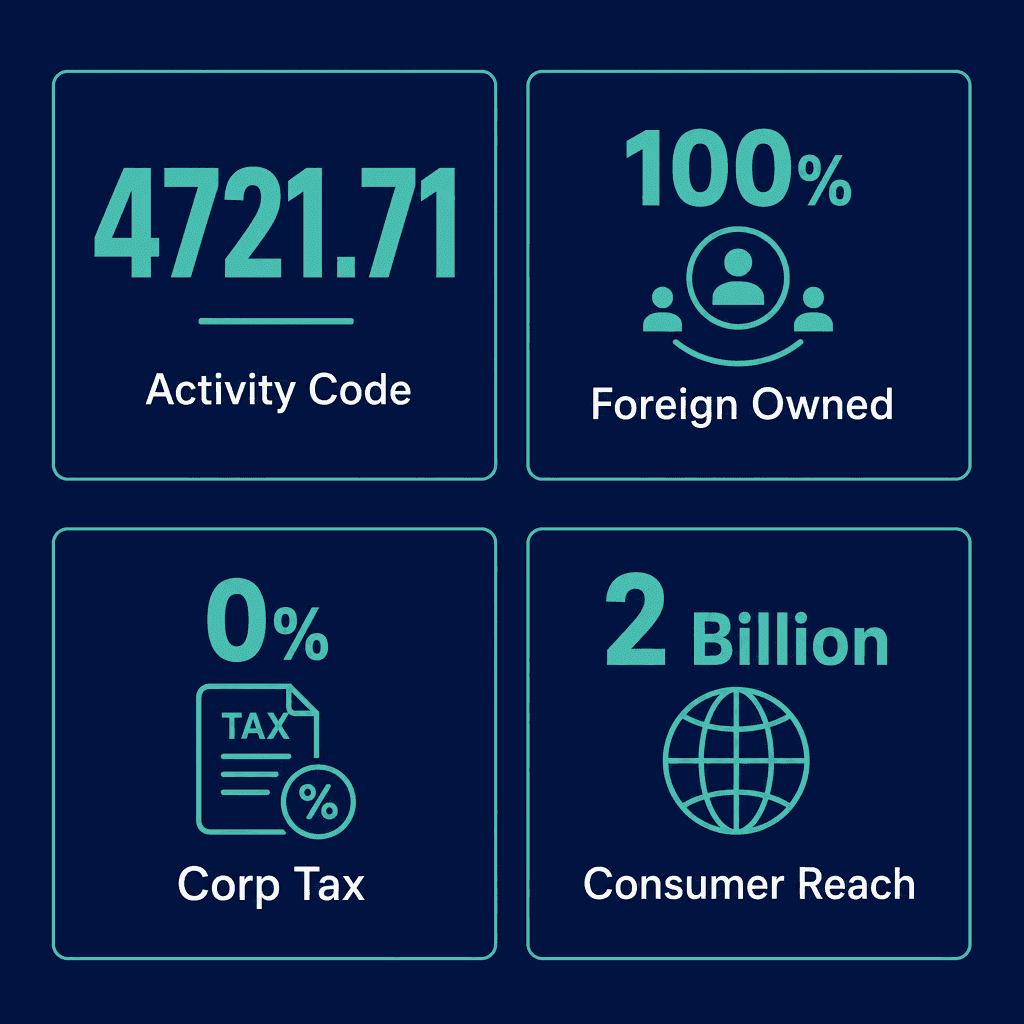
Dubai South Business Hub Free Zone issues the Fresh Fish and Marine Animals Trading License under Activity Code 4721.71. Its proximity to Al Maktoum International Airport and Jebel Ali Port makes it ideal for temperature-sensitive seafood logistics.
Enjoy 100% Foreign Ownership and Tax Benefits
Traders operating under this free zone license face no requirement for a local sponsor and retain full ownership of their business. Qualifying free zone income is subject to 0% corporate tax, and 100% profit repatriation is permitted.
Understand Exactly What the License Covers
Activity Code 4721.71 authorises the import, purchase, sale, and re-export of fresh, chilled, and live fish and marine animals for commercial purposes. It covers trading only, so activities like filleting, smoking, or canning may require additional approvals.
Account for Additional Permits Where Needed
Trading in protected marine species may require CITES permits on top of the standard trading license. Businesses wanting to sell directly to UAE mainland consumers will also need a separate mainland trade license or a distribution agreement.
Tap Into a Multi-Billion Dirham Import Market
The UAE imports a significant share of its seafood needs, with total fish and marine product imports valued in the billions of dirhams annually. Demand is rising due to a growing expatriate population, booming tourism, and health-conscious consumer trends.
Leverage Dubai's Unmatched Geographic Position
Dubai sits within a four-hour flight radius of over two billion consumers across South Asia, East Africa, the GCC, and Southern Europe. This makes it a powerful re-export hub for sourcing seafood globally and redistributing it to high-demand markets quickly.
Dubai sits at the crossroads of global seafood supply chains, making it one of the most strategically valuable locations in the world to trade fresh fish and marine animals. Whether you are an established seafood importer or an entrepreneur entering the marine products sector, understanding the licensing process is your first critical step.
This guide explains exactly how to obtain a Fresh Fish and Marine Animals Trading License (Activity Code 4721.71) at Dubai South Business Hub Free Zone, covering costs, steps, compliance requirements, and why this market rewards early movers.
Dubai's Seafood Market: Why the Opportunity Is Now
The UAE is one of the largest seafood-consuming nations in the Middle East, with per capita fish consumption consistently above the global average. The country imports a significant portion of its seafood requirements, with total fish and marine product imports valued in the billions of dirhams annually. Demand is accelerating, driven by a growing expatriate population, a booming tourism sector, and a health-conscious consumer base that increasingly favours protein-rich diets.
Dubai's geographic position is unmatched. The emirate sits within a four-hour flight radius of over two billion consumers across South Asia, East Africa, the GCC, and Southern Europe. This makes it a natural re-export hub, allowing traders to source from major fishing nations and redistribute to high-demand markets efficiently.
Dubai South amplifies this advantage considerably. Its proximity to Al Maktoum International Airport, one of the world's largest cargo airports by capacity, and Jebel Ali Port, the busiest port in the Middle East, means that temperature-sensitive marine products can move from source to destination with minimal handling time. For fresh and live marine animals, where shelf life is the primary commercial constraint, this logistical edge directly translates into competitive advantage.
Key Market Snapshot: Fresh Fish & Marine Animals Trading in Dubai
Activity Code: 4721.71 (Fresh Fish and Marine Animals Trading)
License Type:Trading License, issued by Dubai South Business Hub Free Zone
Foreign Ownership: 100% permitted, no local sponsor required
Corporate Tax: 0% on qualifying free zone income
Consumer Reach: Over 2 billion people within a four-hour flight
Key Infrastructure: Al Maktoum International Airport and Jebel Ali Port
Profit Repatriation: 100% permitted
What the Fresh Fish and Marine Animals Trading License Covers
Activity Code 4721.71 falls under the International Standard Industrial Classification (ISIC) framework and specifically authorises the commercial trading of fresh, chilled, and live fish, as well as other marine animals. The license is issued as a Trading License under the Trading category by Dubai South Business Hub Free Zone, one of the UAE's most strategically positioned free zones for logistics-dependent businesses.
Under this license, holders are permitted to import, buy, sell, and re-export fresh fish and marine animals for commercial purposes. The free zone status grants significant customs duty advantages, allowing goods to be brought into the zone, processed or stored, and then re-exported to international markets without attracting standard UAE import duties on those outbound goods.
It is important to note that the license covers trading activities rather than processing or manufacturing. If a business intends to carry out value-added processing, such as filleting, smoking, or canning, a separate or supplementary activity approval may be required. Similarly, trading in protected marine species may require additional CITES permits, and retail-facing operations within the UAE mainland would necessitate a separate mainland trade license or a distribution agreement with a mainland entity.
Who This License Is Suited For
This license is well-suited to a broad range of operators within the seafood supply chain. Seafood importers and wholesale distributors targeting GCC and wider MENA markets will find the free zone structure particularly advantageous, given the customs efficiencies and re-export capabilities on offer.
International fish traders seeking a UAE base will benefit from the 100% foreign ownership structure, which removes the need for a local sponsor and allows full operational and financial control. Entrepreneurs entering the halal-certified seafood supply chain will also find Dubai South an appropriate base, given the UAE's established halal standards framework and its credibility with Muslim-majority markets across Asia and Africa.
Existing food trading businesses looking to add a regulated marine products vertical to their portfolio can use this license to diversify their activity scope while operating under a single free zone entity, simplifying corporate governance and reducing overhead.
License Setup: Costs, Steps, and Compliance Requirements
Dubai South Business Hub Free Zone is the issuing authority for this license. It is designed to support businesses that require proximity to world-class air and sea freight infrastructure, and it offers a streamlined application process relative to many other UAE jurisdictions.
The application process typically follows these steps:
Select your business activity (Activity Code 4721.71) and confirm your entity type, typically a Free Zone Limited Liability Company (FZ-LLC)
Submit required documentation, including passport copies for all shareholders and directors, a completed application form, and a basic business plan
Pay the applicable license fee, registration fee, and any facility-related charges
Receive your license and proceed with bank account opening and visa applications as required
Indicative setup costs at Dubai South Business Hub Free Zone include the trading license fee, company registration fee, and the cost of your chosen workspace solution. Flexi-desk and shared office options are available for traders who do not require a dedicated warehouse at the point of incorporation, making the initial setup cost accessible. A physical facility or cold-storage unit becomes necessary once trading operations commence at scale. Total first-year costs, including license, registration, and a flexi-desk arrangement, typically fall in the range of AED 15,000 to AED 30,000, though precise figures should be confirmed directly with the free zone authority as fees are subject to periodic revision.
No local sponsor is required. Foreign nationals may own 100% of the entity, retain 100% of profits, and repatriate capital freely.
Key Regulatory Bodies and Approvals
Beyond the trading license itself, operators in fresh fish and marine animal trading must satisfy several regulatory requirements. Dubai Municipality's Food Safety Department sets and enforces standards for the handling, storage, and transportation of fresh and live marine products. Cold-chain compliance is mandatory, with specific temperature-control requirements for different product categories.
Where a business intends to trade in species listed under the Convention on International Trade in Endangered Species of Wild Fauna and Flora (CITES), the relevant import and export permits must be obtained prior to any commercial transaction. The UAE is a CITES signatory, and enforcement is active.
Halal certification, while not universally mandated for all seafood, may be required or commercially expected when supplying to certain institutional buyers, supermarket chains, or markets in Muslim-majority countries. Traders should assess their target customer requirements and obtain certification from a UAE-recognised halal body accordingly.
Ongoing compliance obligations include annual license renewal, periodic health and safety inspections of storage facilities, and adherence to UAE food labelling regulations, which require accurate origin, storage, and handling information on all commercial packaging.
Why Dubai South Is the Right Base for Marine Animal Trading
Dubai South offers a combination of regulatory, fiscal, and logistical advantages that are difficult to replicate elsewhere in the region. Qualifying free zone businesses benefit from a 0% corporate tax rate on qualifying income under the UAE's corporate tax framework, alongside full exemption from personal income tax and 100% profit repatriation rights.
The cold-chain and temperature-controlled logistics infrastructure at and around Dubai South is among the most advanced in the Middle East. This is a critical consideration for fresh and live marine animal traders, where product integrity depends entirely on unbroken refrigeration from source to buyer.
The UAE's expanding network of Comprehensive Economic Partnership Agreements (CEPAs) with major trading nations further strengthens Dubai's position as a seafood re-export hub. These agreements reduce or eliminate tariff barriers on qualifying goods, improving the economics of sourcing from CEPA partner countries and selling into others. Combined with the UAE's long-standing bilateral trade relationships across Asia, Africa, and Europe, Dubai South-based traders enjoy market access that few other jurisdictions can match.
Related Activities
Fresh, Chilled & Frozen Meat Trading Trading License
Frozen Fish & Seafood Trading Trading License
Salted, Preserved Fish & Seafood Trading Business
Frequently Asked Questions