Non Edible Oil Trading License in Dubai

Topic Summary
What Non Edible Oil Trading License Covers
Operating under activity code 4669.89, this trading license authorises businesses to buy, sell, import, export, and re-export non edible oils commercially. Covered products range from industrial lubricants and transformer oils to castor oil, linseed oil, and tung oil.
Why Dubai South Free Zone Stands Out
Dubai South Business Hub Free Zone sits adjacent to Al Maktoum International Airport and near Jebel Ali Port, the Middle East's largest port, giving commodity traders unmatched logistics access. This dual-access location makes import, export, and re-export operations significantly faster and more cost-efficient.
Key Financial Perks for License Holders
Businesses operating within Dubai South benefit from 100% foreign ownership, zero corporate and personal income tax, and full repatriation of profits and capital. There is also no mandatory minimum share capital for most free zone structures, lowering the barrier to entry.
Who Should Consider This License
The license suits international commodity traders, chemical and petrochemical companies, manufacturers sourcing industrial oils, and entrepreneurs entering wholesale oil supply chains. Existing businesses looking to expand their product lines into non edible oils are also strong candidates.
Fast and Straightforward Setup Timeline
Most businesses can complete the registration process within 3 to 7 business days at Dubai South. The process involves selecting a company structure such as an FZE or FZC, submitting documents including passport copies and a business plan, and paying the applicable license and registration fees.
Dubai's Massive Trade Ecosystem Backs Growth
The UAE recorded over AED 2.8 trillion in non-oil trade in 2023, reflecting a thriving commodities environment that benefits niche sectors like non edible oils. Dubai's position as a global crossroads connects traders to high-demand markets across the Middle East, Africa, and South Asia.
Dubai has long served as a global crossroads for commodity trade, and non edible oils are no exception. From industrial lubricants and transformer oils to castor oil and linseed oil, demand for these products is rising across manufacturing, energy, and chemical sectors throughout the Middle East, Africa, and South Asia. For entrepreneurs and established businesses looking to tap into this growing market, obtaining a Non Edible Oil Trading License in Dubai offers a structured, cost-effective route to market entry.
This guide covers everything you need to know about the trading license under activity code 4669.89, including the ideal setup location at Dubai South Business Hub Free Zone, regulatory requirements, costs, and the strategic advantages Dubai offers for this trade.
What the Non Edible Oil Trading License Covers
The Non Edible Oil Trading License falls under activity code 4669.89 and is classified as a Trading License within the Trading category. It authorises businesses to buy, sell, import, export, and re-export non edible oils on a wholesale or commercial basis. Covered products typically include:
Industrial and lubricating oils
Castor oil and derivatives
Linseed oil and other drying oils
Transformer and electrical insulating oils
Tung oil, jojoba oil, and other non-food-grade plant oils
Petroleum-derived non edible oils used in manufacturing
The license does not cover edible or food-grade oils, which require a separate activity classification and additional food safety approvals.
Why Dubai South Business Hub Free Zone
Dubai South Business Hub Free Zone is one of the UAE's most strategically positioned free zones, located adjacent to Al Maktoum International Airport and within close proximity to Jebel Ali Port, the largest port in the Middle East. This dual-access advantage makes it particularly well-suited for commodity trading businesses that rely on efficient import, export, and re-export logistics.
Key advantages of setting up at Dubai South include 100% foreign ownership, zero corporate and personal income tax, full repatriation of profits and capital, and streamlined business registration processes. The free zone also offers flexible office and warehouse solutions, which is important for businesses that need physical storage or handling facilities for non edible oils.
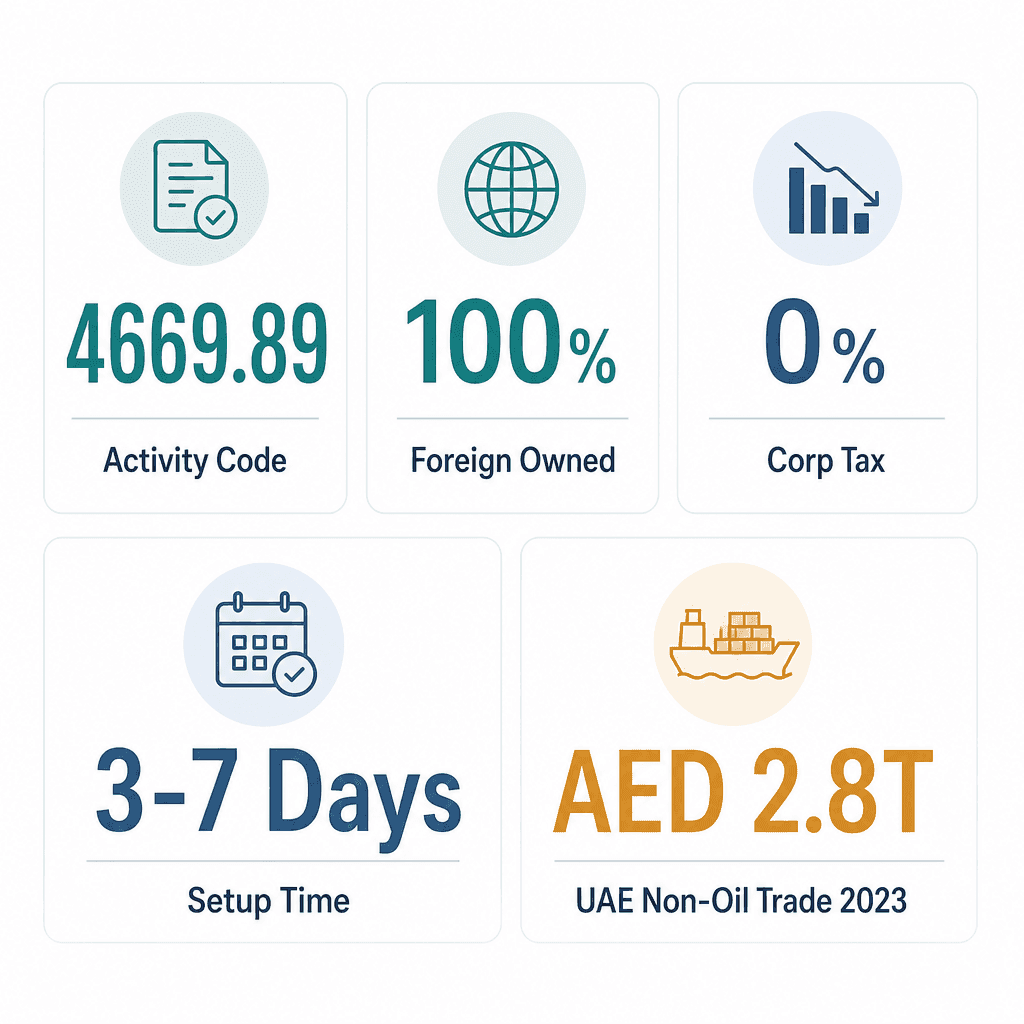
Infographic: At a Glance
Activity Code: 4669.89
License Type: Trading License
Free Zone: Dubai South Business Hub
Foreign Ownership: 100% permitted
Corporate Tax Rate: 0% (within free zone)
Estimated Setup Timeline: 3 to 7 business days
Minimum Share Capital: No mandatory minimum for most free zone structures
UAE's Non-Oil Trade (2023): Over AED 2.8 trillion, reflecting the broader commodities ecosystem
Who This License Suits
The Non Edible Oil Trading License is well-suited to a broad range of business profiles, including:
International commodity traders seeking a UAE hub for regional distribution
Manufacturers sourcing industrial oils for production processes
Chemical and petrochemical trading companies
Entrepreneurs entering the wholesale oil supply chain
Existing businesses looking to expand product lines into non edible oils
Setup Costs and Steps
Setting up a Non Edible Oil Trading company at Dubai South Business Hub Free Zone is a straightforward process. Typical costs include the license fee, registration fee, and any applicable office or flexi-desk package. While exact fees vary and should be confirmed directly with the free zone authority, trading licenses at Dubai South are generally considered competitive compared to other UAE free zones.
Step-by-Step Setup Process
Step 1: Choose your business activity and confirm activity code 4669.89 applies to your intended trade
Step 2:Select a company structure, typically a Free Zone Establishment (FZE) or Free Zone Company (FZC)
Step 3: Submit your application with required documents, including passport copies, business plan, and proof of address
Step 4: Choose an office package, whether a flexi-desk, serviced office, or warehouse unit
Step 5: Pay the applicable license and registration fees
Step 6: Receive your trade license and proceed with visa applications if required
Licensing and Compliance Requirements
While the free zone registration process is efficient, businesses trading in non edible oils must also be aware of broader UAE compliance obligations. These include adhering to UAE customs regulations for import and export, maintaining accurate trade documentation such as certificates of origin and bills of lading, and ensuring products comply with relevant UAE standards set by the Emirates Authority for Standardisation and Metrology (ESMA). Certain non edible oils, particularly those with chemical or hazardous properties, may require additional approvals from the UAE Ministry of Climate Change and Environment or local civil defence authorities.
Why Dubai Is Well-Positioned for Non Edible Oil Trade
Dubai's position as a global trade hub is backed by world-class infrastructure, a business-friendly regulatory environment, and an extensive network of bilateral trade agreements. The UAE has signed Comprehensive Economic Partnership Agreements (CEPAs) with key trading partners including India, Indonesia, and Israel, reducing tariffs and facilitating smoother trade flows. Jebel Ali Port handles millions of containers annually and connects Dubai to over 150 ports worldwide, making re-export a highly viable and profitable business model for non edible oil traders.
Furthermore, the UAE's strategic location between East and West means that traders can efficiently serve markets across the GCC, Africa, the Indian Subcontinent, and Europe from a single base of operations.
Related Activities
Plastic Materials Wholesale Trading Trading License
Rubber Products Wholesale Trading Trading License
Frequently Asked Questions