Solar Energy Systems & Components Trading License in Dubai: Cost and Requirements
Topic Summary
UAE's 2050 Clean Energy Target Drives Demand
The UAE Energy Strategy 2050 mandates 44% clean energy in the national mix, creating sustained, policy-backed demand for solar components. This government commitment, reinforced by multi-billion-dirham infrastructure investment, makes the market far less speculative than typical emerging sectors.
Mohammed bin Rashid Solar Park Fuels Supply Chain
One of the world's largest single-site solar projects, the Mohammed bin Rashid Al Maktoum Solar Park, targets 5,000 MW capacity by 2030. Projects of this scale require a continuous flow of photovoltaic panels, inverters, mounting systems, and ancillary equipment sourced through trading companies.
Dubai as a Re-Export Hub for Solar Equipment
Dubai's world-class logistics infrastructure positions it as a natural gateway for solar equipment destined for the GCC, sub-Saharan Africa, and South Asia. Traders based in the free zone benefit from zero import and export duties, making competitive re-export pricing achievable.
Broad Product Scope Under Activity Code 4773.9
The Solar Energy Systems and Components Trading License covers photovoltaic panels, inverters, mounting structures, charge controllers, battery storage, solar cables, and more. The license permits import, export, re-export, and local distribution within applicable UAE regulatory frameworks.
100% Foreign Ownership With No Local Sponsor
Registering under Dubai South Business Hub Free Zone allows foreign investors to retain full ownership of their entity without requiring a local Emirati sponsor. This structure is particularly attractive for international distributors and entrepreneurs entering the renewables space.
Affordable Setup Cost and Fast Timeline
Typical one-time setup costs range from AED 15,000 to AED 30,000, with an estimated establishment timeline of just two to four weeks. This relatively low barrier to entry makes the license accessible for both startups and established businesses diversifying into solar.
Straightforward Documentation and Compliance Process
The application process at Dubai South Business Hub Free Zone follows a clear documentation pathway, generally requiring passport copies of shareholders and directors alongside standard business registration materials. The streamlined process reduces administrative burden for new applicants.
Dubai's solar energy sector is expanding at pace, with the UAE targeting 44% clean energy in its mix by 2050, creating a compelling window for traders in solar systems and components. Whether you are an established distributor or an entrepreneur entering the renewables space, understanding the licensing process is the essential first step. This guide covers everything you need to know about obtaining a Solar Energy Systems and Components Trading License (Activity Code 4773.9) at Dubai South Business Hub Free Zone, including costs, requirements, and why this jurisdiction suits the trade.
Dubai's Solar Energy Market: Why the Timing Is Right
The UAE Energy Strategy 2050 sets a target of 44% clean and renewable energy in the national energy mix, creating sustained, policy-driven demand for solar components across the supply chain. This is not a speculative market; it is one underwritten by government commitment and multi-billion-dirham infrastructure investment.
The Mohammed bin Rashid Al Maktoum Solar Park in Dubai stands as one of the world's largest single-site solar projects, with a planned capacity of 5,000 MW by 2030. Projects of this scale require a continuous flow of photovoltaic panels, inverters, mounting systems, and ancillary equipment, much of which is sourced through trading companies.
Beyond the UAE's domestic demand, the wider GCC region, sub-Saharan Africa, and South Asia are all experiencing rapid growth in solar adoption. Dubai's logistics infrastructure positions it as a natural re-export hub for solar equipment destined for these high-growth markets. At the local level, rising uptake of rooftop solar among commercial property developers and residential communities is steadily expanding the addressable market for component traders operating within the UAE.
Key Stats at a Glance
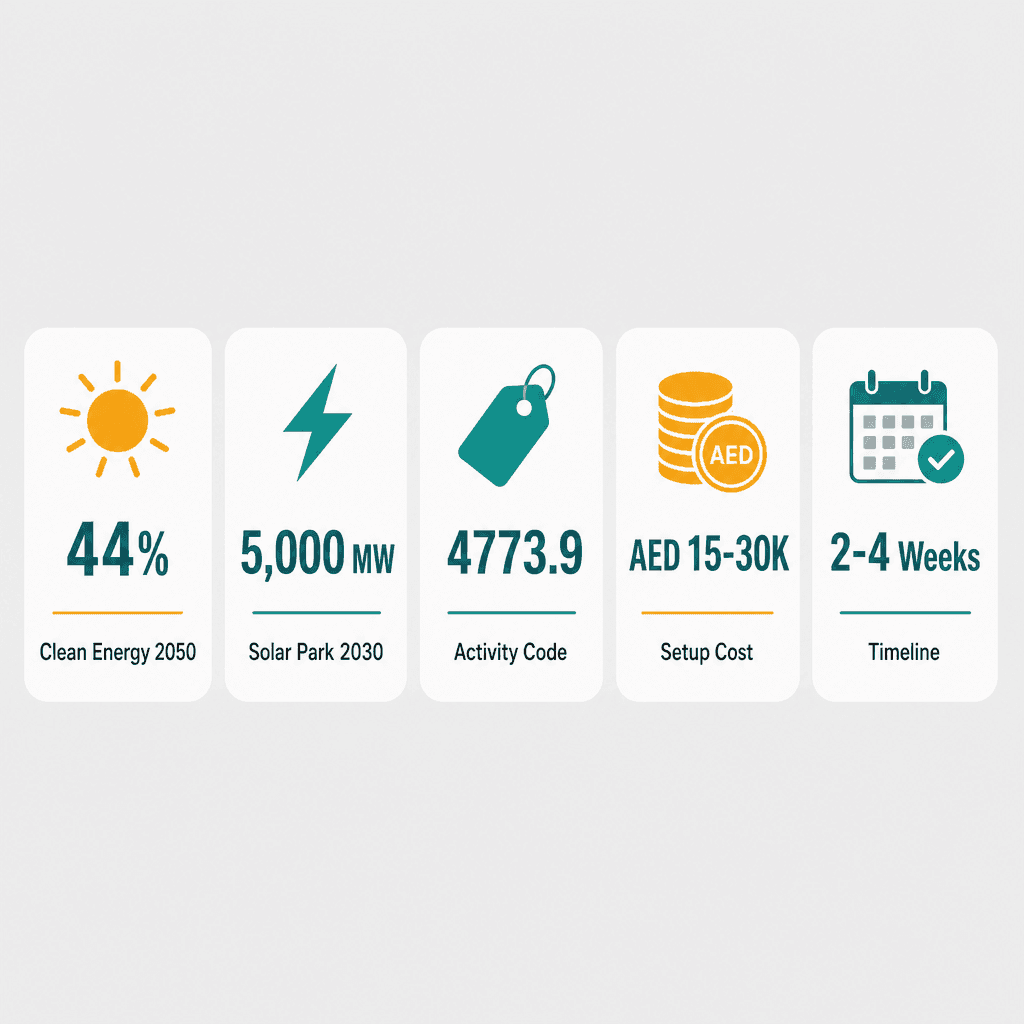
UAE clean energy target: 44% of energy mix by 2050
Mohammed bin Rashid Al Maktoum Solar Park planned capacity: 5,000 MW by 2030
Activity Code: 4773.9 | License Type: Trading | Jurisdiction: Dubai South Business Hub Free Zone
Typical setup cost range: AED 15,000 to AED 30,000 (one-time)
Foreign ownership: 100% permitted
Estimated setup timeline: two to four weeks
Import/export duties within free zone: zero
What the Solar Energy Systems & Components Trading License Covers
Activity Code 4773.9, classified under the International Standard Industrial Classification (ISIC) framework, permits the wholesale and retail trading of solar energy systems and related components. The license is issued as a Trading License under the Trading category by Dubai South Business Hub Free Zone.
The scope of goods covered under this activity is broad and commercially significant. Traders operating under this license may deal in photovoltaic panels, solar inverters, mounting and racking structures, charge controllers, battery storage systems, solar cables, and a wide range of ancillary solar equipment. The license permits import, export, re-export, and local distribution of these products within the regulatory frameworks applicable to the free zone and the wider UAE market.
Who This License Is Suited For
Importers and distributors supplying solar equipment to contractors, property developers, and government-backed energy projects across the UAE
Entrepreneurs seeking to re-export solar components to GCC countries, African nations, or Asian markets using Dubai's established logistics corridors
Foreign investors who wish to hold 100% ownership of a free zone entity without the requirement for a local sponsor
Existing energy or electrical equipment businesses looking to diversify into renewable product lines under a dedicated license
License Requirements and Compliance
Applying for a trading license at Dubai South Business Hub Free Zone follows a straightforward documentation process. Applicants are typically required to submit passport copies of all shareholders and directors, a business plan, a completed application form, and a No Objection Certificate where applicable.
From a product compliance perspective, solar panels, inverters, and related equipment sold within the UAE must conform to standards set by the Emirates Authority for Standardisation and Metrology (ESMA). Importers should verify product-specific conformity requirements with Dubai Customs prior to shipment, as certain categories of solar equipment may require additional conformity certificates before they can be cleared through UAE ports.
Dubai South Business Hub Free Zone operates under its own regulatory framework, which streamlines the approval process considerably when compared to mainland DED licensing. This makes it a practical choice for businesses that require a faster route to market.
Facility and Visa Requirements
Flexi-desk and shared office packages are available for trading license holders who do not require dedicated premises; physical warehouse space is required if goods are to be stored within the free zone
Visa allocation is tied to the office package selected; most entry-level packages include one to two investor visas
Warehouse and storage facilities at Dubai South benefit from direct proximity to Al Maktoum International Airport, supporting efficient inbound and outbound logistics for bulky solar equipment
Setup Costs and Steps
License fees at Dubai South Business Hub Free Zone are competitive relative to mainland DED licenses. The total cost of setting up will depend on the office package selected, the number of visas required, and any product-specific regulatory costs incurred during the compliance process.
Typical cost components include the license registration fee, establishment card issuance, investor visa fees, and the chosen office or flexi-desk package. One-time setup costs generally range from AED 15,000 to AED 30,000 depending on the package, with annual renewal fees applicable thereafter. Importantly, there are no import or export duties within the free zone. UAE VAT at 5% applies to local supply transactions within the mainland market.
Step-by-Step Setup Process
Step 1: Select business activity code 4773.9 and determine the appropriate legal structure, either a Free Zone Establishment (FZE) for a sole shareholder or a Free Zone Company (FZCO) for multiple shareholders
Step 2: Submit your application along with all required documents to the Dubai South Business Hub Free Zone authority
Step 3: Receive initial approval, then pay the applicable license and office package fees
Step 4: Obtain your establishment card, open a corporate bank account, and apply for investor visas
Step 5: Register with Dubai Customs for import and export operations; the full process typically takes two to four weeks from submission
Why Dubai South Is Well-Positioned for Solar Components Trade
Dubai South's geographic and infrastructural advantages make it one of the most strategically sound locations for solar equipment trading in the region. The free zone sits adjacent to Al Maktoum International Airport and benefits from close proximity to the Jebel Ali Port corridor, providing unmatched multimodal logistics access for heavy and oversized cargo such as solar panels and mounting structures.
From an ownership and financial perspective, the free zone offers 100% foreign ownership with no requirement for a local sponsor, zero personal income tax, and the ability to repatriate profits in full. These conditions are particularly attractive to international investors evaluating entry into the UAE market.
Dubai's position at the crossroads of Asia, Europe, and Africa gives traders operating from Dubai South a natural advantage when supplying solar goods to markets across the GCC, East Africa, and the Indian subcontinent. Combined with the UAE government's long-term clean energy commitments, this creates a stable, policy-supported demand environment for businesses in the solar components supply chain.
Related Activities
Frequently Asked Questions