Start a Bricks Trading Business in Dubai

Topic Summary
Why Dubai Is Ideal for Bricks Trading
Dubai sits at the crossroads of Africa, Asia, and Europe, making it one of the world's most efficient re-export hubs. The UAE construction market was valued at approximately USD 34 billion in 2023, creating strong and sustained demand for masonry materials.
Use the Correct Activity Code
Bricks trading in Dubai is registered under Activity Code 4752.35, which covers buying, selling, importing, exporting, and re-exporting bricks and masonry products. This code does not include manufacturing or installation, so separate licenses are needed for those activities.
Products You Can Trade Under This License
A Trading License under code 4752.35 covers a wide range of masonry materials, including clay bricks, concrete blocks, sand-lime bricks, refractory bricks, and decorative facing bricks. This broad scope gives traders flexibility to serve multiple construction segments.
Choose Dubai South Business Hub Free Zone
Dubai South is located next to Al Maktoum International Airport and offers direct access to air freight, Jebel Ali Port, and major regional road networks. It is purpose-built for trading and logistics companies, making it an ideal base for commodity traders.
Key Financial and Ownership Benefits
Businesses registered in Dubai South enjoy 100% foreign ownership, zero corporate and personal income tax on qualifying income, and full repatriation of profits and capital. These advantages make it one of the most cost-efficient jurisdictions for international trade.
Understand the Setup Costs and Timeline
License and registration fees typically range from AED 12,000 to AED 25,000 depending on the package selected. The entire setup process, from application to operational status, generally takes between two and four weeks.
Follow a Clear Five-Step Setup Process
Setting up involves confirming your activity code, selecting a Free Zone LLC structure, reserving a trade name, submitting documents such as passport copies and a business plan, and paying the required fees. The free zone operates a streamlined single-window licensing process to keep things efficient.
Dubai's construction sector continues to expand at a remarkable pace, driven by mega-infrastructure projects, Expo legacy developments, and a sustained pipeline of residential and commercial builds. For entrepreneurs looking to capitalise on this momentum, starting a bricks trading business in Dubai offers a commercially sound entry point into one of the region's most active supply chains. With the right license and the correct free zone, you can be operational quickly, trade internationally, and benefit from a zero-tax environment.
This guide covers everything you need to know about establishing a bricks trading company under activity code 4752.35 at Dubai South Business Hub Free Zone, including costs, compliance, and the strategic advantages Dubai offers for this trade.
Why Dubai for Bricks Trading?
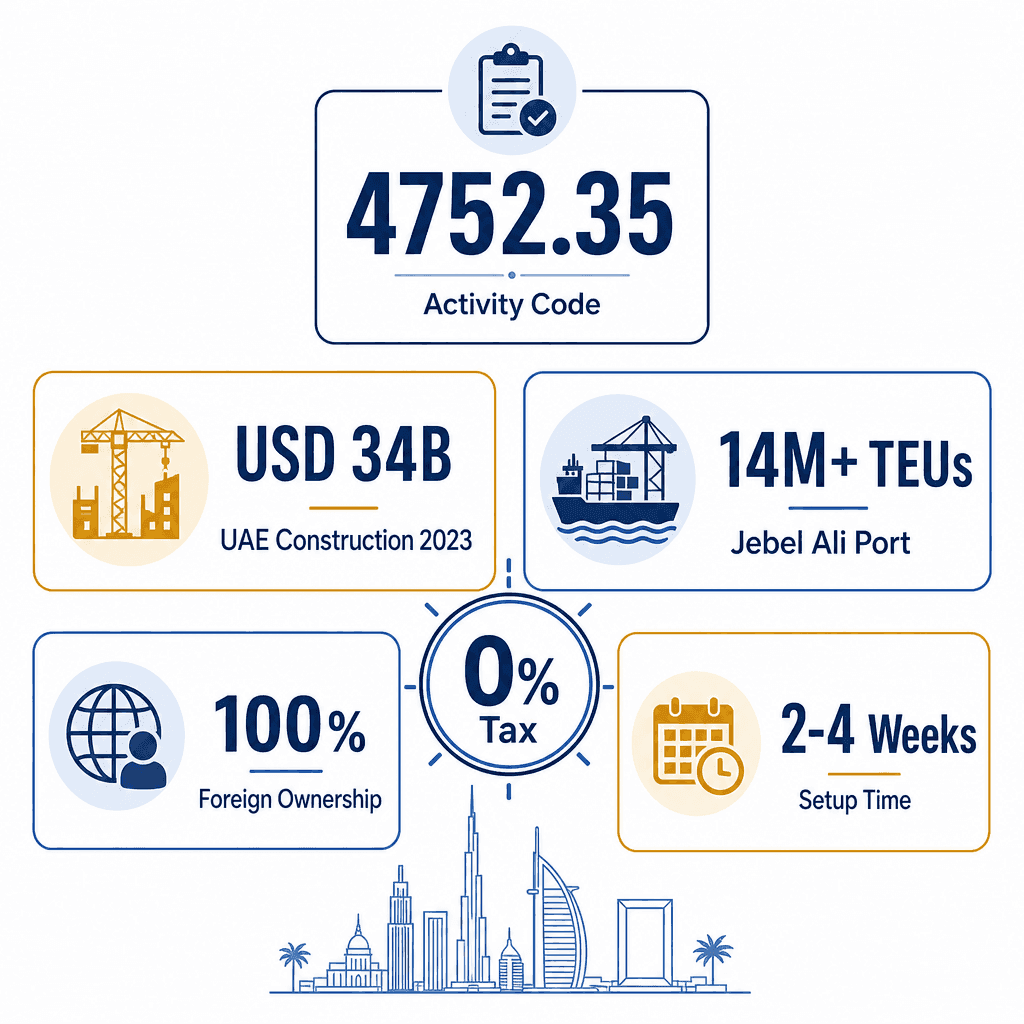
Dubai sits at the crossroads of Africa, Asia, and Europe, making it one of the world's most efficient re-export hubs. The emirate handled over 14 million TEUs of container throughput at Jebel Ali Port in recent years, cementing its status as a global logistics gateway. The UAE construction market was valued at approximately USD 34 billion in 2023 and is forecast to grow steadily through 2030, underpinned by government-backed infrastructure spending and a thriving private real estate sector.
Bricks and masonry materials are foundational inputs across all construction segments. Trading these products from Dubai allows businesses to source from low-cost manufacturing regions, consolidate shipments, and redistribute across the GCC, South Asia, and East Africa with minimal friction.
Activity Code and License Type
The relevant activity for this business is classified under Activity Code 4752.35 - Bricks Trading. This falls within the broader trading category and is issued as a Trading License. The license permits the holder to buy, sell, import, export, and re-export bricks and related masonry products. It does not cover manufacturing or installation services, which would require separate activity codes.
Typical products covered under this activity include:
Clay bricks and fired bricks
Concrete and cement blocks
Sand-lime bricks
Refractory and insulating bricks
Decorative and facing bricks
Dubai South Business Hub Free Zone
Dubai South Business Hub Free Zone is strategically located adjacent to Al Maktoum International Airport, the world's largest airport by design capacity. The free zone is purpose-built for trading and logistics businesses and offers direct connectivity to air freight, sea freight via Jebel Ali, and major road networks linking the UAE to regional markets.
Key advantages of registering here include 100% foreign ownership, zero corporate and personal income tax, full repatriation of profits and capital, and a streamlined single-window licensing process. The zone is particularly well-suited to commodity traders who need efficient customs clearance and access to multimodal logistics.
Key Stats at a Glance
Activity Code: 4752.35 - Bricks Trading
License Type: Trading License
Free Zone: Dubai South Business Hub
Foreign Ownership: 100% permitted
Corporate Tax Rate: 0% (on qualifying free zone income)
UAE Construction Market Size: ~USD 34 billion (2023)
Jebel Ali Port Throughput: 14+ million TEUs annually
Typical License Setup Timeline: 2 to 4 weeks
Setup Costs and Steps
Setting up a bricks trading company in Dubai South is a structured process. Below is a summary of the typical steps and associated cost categories:
Step | Description |
|---|---|
1. Choose Business Activity | Confirm activity code 4752.35 and trading license type |
2. Select Legal Structure | Free Zone LLC (FZ-LLC) is the most common structure for trading companies |
3. Reserve Trade Name | Submit name options for approval; names must comply with UAE naming conventions |
4. Submit Application and Documents | Passport copies, business plan, and completed application forms |
5. Pay License and Registration Fees | Fees vary; typically range from AED 12,000 to AED 25,000 depending on package |
6. Secure Office or Flexi-Desk | A registered address is mandatory; flexi-desk options are available for lean setups |
7. Open Corporate Bank Account | Required to commence trading operations |
Who Is This License Suited To?
A bricks trading license under this activity code is well-suited to a broad range of business profiles, including:
International traders looking to use Dubai as a re-export hub for GCC and African markets
Construction material importers serving UAE-based contractors and developers
Manufacturers from South Asia, China, or Europe seeking a regional distribution base
Entrepreneurs entering the building materials sector for the first time
Existing businesses diversifying their product portfolio into masonry materials
Licensing and Compliance Requirements
Once licensed, bricks traders operating from Dubai South must maintain compliance with a number of regulatory requirements. These include annual license renewal, maintaining a valid registered address, and adhering to UAE customs regulations when importing or exporting goods. Traders dealing in materials that may be subject to standards set by the Emirates Authority for Standardisation and Metrology (ESMA) should verify product compliance before commencing sales into the UAE mainland.
VAT registration is required once annual taxable turnover exceeds AED 375,000. Free zone companies selling directly into the UAE mainland may also need to appoint a local distributor or obtain additional approvals depending on the nature of the transaction.
Profit Margins and Market Opportunity
Bricks and masonry materials typically carry gross margins of between 10% and 30% depending on sourcing, volume, and target market. Traders who establish direct relationships with manufacturers in India, China, or Eastern Europe and supply to UAE developers or GCC construction firms can achieve competitive margins, particularly on bulk orders. The re-export model, where goods are imported into the free zone and then shipped to third-country buyers, can be especially lucrative given Dubai's logistics infrastructure and favourable trade agreements.
Get Started
Use the cost calculator for a tailored quote.
Verify your business name with the company name check.
Browse the full business activities directory.
Get in touch to start your application.
Frequently Asked Questions