Start a Other Telecommunications Services Business in Dubai

Topic Summary
Dubai's Market Is Ready for Telecoms Growth
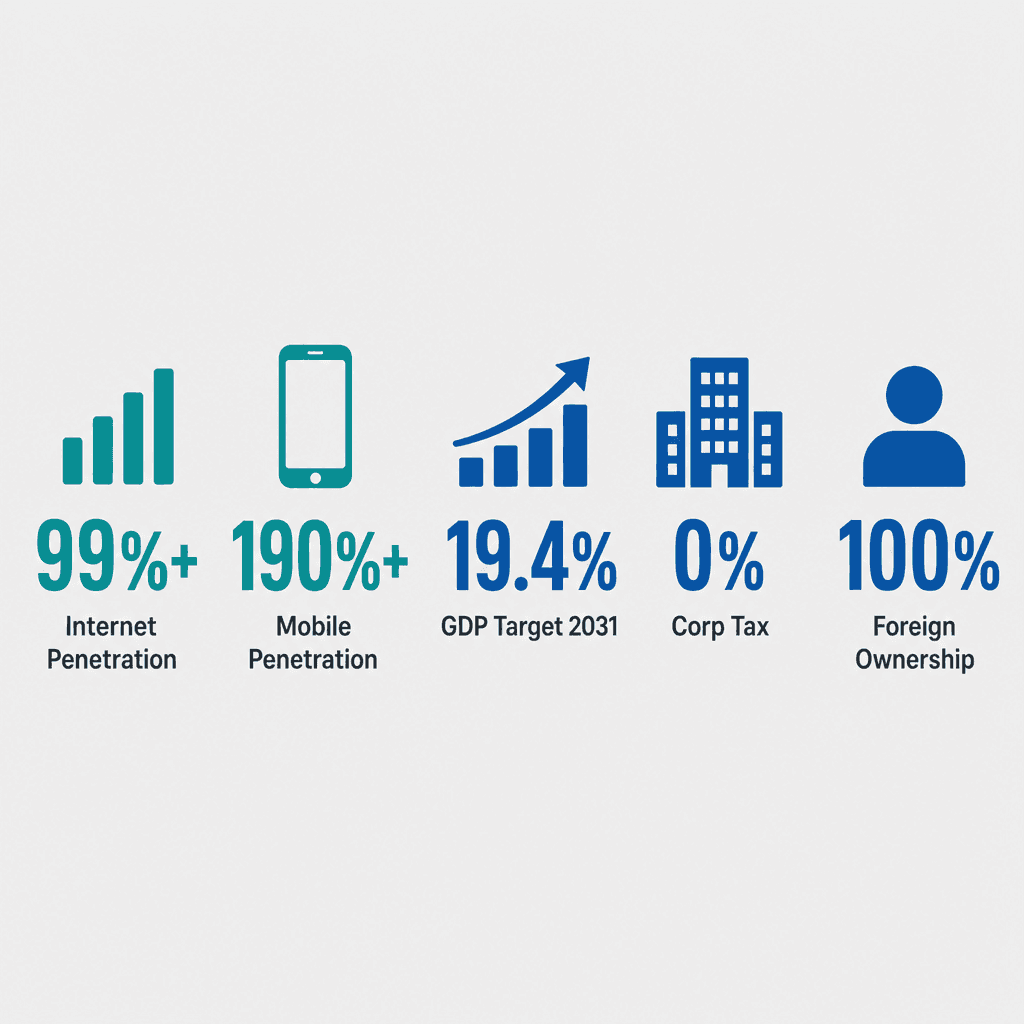
The UAE boasts internet penetration above 99 per cent and mobile penetration exceeding 190 per cent, making it one of the world's most connected markets. The government's Digital Economy Strategy aims to nearly double the sector's GDP contribution to 19.4 per cent by 2031.
Activity Code 6190 Covers a Wide Service Range
This ICT classification includes satellite communications, internet exchange point operations, bandwidth resale, and remote network management. Businesses that don't fit neatly into wired or wireless telephony categories will typically fall under this license.
100 Per Cent Foreign Ownership Is Permitted
Companies setting up at Dubai South Business Hub Free Zone can retain full foreign ownership with no local partner requirement. This makes it especially attractive for international telecoms firms seeking a regional headquarters.
Zero Corporate Tax for Qualifying Free Zone Entities
Eligible businesses operating within Dubai South's free zone benefit from a zero per cent corporate tax rate on qualifying activities. Combined with no personal income tax, the financial environment is highly competitive globally.
Business Licenses Start From AED 12,500 Annually
The entry-level Business License fee for Activity Code 6190 begins at approximately AED 12,500 per year, with additional registration and administration fees also applicable. The setup process is described as structured and straightforward.
Dubai South Offers a Strategic Geographic Advantage
Located alongside Al Maktoum International Airport and the Expo City district, Dubai South sits at a crossroads connecting Europe, Asia, and Africa. This positioning makes it an ideal hub for telecoms operators serving the Middle East, GCC, and South Asian markets.
The License Suits Startups and Enterprises Alike
From technology startups building next-generation connectivity platforms to established satellite providers expanding in the GCC, the license accommodates a broad range of operators. Bandwidth resellers and managed service providers are also well-suited to this structure.
The global telecommunications sector is undergoing rapid transformation, and Dubai sits at the centre of that shift. With world-class infrastructure, a strategic geographic position connecting East and West, and a regulatory environment designed to attract international capital, the emirate offers an exceptional base for businesses operating across the full spectrum of telecoms activities. Whether you are planning to offer satellite communications, internet exchange services, or other specialised connectivity solutions, establishing your operations in Dubai has never been more accessible.
This guide covers everything you need to know about launching an Other Telecommunications Services business under Activity Code 6190 at the Dubai South Business Hub Free Zone, including license details, setup costs, compliance requirements, and the broader market opportunity.
Understanding Activity Code 6190: Other Telecommunications Activities
Activity Code 6190 falls under the ICT category and is classified within the International Standard Industrial Classification (ISIC) framework as "Other Telecommunications Activities." This activity covers a broad range of services that do not fall neatly under wired or wireless telephony, including but not limited to:
Satellite telecommunications services
Internet exchange point operations
Provision of specialised telecommunications infrastructure
Resale of telecommunications capacity and bandwidth
Provision of access to the internet via infrastructure owned or leased by the operator
Monitoring and remote management of communications networks
The license type is a Business License, which permits the holder to carry out commercial activities related to these services within and from the Dubai South free zone jurisdiction.
Dubai and UAE Market Context
The UAE telecommunications market is one of the most advanced in the Arab world. The country consistently ranks among the top globally for mobile penetration, with rates exceeding 190 per cent, and internet penetration standing above 99 per cent of the population. The UAE government's broader digital economy agenda, including the UAE Digital Economy Strategy launched in 2022, targets doubling the digital economy's contribution to GDP from 9.7 per cent to 19.4 per cent within a decade.
Dubai South, home to Al Maktoum International Airport and the Expo City district, is one of the UAE's most ambitious urban and commercial developments. Its Business Hub Free Zone is purpose-built to attract ICT, logistics, aviation, and trade companies, offering streamlined licensing, 100 per cent foreign ownership, and zero corporate and personal income tax on qualifying activities.
Key Stats at a Glance
UAE internet penetration: above 99 per cent of the population
UAE mobile penetration: over 190 per cent
Digital economy target: 19.4 per cent of GDP by 2031
Corporate tax rate for qualifying free zone entities: 0 per cent
Foreign ownership permitted: 100 per cent
Dubai South Business Hub: direct access to Al Maktoum International Airport
Activity Code: 6190 | License Type: Business License | Category: ICT
Who Is This License Suited To?
The Other Telecommunications Services license is ideally suited to a diverse range of operators and entrepreneurs, including:
International telecoms companies seeking a regional hub to serve the Middle East, Africa, and South Asia
Technology startups building next-generation connectivity platforms
Satellite communications providers expanding their footprint in the GCC
Enterprises requiring a licensed entity to resell or redistribute telecoms capacity
Setup Costs and Steps
Setting up at Dubai South Business Hub Free Zone involves a structured and straightforward process. Typical costs and steps include the following:
Estimated Costs
Item | Approximate Cost (AED) |
|---|---|
Business License Fee | From 12,500 per year |
Registration and Administration Fees | From 3,000 to 5,000 |
Flexi-desk or Office Space | From 10,000 per year |
Visa Allocation (per visa) | From 3,500 to 5,000 |
Costs vary depending on office type, visa quota, and any additional regulatory approvals required. It is advisable to obtain a tailored quote from the free zone authority directly.
Step-by-Step Setup Process
Step 1: Choose your business activity and confirm Activity Code 6190 applies to your intended operations
Step 2: Submit your application to Dubai South Business Hub Free Zone with the required documentation
Step 3: Obtain initial approval and select your office or flexi-desk package
Step 4: Pay license and registration fees
Step 5: Receive your Business License and company incorporation documents
Step 6: Apply for residence visas for shareholders and employees
Step 7: Open a corporate bank account with a UAE-registered bank
Licensing and Compliance Requirements
Beyond the standard Business License from Dubai South, operators providing certain telecoms services may be required to obtain additional approvals from the Telecommunications and Digital Government Regulatory Authority (TDRA), which governs the UAE's telecoms sector. Depending on the nature of services offered, a service provider license or spectrum authorisation from the TDRA may be necessary.
All businesses operating in free zones must also comply with UAE Federal Law requirements, including anti-money laundering (AML) regulations, economic substance regulations (ESR) where applicable, and corporate tax registration with the Federal Tax Authority following the introduction of the UAE Corporate Tax Law in 2023.
Why Dubai Is Well-Positioned for Telecommunications Businesses
Dubai offers a combination of advantages that few jurisdictions worldwide can match for telecoms operators:
Infrastructure: The UAE has invested heavily in fibre optic networks, submarine cable landing stations, and data centre capacity, making it a genuine regional connectivity hub
Location: Dubai sits within a four-hour flight of over two billion people, bridging markets across the GCC, South Asia, East Africa, and Central Asia
Regulatory clarity: The TDRA provides a clear and transparent licensing framework, reducing uncertainty for new entrants
Tax efficiency: Free zone entities benefit from zero corporate tax on qualifying income and no personal income tax
Talent pool: Dubai attracts skilled ICT professionals from around the world, supported by competitive visa and residency schemes
Get Started
Use the cost calculator for a tailored quote.
Verify your business name with the company name check.
Browse the full business activities directory.
Get in touch to start your application.
Frequently Asked Questions