Topic Summary
IT Consultancy: Low Cost, High Demand
An IT consultancy requires only a professional license with no additional regulator for pure advisory work. With the UAE ICT sector contributing roughly 4.3% of GDP in 2023, demand for technology expertise is strong and growing.
Software Development Studio From Day One
A software development business can launch under a professional or commercial license, with TDRA clearance needed only for government-facing contracts. A sole founder can be operational at DSBH from AED 18,350 in first-year costs.
Digital Marketing Agency With Global Reach
A digital marketing agency needs a professional license and faces no additional regulator when operating from a free zone targeting international clients. Free zone status means you can invoice overseas clients directly without a mainland presence.
E-Commerce Retail Classified by Goods Type
E-commerce businesses require a trading license, and the activity classification follows the nature of the goods sold rather than the sales channel. An online supplement retailer, for example, falls under retail trade of pharmaceutical goods under ISIC Rev.4.
Management Consulting: Straightforward Licensing Path
Management consulting is among the cleanest setups in the UAE, typically requiring a professional license with minimal additional regulatory approvals. Listing all intended activities upfront at DSBH avoids the AED 2,000 per-activity fee for any sixth or subsequent additions.
Free Zone Setup Cuts Costs and Complexity
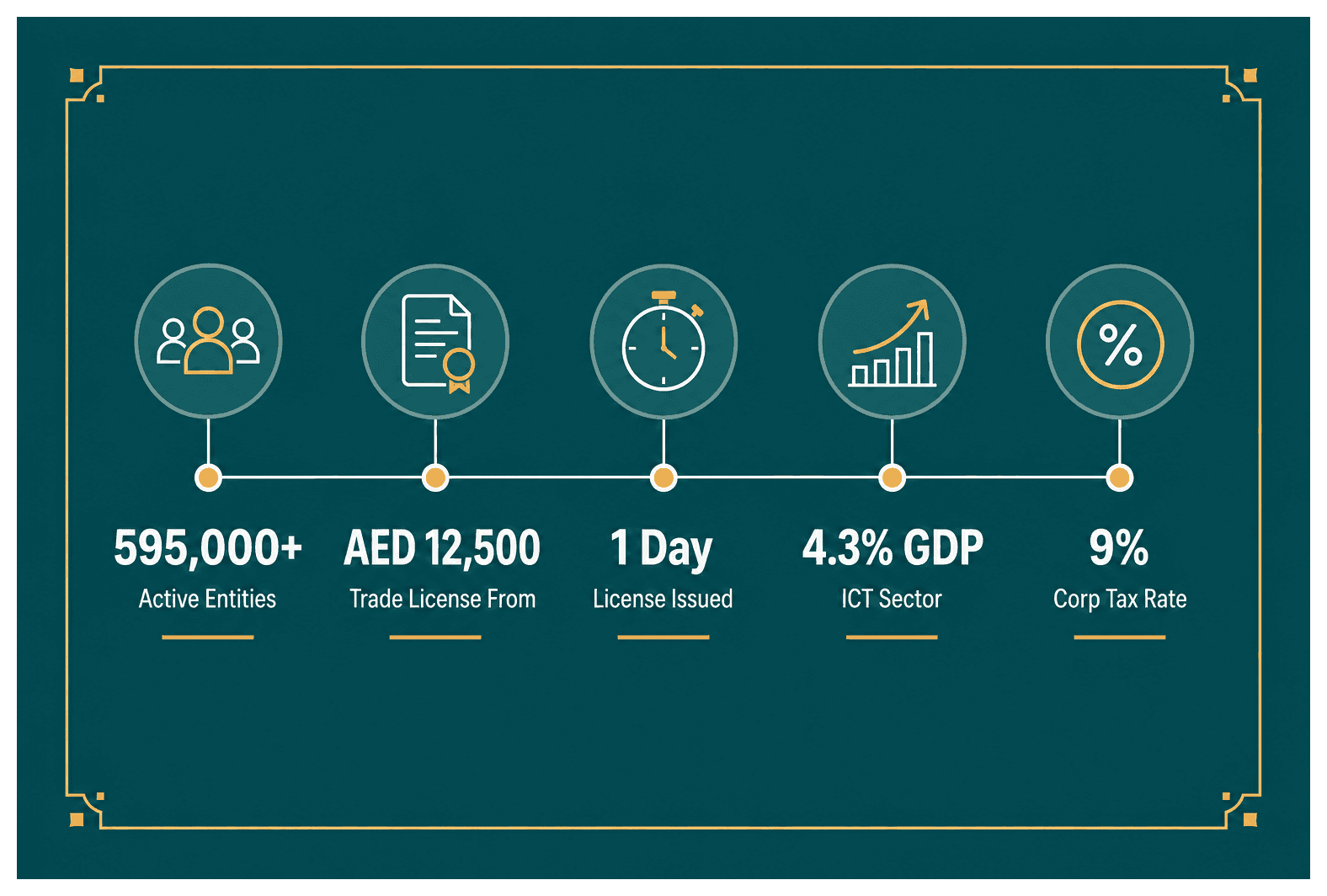
A DSBH free zone license starts from AED 12,500, requires zero paid-up share capital, and is issued within one business day. The first five business activities are included, making it a practical launchpad for founders testing multiple revenue streams.
Know Your Tax and VAT Thresholds Early
Corporate tax applies at 9% on taxable income above AED 375,000, and VAT registration becomes mandatory once annual taxable supplies reach the same threshold. Understanding these figures at the planning stage prevents costly compliance surprises later.
In 2026, the UAE hosts over 595,000 active commercial entities (Ministry of Economy, 2024), and the right 15 business ideas UAE guide can cut months of confusion down to a single afternoon of planning. A trade license at Dubai South Business Hub Free Zone (DSBH) starts from AED 12,500 [1], is issued in one business day [2], and requires zero paid-up share capital [3]. First-year cost for a sole founder with one visa starts from AED 18,350 [4]. The UAE ICT sector alone contributed approximately 4.3% of GDP in 2023 (Statista, 2024) [5], signalling strong demand for technology-led business ideas. Corporate tax applies at 9% above AED 375,000 in taxable income [6], and VAT registration is mandatory once annual taxable supplies hit AED 375,000 (Federal Tax Authority, 2026) [7].
This guide walks you through 15 proven business ideas suited to the UAE market, the license type each one requires, the regulatory approvals that apply, and the realistic cost of getting started at DSBH. Whether you're launching a software studio or a wellness brand, the structure is the same: right activity, right license, right regulator.
What Is a UAE Business License and Why Your Idea Needs One
A UAE business license is the legal authorization issued by a free zone authority or the Department of Economy and Tourism (DET) that permits a company to trade under specified activities. Without one, no entity can open a corporate bank account, hire staff, or invoice clients. Every business idea on this list requires one before trading.
Free Zone License Versus Mainland License
Free zone licenses are issued by the free zone authority itself. Mainland licenses come from DET. Both structures now permit 100% foreign ownership, that's a federal-level right and has nothing to do with designated-zone status.
The practical difference is market access. Free zone entities trade internationally and within the UAE via a local distributor or branch. Mainland entities trade directly in the UAE market. A software consultant setting up at DSBH, for example, can invoice overseas clients directly from day one without needing a mainland presence at all.
DSBH issues free zone licenses from AED 12,500
Zero paid-up share capital required
License issued in one business day
First five activities included; AED 2,000 per activity beyond five
100% foreign ownership available on both free zone and mainland
How Activities Are Classified Under ISIC and UAE Law
The UAE uses ISIC Rev.4 as the reference framework for classifying economic activities. The hierarchy runs four levels deep: sections, divisions, groups, and classes. Each license lists the specific activities a company is permitted to conduct, and choosing the wrong code creates real compliance risk.
Here's a common misconception worth flagging: an e-commerce retailer selling supplements is not classified under "e-commerce" as a standalone category. Under ISIC, the classification follows the nature of the goods, so that business sits under retail trade of pharmaceutical goods. The sales channel is irrelevant to the classification. Browse the full list of business activities in Dubai at DSBH to confirm your specific activity is covered before you apply.
Regulated activities, health, finance, education, require both a DSBH license and separate approval from the named regulator. DSBH licenses the activity; the named regulator approves it separately. Adding a sixth or subsequent activity at DSBH costs AED 2,000 each, so list everything upfront.
15 Business Ideas UAE: License Type and Key Regulator
Business Idea | License Type | Named Regulator (if any) |
|---|---|---|
IT Consultancy | Professional license | No additional regulator for pure advisory |
Software Development | Professional or commercial license | TDRA clearance for government-facing contracts |
Digital Marketing Agency | Professional license | DET approval only if operating on the mainland |
E-Commerce Retail | Trading license | Classified by goods type under ISIC; no single named regulator |
Management Consultancy | Professional license | Ministry of Economy registration required for audit firms |
Financial Advisory (client funds) | Professional license | SCA or Central Bank approval mandatory |
HR and Recruitment | Professional license | MoHRE private employment agency permit required |
15 Business Ideas UAE Founders Are Launching Right Now
The 15 strongest business ideas for UAE setup in 2026 span technology, professional services, health and wellness, education, trading, and creative services. Each maps to a specific ISIC activity group and license type. Regulated sectors, health, finance, education, also require approval from the relevant UAE authority before operating.
Technology and Digital Services (Ideas 1–5)
IT Consultancy, advising on systems, cybersecurity, and digital transformation. Requires a professional ICT license in Dubai via DSBH. No additional regulator for pure advisory work.
Software Development, building custom applications or SaaS products. Falls under ISIC Division 62. Professional or commercial license. The UAE ICT sector contributed approximately 4.3% of GDP in 2023 (Statista, 2024), making this one of the most active growth segments.
Digital Marketing Agency, SEO, paid media, content strategy. Professional license. DET approval is only required if you're operating on the mainland.
E-Commerce Retail, selling physical goods online. Classified by the goods category under ISIC, not by the sales channel. Trading license. Goods held inside the free zone are duty-suspended, not duty-exempt.
Cybersecurity Consulting, penetration testing, risk audits. Professional license. Certain government-facing contracts may require Telecommunications and Digital Government Regulatory Authority (TDRA) clearance.
A two-person software studio licensed at DSBH can serve clients across Europe and MENA from the same free zone entity, invoicing in multiple currencies without a separate mainland branch. That's a real structural advantage for early-stage tech founders watching their runway.
Professional and Financial Services (Ideas 6–9)
Management Consultancy, strategy, operations, market-entry advisory. Requires a professional license in Dubai. No additional regulator for non-regulated advisory.
Accounting and CFO Services, bookkeeping, management accounts, CFO-for-hire. Professional license. Audit firms must register with the Ministry of Economy.
Financial Advisory (non-regulated), business valuation, M&A advisory not involving client money. Professional license. If you handle client funds or securities, Securities and Commodities Authority (SCA) or Central Bank approval becomes mandatory. DSBH licenses the activity; the named regulator approves it separately.
HR and Recruitment Consulting, talent sourcing, payroll advisory. Professional license. Recruitment firms placing workers must hold a MoHRE-issued private employment agency permit in addition to the trade license.
A management consultant relocating from London sets up a sole-founder DSBH entity at AED 18,350 in year one (license plus one visa package) and starts billing Gulf clients within the first week. No office lease required. No share capital deposit. That's the practical reality of a free zone professional license.
Health, Education, and Creative Services (Ideas 10–15)
Health and Wellness Coaching, nutrition coaching, fitness programming (non-clinical). Requires a healthcare license in Dubai. Clinical practice requires Dubai Health Authority (DHA) or the relevant emirate health authority approval. DSBH licenses the activity; DHA approves it separately.
Telemedicine Platform, connecting patients and licensed practitioners digitally. Commercial or professional license. Ministry of Health and Prevention and DHA approvals are both mandatory before operating.
Corporate Training and E-Learning, skills workshops, online courses. Requires an education license in Dubai. Knowledge and Human Development Authority (KHDA) approval is required for training centres operating in Dubai. DSBH licenses the activity; KHDA approves it separately.
Real Estate Brokerage, matching buyers, sellers, and tenants. Requires a real estate license in Dubai. RERA registration and a broker card are both mandatory. DSBH licenses the activity; RERA approves it separately.
Content Creation and Media Production, video, photography, podcasting for brands. Professional license. Broadcast content may require National Media Office approval.
General Trading, importing and re-exporting goods across categories. Trading license. Goods remain duty-suspended inside the free zone; UAE customs duty applies the moment they cross into the mainland for local sale.
A corporate training firm licensed at DSBH delivers online courses globally from the free zone entity and runs in-person Dubai workshops through a mainland branch once KHDA approval is secured. That two-entity structure is a common and practical approach for education businesses targeting both international and local audiences.
Key rule for regulated activities: DSBH issues the trade license for the activity. The named regulator (DHA, KHDA, RERA, SCA, MoHRE) issues the operational approval. You need both before you start trading.
Costs, Tax, and Compliance Every Founder Must Know
A sole founder setting up at Dubai South Business Hub Free Zone pays from AED 18,350 in year one: a license from AED 12,500 plus one visa package. Visas are always an additional cost. Corporate tax late registration carries a one-time AED 10,000 penalty. VAT late registration also carries an AED 10,000 penalty.
License and Visa Pricing at DSBH
Trade license from AED 12,500
First five activities included in the license fee
Each activity beyond five: AED 2,000
First-year cost for a sole founder with one visa: from AED 18,350
Zero paid-up share capital required
License issued in one business day
Visas are always an additional cost, never included in the license fee
A sole-founder IT consultancy with three activity codes and two visas would budget AED 12,500 for the license plus visa costs for two people, no share capital deposit required. Use the DSBH business setup cost calculator to build your exact year-one figure before you apply.
Corporate Tax and VAT Obligations
UAE corporate tax applies at 9% on taxable income above AED 375,000. Qualifying Free Zone Persons (QFZP) may access a 0% rate on qualifying income, but only if they satisfy all four conditions: adequate substance in the UAE, qualifying income, no mainland permanent establishment, and compliance with transfer pricing rules. That 0% rate is conditional, not universal. Never treat the UAE as tax-free.
VAT registration is mandatory once annual taxable supplies reach AED 375,000 (Federal Tax Authority, 2026). Late corporate tax registration carries a one-time flat penalty of AED 10,000. Late VAT registration carries an AED 10,000 penalty as well.
Worth flagging for trading businesses: a DSBH-licensed company re-exporting goods to Saudi Arabia keeps those goods duty-suspended inside the free zone. The moment they cross into the Dubai mainland for local sale, UAE customs duty applies. DSBH is not a designated zone and receives no designated-zone customs or VAT benefit.
How to Set Up Your Business in the UAE: A Step-by-Step Process
Setting up a UAE business involves five core steps: choose your business activity, select your jurisdiction, reserve your trade name, submit incorporation documents, and obtain your license. At DSBH, the license is issued in one business day. Regulated activities require an additional approval from the named authority before trading.
Step 1: Choose Your Activity and Jurisdiction
Match your business idea to the correct ISIC activity group and confirm whether it's regulated. Then decide between a free zone (DSBH) and mainland (DET) based on where your primary customers are. If most of your clients are international or UAE B2B, a free zone structure is usually the cleaner starting point.
Browse the full list of business activities in Dubai at DSBH to confirm your activity is covered. If your idea spans multiple activities, say, IT consultancy and digital marketing, list all of them on the initial application. Adding activities later costs AED 2,000 each, so getting this right upfront saves money.
Step 2: Reserve Your Name, Submit Documents, and Receive Your License
Check company name availability before submitting. Your trade name must comply with UAE naming guidelines and must not conflict with existing registrations.
Submit passport copies, the completed application form, and your activity selections. No notarized documents are required at DSBH for most structures.
Receive your license within one business day.
Apply for your UAE residency visa after license issuance. This is always a separate cost and process.
For regulated activities, submit your license to the relevant authority (DHA, KHDA, RERA, SCA, or MoHRE) to begin the secondary approval process.
A real estate brokerage founder receives the DSBH license on day one, then submits that license to RERA to begin the broker card application. Both steps are required before the business can list or transact property. The license and the regulatory approval are separate processes, plan for both in your timeline.
How Dubai South Business Hub Free Zone Supports Each Business Idea
Dubai South Business Hub Free Zone, launched September 2025, issues trade licenses from AED 12,500 in one business day with zero paid-up share capital. It supports commercial, professional, and trading activities across all 15 business ideas in this guide. Visas, banking, and residency services are available as separate packages.
Banking, Residency, and Ongoing Business Support
After license issuance, you'll need a corporate bank account. DSBH's UAE bank account opening service connects founders with banking partners. A general trading company licensed at DSBH, for instance, can open a multi-currency corporate account within two weeks of license issuance through this introduction service.
Residency visas for founders and staff are processed as a separate package. Costs vary by visa count and category. DSBH's business support services cover PRO services, document attestation, and government transactions. Founders with complex logistics requirements should note that DSBH does not provide bonded warehousing or customs integration, arrange those
References
Frequently Asked Questions