Topic Summary
Choose a Free Zone for Full Ownership
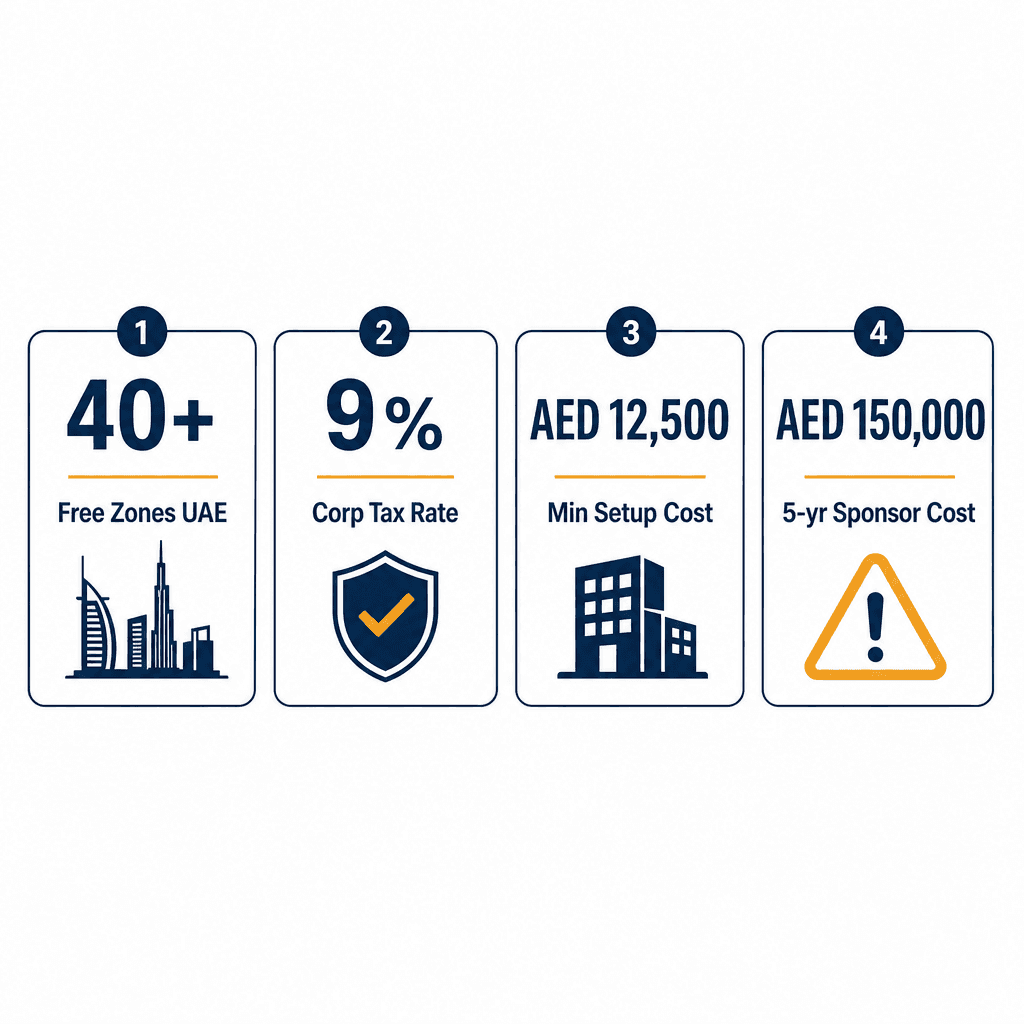
All 40+ UAE free zones allow 100% foreign ownership with no local Emirati sponsor required. Setup costs start from AED 12,500, making them a cost-effective alternative to traditional sponsored mainland structures.
The 2021 Reforms Changed Mainland Rules
Amendments to the UAE Commercial Companies Law in 2021 eliminated the mandatory 51% Emirati ownership requirement for most mainland business activities. Advice that you still need a local sponsor for a mainland LLC is now outdated for the majority of sectors.
Sponsors Cost Far More Than People Realise
Traditional local sponsors charged AED 10,000–AED 30,000 annually despite having no operational role in the business. Over five years, that amounts to AED 50,000–AED 150,000 in avoidable overhead that modern structures eliminate entirely.
Side Agreements Offered Weak Legal Protection
Foreign investors historically used private side agreements to protect their operational control, but these were not always enforceable in UAE courts. Sponsor relationship breakdowns in the early 2010s caused several investors to lose control of their mainland businesses.
Know the Difference: Sponsor vs. Local Service Agent
A local sponsor holds equity in your company, while a local service agent is a separate arrangement used for specific professional license categories without transferring ownership. Understanding this distinction helps you avoid unnecessary costs and structural risks.
Some Sectors Still Carry Ownership Restrictions
Despite the 2021 reforms, certain strategic sectors such as oil and gas, utilities, and some defence-related activities retain Emirati ownership requirements. Verifying your specific business activity against the current restricted list before choosing a structure is essential.
Free Zone Tax Advantages Add to the Savings
Qualifying Free Zone Persons can pay 0% corporate tax on qualifying income, compared to the standard 9% rate applied to taxable income above AED 375,000 on the mainland. This tax benefit compounds the savings already gained by eliminating sponsor fees.
By Editorial Team, UAE business setup specialists with direct experience advising foreign investors on free zone and mainland company formation. Full bio →
In 2026, more than 40 free zones operate across the UAE, every single one allowing 100% foreign ownership with zero local Emirati sponsor required (UAE Ministry of Economy, 2024). The standard UAE corporate tax rate sits at 9% on taxable income above AED 375,000, while Qualifying Free Zone Persons may pay 0% on qualifying income (UAE Federal Tax Authority, 2023). Free zone setup costs start from AED 12,500 at Dubai South Business Hub. Traditional sponsored mainland LLCs historically cost AED 10,000–AED 30,000 per year in sponsor fees alone. Over five years, that's AED 50,000–AED 150,000 in avoidable overhead. The UAE ranked 16th globally for ease of doing business in the World Bank's 2020 index, with the sponsor requirement cited as a structural barrier to foreign direct investment (World Bank, 2020).
You do not need a local Emirati sponsor to own a business in Dubai, as long as you choose the right structure. This is one of the most misunderstood aspects of UAE business setup, and it puts off many would-be entrepreneurs who assume they need to share their company with someone. This guide covers what a local sponsor historically was, the two proven pathways to avoid local sponsor Dubai requirements, which sectors still carry restrictions, the difference between a sponsor and a local service agent, a cost breakdown, and practical guidance on choosing the right structure for your business model.
What a Local Sponsor Is and Why the Rule Existed in the First Place
A local sponsor is an Emirati national who historically held 51% ownership of a mainland UAE company on behalf of a foreign investor. The rule was introduced to protect national economic interests and ensure Emiratis participated in commercial activity. It applied to most mainland businesses until 2021 reforms changed the law. If you've been told you need a sponsor to run a business without sponsor UAE, that advice is now outdated for most activities.
The Original 51/49 Ownership Rule Explained
Under the pre-2021 UAE Commercial Companies Law, most mainland businesses required an Emirati shareholder holding at least 51% equity. Foreign investors retained operational control through side agreements, but legal ownership remained split. The rule applied to Limited Liability Companies (LLCs) incorporated with the Dubai Department of Economic Development (DET), the most common mainland structure.
Sponsors typically charged an annual fee of AED 10,000–AED 30,000 or more, with no management involvement whatsoever. Take a US-based e-commerce entrepreneur who set up a mainland LLC in 2018: they were required to list an Emirati national as 51% shareholder even though that person never set foot in the warehouse, never attended a meeting, and had no operational role.
Why the Model Created Risk for Foreign Investors
Side agreements protecting foreign investor rights were not always enforceable in UAE courts. Business disputes could expose the foreign partner to loss of operating licenses. Several high-profile cases in the early 2010s saw foreign investors lose control of their mainland businesses when sponsor relationships broke down, a risk that no longer applies to the same degree under the 2021 reforms.
Investors in retail, hospitality, and professional services were disproportionately affected. The sponsor model deterred foreign direct investment and ultimately pushed the UAE to overhaul its company law. Free zones were the original workaround, they always permitted 100% foreign ownership, which is why they grew from a handful of zones in the 1980s to more than 40 today. Learn more about what is a free zone in Dubai and how they operate.
Two Pathways to Avoid a Local Sponsor in Dubai Today
There are two legitimate ways to avoid a local sponsor in Dubai: set up in a free zone, which has always allowed 100% foreign ownership, or incorporate on the mainland under the 2021 reforms that removed the Emirati equity requirement for most commercial activities. Both routes give you full legal ownership with no sponsor involved.
Free Zone vs. Mainland: Avoiding a Local Sponsor in Dubai
Feature | Free Zone Company | Mainland LLC (Post-2021) |
|---|---|---|
Local Sponsor Required | ✅ Never required | ✅ Not required (most sectors) |
Foreign Ownership | 100% from day one | 100% (non-restricted sectors) |
Trade in UAE Local Market | Via distributor or dual license | ✅ Direct access |
Setup Cost (Approx.) | From AED 12,500 | From AED 18,000–AED 25,000+ |
Setup Timeline | 3–7 business days | 5–10 business days |
Visa Eligibility | ✅ Investor + employee visas | ✅ Investor + employee visas |
Regulatory Authority | Free zone authority | Dubai DET (formerly DET) |
Free Zone Companies: Always Sponsor-Free by Design
Every UAE free zone operates under its own regulatory authority and has permitted 100% foreign ownership since inception. No Emirati shareholder is required at any equity level. Free zone licenses are issued by the zone authority, not the DET, so mainland sponsorship rules simply don't apply. Dubai South Business Hub, like all UAE free zones, offers full foreign ownership as a baseline condition — making it a straightforward choice for international entrepreneurs and investors.
A Canadian logistics consultant incorporating at Dubai South Business Hub Free Zone in 2026 retains 100% of her shares, appoints herself as sole director, and pays zero annual sponsor fee, with total setup starting from AED 12,500. That's a free zone company without local sponsor, exactly as designed.
Mainland 100% Foreign Ownership: What the 2021 Reforms Actually Allow
UAE Federal Decree-Law No. 26 of 2021 amended the Commercial Companies Law and removed the mandatory 51% Emirati ownership requirement for most mainland LLC activities. The reform took effect in June 2021 and applies to both new and existing companies. Sectors now open to full foreign ownership include trading, consulting, technology, manufacturing, and most services.
A UK-based software firm that previously needed an Emirati 51% shareholder to operate a mainland trading entity in Dubai can now incorporate a fully foreign-owned mainland LLC under the same DET licensing framework. No sponsor. Full ownership. Same market access. For a detailed side-by-side, see our guide on free zone vs mainland business setup Dubai.
Mainland Sectors That Still Require an Emirati Partner in 2026
Even after the 2021 reforms, certain mainland sectors classified as strategic or restricted still require Emirati majority ownership or a government-approved partner. These include oil and gas, utilities, defence, security services, and specific financial activities. If your business falls in these categories, a free zone structure remains your clearest path to full ownership and a genuine business without sponsor UAE.
Restricted and Strategic Sectors: The Exceptions to 100% Foreign Ownership
The UAE Cabinet maintains a list of strategic and restricted sectors where Emirati ownership requirements remain in force. Restricted sectors include:
Oil and gas exploration and production
Arms and ammunition trading
Defence-related manufacturing
Security and investigation services
Certain banking and insurance activities
Publishing and broadcasting (in some emirates)
Specific real estate brokerage activities
A US defence contractor wanting to set up a mainland entity in Dubai for security consulting would still need an Emirati partner holding the required equity stake. This is one area where the 2021 reforms did not apply. Investors targeting these sectors must either partner with an Emirati shareholder or restructure their activity to fall outside the restricted classification.
How to Check Whether Your Activity Is Restricted Before You Incorporate
The Dubai Department of Economic Development and Tourism (DET, formerly DET) publishes a licensed activities list. Cross-reference your intended activity code before choosing a mainland structure. If your activity appears on the restricted list, a free zone license is the cleanest path to 100% ownership. A formation advisor can run that activity check in under 24 hours.
Worth flagging: ISIC Revision 4 activity classifications (the UN's international standard for classifying economic activities, adopted in 2008) underpin how the DET categorises economic activities. The four-level hierarchy of Section, Division, Group, and Class maps directly to how UAE authorities assign license categories. A fintech startup offering payment processing, for instance, should verify whether its specific activity falls under restricted financial services or the broader technology and software category, the classification determines whether you can avoid local sponsor Dubai requirements on the mainland.
6 Steps to Set Up a Business in Dubai Without a Local Sponsor
To set up a business in Dubai without a local sponsor, choose a free zone or 100% foreign-owned mainland structure, confirm your activity is not restricted, select your legal form, prepare incorporation documents, submit your application to the relevant authority, and obtain your license. The entire process typically takes 3–10 business days.
Steps 1 to 3: Structure, Activity, and Legal Form
A Singapore-based marketing agency targeting GCC clients would typically choose a free zone FZE. It avoids a sponsor, keeps overhead low, and the agency has no need for direct mainland trade licenses.
Steps 4 to 6: Documents, Application, and License Issuance
Dubai South Business Hub Free Zone offers a streamlined digital onboarding process where applicants can complete Steps 4 through 6 entirely online. Ready to start? calculate your business setup cost or calculate your setup cost before you commit.
Local Service Agent vs. Local Sponsor: A Critical Distinction
A local service agent is not the same as a local sponsor. A local service agent (LSA) is an Emirati individual or company required for certain sole establishment licenses. They act as a registered intermediary for government filings but hold zero equity in your business. You retain 100% ownership. A sponsor, by contrast, historically held 51% of your shares.
What a Local Service Agent Does, and Does Not Do
An LSA facilitates government paperwork, license renewals, and visa applications. They have no ownership stake and no claim on business profits. LSA annual fees typically run AED 5,000–AED 15,000, notably lower than traditional sponsor fees. The arrangement is a registered agent relationship, not a shareholder relationship, legally and structurally distinct from the old sponsor model.
Consider a German architect registering a professional engineering sole establishment on the Dubai mainland. She appoints an Emirati LSA to handle DET filings. She owns 100% of the business. The LSA earns a flat annual fee and has no claim on any project revenue.
When You Need an LSA and When You Do Not
LSA required: Professional license sole establishments on the mainland, foreign company branch offices in Dubai.
LSA not required: Free zone companies of any type, mainland LLCs (post-2021), and most mainland commercial license structures.
A US-based management consultant setting up a mainland professional license sole establishment needs an LSA. The same consultant setting up an FZE at Dubai South Business Hub needs neither an LSA nor a sponsor. Free zone structures eliminate the LSA requirement entirely, one more reason they remain the preferred no-sponsor route for most foreign entrepreneurs.
Is a local service agent the same as a local sponsor?
No. A local service agent holds zero equity in your business and earns a fixed annual fee for handling government filings. A traditional local sponsor held 51% of your shares. The LSA is a registered intermediary; the sponsor was a co-owner. Confusing the two is one of the most common mistakes foreign investors make when researching UAE business setup.
Cost Comparison: Sponsor vs. Sponsor-Free Business Structures in Dubai
A traditional sponsored mainland LLC costs AED 10,000–AED 30,000 per year in sponsor fees on top of standard licensing costs. A free zone company starts from AED 12,500 all-in with no sponsor fee. A post-2021 mainland LLC eliminates the sponsor fee entirely. Over five years, a sponsor-free structure can save AED 50,000–AED 150,000 in avoidable payments.
Five-Year Cost Savings of Going Sponsor-Free
References
Editorial sources available on request. Full citation list is being compiled.
Cost Item | Sponsored Mainland LLC | Free Zone (e.g., Dubai South Business Hub Free Zone) | Mainland LLC (Post-2021) |
|---|---|---|---|
Initial Setup | AED 18,000–AED 25,000+ | From AED 12,500 | AED 18,000–AED 25,000+ |
Annual Sponsor Fee | AED 10,000–AED 30,000 | AED 0 | AED 0 |
Annual Renewal | AED 8,000–AED 15,000+ | AED 8,000–AED 15,000 | AED 8,000–AED 15,000+ |
5-Year Sponsor Cost | AED 50,000–AED 150,000 |
Citations
UAE Ministry of Economy and Tourism.. moet.gov.ae. MOET UAE, 2024.
Dubai Economy and Tourism.. dubaidet.gov.ae. DET Dubai, 2024.
UAE Cabinet.. uaecabinet.ae. UAE Cabinet, 2023.
Federal Tax Authority.. tax.gov.ae. FTA UAE, 2023.
World Bank.. worldbank.org. World Bank, 2024.
Frequently Asked Questions