
Topic Summary
Dubai's B2B E-Commerce Market Is Booming
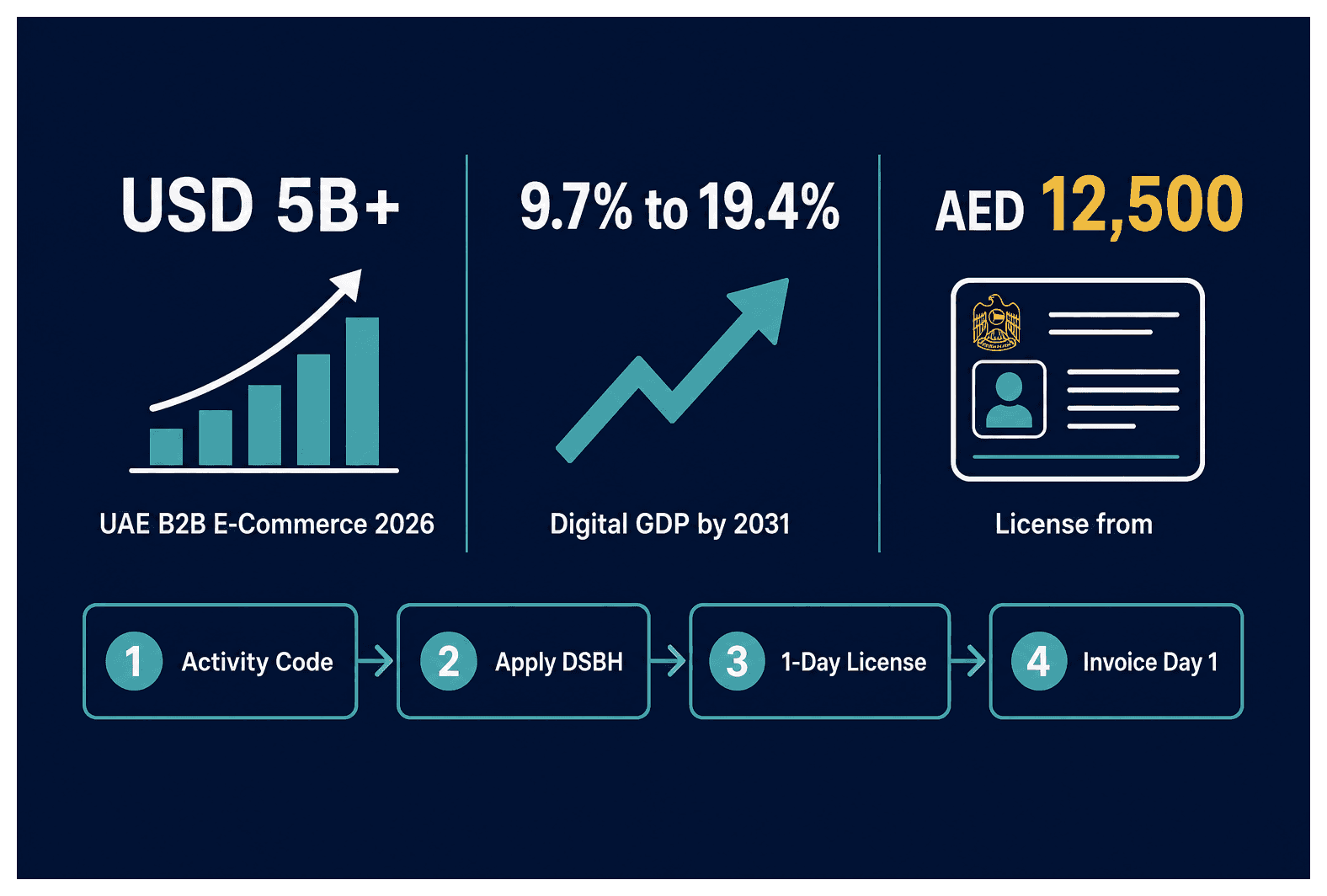
The UAE's B2B e-commerce market is projected to surpass USD 5 billion in gross merchandise value by 2026. Dubai alone accounts for roughly 30% of total UAE non-oil exports, making it a critical hub for digital trade.
Activity Classification Affects Your License Type
Under ISIC Rev.4, B2B e-commerce companies are classified by what they sell, not by the digital channel they use. Choosing the wrong activity code at license stage can trigger compliance issues, especially during bank account opening.
100% Foreign Ownership Is Now Widely Available
Following the 2021 UAE Companies Law reforms, 100% foreign ownership is permitted on both the mainland and in free zones. Free zones like Dubai South Business Hub still offer added advantages such as a streamlined single-window registration process.
Startup Costs Are Lower Than Many Expect
A B2B e-commerce trade license at Dubai South Business Hub Free Zone starts from AED 12,500, with a first-year all-in cost from AED 18,350 for a sole founder with one visa. Zero paid-up share capital is required to get started.
Licenses Can Be Issued in One Business Day
Dubai South Business Hub Free Zone issues trade licenses in a single business day, allowing founders to begin invoicing clients almost immediately. This speed is a significant advantage for international businesses expanding into the Gulf region.
Dubai's Location Unlocks a Massive Trade Corridor
Dubai sits at the intersection of the Europe-Asia-Africa trade corridor, placing over 2 billion consumers within a four-hour flight. A USD-pegged dirham and no currency restrictions further reduce cross-border financial risk for B2B platforms.
UAE's Digital Economy Strategy Sets Ambitious Targets
The UAE aims to more than double the digital economy's share of GDP from 9.7% to over 19.4% by 2031, with digital wholesale trade explicitly included in that agenda. Federal Decree-Law No. 14 of 2023 now provides a unified legal framework governing digital commercial transactions nationwide.
In 2026, the UAE's B2B e-commerce market is projected to surpass USD 5 billion in gross merchandise value (Statista, 2025). Dubai accounts for roughly 30% of total UAE non-oil exports (Dubai Chamber, 2024). The UAE's digital economy strategy targets lifting the digital economy's share of GDP from 9.7% to over 19.4% by 2031 (u.ae, 2025). Federal Decree-Law No. 14 of 2023 now governs digital commercial transactions across the country. A B2B e-commerce trade license at Dubai South Business Hub Free Zone (DSBH) starts from AED 12,500, with a first-year all-in cost from AED 18,350 for a sole founder with one visa. Zero paid-up share capital is required. DSBH issues licenses in one business day.
This guide walks you through the requirements, costs, and steps to launch a b2b e-commerce company in Dubai, using verified figures from Dubai South Business Hub Free Zone so you can plan with confidence before you spend a dirham.
What Is a B2B E-Commerce Company in Dubai and Why It Matters
A B2B e-commerce company in Dubai is a registered legal entity that buys and sells goods or services to other businesses through digital platforms. Under ISIC Rev.4, the activity is classified by what is sold, not the channel used. Dubai's free zone framework lets foreign founders own 100% of such a company with no paid-up share capital requirement.
How Dubai Classifies B2B E-Commerce Activities
Under ISIC Rev.4 and the UAE's own activity framework, e-commerce is not a standalone category. Classification follows the nature of goods or services sold. This is a practical distinction that affects which license type you apply for and which regulators, if any, need to co-approve your application.
Here's how that plays out in practice:
Wholesale trade of physical goods (ISIC Section G): industrial components, construction materials, FMCG sold business-to-business
Information and communication (ISIC Section J): software licenses, SaaS platforms, API-based services
Professional and technical services (ISIC Section M): consulting, procurement advisory, market research sold to businesses
A Dubai-based founder running a wholesale marketplace for construction materials online would be classified under wholesale trade of construction materials, not under a generic "e-commerce" heading. Choosing the wrong code at license stage can trigger compliance issues later, particularly during bank account opening. Browse the full business activities list at Dubai South Business Hub to confirm which codes fit your model.
Why Dubai Is a Strategic Base for B2B Digital Trade
Dubai sits at the intersection of the Europe-Asia-Africa trade corridor, giving B2B platforms access to over 2 billion consumers within a four-hour flight. The UAE's digital economy strategy targets doubling the digital economy's contribution to GDP from 9.7% to over 19.4% by 2031 (u.ae, 2025), and digital wholesale trade is explicitly part of that agenda.
Worth flagging: 100% foreign ownership is available on both the mainland and in free zones following the 2021 UAE Companies Law reforms. It is not a free-zone-exclusive benefit. What free zones do offer is a streamlined formation process, a single-window regulator, and in DSBH's case, a one-business-day license turnaround.
A Singapore-based procurement platform expanding into the Gulf can incorporate at DSBH as a sole founder with no local partner and begin invoicing UAE buyers on day one. No currency restrictions and a USD-pegged dirham reduce cross-border FX risk for B2B platforms invoicing international buyers.
B2B E-Commerce Dubai Requirements: What You Need Before You Apply
To set up a B2B e-commerce company in Dubai you need a valid passport, a chosen trade name, at least one licensed business activity, a registered office address (a free zone flexi-desk qualifies), and compliance with UAE VAT and corporate tax registration rules where applicable. Regulated activities require additional approval from the relevant named authority.
Legal and Document Requirements
The document checklist for a DSBH B2B e-commerce license is short. A sole founder with only a foreign passport can complete it in under 48 hours if documents are apostilled or notarised in advance.
Passport copy (valid for at least six months) for each shareholder and director. No UAE residence visa is required at application stage.
Trade name that complies with UAE naming rules: no offensive terms, no references to political or religious bodies, no names already registered. Check your company name availability before applying.
Memorandum of Association (MOA): DSBH prepares this as part of the formation process for most standard structures.
Registered office address: a free zone flexi-desk or physical office within the free zone qualifies. A P.O. Box alone does not.
Zero paid-up share capital: no bank deposit is required before incorporation at DSBH.
B2B vs. B2C E-Commerce License at Dubai South Business Hub Free Zone
Feature | B2B E-Commerce License | B2C E-Commerce License |
|---|---|---|
License fee starting point | AED 12,500 | AED 12,500 |
Target customer type | Other businesses, wholesalers, corporate buyers | Individual end consumers |
Typical activity codes | Wholesale trade, ICT, professional services, B2B marketplace | Retail trade, direct-to-consumer e-commerce, consumer services |
VAT treatment on sales | Standard-rated at 5%; exports to overseas business buyers may be zero-rated | Standard-rated at 5%; consumer-facing sales generally standard-rated |
Paid-up share capital required | Zero | Zero |
Regulatory and Compliance Requirements
VAT registration: Mandatory once taxable supplies exceed AED 375,000 per year. Voluntary registration is available from AED 187,500. The late registration penalty is AED 10,000 (Federal Tax Authority, 2026). Register before your first taxable supply if you expect to cross the threshold quickly.
Corporate tax registration: Required for all UAE-registered entities, regardless of revenue. The late registration penalty is a one-time flat fee of AED 10,000, not a monthly charge. A Qualifying Free Zone Person (QFZP) may access a 0% rate on qualifying income, but only if four conditions are all met: adequate substance in the UAE, qualifying income from qualifying activities, no election to be taxed at the standard rate, and compliance with transfer pricing rules (Federal Tax Authority, 2026).
Payment services: A B2B marketplace that processes card payments on behalf of sellers must hold a Central Bank of UAE payment service provider license alongside its free zone trade license. The free zone license alone is not sufficient for this activity.
Data protection: B2B platforms collecting personal data of UAE residents must comply with Federal Decree-Law No. 45 of 2021 on Personal Data Protection. This applies even if your customers are businesses, because individual contact data (procurement managers, directors) is still personal data under the law.
Is a flexi-desk address enough for a B2B e-commerce license?
Yes. At DSBH, a flexi-desk within the free zone qualifies as a registered office address for license purposes. A P.O. Box alone does not satisfy the requirement. If your B2B platform needs physical warehousing, that must be arranged separately through a licensed logistics provider, as DSBH does not provide bonded warehousing or customs integration.
Costs of Setting Up a B2B E-Commerce Company in Dubai
At Dubai South Business Hub Free Zone, a B2B e-commerce trade license starts from AED 12,500. A sole founder adding one residence visa can expect a first-year all-in cost from AED 18,350. Visas are always an additional cost. Each business activity beyond the first five is charged at AED 2,000. Zero paid-up share capital is required.
License and Formation Fees at Dubai South Business Hub
B2B e-commerce trade license: from AED 12,500 (launched September 2025 under Dubai South Free Zone authority)
First five business activities: included in the license fee
Each additional activity beyond five:AED 2,000
Paid-up share capital:zero, no bank deposit required before incorporation
License turnaround:one business day once documents are approved
A founder setting up a B2B wholesale platform with seven activity codes would pay AED 12,500 plus AED 4,000 for the two additional activities beyond the first five, totalling AED 16,500 for the license alone before visa costs. Use the business setup cost calculator to build an accurate projection for your specific activity count.
Visa and First-Year Total Cost
Visas are always an additional cost and are never included in the license fee. A sole founder with one residence visa can expect a first-year total from AED 18,350, covering the license and one visa package.
First-year cost (sole founder, one visa): from AED 18,350
Second investor visa: additional cost on top of the base figure
Ongoing annual costs: license renewal, visa renewals (every two or three years), Emirates ID renewal
A two-founder B2B platform team would budget AED 18,350 as the base, then add the cost of a second investor visa. The UAE residency visa services page gives current visa package pricing for planning purposes.
Step-by-Step Guide to Launching Your B2B E-Commerce Company in Dubai
Setting up a B2B e-commerce company in Dubai involves six core steps: confirm your business activities, check your trade name, submit your application with documents, receive your license, apply for visas, and register for tax. At Dubai South Business Hub Free Zone, the license is issued in one business day once documents are approved.
Steps to Incorporate and Go Live
Define your business activities. Decide exactly what your platform will sell and map each product or service to the correct ISIC-aligned activity code. Use the DSBH business activities list to confirm which codes are available under a trade license. Remember: the first five are included in the license fee.
Check your trade name availability. Search for your preferred company name to confirm it is not already registered. Avoid names referencing regulated professions, government bodies, or geographic territories. Use the trade name availability search tool before committing.
Prepare your documents. Gather passport copies for all shareholders, proposed MOA details, and your registered office address. DSBH requires no notarised local documents for most standard setups, apostilled foreign documents are accepted.
Submit your application through the DSBH portal. Pay the license fee (from AED 12,500 for B2B activities). The free zone issues the license in one business day once the application is approved.
Apply for residence visas. Visas are always an additional cost. Submit visa applications after the license is issued. Emirates ID processing follows visa approval.
Register for VAT and corporate tax. Register for corporate tax immediately after incorporation, do not wait for revenue to start. VAT registration is mandatory above AED 375,000 in taxable supplies; register early if you expect to cross the threshold quickly. Late registration for either carries an AED 10,000 penalty (Federal Tax Authority, 2026).
A founder who completes document preparation on Monday can realistically hold a valid DSBH trade license by Tuesday and begin the bank account opening process in the same week.
What Happens After You Receive Your License
Once the license is in hand, the immediate priorities are bank account opening in the UAE, VAT and corporate tax registration, and activating your e-commerce platform's payment gateway. B2B platforms using third-party payment processors, Stripe, Telr, PayTabs, should confirm each processor accepts UAE free zone entities. Most do, but confirmation at this stage avoids delays.
If your platform will store inventory in Dubai for fulfilment, note that DSBH does not provide bonded warehousing or customs integration. Arrange logistics through a licensed customs broker separately. Free zone goods are duty-suspended, not duty-exempt: duties apply when goods cross into the UAE mainland customs territory. A B2B chemicals distributor using a DSBH address as its commercial base but warehousing stock in a mainland logistics park will need a separate storage agreement and customs clearance arrangement. For PRO services and post-incorporation document support, the business support services team can assist.
Choosing the Right License Structure for Your B2B E-Commerce Model
B2B e-commerce companies in Dubai typically operate under a trading license, an ICT license, or a combination of both, depending on whether the platform sells physical goods, digital products, or SaaS services. The license type determines which activities are permitted and whether sector-specific regulators must co-approve the application.
Trading License vs. ICT License for B2B Platforms
Trading license: Covers the buying and selling of physical goods online. The right fit for B2B marketplaces dealing in industrial equipment, FMCG, construction materials, or consumer goods sold business-to-business. See the full trading license in Dubai activity list for eligible codes.
ICT license: Covers software, SaaS platforms, digital marketplace infrastructure, and technology services. The right fit for a B2B platform monetising through subscriptions or API access. Full details are on the ICT license in Dubai page.
Some B2B e-commerce models need both. A B2B marketplace for office supplies that also charges vendors a monthly software fee for storefront management would typically hold both wholesale trading and software-as-a-service activity codes under one license. At DSBH, the first five activity codes are included in the license fee, so bundling both trading and ICT activities in one license is cost-efficient up to five codes. Each additional code beyond five costs AED 2,000.
Regulated B2B Activities: When You Need More Than a Trade License
If your B2B platform facilitates financial services, invoice financing, trade credit, escrow, you need Central Bank of UAE approval in addition to the free zone license. The trade license alone does not authorise these operations.
B2B platforms in healthcare procurement (medical devices, pharmaceuticals) require Ministry of Health and Prevention (MOHAP) or Dubai Health Authority (DHA) product registration alongside the trade license. A B2B platform aggregating bulk pharmaceutical orders for UAE hospitals would need both a DSBH trade license and MOHAP registration for each product category sold.
Always identify regulated activities at the planning stage. Approval timelines from sector regulators can range from two weeks to several months, and that window directly affects your go-live date.
VAT and Corporate Tax Obligations for a B2B E-Commerce Company Dubai
A B2B e-commerce company in Dubai must register for VAT once taxable supplies exceed AED 375,000 annually and must register for corporate tax regardless of revenue. The standard corporate tax rate is 9%; a Qualifying Free Zone Person may access 0% on qualifying income only if four specific conditions are met. Late registration for either carries an AED 10,000 penalty.
References
Frequently Asked Questions