
Topic Summary
Start With the Right License Type
A B2B trading license in Dubai covers wholesale distribution, commodity trading, and supply-chain intermediary services, starting from AED 12,500. The activity listed on your license determines your category, not the product itself, so accuracy here is critical.
Budget Realistically for Year One
A sole founder with one investor visa should plan to spend from AED 18,350 in the first year, covering the license and related setup costs. Knowing this figure upfront prevents the cash-flow surprises that delay many first-time founders.
Choose Your Jurisdiction Based on Market Access
Free zone registration suits international trade and sales to other free zone entities, while selling directly into the UAE mainland market requires either a mainland entity or a local distributor arrangement. Both options now allow 100% foreign ownership, so let your target customer base drive the decision.
Understand Dubai South's Non-Designated Zone Status
Dubai South Business Hub, launched in September 2025, is not a designated zone, meaning standard UAE customs duties apply when goods move into the mainland market. Founders expecting designated-zone VAT or customs treatment will need to revise their cost models accordingly.
Know Your Tax Obligations Before You Trade
VAT at 5% applies to taxable supplies once your revenue exceeds AED 375,000, and corporate tax at 9% applies to taxable income above the same threshold. Registering for both at the right time keeps you compliant and avoids penalties.
Prepare a Lean but Complete Document Pack
The core requirements include valid passport copies for each shareholder and director, a registered office address, at least one shareholder, and a compliant Memorandum of Association. Regulated activities like food or chemicals trading require additional approvals from the relevant UAE authority on top of the trade license.
Leverage Dubai's Scale as a Trading Corridor
Dubai processed over USD 400 billion in annual merchandise trade in 2026, giving B2B companies immediate access to one of the world's most active commercial networks. A license can be issued in as little as one business day at Dubai South Business Hub, making speed to market genuinely achievable.
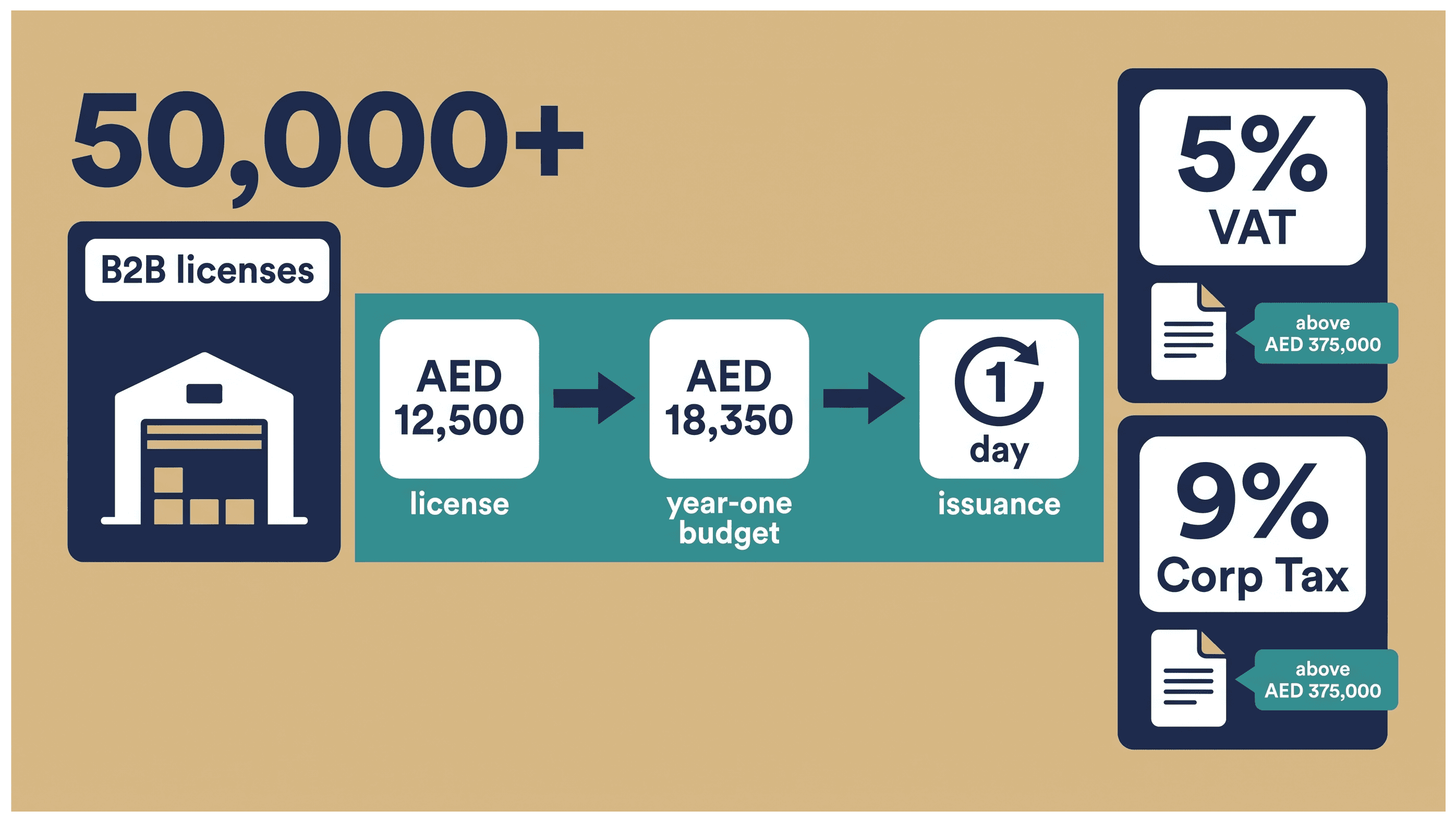
In 2026, Dubai recorded over 50,000 active wholesale and business-to-business trade licenses [1], making it one of the world's most active B2B commerce hubs. A B2B trading license at Dubai South Business Hub starts from AED 12,500 [2], with issuance possible in one business day once documents are complete [3]. A sole founder budgeting for one investor visa should plan from AED 18,350 for year one [4]. VAT applies at 5% on taxable supplies above AED 375,000 [5], and corporate tax at 9% on taxable income above AED 375,000 [6]. Foreign founders account for a growing share of new registrations (Dubai Chamber of Commerce, 2025). Yet many first-time founders still delay their launch because they're unclear on exactly what a B2B trading company setup in Dubai actually requires.
This guide explains what a B2B trading company is under UAE law, why Dubai is a competitive base for wholesale and inter-business trade, and exactly how to complete your B2B trading company setup in Dubai, covering license types, permitted activities, costs, tax obligations, and the practical steps to get trading.
What Is B2B Trading Company Setup in Dubai and Why It Matters
A B2B trading company setup in Dubai involves registering a legal entity licensed to buy and sell goods or services between businesses, not to end consumers. Under ISIC Division 46, this covers wholesale trade, import-export, and distribution. Dubai free zones allow 100% foreign ownership with full profit repatriation.
How B2B Trading Is Defined Under UAE and International Standards
B2B (business-to-business) trading means selling goods or services to other companies, not retail consumers. Under the UN's ISIC Revision 4, B2B wholesale trade falls under Division 46, covering agents, brokers, and wholesale distributors across all product categories. UAE commercial law mirrors this classification closely. A B2B trade license authorises purchasing, importing, storing, and reselling goods to registered business buyers. Permitted activities span commodity trading, manufactured goods distribution, specialist wholesale services, and import-export intermediary operations.
A practical example: a US-based electronics components supplier setting up in Dubai to distribute semiconductor parts to manufacturers across the Gulf and South Asia would be classified under ISIC 4652. UAE free zones permit B2B trading with international counterparties without requiring a local UAE agent.
B2B vs. General Trading: What Your License Actually Covers
A B2B trading license is narrower than a general trading license. It specifies approved product categories and buyer types rather than permitting an unrestricted range of goods. A Dubai South free zone B2B license for industrial equipment allows sales to UAE factories and re-export to GCC buyers, but requires a mainland distributor for retail sales within the UAE. Free zone companies can trade internationally without restriction. Choosing the right license scope from day one avoids costly amendments later. You can explore the full list of business activities in Dubai before applying to confirm your categories are covered.
Why Dubai Is the Right Base for B2B Trading
Dubai offers B2B traders 0% personal income tax, a 9% corporate tax rate on profits above AED 375,000, 100% foreign ownership in free zones, and direct access to over 190 shipping and air freight routes. Its position between Europe, Africa, and Asia makes it a natural wholesale distribution hub. Dubai sits at UTC+4, bridging US, European, and Asian business hours within a single working day. Jebel Ali Port ranks among the world's top 10 container ports by throughput, and Al Maktoum International Airport handles dedicated air freight for high-value B2B cargo. Dubai South free zone companies have direct landside access to both port and airport logistics corridors.
The ownership and tax structure is genuinely competitive for international founders: 0% personal income tax on founder salaries and dividends; 9% corporate tax on taxable profits above AED 375,000; free zone qualifying income may attract a 0% rate where substance and activity conditions are met; 100% foreign ownership with no local sponsor required; full repatriation of capital and profits; and the UAE dirham pegged to USD at 3.6725 since 1997, eliminating currency risk for US-based founders.
Step-by-Step Guide to B2B Trading Company Setup in Dubai
B2B trading company setup in Dubai takes as little as one business day in a free zone once documents are complete. The process covers choosing your jurisdiction, selecting licensed activities, reserving a trade name, submitting incorporation documents, paying license fees, and activating your company, after which you can open a UAE corporate bank account.
Step 1: Choose Your Jurisdiction and License Structure
For most international B2B founders, a free zone license is the faster, lower-cost entry point. Dubai South Business Hub Free Zone suits B2B traders who need proximity to air and sea cargo infrastructure. Free zone licenses start from approximately AED 12,500 per year, and setup typically completes in one business day once documents and payment are confirmed. Confirm that your intended product categories appear on the free zone's approved activity list before applying.
Step 2: Select Your Activities and Reserve a Trade Name
Select the specific wholesale or trading activities that match your business. Activities must align with ISIC-derived classifications used by the UAE licensing authority. The first five activities are included in the base license fee; each additional activity beyond five costs AED 2,000. Before submission, check your trade name availability to confirm your chosen name isn't already registered and meets UAE naming conventions.
Step 3: Submit Documents, Pay Fees, and Receive Your License
Standard documents include passport copies of all shareholders and directors, a visa or entry stamp copy, proof of address, and a completed application form. No paid-up share capital deposit is required before trading begins. A registered office address confirmation is also required; a flexi-desk satisfies this requirement. Controlled product categories may extend timelines due to secondary regulator approvals.
Step 4: Open a Corporate Bank Account and Activate Operations
A UAE corporate bank account is essential for receiving B2B payments, paying suppliers, and managing VAT obligations. Banks require your trade license, certificate of incorporation, shareholder documents, and a business plan as a minimum KYC pack. Account opening typically takes 2–6 weeks. Multi-currency accounts are widely available for import-export businesses. You can learn more about bank account opening in Dubai through Dubai South Business Hub's banking and taxation support service.
Permitted Activities and Tax Obligations
A Dubai B2B trading license permits wholesale buying, selling, importing, exporting, and distributing goods between registered businesses. Common permitted activities include general merchandise wholesale, commodity trading, industrial equipment supply, electronics distribution, food and beverage wholesale, and chemical or pharmaceutical product trading, subject to sector-specific approvals. Certain goods require pre-approval from UAE sector regulators: pharmaceuticals and medical devices require MOHAP approval; food products require Dubai Municipality clearance; and financial intermediation products require Central Bank of UAE authorisation.
B2B trading companies in Dubai are subject to 9% UAE corporate tax on taxable profits above AED 375,000 (Federal Decree-Law No. 47 of 2022). Profits below AED 375,000 are taxed at 0%. VAT at 5% applies to most UAE B2B transactions, with mandatory registration required once annual taxable turnover exceeds AED 375,000. Exports outside the GCC are typically zero-rated for VAT purposes. There is no personal income tax on founder or employee salaries, and no withholding tax on dividends or profit distributions. Late corporate tax registration carries a one-time AED 10,000 penalty.
References
Frequently Asked Questions