
Topic Summary
Bookkeeping Licenses Start From AED 12,500
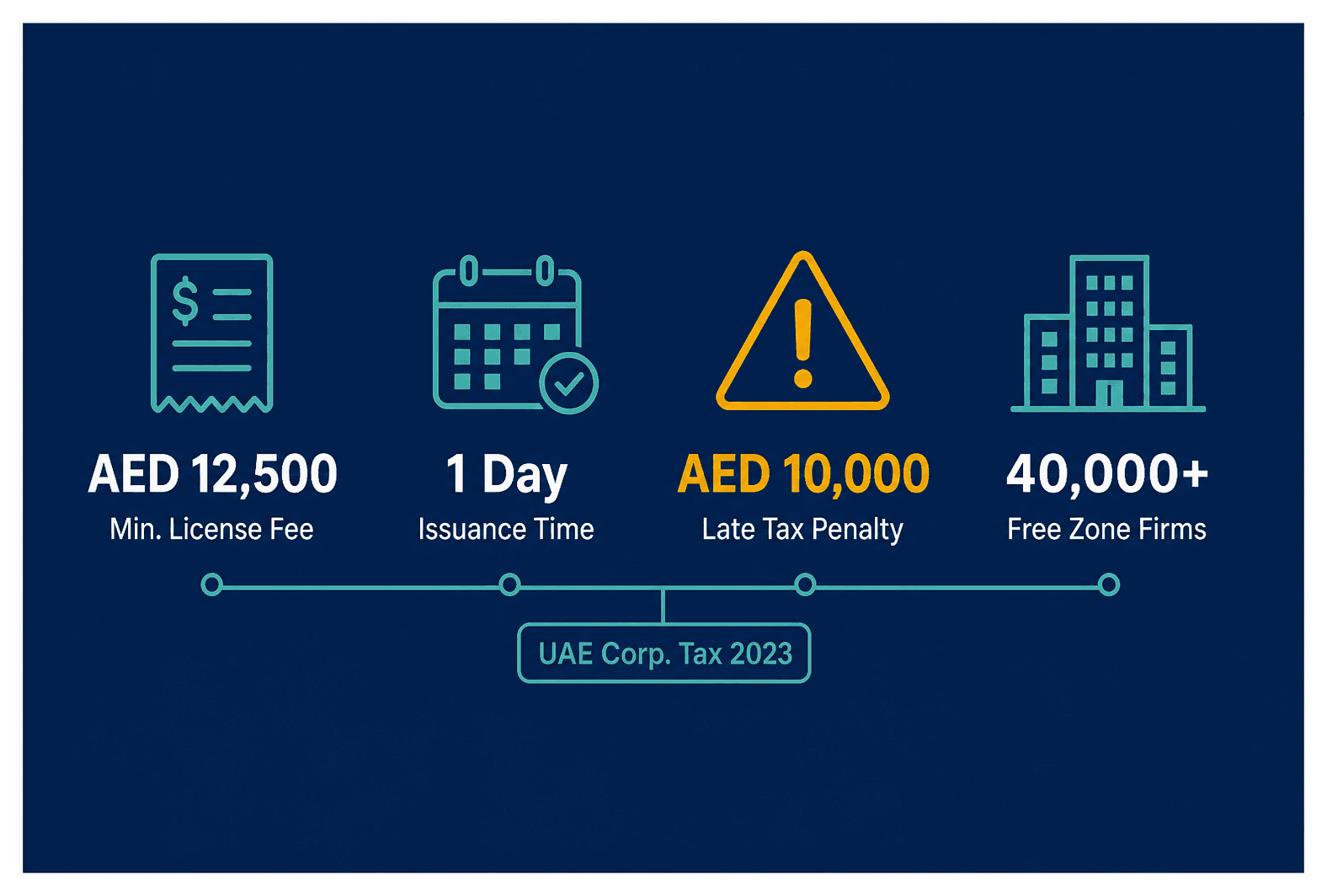
Dubai South Business Hub offers a bookkeeping business license from AED 12,500 with zero paid-up share capital and one-day issuance. A sole founder budgeting for one investor visa should plan for around AED 18,350 in total first-year costs.
Bookkeeping Is Legally Distinct From Auditing
A bookkeeping license covers transaction recording, bank reconciliations, payroll, and ledger maintenance — not statutory audit sign-offs. Audit and assurance work requires separate registration with the UAE Ministry of Economy under the Accountants and Auditors Law.
Corporate Tax Law Created a Structural Market Shift
Federal Decree-Law No. 47 of 2022 requires most UAE businesses to maintain auditable financial records and file corporate tax returns. This regulation created a recurring, large-scale demand for licensed bookkeeping services that did not exist before 2023.
Late Tax Registration Carries a Flat AED 10,000 Penalty
Both late VAT registration and late corporate tax registration each attract a flat AED 10,000 penalty from the UAE Federal Tax Authority. This makes properly licensed bookkeepers a practical necessity for clients, not an optional expense.
Free Zones Offer 100% Foreign Ownership
Free zone licenses are well-suited for bookkeeping firms targeting international or free zone clients, with the key advantage of full foreign ownership. Choosing the right jurisdiction between mainland and free zone depends on your target client base and service model.
ISIC Classification Guides Your Activity Selection
Bookkeeping falls under ISIC Revision 4, Division 69, Class 6920, which also covers tax consulting and payroll services. UAE trade license activity lists map closely to this classification, making it a reliable reference when registering your permitted activities.
In 2026, Dubai hosts more than 40,000 active free zone companies, and demand for licensed bookkeeping firms has risen sharply since the UAE's corporate tax regime launched in June 2023 (u.ae, 2023). A bookkeeping business license in Dubai starts from AED 12,500 at Dubai South Business Hub (DSBH), with zero paid-up share capital and one-day issuance. A sole founder with one investor visa should budget from AED 18,350 for the first year. Late VAT or corporate tax registration each carry a flat AED 10,000 penalty (tax.gov.ae), making properly licensed bookkeepers a necessity for their clients, not a luxury. Federal Decree-Law No. 47 of 2022 now requires most UAE businesses to maintain auditable financial records. That single regulatory shift created a structural, recurring market for bookkeeping services across every sector.
This guide walks you through exactly what a bookkeeping business license in Dubai covers, which jurisdiction suits your model, the step-by-step setup process, a full cost breakdown separating one-off from recurring fees, and the compliance rules you need to know before you open your doors.
What Is a Bookkeeping Business License in Dubai and Why It Matters
A bookkeeping business license in Dubai is an official commercial permit authorising a company to provide financial record-keeping, accounts preparation, and related advisory services to clients. It is issued by a free zone authority or DET and, for certain regulated functions, requires a separate approval from the relevant financial regulator. Getting this license right from day one matters: corporate clients and banks expect a properly licensed firm, not an informal arrangement.
Defining the Activity: Bookkeeping vs. Accounting vs. Auditing
Bookkeeping covers day-to-day transaction recording, bank reconciliations, payroll processing, and ledger maintenance. It's distinct from full audit or assurance work, and that distinction has real licensing consequences.
Audit and assurance services require registration with the UAE Ministry of Economy under the Accountants and Auditors Law. A bookkeeping business license in Dubai does not carry that same mandatory registration for non-audit work. You're licensed for the recording and reporting layer, not the statutory audit sign-off layer.
Under ISIC Revision 4, bookkeeping falls within Division 69 (Legal and accounting activities), Class 6920, which also covers tax consulting (excluding legal representation) and payroll services. UAE trade license activity lists map closely to this classification, so it's a useful reference when selecting your activities.
A sole founder offering monthly management accounts and VAT return preparation for SME clients needs a bookkeeping license, not an audit license. That's the practical test: if you're not signing off statutory audits, you don't need audit registration.
Why the UAE Corporate Tax Regime Makes This License More Valuable Now
Federal Decree-Law No. 47 of 2022 requires most UAE businesses to maintain auditable financial records and file corporate tax returns. That's not optional, and it's not temporary. It creates a structural, ongoing demand for bookkeeping services that didn't exist at this scale before 2023.
Two penalties are worth flagging for your prospective clients:
Late corporate tax registration: AED 10,000 one-time flat penalty (tax.gov.ae)
Late VAT registration: AED 10,000 penalty (tax.gov.ae)
A Dubai-based e-commerce brand with AED 2 million in annual revenue now needs monthly bookkeeping to support its corporate tax filing. That's a recurring contract worth more than the entire first-year setup cost of your bookkeeping firm. For more on related licensing in the financial services space, see the financial services business license in Dubai guide.
Mainland vs. Free Zone: Choosing the Right Jurisdiction for Your Bookkeeping Business
Free zone licenses suit bookkeeping firms targeting international or free zone clients and offer 100% foreign ownership and faster issuance. Mainland licenses issued by DET allow unrestricted client access across the UAE. Both structures now permit 100% foreign ownership; the choice turns on your target client base and cost profile.
Free Zone Advantages for Bookkeeping Firms
DSBH, launched September 2025, issues a bookkeeping business license in Dubai in one business day. The license starts from AED 12,500, with zero paid-up share capital required. A UK-based accountant relocating to Dubai and serving regional SME clients can be operational faster here than through almost any other route.
A few points worth being clear about:
100% foreign ownership is available on both the mainland and in free zones under current UAE company law. It's not exclusive to free zones.
DSBH is not a designated zone and receives no designated-zone customs or VAT benefit. Bookkeeping firms based there operate under standard UAE VAT rules.
Free zone goods are duty-suspended within the zone, not duty-exempt. For a pure-service bookkeeping firm, this distinction rarely applies.
A free zone license does not prevent you from serving mainland clients. Structure your engagements carefully, but the client base is not restricted.
Mainland Considerations Under DET
DET (Department of Economy and Tourism) issues mainland professional licenses for bookkeeping and accounting activities. Mainland firms can contract directly with any UAE-based client without jurisdictional restrictions, which matters if you're targeting Dubai government entities or large mainland corporates.
Regulated bookkeeping or accounting activities on the mainland may require additional approvals from the UAE Ministry of Economy under the Accountants and Auditors regulatory framework (moet.gov.ae). Bookkeeping-only firms have a lighter regulatory footprint than audit firms, but confirm your specific activity list before applying. Use the business setup cost calculator to compare mainland and free zone cost profiles side by side.
How to Set Up a Bookkeeping Business License in Dubai: Step-by-Step
Setting up a bookkeeping business license in Dubai involves five core steps: selecting your jurisdiction, reserving your trade name, choosing your business activities, submitting your application with supporting documents, and receiving your license. At DSBH, the entire process can be completed in one business day with zero paid-up share capital.
Step 1: Choose Your Jurisdiction and Legal Structure
Decide between DSBH (free zone) and DET (mainland) based on your client base, budget, and how quickly you need to be operational. For a sole founder, DSBH requires no paid-up share capital and allows a single shareholder. That's a meaningful difference from many traditional setups.
Before you commit, confirm whether your planned activities include any regulated financial services requiring Central Bank of the UAE or Ministry of Economy approval. Pure bookkeeping and management accounts preparation typically don't trigger those requirements, but payment processing or investment advisory would.
Step 2: Reserve Your Trade Name and Select Business Activities
Your trade name must comply with UAE naming conventions: no offensive terms, no references to political or religious bodies, and no names already registered. Run a trade name availability check before submitting your application.
Activity selection is where many first-time founders lose money. Common selections for a bookkeeping business license in Dubai include:
Bookkeeping and ledger maintenance
Payroll processing
Management accounts preparation
VAT return advisory
Financial reporting
At DSBH, the first five activities are covered within the base license fee. Each activity beyond five costs an additional AED 2,000. A founder planning to offer bookkeeping, payroll, VAT filing, management reporting, and financial advisory covers all five within the base fee. Plan your business activities list carefully before applying.
Step 3: Submit Documents and Receive Your License
The standard document checklist is straightforward:
Passport copy of each shareholder and director
Proposed trade name
Selected business activities
Completed application form
No physical office is required for certain DSBH license packages. Confirm flexi-desk or virtual office options when you apply. Once documents are verified, DSBH issues the license in one business day.
After license issuance, apply for visas separately. Visas are always an additional cost and are never included in the license fee. For any regulated financial activity, DSBH licenses the activity and the named regulator (for example, the Central Bank of the UAE for payment services) approves it separately.
Bookkeeping Business License Dubai: One-Off vs. Recurring Costs
Cost Item | One-Off Costs (Year 1 Only) | Recurring Costs (Annual or Per Visa Cycle) |
|---|---|---|
License fee | From AED 12,500 at setup | Annual renewal fee (UNVERIFIED: confirm current renewal figure before publishing) |
Establishment card / share certificate | Paid once at setup; not repeated annually | Visa renewal required every 2-3 years per person |
Investor visa package | Approx. AED 5,850 for one visa (included in AED 18,350 first-year total) | Mandatory health insurance: AED 700-AED 2,500 per visa holder per year |
Additional business activities | AED 2,000 per activity beyond the first five (one-time per activity added) | Accounting software: AED 200-AED 800/month (Xero, QuickBooks, or Zoho Books) |
Not included in quoted prices | Bank minimum balance (AED 10,000-AED 50,000), professional indemnity insurance, Emirates ID, medical screening | VAT filing costs, corporate tax filing fees, regulator approval fees for regulated activities |
Bookkeeping Business License Dubai: Full Cost Breakdown
A bookkeeping business license in Dubai starts from AED 12,500 at DSBH. A sole founder with one visa should budget from AED 18,350 for the first year. This covers the license and one investor visa package; bank account opening fees, professional indemnity insurance, and compliance costs are separate.
One-Off vs. Recurring Costs at a Glance
A sole founder setting up a bookkeeping firm at DSBH in 2025 pays AED 12,500 for the license and approximately AED 5,850 for one investor visa package, landing at AED 18,350 total for year one before optional add-ons. Zero paid-up share capital is required, which keeps the initial outlay lean.
What is not included in DSBH quoted prices:
Visa medical tests and Emirates ID fees
Mandatory health insurance for each visa holder
Professional indemnity insurance
VAT registration and quarterly filing costs (if applicable)
Corporate tax filing fees
Regulator approval fees for any regulated financial activities
DSBH does not provide bonded warehousing or customs integration. That's not relevant to a pure bookkeeping services firm, but worth confirming if any physical document storage or import activity is planned. Use the company setup cost calculator to model your exact first-year spend.
Hidden Costs First-Time Founders Overlook
Health insurance: Mandatory for each visa holder. Budget AED 700 to AED 2,500 per person per year depending on provider and plan.
Professional indemnity insurance: Strongly recommended for bookkeeping firms advising on VAT and corporate tax. Typically AED 1,500 to AED 5,000 annually depending on coverage limit.
Accounting software: Xero, QuickBooks, or Zoho Books range from AED 200 to AED 800 per month.
Bank account minimum balance: UAE banks generally require AED 10,000 to AED 50,000 depending on the bank. No setup fee, but the balance requirement ties up capital. See the guide to bank account opening in Dubai for current options.
VAT registration: Mandatory once taxable turnover exceeds AED 375,000; voluntary registration available from AED 187,500 (tax.gov.ae). Budget for quarterly filing costs from day one.
VAT, Corporate Tax, and Compliance Obligations for Your Bookkeeping Firm
A licensed bookkeeping firm in Dubai must register for VAT once taxable turnover exceeds AED 375,000, and must comply with UAE corporate tax rules if annual net profit exceeds AED 375,000. Firms handling client funds or offering payment services need separate Central Bank of the UAE approval; standard bookkeeping does not require this.
Corporate Tax: What the 9% Rate Means for Your Firm
The UAE corporate tax rate is 9% on taxable income above AED 375,000. Income at or below that threshold is taxed at 0%. Don't describe your structure as "tax-free", that's inaccurate and potentially misleading to clients.
To benefit from Qualifying Free Zone Person (QFZP) status and the 0% rate on qualifying income, a free zone company must meet four conditions: maintain adequate substance in the free zone, earn qualifying income, not elect to be subject to standard corporate tax, and meet transfer pricing and de minimis requirements. All four must be satisfied. Meeting three out of four doesn't qualify you.
Register for corporate tax on time regardless of whether you believe your income falls below the threshold. Late registration carries a one-time flat penalty of AED 10,000 (tax.gov.ae). That's a straightforward cost to avoid.
AML/CFT Obligations for Bookkeeping and Accounting Firms
The UAE Ministry of Economy has designated certain Designated Non-Financial Businesses and Professions (DNFBPs), which include accountants and bookkeepers providing specific services, as subject to Anti-Money Laundering and Counter-Financing of Terrorism (AML/CFT) obligations (moet.gov.ae).
If your bookkeeping firm prepares or executes transactions involving real estate, manages client funds, or provides company formation services, you likely fall under DNFBP rules. You'll need to register with the Ministry of Economy's goAML platform, which is the mandatory reporting system for DNFBPs in the UAE. Non-compliance can result in significant penalties. Confirm your obligations before you accept your first client.
Do bookkeeping firms in Dubai need Central Bank approval?
Standard bookkeeping, management accounts, and VAT return preparation do not require Central Bank of the UAE approval. Central Bank approval is required only for regulated financial activities such as payment processing, investment advisory, or money services. If you add those activities, DSBH licenses the activity and the Central Bank approves it separately.
Scaling Your Bookkeeping Business in Dubai: Visas, Office, and Growth
A free zone bookkeeping license at DSBH includes the ability to sponsor employee and investor visas as add-on packages. Visas are always an additional cost. As your client base grows, you can add staff visas, upgrade your office arrangement, and expand your licensed activities, each beyond five costs AED 2,000.
Visa Allocation and Residency for Founders and Staff
Visas are always an additional cost. They are never included in the license fee.
A sole founder typically applies for one investor visa. Each additional employee requires a separate employment visa.
The UAE investor visa grants a two- or three-year residency permit linked to your company license.
Emirates ID and mandatory medical screening are required for each applicant and are not included in visa package quotes.
The first-year cost for a sole founder with one visa starts from AED 18,350. Visa renewals are required every two to three years. For full details on the residency process, see UAE residency visa services at DSBH.
References
Frequently Asked Questions