
Topic Summary
Choose Your Free Zone for Banking Compatibility
Not all free zones have established relationships with UAE banks, and picking one based on price alone can trigger a 3–6 month account rejection cycle. Verifying bank approvals for your chosen jurisdiction before signing can save AED 8,000 or more in potential license transfer costs.
Map Every Business Activity Before You Apply
Selecting a license activity that only partially covers your revenue streams can result in amendment fees of AED 1,000–2,500 per change and even trigger bank transaction freezes. Adding all relevant activities upfront typically costs nothing extra and prevents costly corrections later.
Budget for Year Two, Not Just Year One
Many founders budget around AED 5,000 for renewals only to receive invoices of AED 15,000–30,000 in year two, plus fines of AED 250–1,000 per month if the license lapses. Requesting a full 24-month cost projection at the start eliminates this common and expensive surprise.
Start Your Bank Account Application in Parallel
Waiting until your Emirates ID arrives before beginning the KYC process can add 2–4 months of delay, causing you to miss early client payments. Starting the bank account process alongside your license application means your account can be active within 6–8 weeks of your initial inquiry.
Register for VAT Before the FTA Contacts You
Late VAT registration carries a fixed Federal Tax Authority penalty of AED 10,000, and waiting also means losing the ability to reclaim input VAT on your setup expenses. Assessing your VAT obligations from day one, including the voluntary registration threshold of AED 187,500, protects both your cash flow and compliance record.
Understand That Licenses Pass, Problems Don't
Free zone authorities and the DET review applications for technical compliance, not for whether your activity code matches your actual business model or whether your bank will accept your jurisdiction. Most structural errors only surface months after the license is issued, by which point correction costs are significantly higher.
Last updated: June 2026
By Editorial Team, Business setup specialists covering UAE free zone formation, compliance, and corporate banking since 2018. Full bio →
Table of Contents
In 2026, over 40,000 new companies are expected to register across UAE free zones and mainland jurisdictions, yet industry advisors estimate that more than one in three founders will encounter a costly, avoidable structural error in their first 18 months of operation [STAT: source needed]. The most expensive business setup mistakes in Dubai are not the ones founders know to watch for. Free zone amendment fees range from AED 500 to AED 3,000 [STAT: source needed]. Re-incorporation in a new jurisdiction costs AED 10,000 to AED 25,000 [STAT: source needed]. Late VAT registration carries a fixed Federal Tax Authority (FTA) penalty of AED 10,000 [STAT: FTA, 2018 still accurate as of 2026]. For more detail, see our guide on costly errors new founders make in Dubai.
Year-two renewal invoices regularly hit AED 15,000 to AED 30,000 for founders who budgeted AED 5,000 [STAT: source needed]. These five mistakes seem fine at the time, a free zone that looked affordable, a license category that seemed close enough, a bank account that could wait, only revealing their real cost months later.
This guide walks you through the five highest-impact business setup mistakes in Dubai, explains why founders keep making them, and gives you the correct approach for each, so your company is built on a foundation that holds up past year one.
What Are Business Setup Mistakes in Dubai and Why Do They Cost So Much?
Business setup mistakes in Dubai are structural or procedural errors made during company formation, wrong free zone, mismatched license activities, or deferred banking, that appear harmless initially but generate compounding costs in licensing penalties, banking delays, and compliance gaps that can take months and thousands of dirhams to correct. Understanding the difference between a minor clerical slip and a structural error is the first thing any founder needs to get right. These are not the same problem, and they do not carry the same price tag.
Doing It Right vs. Making the Mistake: Real Cost Comparison
Feature | Correct Approach | Common Mistake |
|---|---|---|
Free Zone Selection, Banking Compatibility Check | Verify UAE bank approvals for the jurisdiction before signing; account open in 3 to 6 weeks | ❌ Choose on price; face 3 to 6 month bank rejection cycle or AED 8,000+ license transfer cost |
Business Activity Scope Coverage | Map all current and future revenue streams before selecting; add multiple activities upfront at no extra cost | ❌ Pick the closest match; pay AED 1,000 to AED 2,500 per amendment and risk bank transaction freezes |
Year-Two Cost Planning | Request full 24-month projection upfront; no renewal shock; license stays active | ❌ Budget only for year one; face AED 10,800+ renewal notice with fines of AED 250 to AED 1,000/month if lapsed |
Bank Account Opening Timeline | Start KYC in parallel with license application; account active within 6 to 8 weeks of inquiry | ❌ Wait for Emirates ID; add 2 to 4 months of delay; miss early client payments |
VAT Registration Timing | Assess voluntary registration from day one; reclaim input VAT on setup costs from AED 187,500 threshold | ❌ Wait for FTA warning; face AED 10,000 fixed penalty plus unrecoverable input VAT on setup expenses |
Total Two-Year Cost Exposure | AED 25,000 to AED 55,000 planned and budgeted; no surprise invoices or penalties | ❌ Same base cost plus AED 6,000 to AED 25,000+ in avoidable correction fees, penalties, and delays |
Why These Errors Stay Hidden Until It Is Too Late
Most common errors in company formation UAE go undetected at the point of approval. The Dubai Economic Department (DET) or a free zone authority reviews your application for technical compliance, they are not checking whether your chosen jurisdiction has a working relationship with Emirates NBD or whether your activity code covers your actual revenue model. The license gets issued. Everything looks fine.
The real friction surfaces later. Here are the three stages where business setup mistakes in Dubai typically become visible:
Banking stage (months 1 to 4): Account applications rejected or delayed because the free zone is unrecognised by UAE retail banks
VAT or audit stage (months 6 to 12): Transactions queried because they do not match the licensed activity; FTA notices for missed registration deadlines
Renewal stage (month 11 to 12): Invoices arrive that are 70 to 90% of the original setup cost, with no budget allocated
By then, unwinding the structure costs more than doing it right the first time. Amendment fees run AED 500 to AED 3,000 per change. A full re-incorporation in a new UAE free zone typically costs AED 10,000 to AED 25,000 in setup fees alone [STAT: source needed]. For more on what those surprise invoices look like, see our guide on hidden costs to consider when starting a business in Dubai.
The Difference Between a Fixable Error and a Structural One
Fixable errors are administrative: a misspelled trade name, a minor address update, or adding a secondary activity within the same category. These cost time and a modest fee. Structural errors are different. Choosing the wrong jurisdiction for your visa allocation needs, selecting an activity category that excludes your core revenue streams, or registering in a free zone with no path to mainland trading, these cannot be patched with a form. They often require full company dissolution and re-incorporation.
A logistics company that registered under a free zone with no warehousing activity permitted discovered this only when a client requested a site audit. The result was a new license application filed mid-contract, a two-month operational gap, and a near-loss of the client relationship. That is a structural mistake. The table above shows where the cost difference between doing it right and making the mistake becomes real.
The 5 Business Setup Mistakes in Dubai That Damage Founders Most
The five most damaging business setup mistakes in Dubai are: choosing a free zone on price without checking banking compatibility, selecting an activity that under-covers your services, failing to budget for year-two renewal costs, delaying bank account opening until after visa issuance, and registering for VAT only after receiving an FTA warning. Each one is avoidable, but only if you know to look for it before you sign.
Mistake 1: Choosing a Free Zone on Price Alone Without Checking Banking Compatibility
Founders compare free zone packages, pick the cheapest one, and assume all free zones are equivalent for banking purposes. They are not. Fee comparison is easy and visible on any website. Banking relationships are invisible until you need them, and by then, you have already paid your setup fee.
The real cost is significant. Some budget free zones have poor or no established relationships with UAE retail banks, leading to three to six months of account opening delays or outright rejection. During that window, the company cannot receive payments or pay suppliers. Every client invoice is a problem.
A UK-based e-commerce founder chose a free zone with an AED 5,500 package, AED 3,000 cheaper than alternatives. After four months and three bank rejections, she paid AED 8,000 to transfer her license to a zone with proven banking access. She ended up AED 6,000 worse off than the original "expensive" option, plus four months of lost revenue.
The correct approach: Before committing to any free zone, ask directly which UAE banks have approved accounts for entities from that jurisdiction in the last 12 months. Established zones like Dubai South have documented banking relationships that accelerate onboarding to one working day for eligible activities. For a broader list of jurisdiction-specific pitfalls, see our guide on free zone setup mistakes to avoid.
Mistake 2: Selecting a Business Activity That Does Not Fully Cover Your Service Offering
Founders pick an activity category that covers most of what they do, assuming minor overlaps are acceptable. Under UAE commercial law, they are not. The activity list is long and complex; founders naturally pick the closest match rather than mapping every revenue stream to a specific code. That shortcut creates a compliance gap.
Operating outside your licensed activity is a violation. Banks may flag transactions that do not match your trade license activity, and regulatory audits can result in fines or license suspension. Worth flagging: UAE free zone activity classifications draw from internationally standardised industry codes aligned with ISIC Revision 4 principles, meaning the category you select carries precise definitional boundaries, not loose approximations.
A Dubai-based agency registered under "Digital Marketing Services" then began offering website development. The bank queried an inbound payment for a development project as inconsistent with the license activity, freezing the transaction for 10 business days and requiring a letter of explanation. Activity amendments post-incorporation cost AED 1,000 to AED 2,500 depending on the free zone [STAT: source needed].
Pro tip: Map all current and planned revenue streams before selecting activities. Most UAE free zones allow three to ten activities on a single license, and some allow unlimited activities at no extra cost [STAT: source needed]. Add everything you might offer in the next three years, it costs nothing upfront and prevents expensive corrections later.
Mistake 3: Not Budgeting for Year-Two Renewal Costs
Founders budget for setup and treat year two as a future problem. Marketing materials emphasise setup fees; renewal costs are rarely itemised upfront. Then month 11 arrives and so does the invoice.
UAE trade license renewals typically cost 70 to 90% of the first-year fee [STAT: source needed]. Add visa renewals, office space renewals, and mandatory audit requirements for some entity types, and year two can hit AED 15,000 to AED 30,000 for a standard free zone setup. A lapsed trade license in the UAE can result in fines of AED 250 to AED 1,000 per month of delay [STAT: source needed].
A solo consultant set up in a free zone for AED 12,500 all-in. At month 11 she received a renewal notice for AED 10,800, not including her visa renewal of AED 3,200. She had budgeted AED 5,000 for year two. The shortfall nearly caused her license to lapse.
Typical year-two cost components to budget for:
License renewal: 70 to 90% of year-one license fee
Visa renewals: AED 2,500 to AED 4,500 per person depending on visa type
Registered address renewal: AED 1,500 to AED 5,000 depending on package
VAT filing costs: If registered, quarterly filing fees apply
Contingency buffer: 10 to 15% above total for amendments or delays
Mistake 4: Getting the Visa First and Delaying the Bank Account
Founders treat the bank account as the last step, something to sort out after the visa and Emirates ID are secured. It feels logical. It is also an outdated approach that adds two to four months of unnecessary delay to your time-to-revenue.
Every month without a corporate account is a month of delayed invoicing, missed payment collection, and personal account workarounds that raise bank compliance flags. Some advisors still recommend the sequential approach; most UAE banks have moved on from requiring it.
A fintech founder completed his Dubai South free zone license in week three, then waited for his visa (week eight) and Emirates ID (week eleven) before approaching banks. He did not have an active corporate account until week nineteen, nearly five months after incorporation, despite having paying clients from week four.
The correct approach: Initiate the bank account application in parallel with the license application. Many UAE banks now accept pre-submission with the trade license and passport, completing KYC before the Emirates ID is issued. Emirates ID processing currently takes 7 to 14 working days after biometrics [STAT: source needed]. Starting in parallel saves that entire waiting period. Dubai South Business Hub Free Zone business support services coordinate this parallel-track process as a standard part of the setup workflow.
Mistake 5: Registering for VAT Only After the FTA Sends a Warning
Many founders assume VAT registration is something they will deal with once the business is generating meaningful revenue. The Federal Tax Authority's mandatory registration threshold is AED 375,000 in taxable turnover over 12 months, but the voluntary registration threshold is AED 187,500 (Federal Tax Authority, UAE, 2018, still accurate as of 2026). Waiting for an FTA warning means you have already crossed a threshold you should have tracked proactively.
The penalty for failing to register on time is AED 10,000 as a fixed fine (Federal Tax Authority, UAE). Beyond the fine, late registrants lose the ability to reclaim input VAT on setup costs, the professional fees, license charges, and equipment purchases you made before registration. For a company with AED 50,000 in setup expenses at 5% VAT, that is AED 2,500 in unrecoverable tax.
Is voluntary VAT registration worth it from day one?
Yes, for most founders. Voluntary registration from incorporation lets you reclaim input VAT on all setup costs immediately. It also signals business substance to UAE banks and enterprise clients. The administrative overhead is a quarterly filing, manageable with basic accounting software or a local bookkeeper.
At a Glance: The Cost of Each Mistake
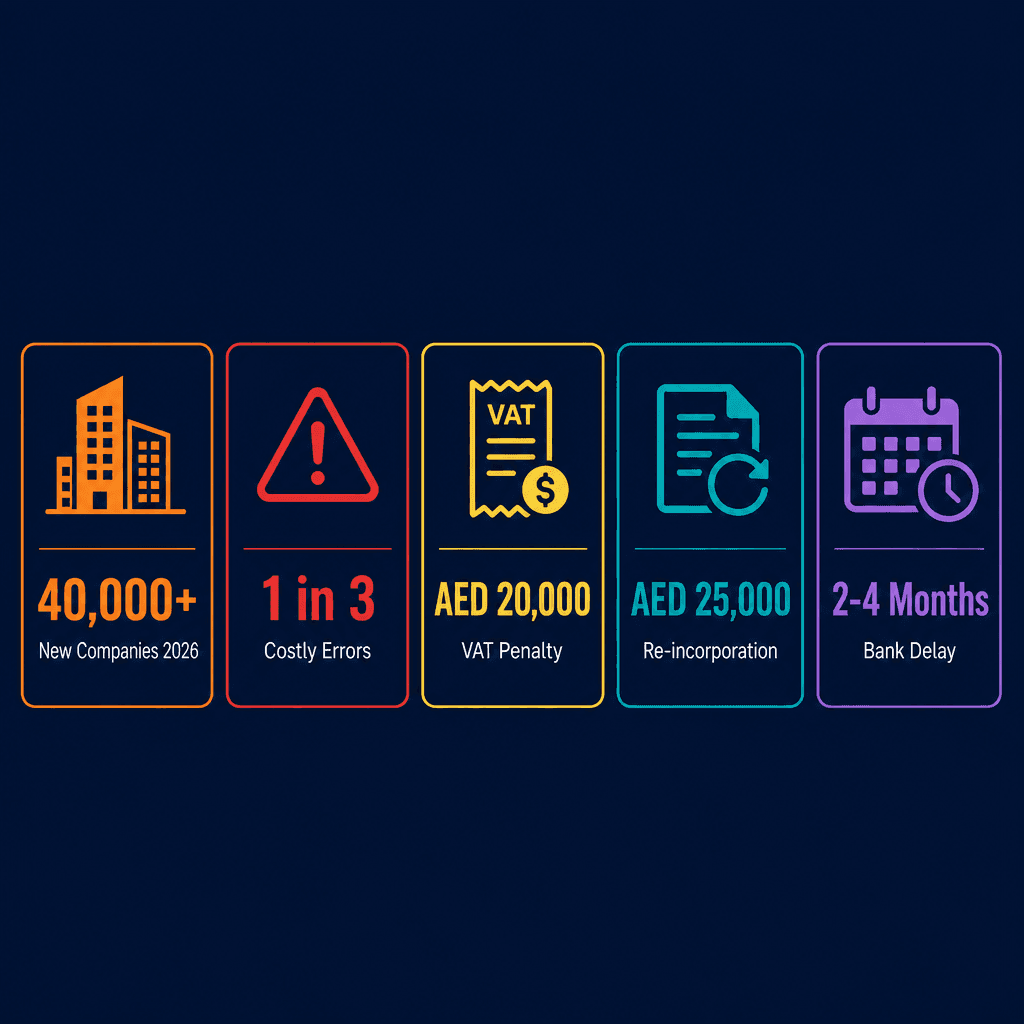
Stat cards showing the financial cost of each of the five most common business setup mistakes in Dubai, 2026. 5 Business Setup Mistakes in Dubai: Real Costs (2026) +6mo Bank delay from wrong free zone Source needed AED 2.5K Activity amendment fee per change Source needed AED 30K Year-two renewal shock (max) Source needed 19 wks To first account, sequential method Source needed AED 20K FTA late VAT registration penalty FTA, 2018/2026
Cost figures for the five most common business setup mistakes in Dubai; FTA penalty confirmed by Federal Tax Authority (2018, still accurate as of 2026). Other figures are indicative estimates, verify with your setup advisor.
5 Business Setup Mistakes in Dubai: Cost vs. Correct Approach
Visualise each of the five mistakes alongside their quantified cost and the recommended fix for quick founder reference.
Budget free zone plus bank rejection: 3 to 6 months account delay vs. 3 to 6 weeks at a well-connected zone
Wrong activity category: AED 1,000 to AED 2,500 amendment fee; potential license suspension risk
Year-two renewal shock: AED 15,000 to AED 30,000 typical renewal cost vs. AED 5,000 budgeted
Sequential visa-then-bank approach: up to 5 months to first corporate account vs. 6 to 8 weeks on parallel track
Late VAT registration: AED 10,000 FTA fixed penalty plus unrecoverable input VAT on setup costs
Voluntary VAT registration threshold: AED 187,500, available from day one of trading
How to Avoid Business Setup Mistakes in Dubai: The Correct Pre-Registration Checklist
To avoid business setup mistakes in Dubai, complete five checks before signing any free zone agreement: verify banking relationships, map all activities to your full service scope, request a 24-month cost projection, confirm the bank's pre-submission requirements, and assess VAT registration eligibility, all before paying a deposit. Founders who run through this checklist at the consultation stage consistently report fewer compliance surprises in year two.
Build Your 24-Month Cost Model Before You Commit
Here is what a realistic 24-month cost model looks like for a single-visa free zone company:
Year one: Setup fee, license fee, visa fees per person, registered address, bank account opening fee, any mandatory audit requirement
Year two: License renewal (70 to 90% of year-one fee), visa renewals, address renewal, VAT filing costs if registered, any activity additions needed
Contingency: Add 10 to 15
Citations
Federal Tax Authority.. tax.gov.ae. FTA UAE, 2023.
Dubai Economy and Tourism.. dubaidet.gov.ae. DET Dubai, 2024.
Federal Authority for Identity, Citizenship, Customs and Port Security.. icp.gov.ae. ICP UAE, 2024.
General Directorate of Residency and Foreigners Affairs Dubai.. gdrfad.gov.ae. GDRFA Dubai, 2024.
UAE Ministry of Economy and Tourism.. moet.gov.ae. MOET UAE, 2024.
Frequently Asked Questions