
Topic Summary
Voluntary Exit: Use Right of First Refusal
When a shareholder chooses to leave, a right of first refusal gives remaining shareholders the first opportunity to purchase the stake before it goes to outsiders. Pairing this with a fixed formula or independent valuation at the seller's election removes the need for tense renegotiation at the moment of departure.
Death: Fund the Buyout With Insurance
A mandatory buyout obligation triggered by a shareholder's death protects the company from an inherited stake landing with an uninvolved party. Insurance-backed funding ensures surviving shareholders can meet the purchase price without draining company cash flow at an already difficult time.
Long-Term Incapacity: Set a Clear Time Threshold
Triggering a buyout option after six consecutive months of incapacity gives the company a defined point to act rather than waiting indefinitely. An independent valuation conducted at the trigger date keeps the price fair and removes any incentive to delay or accelerate the process.
Divorce: Protect Against Non-Operational Shareholders
A drag-along obligation on any incoming spouse prevents a divorcing shareholder's equity from passing to someone with no operational role in the business. A fixed valuation formula avoids protracted disputes with a party who has no baseline understanding of the company's worth.
Personal Bankruptcy: Act Before the Trustee Does
A mandatory buyout at fair market value, triggered before a bankruptcy trustee can offer shares externally, keeps ownership within the existing shareholder group. Without this clause, a trustee could legally transfer equity to a third party the remaining shareholders have no say in accepting.
Deadlock: Use a Shotgun Clause or Arbitration
When shareholders reach an irresolvable impasse, a shotgun clause or independent chair arbitration after a defined period, typically 60 days, forces a resolution rather than letting the company stall indefinitely. Pre-agreeing the mechanism removes the temptation for either party to weaponise the deadlock.
Free Zone Rules Override General UAE Company Law
Most UAE free zone companies fall under their specific authority's regulations rather than the UAE Commercial Companies Law, meaning share transfer rules vary significantly by jurisdiction. Any buy sell agreement must be drafted in alignment with the relevant free zone authority's requirements to be enforceable and registrable.
Over 60% of early-stage UAE ventures had no documented exit mechanism between co-founders at the time of their first shareholder dispute (Magnitt, 2024). Free zone share transfers can stall indefinitely without an agreed valuation. Bank mandates can freeze within weeks of a trigger event. Regulatory scrutiny from the free zone authority follows quickly. And yet most co-founded companies in the UAE operate without a buy sell agreement in place until a crisis forces the conversation. This article explains what a buy sell agreement UAE does, walks through every major trigger event and the valuation mechanism best suited to each, covers how buyouts are funded, and sets out exactly what your free zone authority needs to register the resulting share transfer, so you can build a shareholder exit agreement UAE that actually works when you need it.
What Is a Buy Sell Agreement UAE and Why Every Co-Founded Company Needs One
A buy sell agreement UAE is a legally binding contract between shareholders that pre-determines what happens to a shareholding when a defined trigger event occurs. It sets the valuation method, the buyer, and the timeline in advance, so the company does not stall and operations continue without interruption when one partner exits.
The Core Function: Removing Ambiguity Before It Becomes a Crisis
Without a buy sell agreement UAE, a departing shareholder's stake has no agreed buyer, price, or timetable. The company can be paralysed for months while the remaining shareholders try to negotiate terms under pressure, exactly the worst conditions for a fair deal.
The agreement answers three questions in advance: who buys, at what price, and on what timeline. Two co-founders of a Dubai South free zone logistics consultancy, one based in the UAE, one relocating to Europe, used a buy sell agreement to pre-agree a 12-month instalment buyout at a fixed EBITDA multiple. When the relocation was confirmed, there was nothing to negotiate. The transfer proceeded without a single valuation dispute.
A buy sell agreement is not the same as a general shareholder agreement. The shareholder agreement governs day-to-day governance: voting rights, dividend policy, board composition. The buy sell is specifically activated by exit events. Both documents should exist and cross-reference each other; the buy sell is often drafted as a standalone deed or a schedule to the shareholder agreement.
How a Buy Sell Agreement Differs from a General Shareholder Agreement
Think of the shareholder agreement as the rulebook for running the company. The buy sell agreement is the exit protocol, it only fires when a defined event occurs. One governs operations; the other governs ownership transfer mechanics.
Free zone companies in the UAE operate under their own authority's regulations rather than the UAE Commercial Companies Law in most cases. That means the buy sell agreement must be consistent with your specific free zone's share transfer rules, which vary by authority.
This article provides general information only, not legal advice. A UAE-licensed corporate lawyer should draft and review your buy sell agreement.
Trigger Events and Recommended Buyout Mechanisms
Trigger Event | Recommended Mechanism |
|---|---|
Voluntary Exit | Right of first refusal for remaining shareholders + fixed formula or independent valuation at seller's election |
Death | Mandatory buyout by surviving shareholders + insurance-backed funding to avoid cash-flow strain |
Long-Term Incapacity | Optional buyout triggered after 6 consecutive months of incapacity + independent valuation at trigger date |
Divorce | Drag-along obligation on any incoming spouse + fixed formula to prevent valuation dispute with a non-operational party |
Personal Bankruptcy | Mandatory buyout at fair market value before the trustee can offer shares to external parties |
Deadlock | Shotgun clause or independent chair arbitration after a defined impasse period (typically 60 days) |
Trigger Events in a UAE Shareholder Exit Agreement: What Activates the Agreement
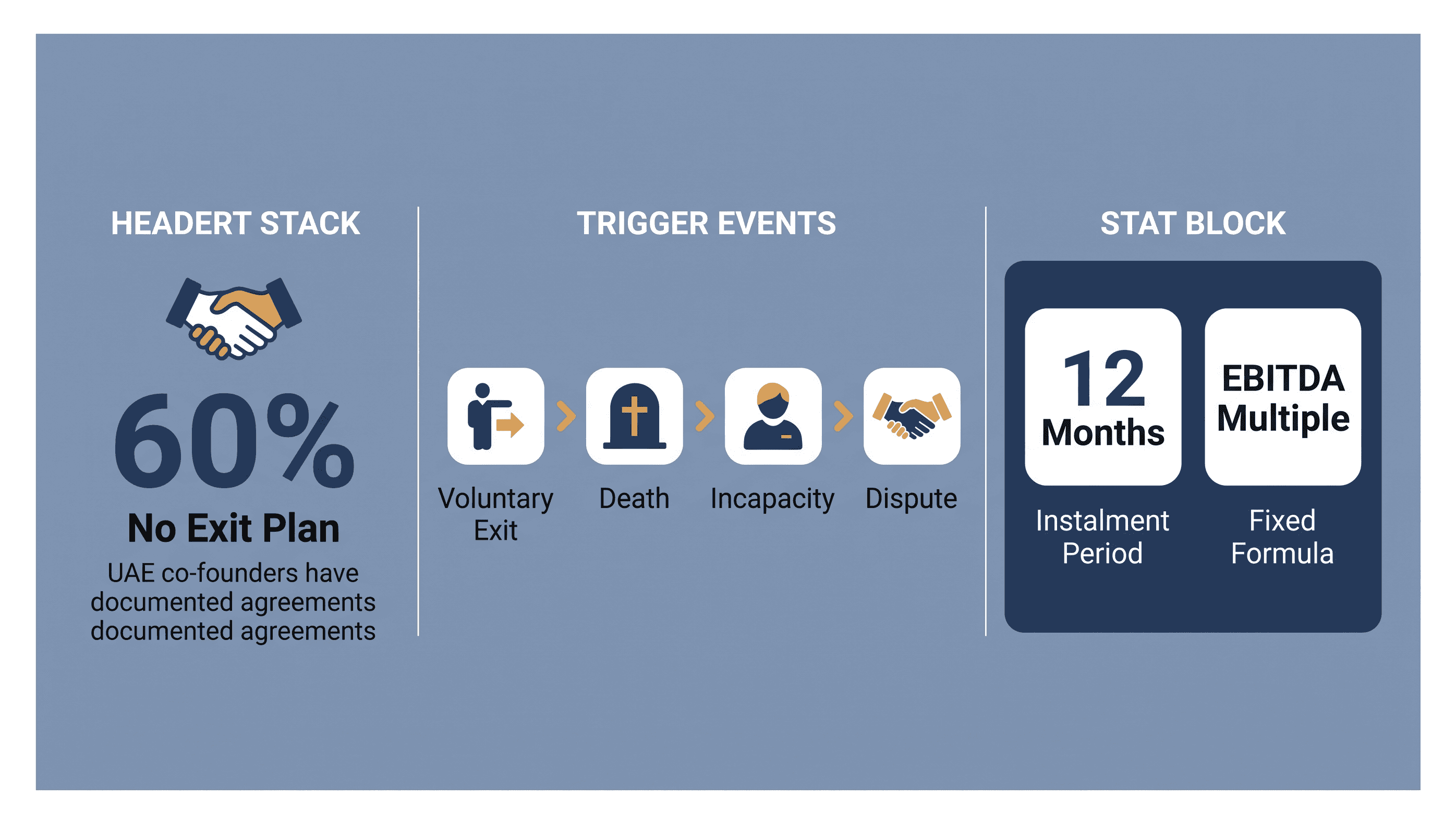
A shareholder exit agreement UAE is activated by defined trigger events: voluntary exit, death, long-term incapacity, divorce, personal bankruptcy, and shareholder deadlock. Each event carries different urgency and legal implications, so the agreement must define each trigger precisely and specify whether the buyout is mandatory or optional for each party.
Voluntary Exit and Deadlock: The Two Most Common Triggers
Voluntary Exit is the most straightforward trigger. A shareholder decides to sell. The buy sell agreement UAE should specify a notice period, typically 30 to 90 days, and confirm whether the remaining shareholders hold a right of first refusal before the shares can be offered to a third party. That right of first refusal is what prevents an unwanted outside party from acquiring a stake without the other shareholders' knowledge.
Deadlock is more dangerous, particularly in 50/50 structures, which are common in UAE free zone companies. When shareholders are split equally and cannot pass resolutions, the company can grind to a halt. A 50/50 Dubai South technology company inserted a deadlock provision requiring either shareholder to trigger a shotgun clause after 60 days of unresolved impasse, breaking the stalemate cleanly without litigation. The agreement must define precisely what constitutes deadlock and how it is resolved.
Death, Long-Term Incapacity, and Divorce: Planning for Personal Events
Death is the trigger most companies fail to plan for. Shares may pass to heirs who have no operational role and no interest in running a business. The buy sell agreement should give surviving shareholders an option, or an obligation, to buy out the estate at a pre-agreed valuation, funded by a life insurance policy assigned for exactly this purpose.
Long-Term Incapacity requires a clear definition. The standard threshold is inability to perform duties for six consecutive months, confirmed by a UAE-licensed medical practitioner. Without that definition, disputes arise over whether the threshold has been reached.
Divorce is an overlooked risk. Under UAE Personal Status Law, assets including shares can form part of a marital estate settlement. A spouse receiving shares through a court order becomes a shareholder with no operational involvement. The buy sell agreement should include a drag-along obligation requiring any incoming spouse to sell their shares to the remaining shareholders at a fixed formula price, removing the uncertainty entirely. Specialist legal advice is essential here, given the interaction between UAE family law and free zone share ownership rules.
Personal Bankruptcy: Protecting the Company from a Shareholder's Creditors
If a shareholder is declared bankrupt, their shares may vest in a trustee or liquidator, someone who is not a business partner and whose only interest is realising value for creditors. The buy sell agreement UAE should trigger a mandatory buyout at the point of a bankruptcy order, at fair market value or a pre-agreed formula.
The UAE Bankruptcy Law (Federal Decree-Law No. 9 of 2016, as amended) governs personal insolvency proceedings (u.ae, 2016, still accurate as of 2026). The buy sell agreement must not conflict with the trustee's legal rights, a well-drafted clause gives the company or co-shareholders a right of first refusal before the trustee can offer shares externally, which is both commercially protective and legally defensible.
How to Value Shares in a Shareholder Buyout Dubai: Three Mechanisms and Their Trade-Offs
A shareholder buyout Dubai can use three main valuation mechanisms: a fixed formula tied to a financial metric such as EBITDA, an independent third-party valuation, or a shotgun clause where one party names a price and the other chooses to buy or sell at that price. Each has trade-offs in speed, cost, and fairness.
Step 1: Fixed Formula Valuation, Speed at the Cost of Precision
The Fixed Formula is the simplest approach. Common formulas include a multiple of EBITDA (for example, 4x trailing 12-month EBITDA), a revenue multiple, or net asset value. A two-partner management consultancy in a UAE free zone set their buyout formula at 3x net profit, reviewed annually, giving both partners certainty without needing an accountant at the point of exit.
The advantage is speed: the price is calculable the moment the trigger fires, with no appointment of a valuer and no delay. The risk is that the formula may not reflect market reality years later. A company that has grown significantly since the agreement was signed will be undervalued. Fixed formulas work best for early-stage, asset-light companies with predictable revenue and short agreement review cycles.
Step 2: Independent Valuation, Fairness at the Cost of Time
An Independent Valuation involves a licensed valuer, typically a Big Four firm or a UAE-registered business valuation specialist, assessing the company at the trigger date. It reflects actual market conditions and is more defensible if the buyout is later disputed.
The trade-off is time and cost. Independent valuations for a mid-sized free zone company typically take 4 to 8 weeks. The appointment of the valuer must itself be pre-agreed in the buy sell agreement UAE, otherwise the parties spend weeks arguing about who conducts the valuation before the valuation even begins. Specify the appointing body (for example, the president of the relevant professional body) in the agreement itself. This mechanism suits established companies with complex assets, intellectual property, or multi-jurisdiction revenues.
Step 3: Shotgun Clause, Fast Resolution When Relationships Have Broken Down
The Shotgun Clause is the bluntest instrument. One shareholder names a price per share; the other must either buy at that price or sell their own shares at that price. Because the naming party does not know which role they will play, the mechanism incentivises a fair price.
The structural flaw is liquidity. The shareholder with more cash can name a low price, knowing the other cannot afford to buy at that level and will be forced to sell. It is best suited to deadlock scenarios between two equal shareholders where speed matters more than precision. Any shotgun clause in a UAE buy sell agreement must be reviewed by a corporate lawyer to confirm it is enforceable under the applicable free zone's rules.
Funding the Buyout: Instalments, Insurance, and What Buyers Can Realistically Afford
A shareholder buyout can be funded through a lump-sum cash payment, structured instalments over an agreed period, or an insurance-backed arrangement where a life or critical illness policy pays out directly to fund the purchase. Each method has different cash-flow implications and must be specified in the buy sell agreement UAE.
Instalment Buyouts: Spreading the Cost Without Losing Control
Instalments allow the buying shareholder to pay over 12 to 36 months, reducing the immediate cash burden. The buy sell agreement UAE must specify the total price, the instalment schedule, the interest rate (if any), and the consequences of a missed payment, for example, the full outstanding balance becoming immediately due.
During the instalment period, clarify whether the departing shareholder retains any voting rights. In most structures, they should not, the operational risk of a departing partner continuing to vote is too high. Dividend rights may continue until the final payment is made, which gives the seller an incentive to support the company's performance during the transition. A charge or personal guarantee over shares or assets can secure the seller's position if payments are missed.
Insurance-Backed Buyouts: Removing the Liquidity Problem on Death or Incapacity
Each shareholder takes out a life and critical illness policy on the other, with the payout assigned to fund the buyout on death or incapacity. Two co-founders of a Dubai South healthcare services company each took out AED 2 million life policies cross-assigned to the other. On one founder's death, the payout covered the buyout within 30 days and the company continued without interruption.
The sum assured should match the agreed valuation formula and be reviewed annually alongside the agreement. Insurance premiums may be treated as a company cost in some structures, confirm the tax treatment with a UAE-licensed tax adviser. The UAE insurance market is regulated by the Central Bank of the UAE following the 2023 merger with the Central Bank of the UAE (Central Bank of the UAE, 2023); policies must be placed with a licensed insurer.
Is an insurance-backed buyout always the best option?
Not always. Insurance is most effective for death and critical illness triggers where the timing is unpredictable and the cash requirement is immediate. For voluntary exit or deadlock, where the timeline is known in advance, structured instalments or a lump-sum cash payment are typically more practical and less expensive to maintain over time.
How the Buy Sell Agreement UAE Interacts with Your MOA and Free Zone Authority
A buy sell agreement UAE must be consistent with the company's Memorandum of Association and the specific free zone authority's share transfer rules. When a trigger event occurs, the authority requires a completed share transfer form, board resolution, updated share register, and in some cases a notarised sale and purchase agreement before registering the change.
MOA Alignment: What Happens When the Two Documents Conflict
The MOA sets out the share transfer restrictions agreed at incorporation. If the MOA requires unanimous shareholder consent for any transfer, but the buy sell agreement provides for a mandatory buyout, one that can proceed without the departing shareholder's agreement, there is a direct conflict. The MOA takes precedence. The buyout mechanism in the buy sell agreement UAE will be unenforceable until the MOA is amended.
Any MOA amendment requires free zone authority approval and a filing fee. Review both documents together every time the buy sell agreement is drafted or updated. This step is often missed, and it is the single most common reason a carefully drafted buy sell agreement fails at the point of execution.
What the Free Zone Authority Needs to Register a Share Transfer
The standard documentation package for a free zone share transfer includes:
Board resolution approving the transfer
Signed share transfer form (authority-specific)
Updated share register reflecting the new ownership
Sale and purchase agreement or a certified extract of the buy sell agreement
For death transfers, a probate order or UAE court order may be required in addition to the standard package. Processing timelines vary by free zone; plan for 5 to 15 working days for a straightforward transfer. Each free zone authority has its own form and documentary requirements, some require notarisation, others accept a certified copy. Confirm the exact checklist with your free zone's company services team before executing any transfer. For the full step-by-step process, the business support services team at Dubai South Business Hub Free Zone can guide you through the documentation requirements specific to the authority.
Drafting and Maintaining a Shareholder Buyout Dubai Agreement: Practical Checklist
A shareholder buyout Dubai agreement should be drafted by a UAE-licensed corporate lawyer, cross-referenced against the MOA, and reviewed at least every two years or after any material change in company value, ownership structure, or applicable free zone regulations. Trigger events, valuation methods, and funding arrangements must all be explicitly defined.
The Six Clauses Every UAE Buy Sell Agreement Must Include
Defined trigger events, an exhaustive list with no catch-all language; each event defined with measurable criteria
Valuation mechanism, which method applies to each trigger, who appoints the valuer, and what happens if the parties cannot agree on the appointee
Funding mechanism, lump sum, instalments, or insurance; payment schedule, interest rate, and consequences of default
Transfer timeline, the number of days from trigger to completed transfer at the free zone authority, with milestones
Right of first refusal, the order of priority among remaining shareholders before shares can be offered externally
Governing law and dispute resolution, specify the applicable law and whether disputes go to UAE courts or arbitration (DIAC or similar)
When to Review and Update the Agreement
A buy sell agreement UAE is a living document. Review it when a new shareholder joins, when the company's revenue grows or declines significantly, when free zone regulations change, or when any shareholder's personal circumstances shift materially. Annual review is best practice; every two years is the minimum.
If the valuation formula is fixed, update the multiple at each review to reflect current market conditions, a multiple set in 2022 may be materially wrong by 2026. File any amendments with the free zone authority if they affect the MOA. A UAE-licensed corporate lawyer should conduct each review, not just the initial drafting. Dubai South Business Hub Free Zone's business support services can
References
Frequently Asked Questions