Topic Summary
1. Cafeteria Licence Falls Under Food and Beverage Activity
A cafeteria or cafe in Dubai requires a commercial food and beverage licence issued through Dubai Economy and Tourism, along with a food safety permit from the Dubai Municipality.
2. Total Licence Cost Ranges from AED 15,000 to AED 30,000
The combined cost of trade licence, food establishment permit, Ejari, and municipality approvals for a cafeteria in Dubai typically falls between AED 15,000 and AED 30,000 depending on location and size.
3. Dubai Municipality Approval Is Mandatory
All food-serving establishments in Dubai must obtain a food establishment permit from Dubai Municipality before trading. This requires a hygiene inspection of the premises and approval of the kitchen layout.
4. Premises Must Meet Dubai Civil Defence Standards
The location must pass a Dubai Civil Defence inspection covering fire safety, emergency exits, and equipment before the licence can be issued and the premises can open to the public.
5. Annual Renewal Includes Re-Inspection
Cafeteria licences in Dubai are renewed annually and include a mandatory Dubai Municipality hygiene inspection. Non-compliance with food safety standards can result in fines or closure orders.
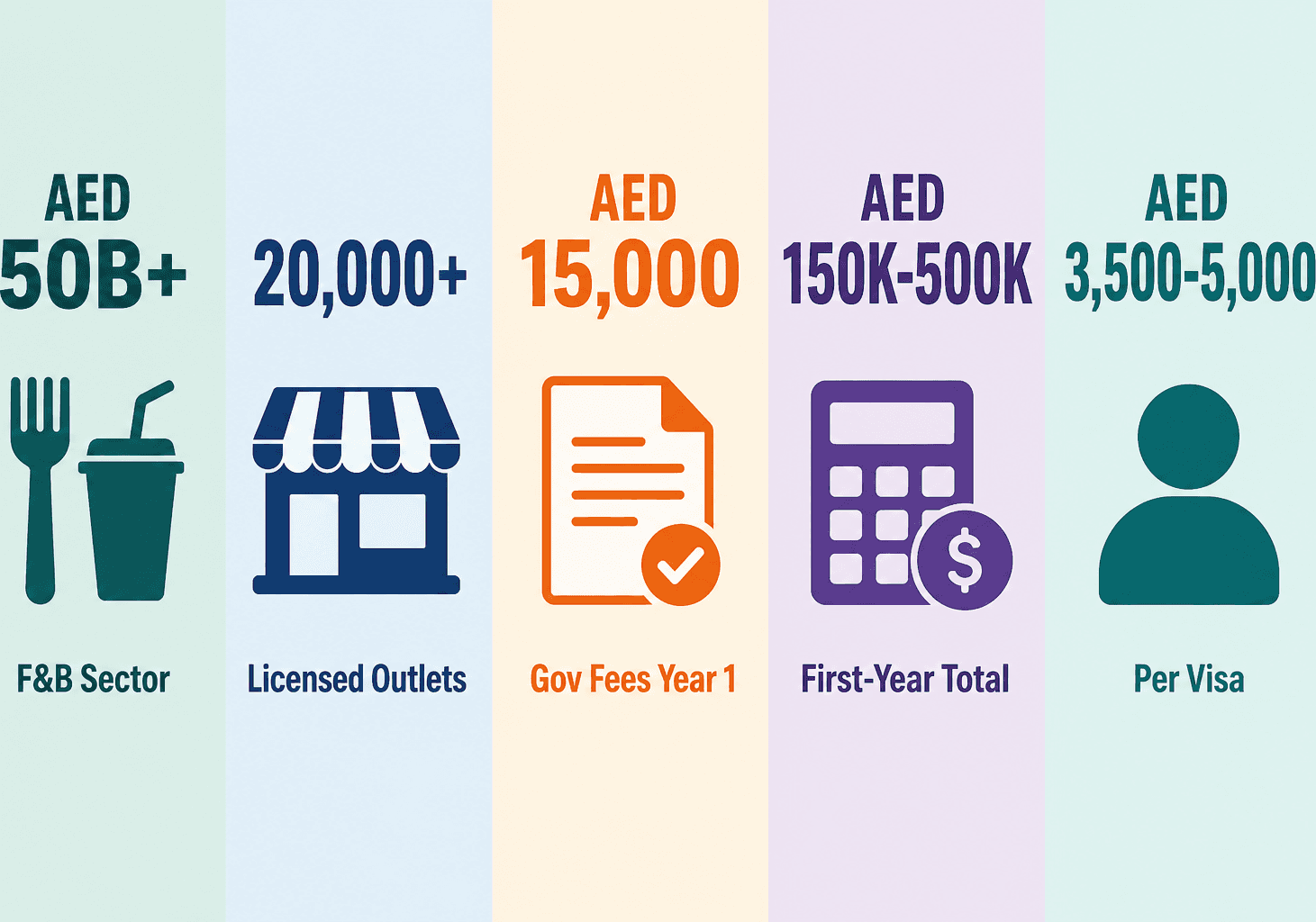
In 2026, Dubai's food and beverage sector accounts for more than AED 50 billion in annual turnover (Dubai Chamber of Commerce, 2025). Over 20,000 licensed food establishments operate across the emirate. The cafeteria license cost in Dubai starts at AED 15,000 in fixed government fees for year one. Total first-year costs, including fit-out and staffing, range from AED 150,000 to AED 500,000. Annual regulatory overhead runs AED 25,000 to AED 40,000 for most operators. The VAT registration threshold is AED 375,000 in annual turnover (Federal Tax Authority, 2023). Employment visas cost AED 3,500 to AED 5,000 per employee to process.
This guide gives you a clear breakdown of the cafeteria license cost Dubai entrepreneurs actually face in 2026: the fixed government fees, the variable approvals, fit-out and staffing budgets, the difference between a cafeteria, a cafe and a restaurant license, and whether a free zone or mainland setup makes commercial sense for your specific concept.
What Is a Cafeteria License in Dubai and What Does It Actually Cover
A cafeteria license in Dubai is a commercial food-service permit issued by Dubai Economy and Tourism (DET) that authorises the sale of light meals, beverages and snacks from a fixed premises. It is distinct from a cafe license and a full restaurant license, each carrying different activity codes, approval requirements and permitted menus. Getting the right license from the start is the single biggest factor in avoiding delays and unnecessary costs.
Cafeteria, Cafe and Restaurant: Three Separate Licenses
DET classifies food-service operations under distinct activity codes, and choosing the wrong one triggers amendments that cost both time and money. Here's how the three main categories break down:
Cafeteria license (DET activity code 561011): Covers self-service or counter-service food and beverages. Think shawarma counters, sandwich bars and juice outlets.
Cafe license (activity code 561012): Designed for sit-down, beverage-led concepts serving coffee, tea and light snacks. It does not permit full meal service.
Restaurant license (activity code 561001): Permits a full-service dining menu and carries additional fire safety, fit-out and seating-capacity requirements.
A specialty coffee brand opening a 30-seat espresso bar in Business Bay applied for a cafeteria license rather than a cafe license, triggering a DET amendment and a three-week delay. That's a common and entirely avoidable error. License amendments cost between AED 300 and AED 1,000 depending on the change, and DET lists more than 2,100 approved food-service activity codes. Confirm the right code against the full business activities list before you submit anything.
What the License Permits and What It Does Not
Knowing what your cafeteria business license UAE does not cover is just as important as knowing what it does. Several operators find this out the hard way.
Alcohol service is not included. A separate liquor license from DET and Dubai Police is required.
Delivery-only operations need an additional home-delivery activity endorsement (approximately AED 500). Without it, third-party aggregator listings can be suspended.
Shisha service requires a standalone permit from Dubai Municipality, issued separately. Annual fee: AED 5,000 per premises.
The license is tied to a specific address. Moving location means a fresh approval cycle.
A cafe in Jumeirah added a delivery service without the endorsement and received a compliance notice from DET within four weeks of going live on a major aggregator platform. The fix was straightforward, but the downtime cost more than the endorsement fee itself.
Fixed Government Fees You Can Budget With Certainty
DET trade license (commercial activity): AED 10,000 to AED 12,000 per year, fixed by DET fee schedule.
Dubai Municipality food-safety permit (initial registration): AED 2,000 to AED 3,500 depending on premises classification.
Municipality annual food-establishment fee: AED 1,500 to AED 5,000 based on seating capacity and risk category.
DET establishment card: AED 1,200 (fixed).
Trade name reservation: AED 620 (fixed, non-refundable).
A 20-seat cafe registered in Al Quoz in early 2025 paid AED 10,800 for the DET license, AED 3,200 for the Municipality food permit and AED 1,200 for the establishment card. Total fixed fees: AED 15,200 before any variable costs. Use the business setup cost calculator to model your specific numbers before signing a lease.
Variable Costs That Shift Based on Concept and Location
Fit-out and interior works: AED 50,000 to AED 300,000+, kiosk at the low end, full-service cafe with custom joinery at the high end.
Commercial kitchen equipment: AED 20,000 to AED 80,000 depending on menu complexity.
Municipality technical inspection fee (post fit-out): AED 500 to AED 2,000.
Health and safety compliance upgrades flagged during inspection: budget at least AED 5,000 contingency.
Initial stock and packaging: AED 10,000 to AED 30,000.
A kiosk-format coffee concept in a community mall fit out for AED 65,000 all-in. A specialty cafe on Sheikh Zayed Road spent AED 280,000 on fit-out alone before opening. Location and concept complexity drive that gap more than anything else.
Cafeteria License Cost Dubai: Fixed vs Variable Fee Breakdown (2026)
Cost Item | Estimated Amount (AED) | Type |
|---|---|---|
DET Trade License (annual) | AED 10,000–12,000 | Fixed |
Dubai Municipality Food Permit (initial) | AED 2,000–3,500 | Fixed |
Municipality Annual Establishment Fee | AED 1,500–5,000 | Fixed |
DET Establishment Card | AED 1,200 | Fixed |
Trade Name Reservation | AED 620 | Fixed |
Fit-Out and Interior Works | AED 50,000–300,000+ | Variable |
Commercial Kitchen Equipment | AED 20,000–80,000 | Variable |
Municipality Technical Inspection | AED 500–2,000 | Variable |
Visa Allocation (per visa, approx.) | AED 3,500–5,000 | Variable |
Initial Stock and Packaging | AED 10,000–30,000 | Variable |
What Food Safety and Municipality Approvals Do You Need Before Opening
Before a cafeteria or cafe can open in Dubai, it must secure a Dubai Municipality food-establishment permit, pass a technical inspection of the fit-out, obtain food-handler health cards for all staff from the Dubai Health Authority, and satisfy ventilation and fire-safety standards set by Civil Defence. All of this happens before DET issues final approval. Getting the sequence right saves weeks.
Dubai Municipality Food-Establishment Permit: What the Inspector Checks
The Municipality's Food Safety Department inspects kitchen layout, ventilation, handwashing facilities, pest-control evidence, food-storage temperatures and waste-disposal systems. Critically, fit-out drawings must be submitted and approved by the Municipality before physical works begin. Retrospective approvals are not granted.
Inspectors issue a conditional pass, a full pass, or a remedial works list before the permit is granted.
The Municipality uses a risk-based categorisation: Category A (low risk, packaged goods only) through Category C (high risk, full cooking on premises). A cafe with a full kitchen is typically Category B or C.
Pre-opening inspection fee: AED 500 to AED 2,000.
Annual renewal inspection: AED 1,500 to AED 5,000.
A cafe operator in Jumeirah Lake Towers submitted fit-out drawings but proceeded with works before receiving sign-off. The Municipality issued a stop-works notice and required partial demolition of a partition wall blocking a required ventilation duct. The delay cost three weeks and approximately AED 18,000 in rework.
DHA Food-Handler Cards and Staff Health Requirements
Every employee who handles food must hold a valid food-handler health card issued by the Dubai Health Authority (DHA).
Cards require a medical fitness test covering typhoid, hepatitis A and TB screening at a DHA-approved clinic. Cost per employee: AED 320 to AED 450.
Cards are valid for 12 months and must be renewed before expiry. Non-renewal triggers a Municipality compliance flag.
The requirement applies to kitchen staff, counter staff and anyone touching unpackaged food or beverages.
A 10-person cafe team incurs approximately AED 3,500 to AED 4,500 per year in DHA health-card renewals alone. That surprises many first-time operators who budget only for the cafeteria license cost in Dubai itself.
Civil Defence Approval and Fire Safety Compliance
Dubai Civil Defence approval is required for all food-service premises. Inspectors assess fire-suppression systems, extinguisher placement, emergency lighting and exit signage.
A commercial kitchen must have a certified fire-suppression hood above cooking equipment. This is a mandatory fit-out specification, not optional.
Civil Defence approval comes after fit-out but before the Municipality pre-opening inspection. Sequencing matters.
Budget AED 5,000 to AED 15,000 for fire-suppression equipment installation depending on kitchen size.
How to Get a Cafeteria License in Dubai: Step-by-Step Process
Getting a cafeteria license in Dubai involves seven sequential steps: reserving a trade name, choosing a legal structure, submitting a DET application, securing initial approval, signing a tenancy agreement, completing the fit-out with Municipality and Civil Defence sign-off, and collecting the final license. The process typically takes four to eight weeks when approvals proceed cleanly.
Step 1: Reserve Your Trade Name and Select the Legal Structure
Submit a trade-name application to DET. The name must not replicate an existing registration, must avoid prohibited words (such as "International" without justification) and must align with the food-service activity. Name reservation fee: AED 620 (fixed, non-refundable).
The most common legal structures for a cafeteria are a sole establishment, a civil company or a Limited Liability Company (LLC). The LLC is the standard choice for foreign investors under the UAE Commercial Companies Law (Federal Decree-Law No. 32 of 2021). 100% foreign ownership is permitted for food-service activities on the Dubai mainland since the 2021 reform. A local sponsor is no longer required for most food-service categories.
Step 2: Obtain Initial Approval and NOCs
DET initial approval confirms the activity is permissible at the chosen location. It is not the final license.
Additional no-objection certificates (NOCs) may be required from Dubai Municipality, Dubai Civil Defence and the landlord.
Mall or managed retail development premises typically require the developer's own NOC before DET accepts the tenancy contract.
Initial approval fee: approximately AED 300 to AED 600. NOC turnaround: typically three to seven working days per issuing authority.
Step 3: Complete Fit-Out, Inspections and Final License Collection
Submit Municipality-approved fit-out drawings before commencing works. After fit-out is complete, book Civil Defence inspection first, then the Municipality pre-opening inspection, then collect the DET final license. The license is issued digitally; physical copies are available on request.
A 25-seat cafe in Al Barsha completed the full process in 39 working days: name reservation on Day 1, initial approval on Day 6, fit-out completed by Day 28, Civil Defence sign-off on Day 34, Municipality pre-opening pass on Day 37, and DET license issued on Day 39. That's achievable with clean drawings and no remedial works. Allow 10 to 12 weeks if significant fit-out is involved.
Once licensed, register for VAT with the Federal Tax Authority if projected annual turnover exceeds AED 375,000.
Free Zone Versus Mainland: Which Jurisdiction Suits a Walk-In Food Business
For a walk-in cafeteria or cafe serving the general public in Dubai, a mainland DET license is almost always the correct choice. Free zone food licenses restrict trading to a captive audience within the zone's boundaries and cannot serve customers on the open market without a mainland branch, adding cost and complexity to an already tight-margin business.
When a Mainland DET License Is the Right Call
Any food concept relying on walk-in footfall from the general public must hold a mainland DET license. Street-facing cafes, mall kiosks, community cafeterias, all of these require it. The mainland license lets you trade anywhere within Dubai's geographical boundaries, sign any commercial tenancy and advertise freely.
100% foreign ownership on mainland: permitted since June 2021 (Federal Decree-Law No. 32 of 2021).
Corporate tax: 9% on taxable income above AED 375,000 per financial year (Federal Tax Authority, 2023).
Mainland VAT registration and corporate-tax compliance apply, but these are standard operating costs for any viable food business.
When a Free Zone Food License Makes Sense
A free zone food license suits operators running a staff canteen or captive-audience outlet within a specific zone, a logistics hub or industrial park, for example. It does not suit public-facing retail concepts.
Free zone base license: AED 6,000 to AED 9,000 per year (zone dependent), lower than mainland, but with restricted trading geography.
To serve customers outside the zone, you must register a mainland branch, incurring additional DET fees of AED 8,000 to AED 12,000 per year on top of the free zone fee.
For a concept built on public walk-in traffic, the dual-license route almost always
References
Dubai Chamber of Commerce (dubaichamber.com)
Federal Tax Authority (tax.gov.ae)
Dubai Health Authority (DHA) (dha.gov.ae)
Citations
Dubai Economy and Tourism.. dubaidet.gov.ae. DET, 2025.
Dubai Health Authority.. dha.gov.ae. DHA Dubai, 2025.
Federal Tax Authority.. tax.gov.ae. FTA UAE, 2025.
Dubai Police.. dubaipolice.gov.ae. Dubai Police, 2025.
Frequently Asked Questions