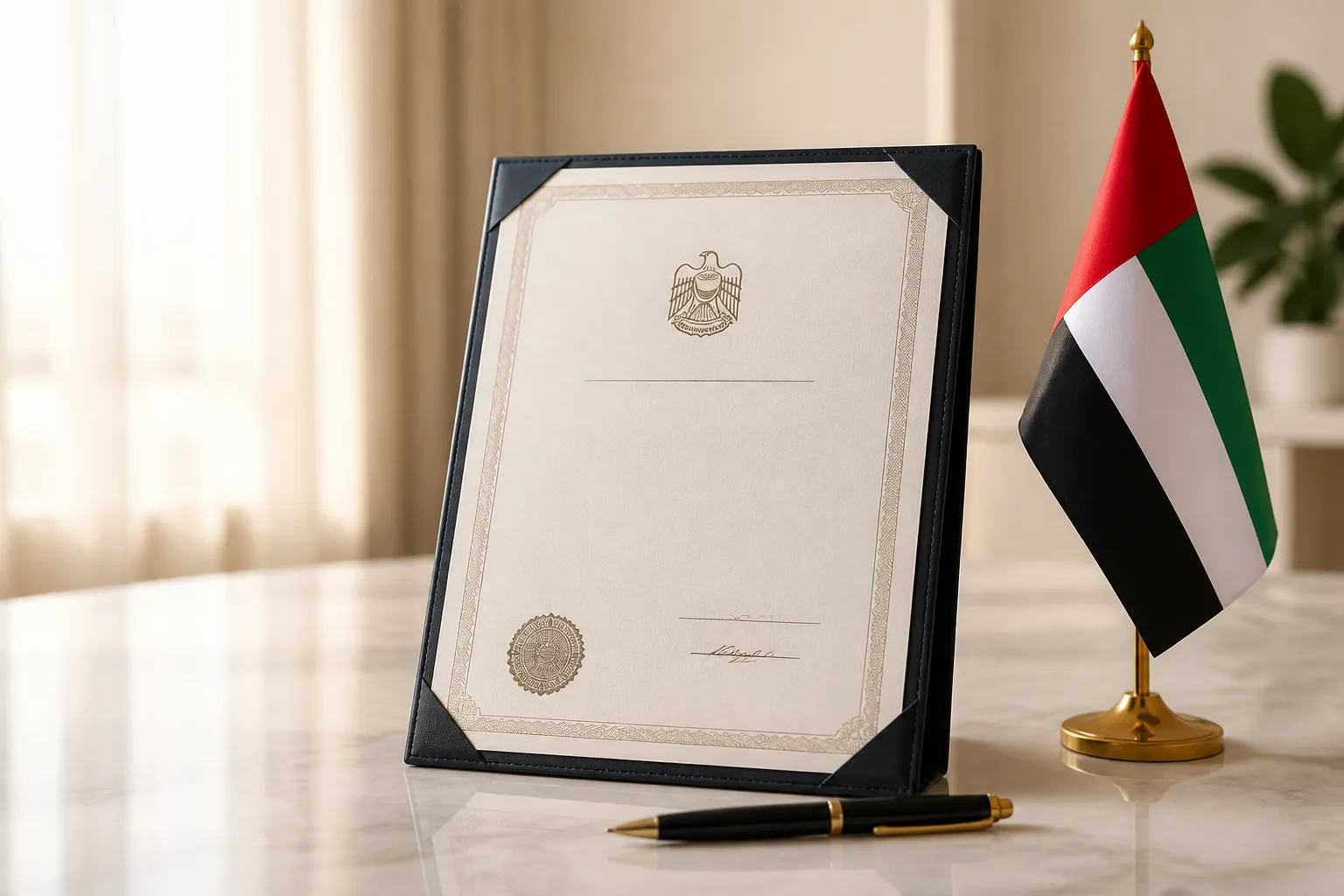
Topic Summary
What a Certificate of Incorporation Actually Does
A UAE certificate of incorporation is an official document confirming your company is a recognised legal entity separate from its shareholders. It records the company name, registration number, date of formation, and jurisdiction, and is required by banks, regulators, and foreign counterparties.
One-Day Turnaround at Dubai South Business Hub
Companies incorporated at Dubai South Business Hub Free Zone receive their certificate on the same day the license is issued. This allows founders to approach banks within days of setup, a speed advantage that those relocating from Europe or Asia consistently find valuable.
Certificate of Incorporation vs. Trade License
These two documents serve distinct purposes: the certificate proves the entity legally exists and retains its original date permanently, while the trade license authorises commercial activity and must be renewed annually. Foreign banks and embassies specifically request the certificate, not the trade license.
Core Documents Every Applicant Must Submit
A standard application requires passport copies for all shareholders and directors, a cleared trade name, a selected business activity, a registered address or flexi-desk lease, and the paid registration fee. Regulated activities require additional approvals from the relevant regulator.
Setup Costs Starting From AED 12,500
Packages at Dubai South Business Hub Free Zone begin at AED 12,500, making it one of the more accessible entry points for founders. Budgeting accurately from the start helps avoid surprises during the incorporation process.
Penalties for Late Tax Registration Are Steep
Both late corporate tax registration and late VAT registration each attract a one-time AED 10,000 penalty from the Federal Tax Authority. Registering promptly after incorporation is essential to avoid these avoidable costs.
Zero Percent Tax for Qualifying Free Zone Persons
A Qualifying Free Zone Person can pay 0% corporate tax on qualifying income, subject to four specific conditions set by UAE tax law. Understanding these conditions before choosing a jurisdiction can significantly affect your company's long-term tax position.
In 2026, the UAE continues to rank among the top ten destinations globally for foreign direct investment, with Dubai alone issuing more than 40,000 new business licenses every year (Dubai Chamber of Commerce, 2025). For any founder planning to set up a company here, the certificate of incorporation UAE process is the legal starting point that converts a trade name into a recognised legal entity. Packages at Dubai South Business Hub Free Zone start from AED 12,500. The license is issued in one business day. Late corporate tax registration attracts a one-time AED 10,000 penalty (Federal Tax Authority, 2026). Late VAT registration attracts the same AED 10,000 figure. And the UAE's corporate tax rate for a Qualifying Free Zone Person (QFZP) can be 0% on qualifying income, subject to four conditions.
This article covers exactly what a certificate of incorporation is, the documents and conditions you need to obtain one, a clear breakdown of costs, and a step-by-step walkthrough of the process at Dubai South Business Hub Free Zone (DSBH).
What Is a Certificate of Incorporation in the UAE
A certificate of incorporation in the UAE is an official document issued by a free zone authority or mainland registry confirming that a company has been legally formed. It records the company name, registration number, date of formation, and jurisdiction. Banks, regulators, and counterparties treat it as proof of the entity's legal existence.
Legal Standing the Certificate Creates
The certificate of incorporation UAE confirms the company is a separate legal entity from its shareholders. That separation matters enormously: it means the company can hold assets, enter contracts, and incur liabilities in its own name, not yours personally.
It also establishes the precise date from which the company's legal life begins. No UAE bank will open a corporate account or accept a signature mandate without it. Mainland companies receive their certificate from the Department of Economy and Tourism (DET); free zone companies receive theirs from the relevant free zone authority (UAE Ministry of Economy, 2025).
A tech consultancy incorporated at Dubai South Business Hub Free Zone receives its certificate on the same day the license is issued, allowing the founder to approach banks within days of setup. That one-day turnaround is a practical advantage that founders relocating from Europe or Asia consistently find valuable.
Certificate of Incorporation vs. Trade License: Key Differences
These two documents are often confused, but they do different jobs:
Certificate of incorporation: proves the entity legally exists; carries the original registration date permanently
Trade license: authorises what the company can do commercially; must be renewed annually
Both are issued together at most UAE free zones, but they serve distinct legal purposes
Regulators, courts, and foreign embassies specifically request the certificate of incorporation, not the trade license
Renewing the trade license each year does not alter the certificate, which retains its original date
When a Dubai-incorporated company applies for a business bank account abroad, foreign banks request the certificate of incorporation to verify legal formation. The trade license alone won't satisfy that requirement.
Certificate of Incorporation UAE Requirements: Documents and Conditions
To obtain a certificate of incorporation in the UAE, founders typically need a completed application form, passport copies of all shareholders and directors, a chosen trade name that has passed availability checks, a selected business activity, a registered address or flexi-desk lease, and the paid registration fee. Regulated activities require additional approvals from the named regulator.
Core Documents Every Applicant Must Submit
The document list for a standard certificate of incorporation UAE application is shorter than most founders expect. Here's what you'll need:
Passport copy (valid for at least six months) for each shareholder, director, and authorised signatory
Completed application form provided by the free zone authority
Proof of residential address for each shareholder, a utility bill or bank statement dated within three months
Proposed trade name that has cleared the free zone's trade name availability search
Selected business activity or activities from the free zone's approved list of business activities
A solo founder applying at DSBH submits a single passport copy, a residential address document, and an activity selection form. No notarised documents are required at the application stage for standard activities, a point that surprises many first-time founders used to more paperwork-heavy jurisdictions.
Conditions for Regulated Business Activities
Some activities require a second layer of approval beyond the free zone license itself. DSBH licenses the commercial activity; a named external regulator approves the practice separately. The certificate of incorporation UAE is issued regardless, but you can't commence the regulated activity until that secondary approval is in place.
Healthcare: DSBH issues the license; the Dubai Health Authority (DHA) approves the clinical operation
Financial services: DSBH issues the license; the Central Bank of the UAE or the relevant authority approves the financial activity
Education: DSBH issues the license; the Knowledge and Human Development Authority (KHDA) approves the curriculum and premises
Founders must secure regulatory approval before commencing the regulated activity, even after the certificate of incorporation is issued
Worth flagging: late corporate tax registration carries a one-time AED 10,000 flat penalty, and late VAT registration carries an AED 10,000 penalty too (Federal Tax Authority, 2026). Getting compliant from day one avoids both.
Registered Address Requirement
Every UAE company must have a registered address in the jurisdiction where it is incorporated. That address appears on the certificate of incorporation itself. DSBH packages include a flexi-desk space, satisfying this requirement without the cost of dedicated office space.
The lease agreement is a mandatory attachment to the incorporation application. Flexi-desk access is included in all DSBH packages from AED 12,500, making it one of the most cost-efficient ways to meet the registered address condition in Dubai.
Dubai South Business Hub Free Zone Incorporation Package Comparison
Feature | 0 Visa Package | 1 Visa Package | 2 Visa Package |
|---|---|---|---|
Package Fee | AED 12,500 | AED 16,350 | AED 18,200 |
Trade License | Included | Included | Included |
Articles of Association and Share Register | Included | Included | Included |
Flexi-Desk Space and Lease Agreement | Included | Included | Included |
Visa Allocation and Establishment Card | Not included | 1 investor or partner visa allocation + establishment card | 2 visa allocations + establishment card |
Visa Processing Fees (entry permit, medical, Emirates ID) | Not applicable | Quoted and invoiced separately | Quoted and invoiced separately |
Certificate of Incorporation UAE: Costs and Package Fees
At Dubai South Business Hub Free Zone, incorporation packages start at AED 12,500 for the zero-visa option and rise to AED 18,200 for the two-visa-allocation package. Every package includes the trade license, Articles of Association, share register, flexi-desk space. Visa processing fees are quoted separately.
DSBH Package Pricing Breakdown
All three packages produce the certificate of incorporation UAE, the trade license, and the full suite of constitutional documents on the day of license issuance. Here's what each tier covers:
0 Visa Package, AED 12,500: trade license, Articles of Association, share register, flexi-desk space, and lease agreement. No visa allocation.
1 Visa Package, AED 16,350: everything in the 0 Visa Package, plus one investor or partner visa allocation and an establishment card.
2 Visa Package, AED 18,200: everything in the 1 Visa Package, plus a second visa allocation. This is the maximum allocation under a standard DSBH package.
Visa processing (entry permit, status change, medical examination, Emirates ID) is always invoiced separately from the package fee.
A founder relocating from Germany who needs a UAE residency visa selects the 1 Visa Package at AED 16,350. The visa allocation covers the investor visa; processing costs are invoiced separately once the certificate of incorporation is issued. You can use the business setup cost calculator to model the full outlay before committing.
What the Package Fee Does Not Cover
Visa processing fees (entry permit, status change, medical, Emirates ID), always quoted and invoiced separately
Regulated-activity approval fees charged by external regulators such as DHA or KHDA
Corporate tax registration with the Federal Tax Authority, a separate obligation; late registration carries a one-time AED 10,000 flat penalty (Federal Tax Authority, 2026)
VAT registration, if taxable turnover exceeds the mandatory threshold, late registration also carries an AED 10,000 penalty
Step-by-Step Process to Obtain Your Certificate of Incorporation in the UAE
Obtaining a certificate of incorporation in the UAE involves four main steps: reserving your trade name and selecting your activity, submitting your application with supporting documents, signing the constitutional documents and paying fees, and receiving the certificate and trade license. At Dubai South Business Hub Free Zone, the license and certificate are issued within one business day.
Step 1: Reserve Your Trade Name and Select Your Activity
Run a company name availability check through the free zone's name reservation portal before submitting any documents
The name must comply with UAE naming conventions: no offensive language, no references to political bodies, no generic geographic terms without approval
Select your business activity or activities from the free zone's approved list; activities determine what your license authorises you to do commercially
If your chosen activity is regulated, identify the external regulator and begin that approval process in parallel, don't wait until after incorporation
Step 2: Submit Your Application and Supporting Documents
Complete the free zone's application form with shareholder and director details
Attach passport copies, residential address proof, and the reserved trade name confirmation
For regulated activities, attach any preliminary approvals or no-objection letters from the external regulator
The free zone team reviews the application, typically confirming acceptance within one business day
Step 3: Sign Constitutional Documents and Pay Fees
Once the application is approved, sign the Articles of Association and the share register
Pay the applicable package fee: AED 12,500, AED 16,350, or AED 18,200 depending on the visa allocation selected
The flexi-desk lease agreement is issued and signed at this stage, completing the registered address requirement
Visa processing fees, if applicable, are invoiced separately at this point
Step 4: Receive Your Certificate of Incorporation and Trade License
The free zone authority issues the trade license and certificate of incorporation on the same day payment is confirmed
Both documents are typically delivered digitally, with physical copies available on request
With the certificate in hand, the founder can open a corporate bank account, register for corporate tax with the FTA, and apply for visas
If a visa allocation was purchased, the UAE residency visa process begins immediately after incorporation is complete
A logistics consultancy founder receives her certificate of incorporation and trade license on the afternoon of payment. She submits the certificate to her chosen bank the following morning to begin the bank account opening in the UAE process. That's a realistic timeline, not a best-case scenario.
What a Certificate of Incorporation Authorises You to Do in the UAE
A UAE certificate of incorporation authorises the company to enter contracts, open corporate bank accounts, sponsor employee and investor visas, register for corporate tax and VAT, and operate commercially within the scope of its licensed activities. It is the foundational document for all subsequent regulatory and banking interactions in the UAE.
Corporate Banking and Financial Transactions
UAE banks require the certificate of incorporation, trade license, Articles of Association, and shareholder passport copies to open a corporate account. The certificate confirms the entity's legal standing, satisfying the bank's Know Your Customer (KYC) obligations under UAE Central Bank regulations.
Without the certificate, the company can't receive payments, pay suppliers, or hold funds in its own name. Some banks also require a board resolution authorising the signatory, which references the certificate's registration number directly.
Is the certificate of incorporation enough to open a UAE bank account?
The certificate of incorporation is necessary but not sufficient on its own. UAE banks also require the trade license, Articles of Association, and shareholder passport copies. Some banks request a board resolution referencing the certificate's registration number. The full document pack satisfies the bank's KYC requirements under Central Bank guidelines.
Visa Sponsorship and Residency
An incorporated free zone company can sponsor investor, partner, and employee visas up to the limit set by the visa allocation purchased
The 1 Visa Package provides one investor or partner visa allocation; the 2 Visa Package provides two allocations, the maximum under a standard DSBH package
The establishment card, included in the 1 and 2 Visa packages, formally authorises the company to act as a visa sponsor
The ICP (Federal Authority for Identity, Citizenship, Customs and Port Security) processes residency applications once the establishment card is active (ICP, 2026)
Tax Registration and Compliance
The certificate of incorporation UAE is a required attachment for corporate tax registration with the Federal Tax Authority
A Qualifying Free Zone Person (QFZP) may access a 0% corporate tax rate on qualifying income, subject to four conditions: meeting substance requirements, having qualifying income, not electing the standard rate, and complying with transfer pricing rules (Federal Tax Authority, 2026)
VAT registration is mandatory once taxable supplies exceed the mandatory threshold; the certificate is needed to complete that application
Late corporate tax registration and late VAT registration each attract a flat AED 10,000 penalty, register promptly after incorporation
Renewing and Updating Your Certificate of Incorporation in the UAE
A UAE certificate of incorporation itself does not expire, but the trade license attached to the same entity must be renewed annually. Changes to shareholder structure, company name, or business activities require formal amendments filed with the free zone authority, which issues updated constitutional documents reflecting the changes.
Annual License Renewal and What It Covers
The trade license must be renewed each year; failure to renew puts the company's legal status at risk and can freeze banking access
Renewal typically requires a current lease agreement, settled government fees, and confirmation that no regulatory conditions have lapsed
The certificate of incorporation retains its original issuance date throughout the life of the company, that date never changes
Visa allocations linked to the license must also be renewed as part of the annual cycle
Amending Corporate Details After Incorporation
Shareholder changes, director appointments, and trade name changes all require a formal amendment application to the free zone authority
Each amendment produces updated Articles of Association and, where relevant, an updated share register
Banks and the FTA must be notified of material changes to shareholder or director details to keep records consistent
References
Frequently Asked Questions