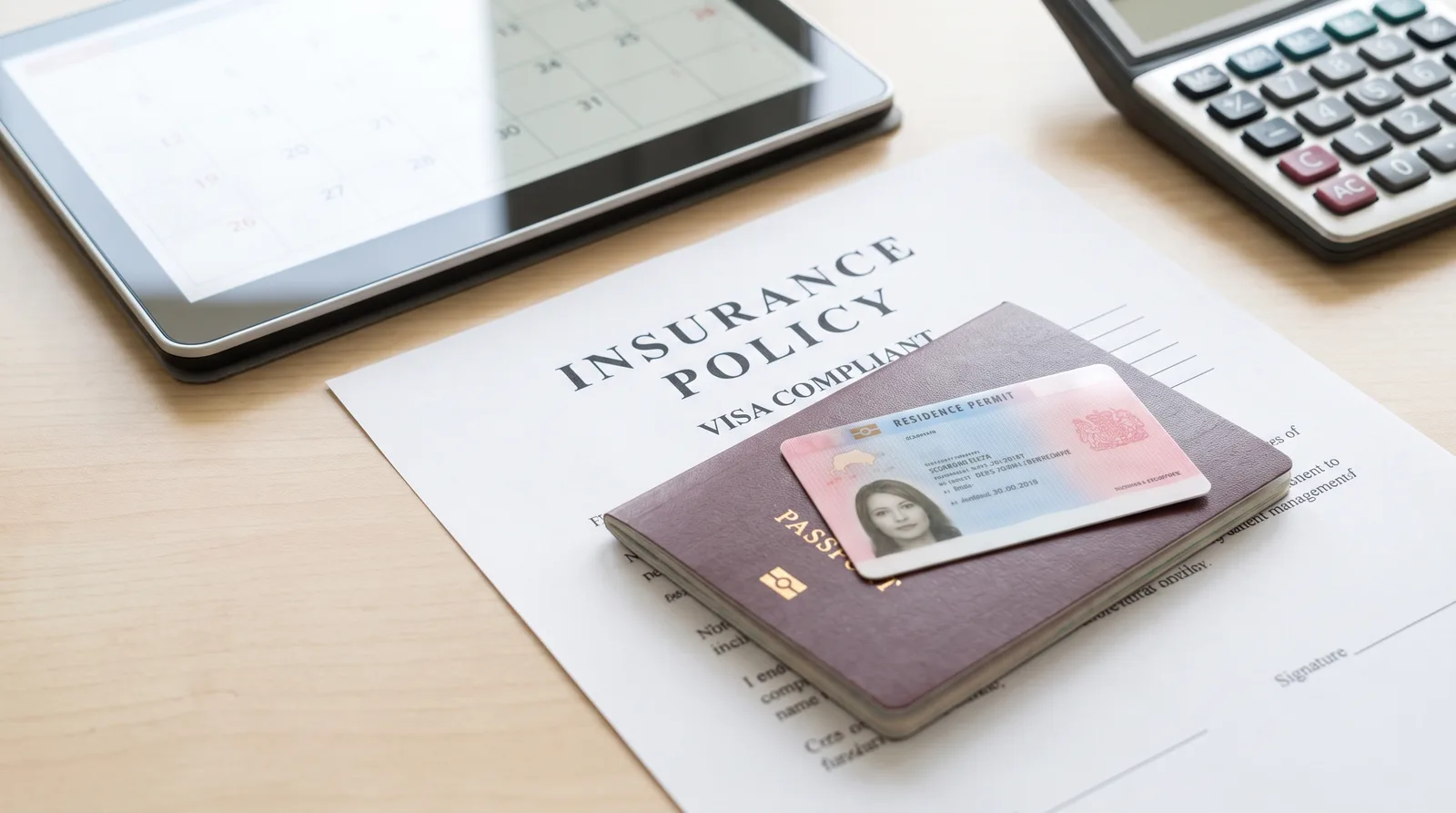
Choosing an Insurance Plan That Meets Visa Rules: Steps, Cost and Common Delays

Topic Summary
Verify Your Insurer Is DHA-Approved First
About one in ten insurance submissions is rejected by GDRFA not because the policy is inadequate, but because the insurer isn't on the Dubai Health Authority's approved list. Always cross-check the DHA-approved insurer register at dha.gov.ae before purchasing any policy.
Meet the Essential Benefits Plan Minimum Coverage
A visa-compliant policy must provide at least AED 150,000 in annual benefits, cover inpatient and outpatient treatment, emergency care, maternity care up to AED 7,000, and pre-existing conditions up to a defined sub-limit. Policies that fall below this threshold fail the GDRFA electronic verification check automatically.
Understand Both Federal and Emirate-Level Rules
Dubai residents are governed by two legal layers: Federal Law No. 7 of 1999 and Dubai Law No. 11 of 2013, which mandates active health insurance for every person residing in Dubai regardless of employment status or visa category. Free zone visa holders are subject to the same DHA rules as mainland visa holders, with no exemptions.
Budget Separately for One-Off and Recurring Costs
The annual EBP premium typically ranges from AED 650 to AED 1,800 per person, but that figure covers only the premium itself. Co-payments, policy excess fees, out-of-network treatment, optical, dental above basic, and chronic-disease management beyond sub-limits are all additional costs not included in standard quotes.
A Rejected Submission Costs Time and Money
An insurer not appearing on the DHA-approved list can add 10 or more days to your visa timeline and trigger a repeat set of government fees averaging AED 500–700. Getting the insurer selection right the first time is the most effective way to protect your setup schedule.
Abu Dhabi Operations Require a Separate Check
If you plan to operate in Abu Dhabi as well as Dubai, note that Abu Dhabi runs its own health insurance mandate under Law No. 23 of 2005, with a different approved insurer list. The two emirates' requirements do not overlap, so compliance in Dubai does not guarantee compliance in Abu Dhabi.
The GDRFA electronic verification check rejects roughly one in ten insurance submissions at the visa stamping stage, not because the policy is inadequate, but because the insurer isn't on the DHA-approved list. That single oversight costs founders 10 or more days and a repeat set of government fees averaging AED 500–700. Choosing insurance plan dubai correctly the first time is the difference between a smooth stamp and a frustrating restart.
This guide is for first-time founders setting up a company in Dubai who need to understand exactly what makes a policy visa-compliant, what the realistic costs look like broken into one-off and recurring charges, and where the process most commonly slows down. By the end, you'll know the sequence to follow, the figures to budget, and the mistakes to sidestep before they hit your timeline.
What Qualifies as a Visa-Compliant Insurance Plan in Dubai
A visa-compliant insurance plan in Dubai must be issued by a Dubai Health Authority-approved insurer, provide Essential Benefits Plan coverage of at least AED 150,000 per year, cover pre-existing conditions up to a defined sub-limit, and be electronically verifiable by GDRFA at the point of visa stamping. Choosing insurance plan dubai starts with those four criteria, not the premium price.
The Essential Benefits Plan Baseline
The Dubai Health Authority mandates the Essential Benefits Plan (EBP) as the minimum standard for employee and investor visa holders. The EBP covers:
Inpatient and outpatient treatment at network facilities
Emergency care, including stabilisation before transfer
Maternity care up to AED 7,000 per delivery
Diagnostic tests and imaging at approved network providers
Annual benefit limit of AED 150,000, policies below this threshold fail the GDRFA electronic check
The DHA-approved insurer list is updated periodically at dha.gov.ae, and it's not the same as a list of all UAE-licensed insurers. That distinction matters. A founder setting up a consulting firm applied for her investor visa and her broker recommended a policy from a well-known regional insurer. The insurer wasn't on the DHA-approved list. GDRFA rejected the submission electronically, and she had to source a replacement policy before resubmission, adding 10 days to her timeline and a second broker fee.
Federal vs. Emirate-Level Requirements
Two legal layers govern health insurance for Dubai residents. Federal Law No. 7 of 1999 establishes the national framework for health insurance across the UAE. Dubai Law No. 11 of 2013 adds the emirate-level mandate: every person residing in Dubai must hold active health insurance, with no exceptions for employment status or visa category (MOHAP, 2023).
If you're also considering Abu Dhabi operations, note that emirate runs its own mandate under Law No. 23 of 2005, the insurer requirements and approved lists differ. For Dubai, MOHAP sets federal policy content standards while DHA enforces compliance and maintains the approved insurer register.
Free zone visa holders in Dubai are subject to the same DHA rules as mainland visa holders. The free zone boundary creates no insurance exemption. If you're obtaining a UAE residency visa through a Dubai free zone, you still need a DHA-approved policy in place before GDRFA stamps the visa.
What Choosing Insurance Dubai Cost Actually Covers, and What It Does Not
Choosing insurance dubai cost typically ranges from AED 650 to AED 1,800 per person per year for an Essential Benefits Plan policy. That figure covers the annual premium only. Medical network co-payments, policy excess fees, treatment outside the approved network, optical, dental above basic, and chronic-disease management beyond sub-limits are all excluded from standard quotes.
One-Off vs. Recurring Cost Breakdown
Split your insurance budget into two buckets before you start comparing quotes. The one-off costs apply only at setup; the recurring costs repeat every year.
Choosing Insurance Dubai Cost: One-Off vs. Recurring Charges
Category | Cost Item | Amount (AED) |
|---|---|---|
ONE-OFF | Broker administration fee | 150–300 |
ONE-OFF | Policy issuance fee (some insurers) | 100–200 |
ONE-OFF | PRO upload to GDRFA/ICP portal | 100–200 |
RECURRING | EBP annual premium per person | 650–1,800 |
RECURRING | Enhanced plan annual premium per person | 2,500–6,000 |
RECURRING | Annual renewal administration fee | 100–200 |
NOT INCLUDED | Dental (beyond emergency extraction), optical frames and lenses, fertility treatment, cosmetic procedures, treatment outside UAE, chronic-condition treatment above annual sub-limit | Billed separately |
How Pre-Existing Conditions Affect Your Premium
The EBP requires insurers to cover pre-existing conditions, but permits a sub-limit. At EBP level, that sub-limit is typically set at AED 150,000, the same as the annual ceiling, meaning no additional exclusion applies. That's actually more generous than many founders expect.
Enhanced plans are different. They may impose waiting periods of 6–12 months for declared pre-existing conditions. Group policies covering two or more insured persons generally use community rating, which can reduce individual premiums by 10–20% compared with individual policies. Before you submit any policy to GDRFA, confirm the pre-existing condition clause says "sub-limit" not "exclusion", a policy that excludes rather than sub-limits will fail a DHA audit (DHA, 2024).
Step-by-Step Guide to Choosing Insurance Plan Dubai for Your Visa Application
To choose a visa-compliant insurance plan in Dubai: confirm the insurer is DHA-approved, select a policy meeting the EBP minimum, submit your Emirates ID application number to the insurer for policy issuance, upload the policy certificate to the GDRFA residency portal, and verify the electronic status shows active before your visa stamping appointment.
Step 1: Confirm the Insurer Is on the DHA-Approved List
Download the current DHA-approved insurer list directly from dha.gov.ae before contacting any broker.
Cross-check the insurer's trade name against the official list, some brands operate under a parent company name on the register, so the name your broker gives you may not match exactly.
Ask the broker to provide the insurer's DHA approval reference number. If they can't produce it on request, that's a clear signal to find a different broker.
Step 2: Match the Policy to Your Visa Category
Investor and partner visas, the visa allocation included in the 1 Visa Package (AED 16,350) and 2 Visa Package (AED 18,200) at Dubai South Business Hub Free Zone, require the same DHA-compliant policy as any other Dubai residence visa.
Employee visas sponsored by your company require the licensed entity to be the policyholder, not the individual employee.
Domestic worker visas carry a separate mandatory insurance product governed by MOHRE, this is a distinct product and must not be confused with the standard DHA health insurance requirement.
If you need the visa allocation handled alongside the insurance step, PRO services in Dubai can coordinate both in sequence.
Step 3: Issue the Policy and Upload to GDRFA
Provide the insurer with a clear passport copy, your Emirates ID application reference number, and your entry permit number, all three are required before the certificate can be issued.
Upload the policy certificate to the GDRFA residency portal via the ICP system at icp.gov.ae. GDRFA performs a live electronic pull at stamping, they don't accept a physical document as a substitute.
Allow 1–3 working days for the insurer to generate the certificate and for the ICP system to reflect the active status. If the status doesn't update in time, your stamping appointment must be postponed.
Is an EBP policy enough for an investor visa, or do I need an enhanced plan?
An EBP policy meeting the AED 150,000 annual benefit limit is sufficient for GDRFA to stamp an investor or partner visa in Dubai. Enhanced plans are not a regulatory requirement, they're a personal or employer choice based on coverage preferences. Confirm the insurer is DHA-approved first; the tier of plan is secondary.
Common Delays When Choosing an Insurance Plan for a Dubai Visa and How to Avoid Them
The most common delays in choosing an insurance plan for a Dubai visa are: using a non-DHA-approved insurer, a mismatch between the policy name and the passport name, the ICP system not reflecting the active policy in time for stamping, and submitting an expired entry permit before the insurance step is complete. This choosing insurance dubai guide covers each in turn.
Name and Document Mismatches
The name on the insurance certificate must match the passport exactly. Middle names, transliteration differences, and initials are all grounds for system rejection, the ICP matching is character-level, not phonetic.
A founder whose passport reads "Mohammed Al Rashidi" submitted his insurance onboarding form with "Mohamed Rashidi." The ICP system flagged the mismatch and rejected the electronic link, delaying the stamp by four working days while a corrected certificate was reissued. Name corrections typically take 3–5 working days and may attract a reissuance fee from the insurer. The fix is simple: always submit a clear scan of the biographical page of your passport and let the insurer copy the name exactly as printed.
Timing Gaps Between Entry Permit Expiry and Policy Activation
Entry permits are valid for 60 days from the date of issue (GDRFAD, 2024). Leaving the insurance step until week 7 or 8 risks the permit expiring before the policy certificate uploads to ICP.
A lapsed entry permit requires a new permit application before the insurance and stamping steps can restart, adding AED 500–700 in repeat government fees and at least 5 working days to your timeline.
The safest sequence: initiate insurance procurement within the first two weeks after the entry permit is issued, not the last two.
How Choosing Insurance Plan Dubai Fits Into Your Overall Company Setup Cost
Insurance is a recurring line in your Dubai company setup budget, separate from the one-off license and visa fees. For founders taking a 1 Visa Package at AED 16,350, the annual insurance premium of AED 650–1,800 is an additional recurring cost on top of the package price and any separately quoted visa processing fees.
What the Dubai South Business Hub Free Zone Visa Package Includes
The 0 Visa Package at AED 12,500 includes the license, Articles of Association, share register, flexi-desk space, and lease agreement. No visa allocation is included, so the insurance step isn't triggered by this package alone.
The 1 Visa Package at AED 16,350 adds a single investor or partner visa allocation and the establishment card. This is one visa, not two.
The 2 Visa Package at AED 18,200 adds two visa allocations and the establishment card, the maximum available under any package.
Visa processing costs (entry permit, status change, medical fitness test, Emirates ID, stamping) are quoted separately from the package price. So is the insurance premium.
The license is issued in 1 day. The residency visa timeline then depends on the GDRFA queue and the insurance verification step.
Budgeting Insurance as a Recurring Annual Line Item
Insurance renews annually, budget AED 650–1,800 per person per year for EBP-level cover, or AED 2,500–6,000 for enhanced plans. That's a separate line from your license renewal and visa renewal fees.
If you add employees under your company license, each employee's insurance becomes a mandatory employer cost from day one. Factor this into your choosing insurance dubai cost projections before you hire. Use the business setup cost calculator to model the full first-year outlay including insurance alongside the license and visa fees.
Renewing and Updating Your Insurance When Visa Conditions Change
When a Dubai residence visa is renewed, the linked insurance policy must also be active and electronically verifiable at the point of renewal stamping. A lapsed or cancelled policy triggers the same GDRFA block as at initial application. Policy updates, such as adding dependants or changing insurer, require re-linking to the ICP record before the next visa transaction.
Renewal Timing and the 30-Day Grace Period
Dubai residence visas carry a 2 or 3-year validity. Insurance must be renewed before or on the policy expiry date, which may differ from the visa expiry date, so track both separately.
A lapsed policy doesn't automatically cancel the visa, but GDRFA will block any visa transaction (renewal, cancellation, or dependent addition) until the policy is active again in the ICP system.
Some insurers offer a 30-day grace period before cancellation. Use that window to switch insurer or upgrade coverage without creating a gap in the ICP record (u.ae, 2024).
Adding Dependants to an Existing Policy
Spouse and child dependant visas each require their own DHA-compliant insurance certificate, linked individually to their own ICP records. The primary holder's policy does not extend to dependants automatically.
Adding a dependant mid-term generates a pro-rata premium for the remainder of the policy year. Inform the insurer before the dependant's entry permit is issued, that way the certificate is ready for the stamping appointment rather than causing a delay after it.
What happens if I switch insurer at renewal?
You can switch to any DHA-approved insurer at renewal. The new insurer issues a fresh certificate, which must be uploaded to the ICP system before the old policy lapses. Allow 1–3 working days for the ICP record to update. Switching during the grace period avoids a coverage gap and keeps the
References
Frequently Asked Questions