
Topic Summary
Free Zone Companies Can Pay 0% Tax
Companies set up in a UAE Cabinet-recognised free zone may qualify as a Qualifying Free Zone Person and pay 0% on their profits. This compares to the standard 9% federal corporate tax rate that applies to most mainland businesses.
Four Conditions Must All Be Met
To claim the exemption, a company must be in a recognised free zone, earn qualifying income, maintain real substance on-site, and keep non-qualifying income below the de minimis cap. All four conditions must be satisfied every tax period, not just in the first year.
Qualifying Income Has Specific Boundaries
Income from transactions with other free zone persons and certain cross-border activities generally qualifies, as does passive income, dividends, and capital gains from qualifying sources. Sales to UAE mainland customers are typically non-qualifying and can jeopardise the exemption if they exceed the cap.
The De Minimis Cap Is a Hard Limit
Non-qualifying income must stay below 5% of total revenue or AED 5 million, whichever is lower. Exceeding this threshold causes the company to lose its 0% status for the entire tax year, not just on the excess amount.
Real Substance Is Not Optional
The Federal Tax Authority requires actual staff, genuine operations, and real decisions made within the free zone. A shell structure with no physical presence will not satisfy the substance condition and will disqualify the company from the exemption.
Small Business Relief Is a Separate Benefit
Companies with revenue under AED 3 million can elect for Small Business Relief and pay no tax, but this is entirely distinct from the free zone Qualifying Free Zone Person exemption. Businesses should understand which relief applies to their situation before filing.
Compliance Failures Carry Real Penalties
Late registration with the Federal Tax Authority results in a fixed penalty of AED 10,000, and financial records must be retained for a minimum of seven years. Staying compliant requires annual filing and ongoing documentation, not a one-time setup.
In 2026, the UAE applies a 9% corporate tax rate to most businesses. But free zone companies that meet the right conditions pay 0%. The Federal Tax Authority classes these firms as Qualifying Free Zone Persons. They face no tax on qualifying income. The standard rate came in under Federal Decree-Law No. 47 of 2022. Free zones account for roughly 30% of UAE GDP (Ministry of Finance, 2023). The de minimis cap sits at 5% of total revenue or AED 5 million. Late FTA registration carries a fixed penalty of AED 10,000. Records must be kept for 7 years minimum.
This guide covers corporate tax exemptions in the UAE: who qualifies, what conditions apply, and how a free zone setup at Dubai South Business Hub can put you in the 0% bracket from day one.
What Corporate Tax Exemptions in the UAE Mean for Your Business
Corporate tax exemptions in the UAE let certain companies pay 0% on their profits instead of the standard 9% rate. Free zone companies that meet the Qualifying Free Zone Person conditions set by the Federal Tax Authority are the main group that benefits. The exemption is not automatic. You must earn the right income, keep real substance in the zone, and file correctly each year.
The Standard Rate and What It Replaces
The UAE introduced a 9% federal corporate tax in June 2023 under Federal Decree-Law No. 47 of 2022. Before that, there was no federal corporate tax at all. The 9% rate applies to taxable income above AED 375,000. Small Business Relief lets companies with revenue under AED 3 million elect to pay no tax. That is a separate relief, not the same as the free zone exemption.
A mainland consultancy earning AED 1 million in net profit pays 9% on AED 625,000, roughly AED 56,250 in tax. A free zone firm earning the same amount and meeting all qualifying conditions pays nothing.
Why the UAE Created These Exemptions
The UAE built the exemption to keep its free zones competitive with global hubs. Free zones generate roughly 30% of UAE GDP (Ministry of Finance, 2023). The Ministry of Finance confirmed the exemption was designed to honour existing commitments made to free zone investors. The framework follows OECD base-erosion rules, so the conditions are strict. You must meet them every tax period, not just in year one.
Who Qualifies for Corporate Tax Exemptions in the UAE
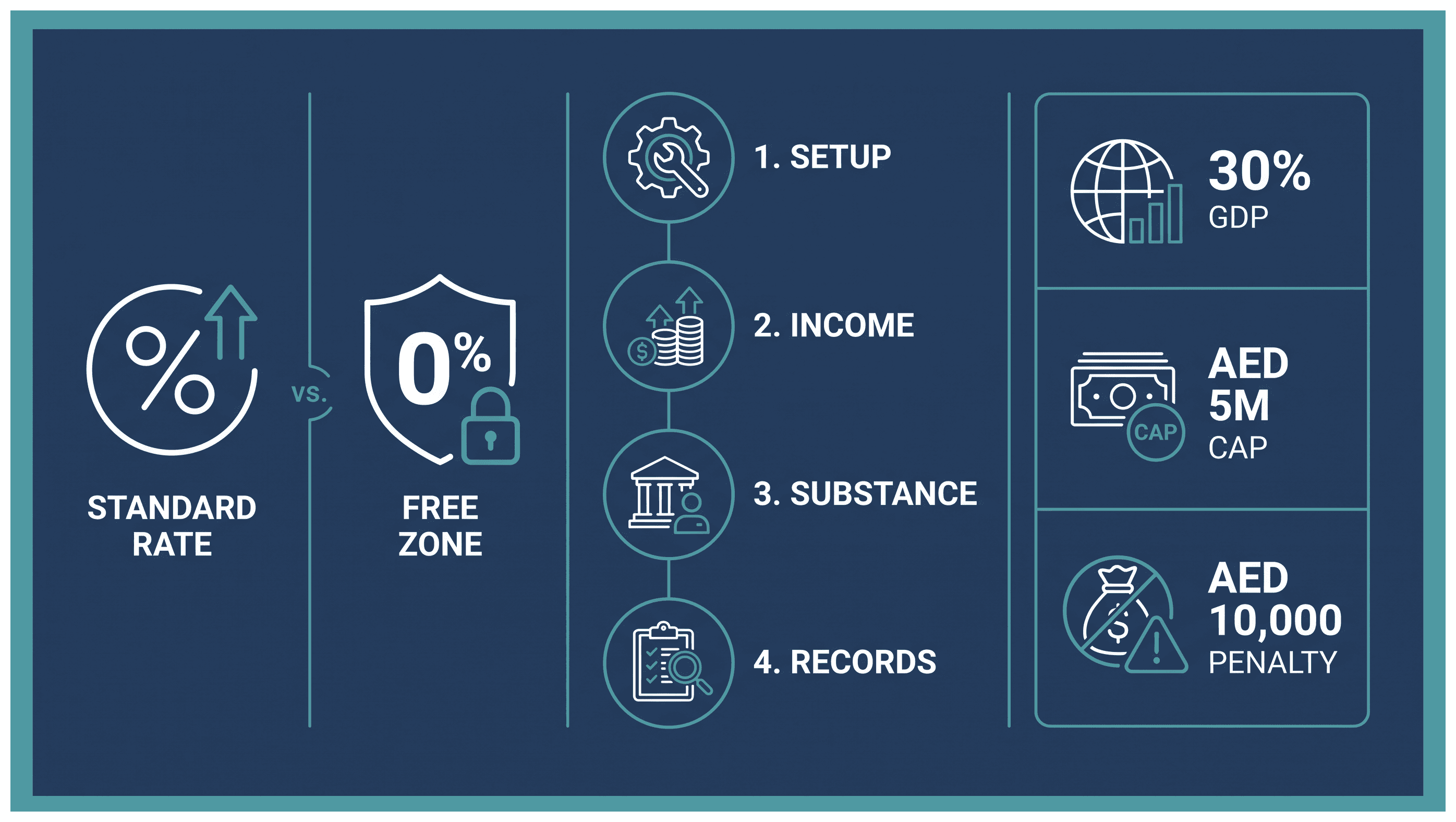
A company qualifies for the 0% corporate tax exemption in the UAE if the Federal Tax Authority classes it as a Qualifying Free Zone Person. It must be set up in a recognised free zone, earn mostly qualifying income, have real substance in the zone, and keep proper financial records. All four conditions must be met every tax period.
The Four Conditions You Must Meet
Cabinet Decision No. 55 of 2023 sets the qualifying activities list. To claim the exemption, your company must satisfy all of the following:
Condition 1: Set up in a UAE free zone the Cabinet has recognised for this purpose.
Condition 2: Earn qualifying income, broadly from other free zone persons or certain cross-border activities.
Condition 3: Keep real substance in the zone: actual staff, actual operations, actual decisions made on site.
Condition 4: Not elect the standard 9% rate, and keep non-qualifying income below 5% of total revenue or AED 5 million, whichever is lower.
What Counts as Qualifying Income
Income from transactions with other free zone persons counts as qualifying. Income from qualifying activities with overseas clients also qualifies, depending on the activity type under Cabinet Decision No. 55 of 2023. Passive income, dividends, capital gains, and interest from qualifying sources is generally exempt.
Watch out for mainland sales. Domestic sales to UAE mainland customers are usually non-qualifying. If that income stays below the de minimis cap, the firm keeps its 0% status overall. Above the cap, it loses the exemption for the whole year.
Who Does Not Qualify
Not every company can access corporate tax exemptions in the UAE. The following are disqualified:
Mainland companies: they always pay 9% on profit above AED 375,000.
Free zone companies that elected the standard rate at registration cannot switch back in the same period.
Companies with no real substance: no staff, no office, no local decisions.
Businesses earning most income from mainland UAE clients, likely breaching the de minimis rule.
Does my free zone company need to file a return if it pays 0%?
Yes. Every UAE company, including free zone firms expecting to pay 0%, must register with the Federal Tax Authority and file an annual return. The 0% rate is claimed inside the standard FTA return. Missing the filing deadline removes the exemption and triggers penalties.
How a Free Zone Company Can Pay 0% Corporate Tax
A free zone company pays 0% corporate tax in the UAE by meeting the Qualifying Free Zone Person conditions each tax period. It must earn qualifying income, keep real substance in the zone, stay within the de minimis cap on non-qualifying income, and register correctly with the Federal Tax Authority.
Choosing the Right Free Zone
Only free zones listed by the Cabinet qualify. Confirm the zone is on the approved list before you set up. Dubai South Free Zone covers logistics, trading, ICT, and professional services. All of these appear on the Cabinet's qualifying activities list. You can explore the full list of business activities before committing to a license. Setup at Dubai South Business Hub completes in one working day for eligible activities.
Building Substance in the Zone
Substance means real staff, real space, and real decisions made inside the zone. A registered address alone is not enough.
What the FTA checks:
Where key management decisions are made.
Where staff work day to day.
Where assets are held.
Whether employment contracts and board minutes exist and are dated in the zone.
Substance rules were introduced under UAE Economic Substance Regulations 2019, and an Annual Economic Substance Report is due to the relevant free zone authority each year.
5 Steps to Secure Your Corporate Tax Exemption in the UAE
To secure a corporate tax exemption in the UAE, set up in a recognised free zone, pick a qualifying activity, build real substance in the zone, register with the Federal Tax Authority, and file your tax return each year. Missing any one step can cost you the 0% rate for the whole period.
Step 1, pick your zone and activity: Choose a Cabinet-recognised free zone and a license activity on the qualifying activities list.
Step 2, set up your company: At DSBH this takes one working day for eligible activities and gives you a trade license and a registered address.
Step 3, register with the FTA: Go to tax.gov.ae and register before the deadline for your financial year-end. Late sign-up carries a penalty of AED 10,000.
Step 4, file your return: Submit within 9 months of your financial year-end. Show all income split between qualifying and non-qualifying.
Step 5, review every year: Changes in your income mix or substance level can flip you from 0% to 9%.
Annual review checklist:
Check your qualifying income share is above 95% of total revenue.
Confirm non-qualifying income is below the de minimis cap.
Update employment contracts and board minutes for the year.
File your Economic Substance Report with the free zone authority.
You can use the banking and taxation services at DSBH to help manage your annual compliance from the start. Keep records for at least 7 years. The FTA can ask to see them at any time.
Key Risks That Can Cost You the Exemption
The most common risks that remove a UAE corporate tax exemption are breaching the de minimis cap on mainland sales, failing the substance test, and missing FTA filing deadlines. Each risk is avoidable with the right setup and annual review.
The Mainland Sales Trap
Selling goods or services directly to mainland UAE clients generates non-qualifying income. If that income exceeds 5% of total revenue or AED 5 million, the whole year's taxable income is taxed at 9%. Not just the mainland portion. All of it.
The fix: Route mainland sales through a mainland entity or a licensed distributor. Keep the free zone company focused on qualifying income. Track your income split monthly, not at year-end.
Substance Failures and Record Gaps
A free zone address alone is not substance. The FTA looks for real activity, real staff, and real decisions made in the zone.
What to file each year:
Employment contracts for all zone-based staff.
Board minutes dated and signed in the UAE.
Utility bills or lease agreements for your office or flexi-desk.
Annual Economic Substance Report to your free zone authority.
Economic Substance Regulations were set under Cabinet Resolution No. 57 of 2020. Record gaps are the easiest thing for an auditor to find and the hardest to fix after the fact.
What happens if I breach the de minimis cap by accident?
If your non-qualifying income goes above the de minimis threshold in any year, the 9% rate applies to your whole taxable income for that period, not just the non-qualifying portion. Report it correctly in your FTA return and pay the right amount. The FTA has access to your free zone authority's records.
How to Register and Stay Compliant with the FTA
Every UAE company must register with the Federal Tax Authority for corporate tax, regardless of whether it expects to pay any. Free zone companies register at tax.gov.ae, file an annual return within 9 months of their financial year-end, and keep records for 7 years. Missing these steps removes the exemption.
Registration goes through the EmaraTax portal at tax.gov.ae. You need your trade license, Emirates ID or passport copy, and company details including your financial year-end date. The FTA publishes deadline schedules at tax.gov.ae. Late registration costs AED 10,000. Late filing adds further penalties on top.
Your return must show total income split between qualifying and non-qualifying. Attach your audited financial statements. Confirm your Qualifying Free Zone Person status for the period. That is where you claim the 0% rate. There is no separate free zone return. The 0% rate is claimed inside the standard FTA return.
If you breach a condition: Report it correctly and pay the right amount. The FTA has access to your free zone authority's records. Trying to hide a breach is far more costly than reporting it.
Your Next Steps
Corporate tax exemptions in the UAE are real. But they come with strict conditions. A free zone company at a recognised zone pays 0% on qualifying income as long as it has real substance, earns mostly qualifying income, and files correctly with the FTA each year.
If you want to access the 0% corporate tax rate, start here:
Confirm your activity is on the Cabinet's qualifying activities list.
Pick a recognised free zone that matches your work.
Use the DSBH cost calculator to check your setup cost before you commit.
Talk to a UAE tax adviser before you sign anything.
DSBH setup takes one working day for eligible activities. Registration with the FTA follows at tax.gov.ae. Getting the structure right at the start is the simplest way to protect the 0% rate for every year that follows.
References
Federal Tax Authority (tax.gov.ae)
Ministry of Finance (mof.gov.ae)
Frequently Asked Questions