Topic Summary
Restore Diplomatic Ties Opened the Door
Qatar and the UAE restored full diplomatic ties in January 2021, ending trade barriers and resuming direct flights. This makes cross-border setup visits and business meetings straightforward for Qatari founders.
Free Zone Setup Takes Just Days
UAE free zone company registration can complete in as little as 3 to 5 working days. Qatari nationals qualify for 100% ownership with no local sponsor required.
UAE Trade Scale Is Hard to Ignore
UAE non-oil trade reached AED 2.9 trillion in 2023, and Jebel Ali port alone handled over 14 million TEUs that year. Any Qatar-based firm in trade or distribution gains immediate access to a world-class logistics network by establishing a UAE presence.
A UAE License Unlocks Government Contracts
UAE government bodies and large corporate clients typically require suppliers to hold a valid UAE trade license before placing an order. Qatar-based firms without one are often blocked from bidding, regardless of their capabilities.
CEPAs Give UAE Firms a Trade Advantage
The UAE signed six Comprehensive Economic Partnership Agreements between 2021 and 2024, granting preferential trade terms with key global markets. Qatar-registered firms cannot access these terms directly, making a UAE entity strategically valuable.
Banking Access Improves Significantly
UAE banks offer multi-currency accounts and trade finance facilities that are difficult to replicate through Doha-only banking relationships. A UAE entity gives founders the financial infrastructure needed to serve international clients smoothly.
Run Both Companies in Parallel
Expanding into the UAE does not require closing your Qatar company. Most founders operate both entities simultaneously, using the UAE presence to access new markets while maintaining their existing Qatar operations.
UAE non-oil trade hit AED 2.9 trillion in 2023 (u.ae, 2024). The UAE population exceeded 10 million in 2024 (u.ae). DP World's Jebel Ali port handled over 14 million TEUs in 2023 (DP World, 2024). Qatar and UAE restored full diplomatic ties in January 2021. The UAE signed 6 Comprehensive Economic Partnership Agreements between 2021 and 2024 (u.ae, 2024). UAE free zone setup completes in as little as 3 working days. Cross-border business expansion from Qatar to the UAE is one of the most direct moves a Gulf-based founder can make right now.
This guide walks you through cross-border business expansion from Qatar to the UAE. You will learn which structure fits your goals, what the setup steps look like, what it costs, and how to stay on the right side of UAE tax and company rules from day one.
What Is Cross-Border Business Expansion from Qatar to the UAE and Why It Matters
Cross-border business expansion from Qatar to the UAE means setting up a legal company entity in the UAE while operating from or originating in Qatar. It lets you access UAE markets, hold a UAE trade license, hire staff, open a UAE bank account, and benefit from the UAE's global trade links.
Your options are a branch of your Qatar company, a subsidiary, or a brand-new free zone company. Most Qatar-based founders choose a free zone company. It is faster, cleaner, and gives you 100% ownership from day one. Your Qatar company does not need to close. Most founders run both in parallel.
Why the UAE Is the Right Next Market
The UAE sits at the crossroads of Africa, Asia, and Europe. Goods and services move through the UAE to 190-plus countries.
100% foreign ownership in UAE free zones, including for Qatari nationals
6 CEPAs signed between 2021 and 2024, giving UAE-based firms preferential trade terms Qatar-registered firms cannot access directly (u.ae, 2024)
UAE ranks in the global top 10 for ease of doing business (World Bank)
Profit repatriation at 100%, subject to applicable tax obligations, AML and CFT requirements and banking compliance
A Qatari consultancy that wins a contract with an Abu Dhabi government body often hits one wall fast: the client needs a UAE-licensed entity to invoice them. Start your business in Dubai and you remove that barrier for good.
Why Qatar-Based Firms Are Moving into the UAE
Qatar-based firms expand into the UAE to reach a larger consumer market, access UAE banking and trade infrastructure, win UAE government and corporate contracts that require a local license, and position themselves as regional hubs for clients across Africa, Asia, and Europe.
Logistics scale: Jebel Ali handled over 14 million TEUs in 2023 (DP World, 2024). Any firm in trade or distribution needs a UAE presence to plug into that network
Procurement rules: UAE corporate clients and government bodies often need a UAE-licensed supplier to place an order
Banking access: UAE banks offer multi-currency accounts and trade finance that Doha-only firms cannot easily access
A Qatari food-import firm wanting to supply UAE hotel chains runs into this fast. The hotels need a UAE-licensed supplier for procurement compliance. A UAE trading license in Dubai solves that instantly.
Bilateral Ties That Make the Move Easier
Qatar and UAE restored full diplomatic ties in January 2021. Direct flights resumed. Trade barriers dropped. GCC nationals, including Qataris, can own 100% of a UAE free zone company with no local sponsor. Qatari passport holders also enter the UAE visa-free, which keeps site visits and setup meetings simple.
6 Steps to Cross-Border Business Expansion from Qatar to the UAE
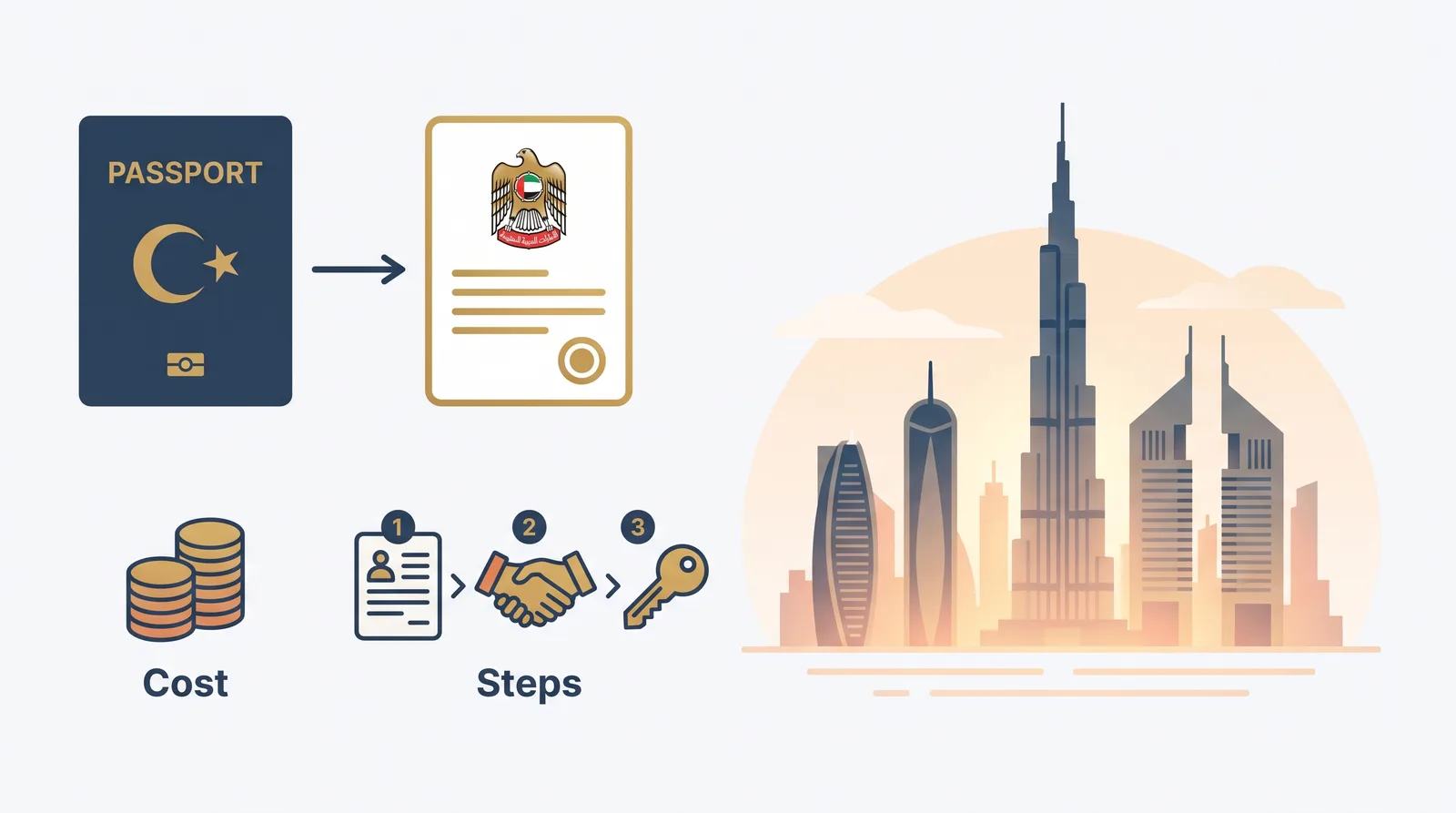
To complete cross-border business expansion from Qatar to the UAE: choose your structure, pick your trade license activity, reserve your company name, submit your documents, pay your license fee, then apply for visas and open a UAE bank account. The full process takes as little as 5 working days in a free zone.
Steps 1 to 3: Structure, Activity, and Name
Step 1, choose your structure: A free zone company suits most Qatar-based founders who want speed and 100% ownership.
Step 2, pick your activity code: The code sets what you can legally sell or do. Check the approved list of business activities before you go further.
Step 3, reserve your trade name: The name must not clash with an existing registered company. Check company name availability online before you apply.
Steps 4 to 6: Documents, Fees, and Bank Account
Step 4, submit your papers: You need your passport copy (valid 6-plus months), a passport photo, and proof of your Qatar address.
Step 5, pay the license fee: DSBH issues the trade license in 3 to 5 working days.
Step 6, apply for your visa and open a bank account: You need the trade license to do both. Apply for your UAE residency visa first, then approach the bank.
Free Zone vs Mainland: Key Differences for Qatar-Based Founders
Feature | Free Zone (DSBH) | UAE Mainland |
|---|---|---|
Foreign ownership | 100% foreign ownership, no restrictions | 100% allowed in most activities since 2021 reforms; some sectors still need a local service agent |
Setup time | 3 to 5 working days | Typically 2 to 4 weeks |
Local sponsor needed | No local sponsor required | Local service agent required for some regulated activities |
Sell to UAE mainland market | Via a distributor or agent; direct retail sales restricted | Full direct access to UAE consumers and businesses |
Bid on government contracts | Limited; some federal tenders require a mainland license | Full access to UAE federal and emirate-level tenders |
Corporate tax 0% option | Yes, if you meet Qualifying Free Zone Person conditions | Standard 9% rate applies; no 0% qualifying route |
Choosing the Right License and Structure
Qatar-based founders expanding into the UAE typically choose between a free zone company and a UAE mainland company. Free zones offer 100% foreign ownership, fast setup, and no need for a local partner. Mainland companies give you direct access to UAE government contracts and the full local market. DSBH offers 3 main license types:
Trading license: Buy and sell goods, import and export. Right for Qatari firms in commodities, retail, or distribution
Service or consulting license: Deliver skills and advice. Right for Qatari firms in tech, finance, marketing, or management
Industrial license: Make or process goods. Less common for Qatar-based starters but available at DSBH
A Qatari management consulting firm picks a professional services license at DSBH. They invoice UAE and international clients from day one. Free zone companies can repatriate 100% of profits subject to applicable tax obligations, AML and CFT requirements and banking compliance (u.ae).
If most of your target clients are UAE federal or emirate agencies, a mainland license or a dual setup gives you cleaner access to those tenders.
Tax and Compliance Rules You Must Know
UAE companies must register for corporate tax once the entity exists, regardless of turnover. The standard rate is 9%. Free zone companies can pay 0% corporate tax if they meet the Qualifying Free Zone Person conditions the Federal Tax Authority sets. VAT at 5% applies to most goods and services above AED 375,000 annual turnover.
A free zone company run by a Qatari founder earning AED 2 million in consulting fees from international clients can qualify for the 0% rate if all income comes from outside the UAE domestic market. Check the FTA site for the exact conditions before you rely on that rate.
Qatar has its own VAT system at 5%. Two entities means two separate VAT duties. Keep financial records for at least 5 years. The FTA can ask to see them at any point. Get tax advice before you start trading from both. The banking and taxation services at DSBH can point you to the right professionals.
Costs and Timelines for Setting Up in the UAE
A UAE free zone trade license at Dubai South Business Hub costs vary by activity and visa quota. Setup takes 3 to 5 working days. Budget separately for your trade license fee, visa costs per person, and a flexi-desk or office package. Use the DSBH cost calculator to get an exact figure for your setup.
License fee: Paid at setup and renewed each year. The amount depends on your activity and visa quota
Visa costs: Each residency visa (investor or employee) carries its own fee. Most founders start with 1 to 2 visas
Office or flexi-desk: DSBH offers flexi-desk options for companies that do not need a full physical office from day one
Stage | Typical timeline |
|---|---|
Trade license issued | 3 to 5 working days (DSBH) |
Investor visa processed | 5 to 10 working days after license |
UAE bank account opened | 2 to 4 weeks (varies by bank) |
Full setup complete | 3 to 5 weeks from day one |
Common Mistakes to Avoid When Expanding from Qatar
The most common mistakes Qatar-based founders make when expanding into the UAE are choosing the wrong license activity, underestimating the bank account timeline, ignoring UAE corporate tax registration, and trying to run UAE client contracts through the Qatar entity instead of the UAE company.
Wrong activity code: Picking the wrong code means you cannot legally do the work. Fix it before you sign client contracts
Wrong structure: Choosing a free zone when your client base is UAE mainland government bodies creates problems. They may need a mainland-licensed supplier
Bank timeline: UAE bank account opening is not automatic. Banks do due diligence that takes 2 to 4 weeks or longer
Corporate tax registration: Failing to register for UAE corporate tax from day one can lead to penalties. Do it right away (FTA)
Invoice routing: Running UAE client invoices through your Qatar company while operating a UAE entity creates a compliance risk in both countries
References
u.ae (u.ae)
DP World (dpworld.com)
World Bank (worldbank.org)
FTA (tax.gov.ae)
Frequently Asked Questions