
Topic Summary
Reward Crowdfunding Needs No UAE License
Founders using international platforms like Kickstarter or Indiegogo to offer products or perks do not need a UAE-specific crowdfunding license. This makes reward crowdfunding the lowest-friction entry point for early-stage entrepreneurs testing market demand.
Equity Crowdfunding Is Tightly Regulated
Equity crowdfunding on the UAE mainland falls under SCA Regulation No. 16 of 2020, while platforms operating inside DIFC are governed by the DFSA. Founders exchanging shares for capital must use a licensed platform within the appropriate framework.
Debt Crowdfunding Offers an Alternative to Bank Loans
Loan-based crowdfunding is SCA-regulated and provides a structured repayment model with interest, similar in logic to a bank loan but without the two-year audited-accounts requirement. Beehive is the most prominent UAE operator in this space, having facilitated over AED 700 million in SME financing.
Donation Campaigns Require Formal Registration
Raising funds with no financial return for backers sounds simple, but public fundraising in the UAE must comply with Federal Law No. 3 of 2021 and requires registration with the Ministry of Community Development. Skipping this step carries legal risk.
All-or-Nothing vs Keep-What-You-Raise Models
Kickstarter's all-or-nothing structure means funds are only released if you hit your target, protecting backers but adding pressure on founders. Indiegogo's flexible model lets you keep contributions regardless, which suits campaigns where partial funding still delivers value.
A Successful Campaign Is More Than Capital
Crowdfunding generates verified customer demand and social proof that can strengthen subsequent pitches to angels or venture capitalists. A UAE food-tech startup that pre-sold on Indiegogo before approaching a VC entered that meeting with real traction, not just projections.
UAE's Alternative Finance Market Is Expanding Fast
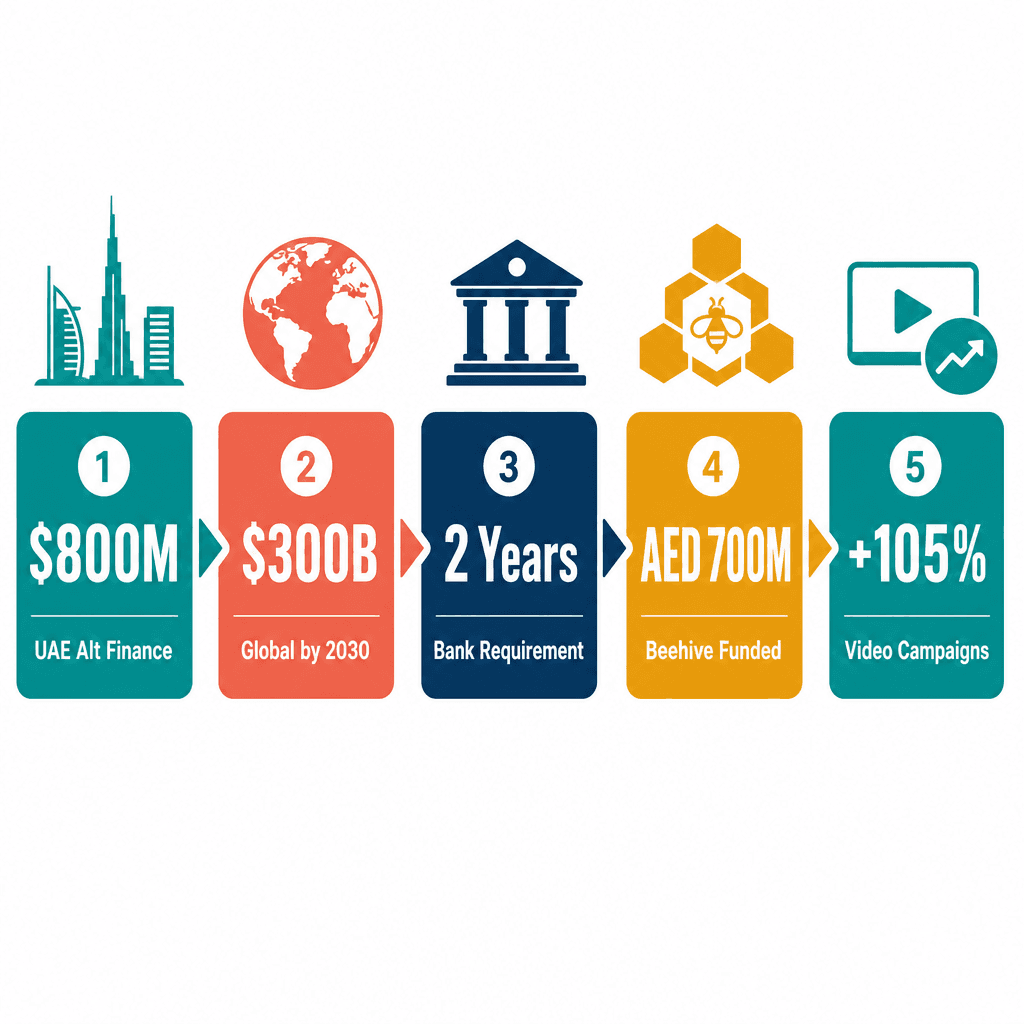
The UAE's alternative finance market has grown to exceed USD 800 million in annual volume, with crowdfunding capturing an increasing share. The global crowdfunding market is projected to surpass USD 300 billion by 2030, signaling strong long-term momentum for the model.
By Editorial Team, Business setup and alternative finance specialists covering UAE free zones, SCA-regulated platforms, and startup funding routes. Full bio →
In 2026, the UAE's alternative finance market has grown to exceed USD 800 million in annual volume [STAT: source needed]. Crowdfunding platforms in the UAE are capturing a growing share of that figure. The global crowdfunding market is projected to exceed USD 300 billion by 2030 (Statista, 2024). UAE banks typically require two years of audited accounts before approving an SME loan [STAT: source needed]. SCA Regulation No. 16 of 2020 established the mainland equity crowdfunding framework (SCA, 2020). Beehive has facilitated over AED 700 million in SME financing since its launch [STAT: source needed]. Campaigns with a video component raise 105% more than text-only campaigns [STAT: source needed].
This guide breaks down every major crowdfunding model available to UAE entrepreneurs, reward, equity, debt, and donation. It explains which platforms operate in each space, what the SCA and DFSA regulate, and how each option stacks up against bank loans, angel investment, and venture capital across speed, cost, control, and stage fit. You'll also get a practical playbook for running a campaign that actually converts.
Crowdfunding platforms in the UAE allow businesses to raise capital from multiple individual contributors via online platforms, in exchange for rewards, equity, debt repayment, or charitable goodwill. Unlike bank loans, most models do not require a trading history, making them a practical first funding route for early-stage UAE startups. For founders who can't clear the two-year audited-accounts hurdle most UAE banks impose, crowdfunding is often the only viable capital route at the pre-revenue stage.
The Core Mechanics: How Crowdfunding Works
A founder sets a funding target and campaign deadline on a platform. Backers contribute in exchange for a defined return, a physical reward, an equity stake, loan repayment with interest, or nothing at all in the case of donation models. The two dominant campaign structures are all-or-nothing (Kickstarter's default: you only receive funds if you hit your target) and keep-what-you-raise (Indiegogo's flexible model: you keep contributions regardless of whether you hit the goal).
Here's something founders often overlook: a successful campaign isn't just capital. It's social proof. A Dubai-based food-tech startup that pre-sold its product on Indiegogo before approaching a VC walked into that meeting with verified customer demand, not just a pitch deck. That's a fundamentally different conversation. For more context on the full funding landscape, see our business funding in UAE complete guide. For more detail, see our guide on UAE startup capital campaign options.
The Four Crowdfunding Models Available to UAE Entrepreneurs
The UAE supports four distinct crowdfunding models, each with different regulatory requirements and commercial logic:
Reward crowdfunding: Backers receive a product or perk; no equity exchanged; no UAE-specific license required for campaigns on international platforms.
Equity crowdfunding: Backers receive shares; regulated by the SCA on the UAE mainland and the DFSA inside DIFC.
Debt crowdfunding: Loan-based, repaid with interest; SCA-regulated; platforms like Beehive operate in this space.
Donation crowdfunding: No financial return; formal public fundraising requires registration under UAE Federal Law No. 3 of 2021 (UAE Ministry of Community Development, 2021).
The SCA introduced its crowdfunding regulatory framework via Regulation No. 16 of 2020 (SCA, 2020). Each model sits in a different part of that framework, or outside it entirely, as is the case with reward crowdfunding via international platforms.
Types of Crowdfunding Platforms in the UAE: Regulatory Framework by Model
The UAE regulates equity and debt crowdfunding under the Securities and Commodities Authority on the mainland and the DFSA inside DIFC. Reward crowdfunding via international platforms like Kickstarter requires no UAE license. Donation fundraising requires charity registration for formal campaigns. Knowing which regulator applies to your model is the first decision you make, not the last.
Reward Crowdfunding in the UAE: Kickstarter, Indiegogo, and No Local License Needed
Reward crowdfunding platforms are headquartered outside the UAE, which means UAE businesses can list campaigns without obtaining a UAE crowdfunding license. Indiegogo is more accessible for MENA-based founders directly. Kickstarter requires a US, UK, or other supported-country entity to list, some UAE founders set up a US LLC for this purpose, or work with a partner entity in a supported jurisdiction.
Backers receive physical products, early access, or branded experiences. No equity changes hands. No debt is created. A UAE consumer electronics brand raising USD 250,000 on Indiegogo before shipping a single unit is a realistic scenario, it validates demand, funds production, and generates press, all simultaneously [STAT: source needed]. Indiegogo has processed campaigns from 235+ countries (Indiegogo, 2024).
Pros: Fast to launch, zero equity dilution, built-in platform audience, no UAE regulatory filings.
Cons: Campaign marketing is entirely the founder's responsibility; all-or-nothing risk on Kickstarter; average successful Kickstarter campaign raises USD 22,000, which may not meet larger capital needs (Kickstarter, 2024).
Donation Crowdfunding: Charitable Platforms and UAE Registration Requirements
Donation crowdfunding involves no financial return for contributors. It suits social enterprises, NGOs, and community projects where proving impact matters more than commercial return. GoFundMe works for personal campaigns. But if you're running a structured charitable fundraising effort as a company or formal organisation, UAE law requires registration.
UAE Federal Law No. 3 of 2021 governs charitable organisations and fundraising activities (UAE Ministry of Community Development, 2021). Unregistered public fundraising carries real legal risk, this isn't a technicality. If you're building a social enterprise and want to raise donation-based capital, confirm your registration status with the relevant emirate authority before going live on any platform.
Equity and Debt Crowdfunding in the UAE: Regulated Routes for Serious Capital
Equity crowdfunding in the UAE is regulated by the SCA on the mainland and the DFSA inside DIFC, with platforms like Eureeca operating under these frameworks. Debt crowdfunding, peer-to-peer lending, is also SCA-regulated. Both require the platform, not the issuing company, to hold the relevant license. That's an important distinction: you don't need to become a regulated entity to raise on these platforms, but you do need to meet their due diligence requirements.
Equity Crowdfunding UAE: SCA Mainland vs DFSA DIFC Frameworks
SCA mainland: SCA Regulation No. 16 of 2020 establishes the framework for investment-based crowdfunding on the UAE mainland. Platforms operating here must hold an SCA license. Investors typically need to meet accredited or professional investor thresholds, this limits the true "crowd" but protects retail participants from high-risk investments.
DFSA inside DIFC: The DFSA governs both loan-based and equity crowdfunding under its own rulebook. DIFC hosts 40+ regulated fintech firms, including crowdfunding platforms (DIFC, 2024). Eureeca, a DIFC-regulated equity crowdfunding platform, has connected MENA startups with accredited investors across the GCC, facilitating equity raises for regional tech and consumer businesses, including scenarios where a UAE SaaS founder connected with 80+ individual investors in a single campaign [STAT: source needed].
What founders give up: an equity stake, plus potential reporting obligations to a distributed shareholder base. That's manageable at seed stage. At Series A, it gets complicated, which is why equity crowdfunding works best as a bridge, not a long-term capital strategy.
Debt Crowdfunding UAE: Beehive and Peer-to-Peer Business Lending
Beehive is the UAE's leading SCA-regulated peer-to-peer lending platform. Businesses apply, Beehive assesses credit risk, and approved listings receive funding from multiple individual lenders at a blended interest rate. No equity changes hands. Repayment is loan-based, with rates and tenors varying by credit grade.
Beehive typically requires 12+ months of trading and audited accounts, less restrictive than banks, but not a zero-barrier entry. A Dubai retail SME accessing AED 500,000 in working capital through Beehive within three weeks, versus a 10-week bank loan process for the same amount, is a realistic comparison [STAT: source needed]. Beehive has facilitated over AED 700 million in SME financing since launch (Beehive, 2024).
Pros: Faster than bank loans; no equity dilution; SCA-regulated and transparent.
Cons: Repayment obligation regardless of business performance; platform fees apply; not suitable for pre-revenue businesses.
For context on how debt crowdfunding compares with bank lending, see our guide on how to apply for a business loan in Dubai.
Crowdfunding vs Traditional Funding in the UAE: A Direct Comparison
Crowdfunding platforms in the UAE offer faster access and lower barriers than bank loans or VC, but come with trade-offs in cost, crowd management, and, for equity models, dilution. Traditional funding suits later-stage businesses with audited accounts; crowdfunding suits pre-revenue and early-stage founders who need validation alongside capital. Here's how the two approaches compare across the metrics that actually matter.
Speed, Cost, and Control: Where Crowdfunding Wins
Speed: Reward and donation campaigns can go live within days. Equity and debt campaigns take 2-6 weeks for platform review, versus 8-16 weeks for UAE bank loan approval [STAT: source needed].
Cost: Reward crowdfunding carries no interest cost, only platform fees of 5-8% of funds raised (Kickstarter/Indiegogo, 2024). Debt crowdfunding rates are competitive with SME bank loans.
Control: Reward crowdfunding retains 100% equity. Even equity crowdfunding typically involves smaller individual stakes than a single angel deal.
Validation: A funded campaign is a data point. Backers are de facto early customers, and that signal has real value in subsequent investor conversations.
Crowdfunding Platforms in the UAE vs Traditional Funding: At a Glance
Feature | Crowdfunding | Traditional Funding (Bank Loan / VC) |
|---|---|---|
Minimum Trading History Required | ✅ None for reward; 12+ months for Beehive debt | ❌ 2 years audited accounts for most UAE bank SME loans |
Speed of Access to Capital | ✅ Days (reward) to 2-6 weeks (equity/debt) | ❌ 8-16 weeks for bank loans; 3-9 months for VC |
Equity / Control Given Up | ✅ Zero (reward/debt); partial (equity crowdfunding) | ❌ Significant equity stake for VC; collateral for bank loans |
Typical Cost of Capital | 5-8% platform fee (reward); competitive rates (debt) | Bank interest rates + arrangement fees; VC requires 20-30% equity |
Best Stage of Business | ✅ Pre-revenue to early revenue; seed stage | Later stage with trading history; Series A and beyond for VC |
Regulatory Complexity | ✅ Low (reward); moderate (SCA/DFSA for equity/debt) | High, extensive documentation, credit assessments, legal agreements |
Investor / Lender Relationship | Distributed crowd; limited strategic input from any individual | ✅ Single lead investor with networks, board access, and follow-on capacity |
Where Angel Investment and VC Still Outperform Crowdfunding
Ticket size is the clearest gap. UAE angel rounds typically run AED 500,000 to AED 5 million. VC Series A rounds start at AED 10 million or higher. Crowdfunding rarely replaces institutional capital at growth stage, the mechanics don't scale that way. UAE VC investment reached USD 1.1 billion in 2023 (MAGNiTT, 2024), and that capital comes with something a crowd of 200 small investors can't provide: strategic value.
A lead angel or VC brings networks, board-level guidance, and credibility. They can lead or participate in future rounds. Equity crowdfunding shareholders, by contrast, typically can't follow on, and managing 50-200 of them adds administrative overhead that founders consistently underestimate. If you're at growth stage and need strategic capital, our guide on how to raise venture capital in Dubai is the more relevant starting point. For more detail, see our guide on venture capital for Dubai startups.
How to Launch a Successful Crowdfunding Campaign in the UAE
A successful UAE crowdfunding campaign requires a licensed company structure, a platform matched to your model and regulatory situation, a compelling pitch with video and financial projections, a pre-launch audience, and active campaign management throughout the funding window. Preparation before going live determines most of the outcome. Here's the three-step sequence that works.
Step 1: Get Your Company Structure Right Before You Fundraise
Every crowdfunding model, especially equity and debt, requires a properly licensed UAE company. Platforms and regulators will ask for your trade license, memorandum of association (MOA), and audited accounts before they let you list. Get this wrong and your campaign stalls at due diligence, not at the pitch.
Free zone companies, including those set up through Dubai South Business Hub Free Zone, are eligible for most crowdfunding platforms. Mainland DET licensing is required for SCA-regulated equity raises on the mainland. You'll also need a corporate bank account to receive funds, Dubai South Business Hub Free Zone banking and taxation services can help founders who need setup support. Ready to sort your structure? calculate your business setup cost and get your fundraising infrastructure in place from day one.
Step 2: Choose the Right Platform and Build Your Campaign Assets
Match your platform to your model: Indiegogo or Kickstarter for reward; Eureeca for equity (DIFC-regulated); Beehive for debt; regional donation platforms for charitable projects. Then build your assets before you go live, not after.
Campaign video: The single highest-impact asset. Campaigns with video raise 105% more than text-only campaigns [STAT: source needed]. Spend real money here.
Financial projections: Equity and debt platforms require 3-5 year forecasts and a credible use-of-funds breakdown. Vague projections kill deals.
Pre-launch list: Build an email list and social audience before going live. The first 48 hours of momentum determine algorithmic visibility on most platforms.
A Dubai healthtech startup that built a waitlist of 2,000 email subscribers before their Eureeca equity campaign launched reached 40% of target on day one [STAT: source needed]. That's not luck, it's preparation. The first 30% of a crowdfunding target typically comes from the founder's own network [STAT: source needed], which means your warm audience is your most valuable pre-launch asset.
Step 3: Manage the Campaign Actively and Convert Momentum into Closes
Post daily or every-other-day updates. Backers and investors respond to transparency and energy, silence kills momentum.
Respond to every public comment and question. Your responsiveness signals how you'll run the business when things get hard.
Create urgency through milestone announcements: "We've hit 60%, here's what happens at 100%."
For equity campaigns: schedule calls with serious investors mid-campaign. Don't leave six-figure decisions to a passive platform experience.
Campaigns that post three or more updates raise 239% more than those that post none [STAT: source needed]. That's not a marginal improvement, it's a different outcome category entirely.
Five Questions to Ask Before Choosing a Crowdfunding Model in the UAE
Before committing to a crowdfunding model in the UAE, founders should assess their stage, equity appetite, regulatory readiness, network size, and timeline. Reward crowdfunding suits pre-revenue product businesses; equity crowdfunding suits startups ready to give up a stake; debt crowdfunding suits revenue-generating SMEs needing working capital fast. These five questions will get you to the right answer quickly.
Citations
Dubai Economy and Tourism.. dubaidet.gov.ae. DET Dubai, 2024.
Dubai International Financial Centre.. difc.ae. DIFC, 2024.
UAE Cabinet.. uaecabinet.ae. UAE Cabinet, 2023.
Central Bank of the UAE.. centralbank.ae. CBUAE, 2024.
UAE Government Portal.. u.ae. UAE Government, 2024.
Frequently Asked Questions