Topic Summary
Small Businesses Are Prime Cyber Attack Targets
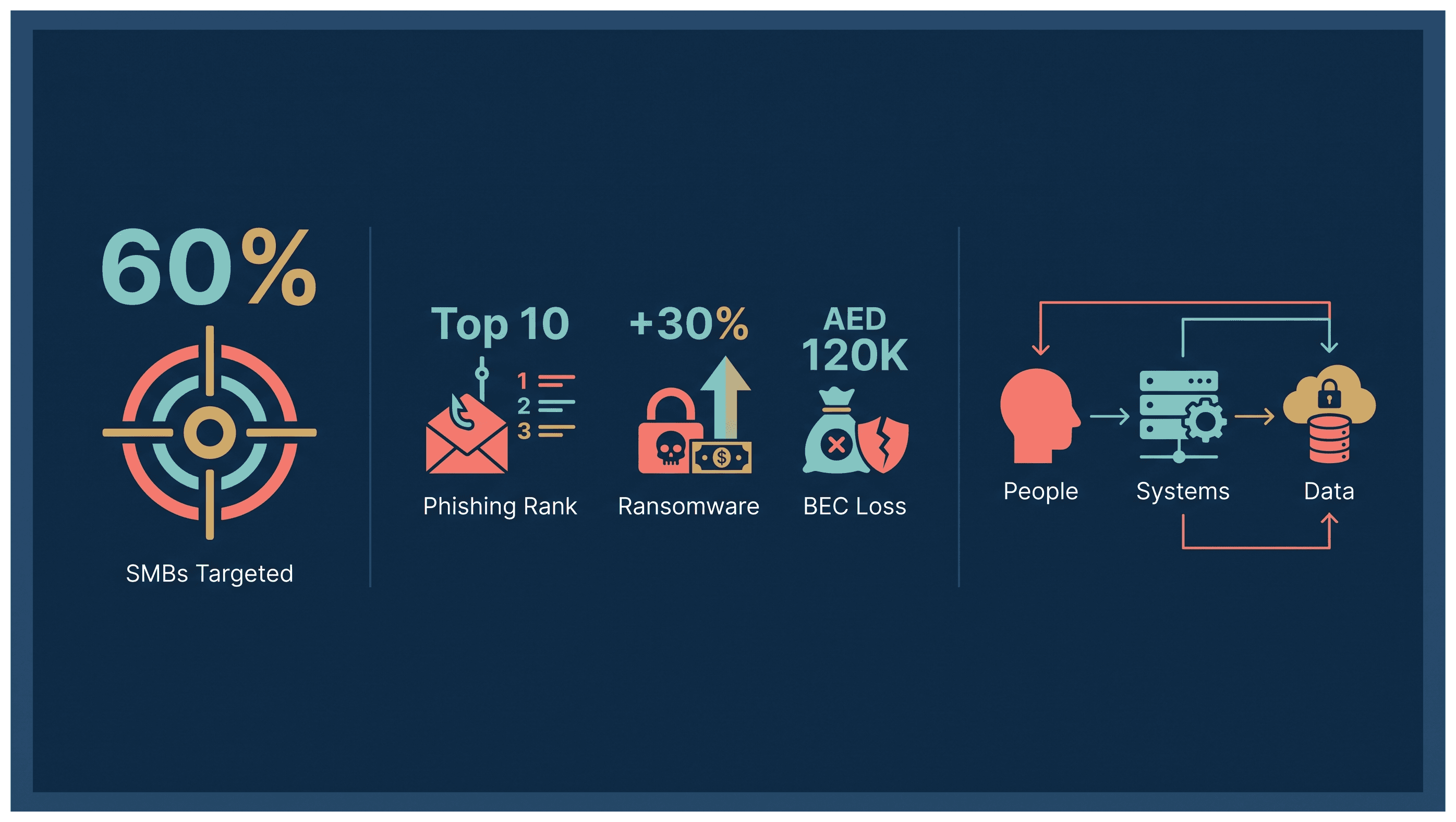
Over 60% of global cyber attacks target small and medium businesses, and UAE firms are no exception. Most SME owners wrongly assume they are too small to be worth attacking, but low defences make them easier marks than large corporations.
Cybersecurity Covers People, Systems, and Data
Cybersecurity is a business risk across three areas: your staff, your technology, and the data you hold. Most breaches start with a person, not a machine — a Dubai retail SME lost AED 85,000 after an employee clicked a fake supplier email that no antivirus detected.
UAE's Digital Adoption Creates More Entry Points
High use of cloud tools, WhatsApp payments, and online banking expands the attack surface for UAE small businesses. Free zone companies are especially exposed, as they often store sensitive client data with little to no dedicated IT support.
Four Threats Hitting UAE SMEs Hardest Right Now
Phishing, business email compromise (BEC), ransomware, and SIM-swap fraud are the most common attacks targeting UAE small businesses today. Ransomware attacks on UAE firms rose 30% year-on-year in 2024, and BEC scams have cost individual businesses up to AED 120,000 in a single incident.
Personal Devices Create Dangerous Security Gaps
Most UAE SMEs rely on personal devices for business tasks, which are harder to patch, monitor, and control than company-issued equipment. A single compromised personal device can expose your entire client list or give attackers a back door into larger supply chain partners.
UAE Cybercrime Laws Apply to Your Small Business
UAE small businesses must comply with Federal Decree-Law No. 34 of 2021 on cybercrime and the UAE Personal Data Protection Law. Breaches can result in fines, criminal charges, and loss of your trade license, and claiming ignorance of the law is not a legal defence.
Over 60% of all cyber attacks globally target small and medium businesses, and UAE firms are no exception (UAE Cybersecurity Council, 2024). The UAE ranked among the top 10 most targeted countries for phishing in 2024. Ransomware attacks on UAE firms rose 30% year-on-year in 2024. Most small business owners think they are too small to be a target. They are wrong.
This guide covers what small businesses and cybersecurity in the UAE means in practice. You will learn which threats are most common, what the law requires, and the exact steps you can take to protect your business right now.
What Is Cybersecurity for Small Businesses in the UAE and Why It Matters
Cybersecurity for small businesses in the UAE means protecting your company's data, systems, and money from digital attacks. UAE SMEs face phishing, ransomware, and fraud daily. A single breach can cost tens of thousands of dirhams and damage your reputation with clients and partners for years.
What Cybersecurity Actually Covers
Cybersecurity is not just an IT problem. It is a business risk covering three areas: your people, your systems, and your data. All three must be protected, and most attacks exploit the weakest of the three.
A Dubai-based retail SME lost AED 85,000 after a staff member clicked a fake supplier email. No antivirus caught it. The attack targeted a person, not a machine. That is how most breaches start.
People: staff who click bad links, reuse passwords, or share login details
Systems: devices, software, Wi-Fi, and cloud tools your business runs on
Data: client records, payment details, contracts, and financial files
Why UAE Small Businesses Face Unique Risks
The UAE's high digital adoption creates more attack surfaces. Cloud tools, WhatsApp payments, and online banking are all entry points. More tools mean more ways in for attackers.
Free zone companies often store sensitive client and financial data with minimal IT staff. One free zone consultancy using a shared cloud drive with no password policy had client contracts exposed in a credential-stuffing attack. That kind of gap is common, and it is avoidable.
Why Small Businesses in the UAE Are at High Risk
Small businesses in the UAE are high-value, low-defence targets. Most run with no dedicated IT team, weak passwords, and outdated software. Attackers know this. UAE SMEs are hit by phishing, business email fraud, and ransomware more than large firms because the barriers to entry for attackers are much lower.
The Most Common Threats Right Now
Knowing what you are up against is the first step. Here are the 4 attacks hitting UAE small businesses hardest right now:
Phishing: fake emails that look like UAE government bodies, banks, or suppliers
Business email compromise (BEC): attackers fake a manager's email to redirect payments
Ransomware: your files are locked and you pay to get them back
SIM-swap fraud: attackers take over your mobile number to access business bank accounts
A trading company in Dubai received an email that appeared to come from its freight partner. The account number had changed by one digit. AED 120,000 was transferred before anyone noticed. That is a BEC attack, and it is one of the most common threats facing UAE SMEs today.
Why Attackers Target Small Businesses First
Small firms rarely have a dedicated security team. Staff get less training than in large corporates. And SMEs often connect to large enterprise supply chains, making them a back door to bigger targets.
Most UAE SMEs rely on personal devices for business work
Personal devices are harder to patch, monitor, and control
One weak device can expose your entire client list
UAE Cybersecurity Laws Your Small Business Must Follow
UAE small businesses must comply with Federal Decree-Law No. 34 of 2021 on cybercrime and the UAE Personal Data Protection Law. Breaches can lead to fines, criminal charges, and loss of your trade license. Ignorance of the law is not a defence.
Federal Decree-Law No. 34 of 2021
This is the UAE's main cybercrime law. It applies to every business registered in the UAE, including free zone companies. Fines start at AED 100,000, and serious breaches carry jail terms.
Hacking and unauthorised access: covered under Articles 2 to 6
Data theft and fraud: criminal offence regardless of company size
Spreading malware: your business can be liable even if the attack came from outside
Data Protection and What It Means for You
The UAE Personal Data Protection Law (PDPL) came into force in January 2022. It requires businesses to collect data lawfully, store it securely, and delete it when it is no longer needed. If you suffer a breach, you may be required to report it to the relevant authority within 72 hours (UAE Cabinet, 2022).
Collect only the data you actually need
Store it with encryption and access controls
Have a breach reporting process ready before you need it
8 Cybersecurity Steps Every UAE Small Business Should Take
UAE small businesses should use strong passwords, enable two-factor login, train staff on phishing, back up data daily, keep software updated, secure their Wi-Fi, control who can access what, and have a plan ready for when something goes wrong. These 8 steps cut most common attack risks significantly.
Steps 1 to 4: The Basics You Cannot Skip
Most breaches involve a human element. These 4 steps address that directly. A small logistics firm in Dubai ran one phishing simulation with staff. Within 3 months, click rates on fake emails dropped from 34% to 6%.
Step 1, use strong unique passwords: Use a password manager and never reuse passwords across accounts.
Step 2, turn on two-factor login: Adds a second check even if a password is stolen.
Step 3, train your staff: Run a short phishing drill every quarter, most attacks start with a person, not a system.
Step 4, back up your data: Keep 3 copies, one local, one cloud, one offsite, and test the restore every month.
Steps 5 to 8: Locking Down Your Systems
A UAE professional services firm discovered an ex-employee still had active login credentials 4 months after leaving. A quarterly access audit would have caught this on day one.
Step 5, keep software updated: Most attacks exploit known weaknesses that patches already fix.
Step 6, secure your Wi-Fi: Use WPA3 encryption and set a separate guest network for visitors.
Step 7, limit access rights: Staff should only see what they need, review access every time someone leaves.
Step 8, write an incident plan: Know who you call, what you shut down, and how you tell clients if something goes wrong.
How Much Cybersecurity Costs for a UAE Small Business
Basic cybersecurity for a UAE small business can cost as little as AED 200 to AED 800 per month. This covers antivirus software, a password manager, cloud backup, and email filtering. More advanced tools like endpoint detection or a managed security service run from AED 1,500 to AED 5,000 per month depending on team size.
Low-Cost Tools That Work
Microsoft 365 Business Premium: email filtering, device management, and threat detection built in (approx. USD 22 per user per month, 2024 pricing)
Password manager: under AED 50 per user per month for a business-grade tool
Cloud backup: included in most Google Workspace and Microsoft 365 plans
Have I Been Pwned: free tool to check if your business email appeared in a known breach
When to Bring in Outside Help
If you handle customer financial data, health records, or legal documents, a managed security provider is worth the cost. A UAE-based IT security firm can carry out a one-off vulnerability check for AED 3,000 to AED 8,000. Cyber insurance is now available in the UAE, with premiums starting from AED 5,000 per year, covering breach response costs, legal fees, and client notification.
The Central Bank of the UAE also sets minimum cybersecurity standards for financial services firms, worth checking if your business touches payments or lending.
Cybersecurity When You Set Up or Move a Business in the UAE
When setting up a business in the UAE, cybersecurity should be built in from day one. Choose a business email with two-factor login before you trade. Secure your accounting software, client data, and payment systems before you onboard your first customer. Retrofitting security after a breach costs far more than getting it right at the start.
Security Checks Before You Launch
Register your business domain and set up a professional email first, personal Gmail accounts are a security risk
Use a business-grade cloud accounting tool with role-based access from day one
Set up your data backup system before you store any client files
Confirm your UAE business bank account has two-factor login active before your first transfer
Picking the Right Business Structure for Digital Safety
Free zone companies in the UAE often have access to faster digital onboarding with built-in compliance tools. If you are setting up a business in a free zone, your business activity also determines which data rules apply. An ICT license in Dubai carries different data handling duties than a retail trading license.
An SME owner setting up an ICT consultancy at Dubai South Business Hub matched their business activities to the correct license category. That step clarified their data handling duties under UAE law from the start. Free zone setup at Dubai South Business Hub completes in one working day for eligible activities, which means you can have your security basics in place before you open for business.
Is cybersecurity a legal requirement for UAE small businesses?
Yes. Federal Decree-Law No. 34 of 2021 applies to all UAE-registered businesses regardless of size. The UAE Personal Data Protection Law adds further duties for any business handling customer data. Fines start at AED 100,000 for serious breaches.
What to Do If Your UAE Small Business Is Attacked
If your UAE small business suffers a cyber attack, act fast. Disconnect the affected device from your network. Change all passwords from a clean device. Call your bank if financial accounts are involved. Report the incident to the UAE Cybersecurity Council or local police. Document everything from the moment you discover the breach.
Your First 24 Hours After an Attack
Disconnect: unplug the affected device from Wi-Fi and ethernet, do not turn it off
Change: update passwords on all key accounts from a different, clean device
Call: notify your bank immediately if any financial accounts were accessed
Document: write down what happened, when, and which systems were involved, you will need this for any report or insurance claim
How to Report a Cyber Attack in the UAE
Report to the UAE Cybersecurity Council via their official portal at u.ae
File a report with Dubai Police (cybercrime hotline: 901) or your emirate's cybercrime unit
References
UAE Cybersecurity Council (u.ae)
Statista (statista.com)
Dubai Chamber (dubaichamber.com)
UAE Cabinet (uaecabinet.ae)
Central Bank of the UAE (centralbank.ae)
Frequently Asked Questions