
Topic Summary
What Is Home Country Deregistration Redomicile and Why Does It Matter?
Home country deregistration after redomicile is the formal removal of your company from its original country's register once the UAE registration is confirmed. It follows the transfer and ends the old entity's legal existence. Requirements vary by jurisdiction, so confirm steps with a lawyer where the company was first incorporated.
What Happens Right After the Transfer Is Confirmed?
Once the transfer is confirmed, confirm the new registration in writing and then begin the home-country exit. Keep copies of every confirmation. The order and documents depend on the home jurisdiction, so verify each step with local counsel before filing anything.
What Are the Steps in Home Country Deregistration Redomicile?
The general sequence runs in four stages: confirm the UAE registration, file the home-country deregistration, complete final filings, and retain proof. Each stage depends on local rules, so treat this as a map rather than a checklist you can run without advice.
How Does Home Country Deregistration Redomicile Connect to UAE Tax Filings?
UAE tax registrations sit apart from home-country registers, so they need their own confirmation after the transfer. Corporate tax and VAT positions still need review in the UAE, even when the home side is closed. Check current filing duties with the Federal Tax Authority and a tax adviser before you rely on any deadline.
Which Proof Should You Keep After Deregistration?
Keep the UAE registration confirmation, the home-side deregistration notice, shareholder approvals and final filing receipts. Store them together with dates and reference numbers. Retention periods depend on the home jurisdiction and on UAE record rules, so confirm them with a lawyer.
How Can You Avoid Common Gaps in Home Country Deregistration Redomicile?
The most common gaps are mismatched dates, forgotten tax registrations and missing proof. A simple checklist with named owners, dates and document links closes most of them. Review it with your advisers at every stage, and confirm any figure or deadline with the Dubai South Business Hub team before acting.
What to Do Next With Your Home Country Deregistration Redomicile
Home country deregistration redomicile is the last legal step that closes the old company after a UAE transfer. Confirm the UAE registration, file the home-side exit, complete final filings and keep proof at each stage. Because requirements vary, confirm each step with a lawyer where the company was first incorporated. Contact Dubai South Business Hub Free Zone to confirm your UAE registration details and plan the post-transfer sequence with your advisers.
Home country deregistration redomicile is the formal removal of your company from its original register after the UAE registration is confirmed. It closes the old company's legal existence abroad. The sequence is confirm the UAE registration, file the home-side exit, complete final filings, then keep proof. Rules differ by jurisdiction, so confirm each step with a lawyer where the company was first incorporated. Over 30% of lapsed free zone companies accumulate unpaid fees, visa liabilities and tax gaps [3]. The UAE has over 130 double tax treaties in force [1], and VAT has applied at 5% since 2018 [2]. This guide shows you the general sequence and why each stage needs a paper trail.
What Is Home Country Deregistration Redomicile and Why Does It Matter?
Home country deregistration after redomicile is the formal removal of your company from its original country's register once the UAE registration is confirmed. It follows the transfer and ends the old entity's legal existence. Requirements vary by jurisdiction, so confirm steps with a lawyer where the company was first incorporated.
Why Can't a Redomiciled Company Simply Stop Filing at Home?
A transfer moves the legal home, but the original entity can stay visible on a foreign register until it is formally removed. Consider a holding company that moves its legal home to Dubai South while its old registry still lists it as active. Annual returns keep arriving at the former office, and banks or counterparties may question the mismatch. If you are still weighing the transfer itself, our redomiciliation process for foreign companies guide covers the earlier stages.
How Is This Different From Closing a UAE Company?
Redomicile deregistration concerns the home register, not your UAE license. A Dubai South license from AED 12,500 a year stays active after the transfer [3], so you should not treat the two processes as one. Think of the home exit as closing a door behind you, while the UAE license keeps the new office open.
What Happens Right After the Transfer Is Confirmed?
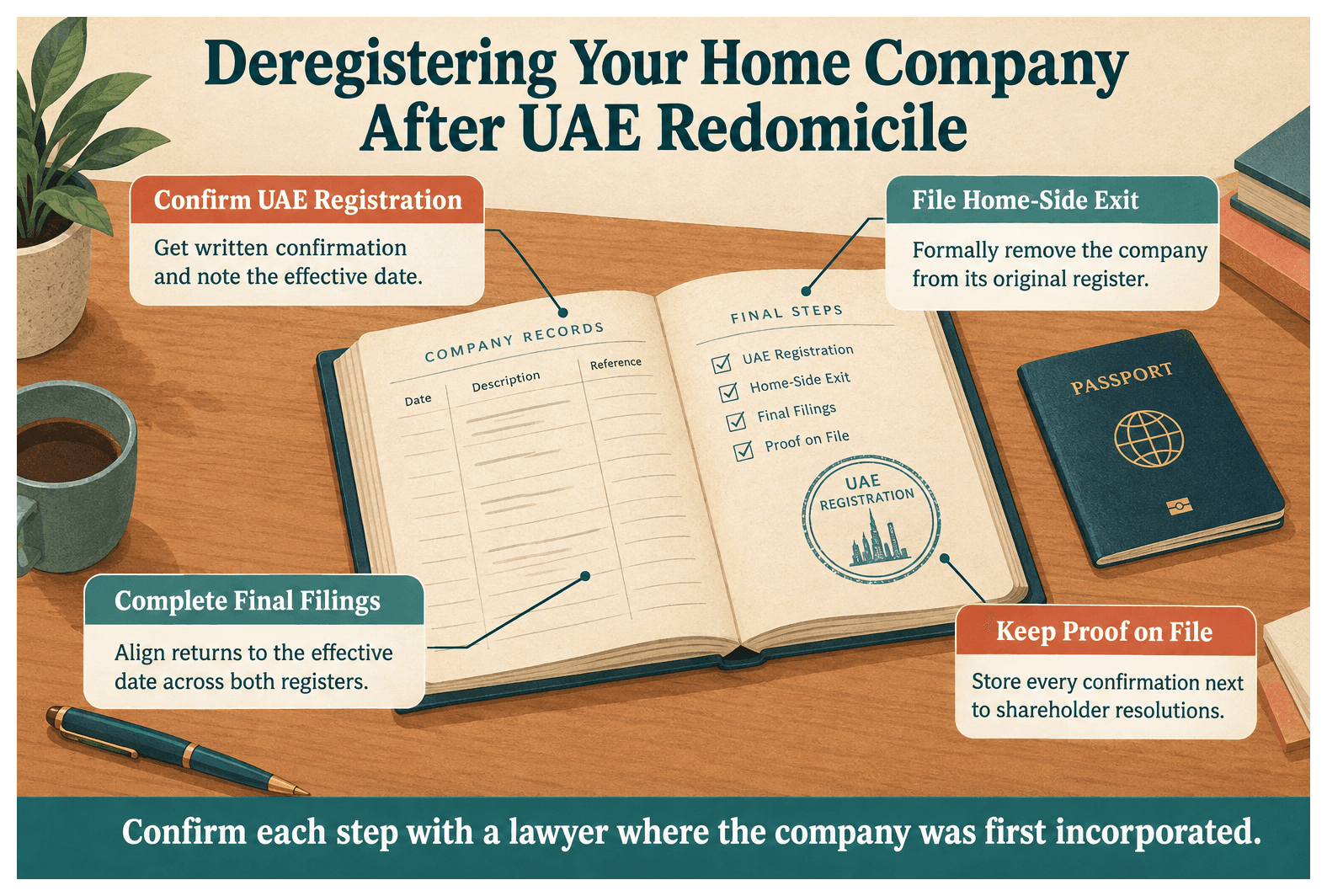
Once the transfer is confirmed, confirm the new registration in writing and then begin the home-country exit. Keep copies of every confirmation. The order and documents depend on the home jurisdiction, so verify each step with local counsel before filing anything.
How Do You Confirm the UAE Registration Is Final?
Ask for written confirmation that the registration is complete, and note the date it took effect. Check that the company name, number and effective date match your records. Store the confirmation next to the shareholder resolutions that authorised the transfer. Your bank will likely ask for the same paperwork, so keep a copy ready for a branch bank account in the UAE review.
Why Does the Effective Date Drive Everything Else?
The effective date anchors deadlines for final filings and tax positions. Mismatched dates between the two registers cause most disputes we see. One company filed its final return against the wrong period because two registers showed different dates. Record the date in a single compliance calendar that every adviser can read.
What Are the Steps in Home Country Deregistration Redomicile?
The general sequence runs in four stages: confirm the UAE registration, file the home-country deregistration, complete final filings, and retain proof. Each stage depends on local rules, so treat this as a map rather than a checklist you can run without advice.
Step 1: Confirm the UAE Registration in Writing
Obtain the completion or registration confirmation from the Dubai South Business Hub team.
Verify the company name, number and effective date.
Share the confirmation with your home-country lawyer and accountant.
Step 2: File the Home Country Deregistration
Prepare the deregistration request that your home register requires.
Attach the UAE confirmation and any shareholder approvals the home side asks for.
Expect documents to be certified or legalised in some jurisdictions. Our guide to a legalization certificate explains the UAE side of that process.
Step 3: Complete Final Filings and Keep Proof
Settle outstanding statutory filings up to the transfer date.
Collect the final deregistration notice from the home register.
Store every record in one secure archive for future audits.
How Does Home Country Deregistration Redomicile Connect to UAE Tax Filings?
UAE tax registrations sit apart from home-country registers, so they need their own confirmation after the transfer. Corporate tax and VAT positions still need review in the UAE, even when the home side is closed. Check current filing duties with the Federal Tax Authority and a tax adviser before you rely on any deadline.
Are Your UAE Tax Registrations Still Aligned?
Review your corporate tax and VAT registration status after the transfer, and confirm any change of registered details with the authority. Corporate tax applies at 9% on taxable income above AED 375,000 [1]. VAT applies at 5% [2]. Home-side and UAE tax duties are assessed separately, so one does not clear the other.
Why Do Tax Gaps Surface Late?
A closed home register does not automatically close UAE tax obligations. Unfiled returns can sit unnoticed for several periods. If your group also owns a Dubai company, the tax rules when you also own a Dubai company need a separate review. Schedule that review before the final home-side notice arrives.
Stage | What to Keep as Proof |
|---|---|
UAE registration confirmation and effective date | Written confirmation showing the effective date, used as the anchor for every later deadline |
Shareholder and board resolutions | Signed resolutions authorising the transfer and each home-side step |
Home-side deregistration notice | Final notice from the home register, which shows the old entity is closed |
Final statutory and tax filing receipts | Submission receipts for every final return, including the UAE corporate tax and VAT positions |
Archive index with reference numbers | A single index that maps each document to its date and reference number |
Which Proof Should You Keep After Deregistration?
Keep the UAE registration confirmation, the home-side deregistration notice, shareholder approvals and final filing receipts. Store them together with dates and reference numbers. Retention periods depend on the home jurisdiction and on UAE record rules, so confirm them with a lawyer.
Which Documents Belong in the Archive?
The UAE confirmation and effective date record.
The home-side deregistration notice and filing receipts.
Shareholder and board resolutions for each step.
Why Does Proof Protect You Later?
Banks and auditors ask for evidence that the old entity is closed. A buyer in due diligence may ask the same question. Clear records shorten that review, while missing proof can delay a sale or refinancing. If the group also runs a branch, check the parent company memorandum for branches before you finalise the archive.
How Can You Avoid Common Gaps in Home Country Deregistration Redomicile?
The most common gaps are mismatched dates, forgotten tax registrations and missing proof. A simple checklist with named owners, dates and document links closes most of them. Review it with your advisers at every stage, and confirm any figure or deadline with the Dubai South Business Hub team before acting.
How Do You Build a Post-Transfer Checklist?
Assign one owner to each stage of the sequence.
Track confirmation, filing and proof in one shared document.
Review the checklist with advisers before every filing.
Who Should You Work With?
Use a lawyer in the home jurisdiction for home-side steps, and use the Dubai South Business Hub team for UAE registration confirmations. Appoint one named contact to relay documents between them. Before you close any UAE side of the group, plan how to cancel employee visas before cancelling your Dubai company.
What to Do Next With Your Home Country Deregistration Redomicile
Home country deregistration redomicile is the last legal step that closes the old company after a UAE transfer. Confirm the UAE registration, file the home-side exit, complete final filings and keep proof at each stage. Because requirements vary, confirm each step with a lawyer where the company was first incorporated. Contact Dubai South Business Hub Free Zone to confirm your UAE registration details and plan the post-transfer sequence with your advisers.
References
Frequently Asked Questions


