Topic Summary
Meet the USD 3,500 Monthly Income Requirement
The UAE Virtual Working Programme requires applicants to earn at least USD 3,500 per month from a non-UAE source. Bank statements from the past three months are a standard way to demonstrate this threshold.
Secure UAE-Covering Health Insurance First
Valid health insurance that covers treatment within the UAE is mandatory before your application can be approved. Arranging this before you apply prevents delays in the two-to-four-week processing window.
Prove Your Income Comes From Outside the UAE
You must show either a formal employment contract with a non-UAE company or evidence of self-employment with all income sourced abroad. The programme explicitly excludes anyone seeking to work for a UAE-based employer.
Apply Through the ICP or DCTM Portal
The application is submitted online through the UAE's ICP portal, with a government fee starting at approximately AED 611. Processing typically takes two to four weeks from submission.
Understand What the Visa Does and Doesn't Allow
Approval grants 12 months of legal UAE residency and an Emirates ID, renewable annually. It does not authorise you to take up employment with any UAE-registered company.
Know the Two Eligible Applicant Profiles
The programme targets remote employees of foreign companies who want to relocate without changing their contract, and self-employed owners whose revenue originates entirely outside the UAE. If you fall outside these two profiles, a separate UAE work permit or investor visa may be more appropriate.
By Editorial Team, Business setup specialists covering UAE residency, free zone licensing, and remote work visa pathways since 2018. Full bio →
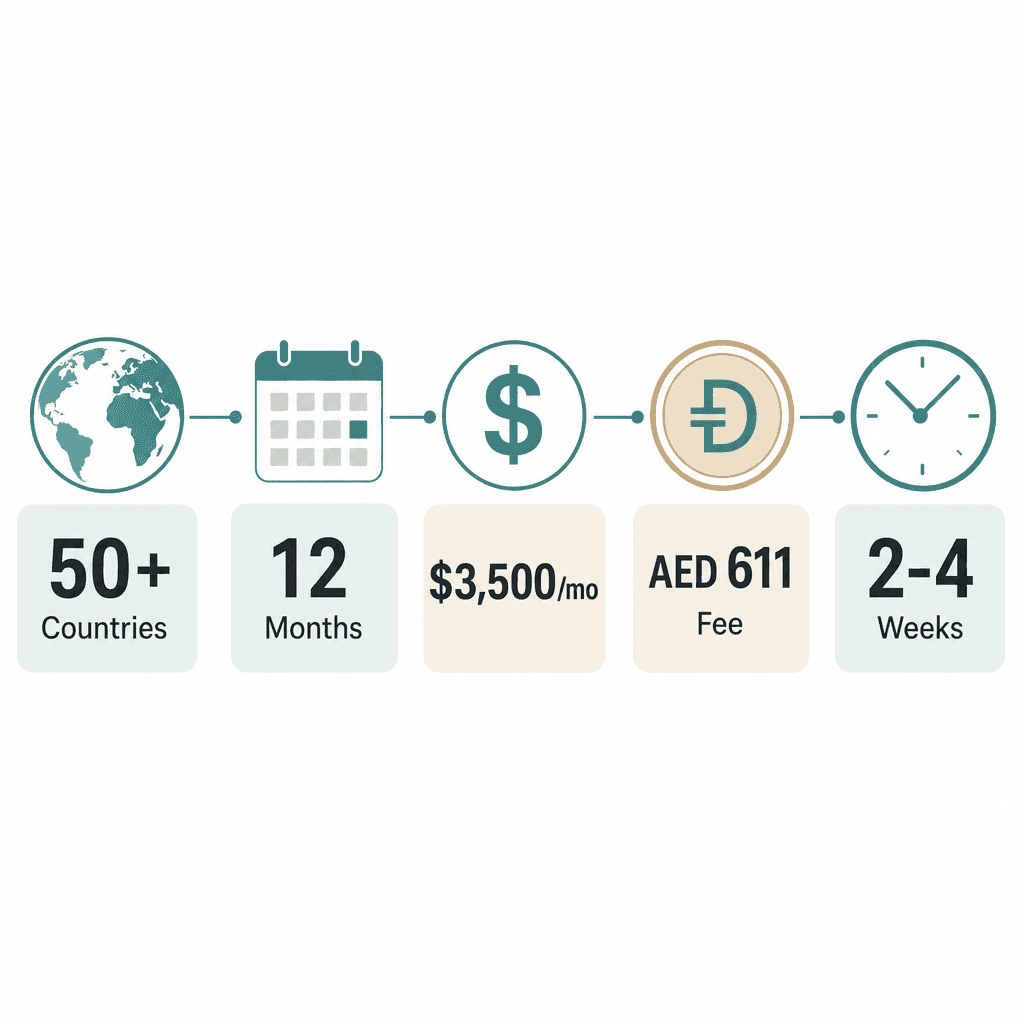
In 2026, Dubai ranks among the top five cities globally for remote workers, with the UAE Virtual Working Programme having processed applications from residents of over 50 countries since its October 2021 launch (Dubai Department of Culture and Tourism, 2021). The government fee starts at approximately AED 611 through the ICP portal. Processing runs two to four weeks. The income threshold sits at USD 3,500 per month. Health insurance covering UAE treatment is mandatory. And the whole thing grants you 12 months of legal residency, renewable.
That's the digital nomad visa Dubai in five data points. Dubai is now one of the world's top destinations for location-independent professionals, and it has a formal visa structure to match. The UAE Virtual Working Programme lets remote workers live here legally for up to a year while employed by or running a business entirely outside the UAE.
This guide covers everything you need: what the digital nomad visa Dubai actually is, who qualifies, the exact eligibility requirements, how to apply through ICP or DCTM, what it costs, what rights it gives you, and how it stacks up against the UAE investor visa, so you can choose the right path for your situation.
What Is the Digital Nomad Visa Dubai and How Does It Work
The digital nomad visa Dubai, officially called the UAE Virtual Working Programme, is a one-year renewable residency permit that lets remote workers live in Dubai legally while employed by or running a business outside the UAE. It grants UAE residency and Emirates ID but does not authorise employment with UAE-based companies.
Who the Programme Is Designed For
The Virtual Working Programme targets two distinct profiles. First, employees of foreign companies who work remotely and want to relocate to Dubai without changing their existing employment contract. Second, self-employed business owners whose income originates entirely outside the UAE.
Think of a US-based software engineer employed by a San Francisco tech firm. She wants to live in Dubai Marina while keeping her existing job contract, salary, and US employer intact. That's the exact profile this programme was built for. Similarly, a UK-based independent professional billing exclusively European clients through a UK sole trader structure qualifies straightforwardly.
Profile 1: Remote employee of a non-UAE company, with a formal employment contract
Profile 2: Self-employed business owner with all income sourced outside the UAE
The programme is not designed for people who want to work for UAE employers. That requires a separate UAE work permit, issued by a UAE-registered company.
How the Virtual Working Programme Differs from a Standard UAE Visa
Standard UAE residency visas are employer-sponsored, a Dubai company applies on your behalf and your residency is tied to that employer. The Virtual Working Programme flips that model. You sponsor yourself using proof of foreign income. No UAE employer is involved at any stage.
The contrast with a tourist or visit visa is equally sharp. A UAE visit visa allows a maximum stay of 90 days. The Virtual Working Programme grants 12 months of legal residency, renewable annually, with full Emirates ID entitlement. For a broader look at UAE residency options, see the full guide to types of visas in the UAE.
Digital Nomad Visa Dubai Eligibility Requirements You Must Meet
To qualify for the digital nomad visa Dubai, you need a minimum monthly income of approximately USD 3,500, valid health insurance covering the UAE, proof of remote employment or self-employment with a non-UAE company, a valid passport, and supporting financial documents such as bank statements from the past three months. Knowing how to get a digital nomad visa UAE starts with confirming you meet every one of these criteria before you apply.
Income Threshold and Proof of Remote Employment
The income threshold, approximately USD 3,500 per month, is assessed through bank statements, payslips, or invoices covering the previous three months. Employees need a letter from their employer on company letterhead confirming the remote work arrangement and monthly salary. Self-employed applicants need business registration documents from their home country alongside consistent income evidence.
A Canadian independent video producer presenting three months of invoices totalling USD 14,000, well above the USD 3,500/month threshold, alongside a business registration document from her home province is a textbook-strong application. The key is demonstrating consistency, not just a single high-earning month.
Acceptable income documents include:
Three months of bank statements showing regular income deposits
Employer letter confirming remote work and salary (employees)
Signed client contracts or invoices (self-employed)
Business registration certificate from home country (self-employed)
Health Insurance and Other Mandatory Requirements
Valid health insurance that covers medical treatment inside the UAE is mandatory. Travel insurance does not qualify. Applicants who arrive with travel insurance only are typically rejected at the documentation stage, you need a proper health insurance policy with UAE coverage confirmed in writing. Basic individual UAE health insurance typically costs AED 600 to AED 2,500 per year, depending on the provider and coverage level.
Your passport must be valid for at least six months beyond your intended stay. A clean background is assumed, though documentation may be requested. For context on how this visa compares to other residency options, check UAE Green Visa eligibility.
Full mandatory document checklist:
Passport copy (valid 6+ months beyond intended stay)
Passport-sized photograph against a white background
Three months of bank statements
Employment letter or self-employment proof
Health insurance certificate with UAE coverage
How to Apply for the Digital Nomad Visa Dubai: Step-by-Step
You can apply for the digital nomad visa Dubai through two channels: the UAE Federal Authority for Identity and Citizenship (ICP) portal online, or through the Dubai Department of Culture and Tourism (DCTM). The process takes roughly two to four weeks and requires submitting financial, employment, and identity documents digitally. Here's how to get a digital nomad visa UAE without unnecessary delays.
Step 1: Choose Your Application Channel, ICP or DCTM
Two official portals handle applications. The ICP (Federal Authority for Identity, Citizenship, Customs and Port Security) at icp.gov.ae is the federal route, covering all seven emirates. The DCTM (Dubai Department of Culture and Tourism) portal at dubairemotework.com is Dubai-specific and was the first channel launched in October 2021.
Both lead to the same visa outcome. An American marketing consultant planning to live in Dubai Marina typically chooses the DCTM portal because it's Dubai-specific and her residency address will be in the emirate. If you're considering another emirate, ICP is the cleaner route. Pick based on where you plan to live, not which portal looks nicer.
Step 2: Gather and Submit Your Documents
A German UX designer submits her employer's remote work confirmation letter on company letterhead, three months of payslips converted to USD equivalent, and her international health insurance certificate, all uploaded as PDFs through the ICP portal. That's the standard submission package.
Processing runs approximately two to four weeks after successful document submission. Incomplete submissions are the most common cause of delays, double-check every document before uploading.
Step 3: Pay Fees, Receive Approval, and Activate Emirates ID
Pay the application fee online at the time of submission. Once approved, you enter the UAE on the issued visa or convert your status if you're already in-country on a visit visa. The next step is a medical fitness test at a UAE-approved medical centre, this is required before ICP issues your Emirates ID.
An Australian copywriter books her medical fitness test at a Dubai Health Authority-approved clinic after receiving her approval email, passes within two days, and receives her Emirates ID within a week. With that card in hand, she can open a personal UAE bank account the same afternoon. Medical fitness tests cost approximately AED 320 to AED 500. Emirates ID processing typically takes five to seven business days.
For guidance on residency activation and post-approval steps, Dubai South Business Hub Free Zone residency services covers the full process.
Cost, Processing Time, and What the Digital Nomad Visa Dubai Covers
The digital nomad visa Dubai typically costs between AED 611 and AED 1,200 in government fees, excluding health insurance and medical testing. Processing takes two to four weeks. The visa grants one year of UAE residency, an Emirates ID, and the right to open a personal UAE bank account. If you want to work remotely from Dubai on a visa with full legal residency status, this is the most cost-efficient route available.
Government Fees and Total Cost Breakdown
Here's what a realistic budget looks like:
ICP application fee: approximately AED 611
DCTM application fee: approximately USD 287 (AED 1,054)
Medical fitness test: AED 320–AED 500
Emirates ID fee: AED 100–AED 370
Health insurance (basic individual): AED 600–AED 2,500 per year
Total all-in: a US remote worker should budget approximately USD 500 to USD 700 to cover government fees, medical testing, Emirates ID, and a basic UAE health insurance plan. There are no sponsor company fees because you're self-sponsoring, that's a meaningful cost saving compared to employer-sponsored visa routes.
What Rights and Privileges the Visa Grants You
Legal UAE residency for 12 months means you're not on a tourist clock. You can rent an apartment, sign a tenancy contract, open a personal bank account at Emirates NBD, ADCB, or Mashreq, and access government services, all tied to your Emirates ID.
The tax position is worth flagging explicitly. The UAE has a 0% personal income tax rate. The UAE corporate tax introduced in June 2023 at 9% applies to UAE-based business profits, it does not apply to the foreign-sourced personal income of a nomad visa holder. A remote CFO from New York pays no UAE tax on her US salary while living in Dubai Marina. That's a concrete financial advantage, not a vague benefit.
For a full comparison of UAE residency options, see types of visas in the UAE.
Digital Nomad Visa Dubai vs Investor Visa: Which Is Right for You
The digital nomad visa Dubai suits remote workers with foreign income who want residency without setting up a UAE entity. The investor or partner visa is for those establishing or owning a UAE-registered business. Each serves a distinct professional profile, and picking the wrong one creates compliance problems.
When the Virtual Working Programme Is the Right Fit
A product manager employed by a Dutch tech company who wants to spend 12 months in Dubai without altering her Amsterdam-based employment contract is the ideal Virtual Working Programme candidate. Her income stays Dutch, her employer stays Dutch, and her Dubai residency is self-sponsored. No UAE entity. No UAE trade license. Lower cost and lower administrative commitment than any other residency route.
The programme stops being the right fit the moment you start invoicing UAE companies. That triggers the need for a UAE trade license. You might also check UAE Green Visa eligibility if you're considering longer-term residency options.
Comparison Table: Digital Nomad Visa and Investor Visa
Digital Nomad Visa Dubai vs Investor Visa
Feature | Digital Nomad Visa (Virtual Working Programme) | Investor / Partner Visa | |
|---|---|---|---|
Income Source | ✅ Foreign income only | ✅ UAE + foreign clients | ✅ UAE + global |
Work for UAE Clients | ❌ Not permitted | ✅ Yes, with permit | ✅ Yes, via trade license |
UAE Entity Required | ❌ None needed | ✅ Trade license mandatory | |
Approximate Cost | USD 500–700 all-in | AED 7,500–AED 20,000 | AED 15,000+ (varies) |
Residency Period | 1 year, renewable | 2–3 years typically | 2–3 years typically |
Emirates ID | ✅ Yes | ✅ Yes | ✅ Yes |
Corporate Bank Account | ❌ Personal only | ❌ Personal only | ✅ Yes, with trade license |
An e-commerce entrepreneur who wants to sell to UAE customers and open a corporate bank account in a company name needs an investor visa and trade license, not a Virtual Working Programme. The table above makes that distinction clear across every practical dimension.
What the Digital Nomad Visa Dubai Does Not Allow
The digital nomad visa Dubai does not permit you to be employed by or receive a salary from a UAE-registered company. It also does not function as a UAE work permit, does not allow you to sponsor a UAE trade license, and does not automatically grant dependent sponsorship rights without additional documentation. These restrictions catch a surprising number of applicants off-guard.
Key Restrictions You Need to Understand Before You Apply
Cannot accept employment from a UAE company, violates visa terms without a separate UAE work permit
Cannot use the visa to sponsor or establish a UAE trade license
Dependent sponsorship (spouse, children) is not automatic, confirm current ICP policy at the time of application
Does not convert into a UAE Golden Visa without meeting separate eligibility criteria
If income shifts to UAE clients, you must transition to a UAE trade license
The most common mistake: a nomad starts consulting for a Dubai-based startup and invoices them directly. She's technically operating outside the scope of her Virtual Working Programme at that point and would need a UAE trade license to do so legally. The line between "foreign client" and "UAE client" is the key compliance boundary to watch.
When to Upgrade from a Nomad Visa to a Full UAE Business Setup
Three clear triggers should prompt an upgrade. First, you start generating income from UAE clients. Second, you want to hire UAE-based employees. Third, you want a corporate bank account in a company name. All three require a UAE trade license — the nomad visa covers none of them.
A US-based SaaS founder who starts closing enterprise deals with UAE corporates while on a nomad visa should move to a Dubai South Business Hub Free Zone license. It allows 100% foreign ownership, enables invoicing UAE clients, opens access to a corporate bank account, and supports local hiring. Dubai South is among the most cost-competitive free zones in the UAE for this kind of transition.
Citations
Federal Authority for Identity, Citizenship, Customs and Port Security.. icp.gov.ae. ICP UAE, 2024.
Dubai Health Authority.. dha.gov.ae. DHA UAE, 2024.
General Directorate of Residency and Foreigners Affairs Dubai.. gdrfad.gov.ae. GDRFA Dubai, 2024.
Ministry of Human Resources and Emiratisation.. mohre.gov.ae. MoHRE UAE, 2024.
UAE Ministry of Economy and Tourism.. moet.gov.ae. MOET UAE, 2024.
Frequently Asked Questions