
Topic Summary
Trade License: Your Company's Core Credential
A valid trade license is the first document every UAE bank checks, as it confirms your business activity is legally authorised. It must be current, not expired, and issued by the relevant mainland or free zone authority.
Memorandum of Association Needs Proper Attestation
The memorandum of association establishes ownership structure and must be notarised through a UAE notary public for mainland companies or through the free zone authority for free zone entities. Skipping or incorrectly completing this step is one of the most common rejection triggers.
Passport Copies Must Have Sufficient Validity
All shareholders and authorised signatories must provide passport copies with at least six months of remaining validity. A passport with less than six months left will result in an outright rejection at most banks, as one founder discovered after two declined applications.
Emirates IDs Are Required for All Signatories
Banks require Emirates ID copies for every signatory on the account, typically as certified true copies verified by a bank officer or legal professional. This applies even when the signatory has already provided a passport copy.
Certificate of Incorporation and Share Certificate
These documents confirm the company's legal existence and the distribution of ownership among shareholders. Banks use them to identify beneficial owners in line with Central Bank of UAE AML and KYC requirements.
Proof of Registered Address Is Non-Negotiable
Banks require documentary evidence of your company's physical or registered address, such as a tenancy contract or free zone office agreement. This supports the bank's obligation to verify the legitimacy of your business premises.
Tax Registration Certificates Confirm Compliance Status
VAT and corporate tax registration certificates show that your company is meeting its Federal Tax Authority obligations, and missing either can delay account opening. Late registration carries a one-time AED 10,000 penalty per certificate, making early registration both a legal and banking priority.
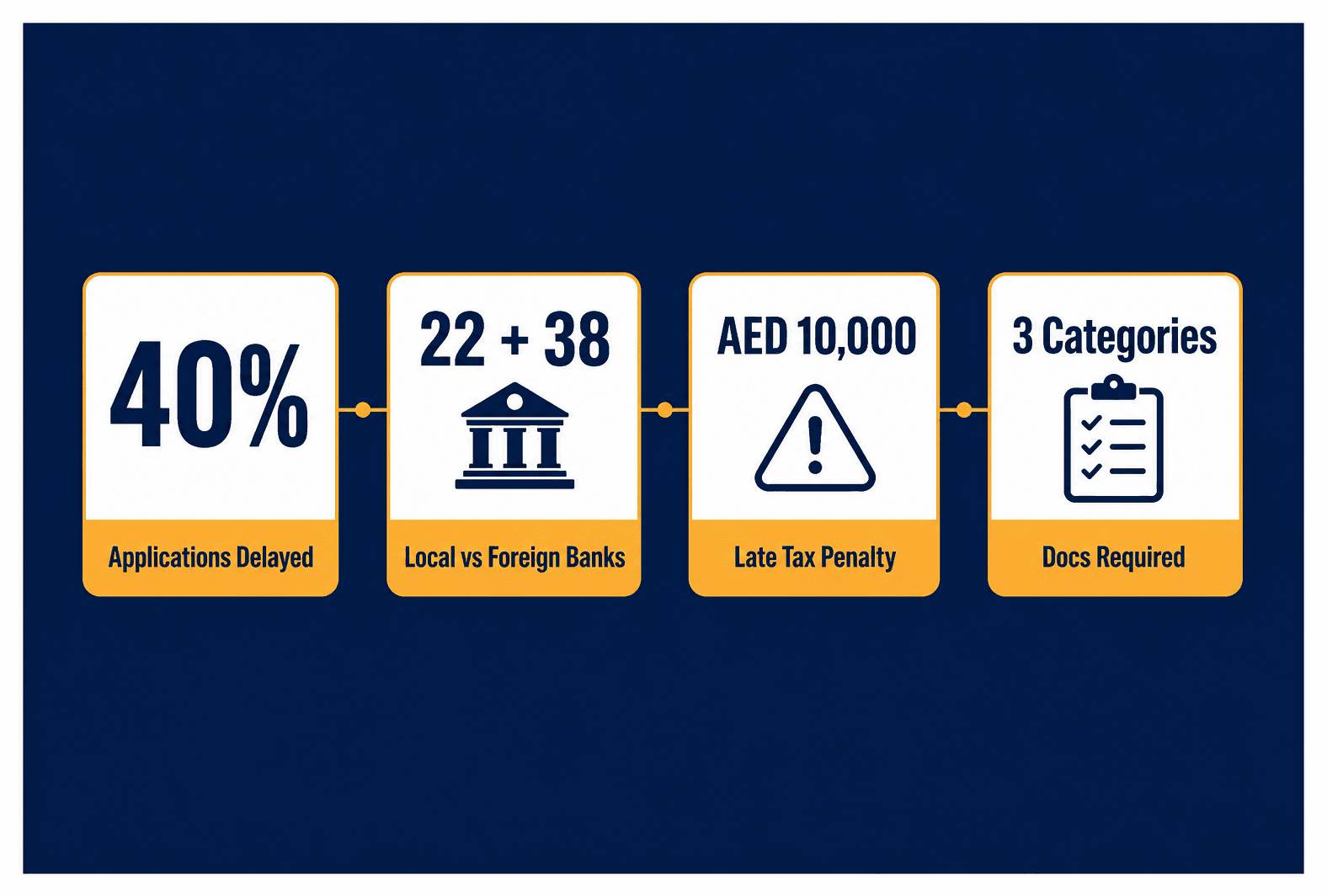
In 2026, roughly 40% of first-time founders who open a company in Dubai report that their corporate bank account application is delayed or declined at least once before approval, according to business setup consultants active in the market. The leading cause is not a poor credit history or a weak business idea. It is incomplete or incorrectly attested documents. The UAE has 22 locally incorporated banks and 38 foreign bank branches (Central Bank of UAE, 2024), and every one of them runs a compliance checklist before a relationship manager even reviews your file. Late corporate tax registration carries a one-time AED 10,000 penalty (Federal Tax Authority). Late VAT registration carries the same. The documents banks require in UAE are not optional formalities; they are the entire basis on which a new company is assessed.
This guide breaks down every document UAE banks require from a new company, organised by stage, with format requirements, validity periods, attestation rules, and the rejection triggers you need to avoid before you walk into your first branch meeting.
What Documents Banks Require in UAE From a New Company
UAE banks require a valid trade license, memorandum of association, passport copies and Emirates IDs for all shareholders and signatories, a certificate of incorporation, a share certificate, proof of registered address, and VAT or corporate tax registration certificates. Each document must meet the bank's format, validity, and attestation rules before the account is opened. The documents banks require in UAE fall into three clear categories: company formation documents, identity documents, and compliance documents. Free zone companies and mainland companies submit the same core set; the difference is the issuing authority printed on the trade license and the notarisation route for the memorandum of association. You can explore bank account opening in Dubai support options before you incorporate, so you know exactly what your chosen bank expects.
Why Banks Treat New Companies Differently From Established Ones
A newly incorporated company has no transaction history, so banks rely entirely on documents to assess risk. The Central Bank of UAE has tightened its AML framework every year since 2021, and that pressure flows directly to relationship managers, who score applications against a compliance checklist before the file reaches any credit committee.
Here is a real scenario that illustrates the stakes. A sole founder incorporated a consultancy in a free zone and submitted documents with a passport copy that had less than six months' validity. Two banks rejected the application outright. A business setup consultant flagged the issue in under five minutes. The fix was simple; the delay was not.
Core Terminology: What "Attested," "Notarised," and "Certified True Copy" Mean
Notarisation: A UAE notary public confirms the document's authenticity and signature.
Attestation: A government authority (Ministry of Foreign Affairs, embassy, or consulate) authenticates a foreign document for use in the UAE.
Certified true copy: A bank officer or legal professional certifies that a photocopy matches the original. Most UAE banks require this for passports and Emirates IDs.
Apostille: Accepted for countries in the Hague Apostille Convention, replacing the full legalisation chain. Germany, the UK, and most EU states are members.
Why UAE Banks Scrutinise New Company Documents So Closely
UAE banks operate under Central Bank of UAE AML and KYC regulations that require them to verify the identity of every beneficial owner, the legitimacy of the business activity, and the source of funds before opening a corporate account. Non-compliance exposes the bank to regulatory penalties, so document scrutiny for new companies is thorough by design. Free zone licenses issued by regulated authorities are generally viewed favourably because the free zone authority has already conducted its own KYC at incorporation.
UAE Corporate Bank Account: Documents by Stage
Document | Format / Validity / Attestation |
|---|---|
Trade license | Certified true copy; valid on application date; most banks reject if expiry is within 30 days; no MOFA attestation required for UAE-issued licenses |
Passport (all shareholders and signatories) | Certified true copy; minimum 6 months' remaining validity from application date; all pages required |
Board resolution authorising account opening | Original on company letterhead; signed by all directors; dated within 3 months of application; specifies authorised signatories and transaction limits |
UBO beneficial ownership declaration | Original, signed; mandatory under UAE Cabinet Resolution on UBO; names every natural person owning 25% or more |
Source-of-funds letter | Original on company letterhead; dated within 3 months; signed by authorised signatory; supported by bank statements if requested |
VAT / corporate tax registration certificate | Copy; issued by Federal Tax Authority; entity name and license number must match exactly |
AML and KYC Obligations That Drive the Document List
Know Your Customer (KYC) rules require banks to verify the identity of all shareholders holding 25% or more. That threshold defines the beneficial owner (UBO). Anti-Money Laundering (AML) checks then screen every named party against international sanctions lists. The FATF grey list as of 2024 covers 21 jurisdictions; shareholders from those countries face enhanced scrutiny regardless of the company's activity or jurisdiction.
The UAE Cabinet UBO Resolution requires every company to maintain and disclose an up-to-date beneficial owner register. Banks treat a missing or unsigned UBO declaration as an automatic disqualifier.
How the Bank's Internal Risk Rating Affects What It Asks For
Banks assign a risk rating (low, medium, or high) to each new corporate applicant based on activity type, shareholder nationality, and expected transaction volumes. High-risk ratings trigger requests for additional documents: source-of-funds declarations, business plans, and proof of existing client relationships.
A technology consulting company with a European sole shareholder typically receives a standard document request. The same structure with a shareholder from a FATF-listed jurisdiction triggers a full enhanced due diligence process. Activities in financial services, real estate, and cash-intensive sectors almost always attract enhanced due diligence requests regardless of the company's jurisdiction.
The Complete Document Checklist: Stage by Stage
The documents banks require in UAE fall into three stages: company formation documents (trade license, MOA, incorporation certificate), identity documents for all shareholders and signatories (passports, Emirates IDs, visa pages), and compliance documents (UBO declaration, source-of-funds letter, VAT or corporate tax registration). Each stage has specific format, validity, and attestation requirements. For help gathering and attesting documents, business support services at Dubai South Business Hub Free Zone can manage government transactions on your behalf.
Stage 1: Company Formation Documents
Trade license: Original or certified true copy; must be valid on the application date; most UAE banks reject a license expiring within 30 days; issued by the free zone authority or DET.
Certificate of incorporation: Issued at the time of company registration; no standard expiry but must match the current license exactly.
Memorandum and articles of association (MOA/AOA): Notarised copy; must reflect the current shareholding structure; if amended, the latest version with all addenda is required.
Share certificate(s): Confirms shareholding percentage for each partner; must match the MOA exactly, any discrepancy triggers a compliance flag.
Board resolution authorising account opening: Signed by all directors; specifies authorised signatories and transaction limits; must be on company letterhead and dated within three months of submission.
Stage 2: Identity Documents for Shareholders and Signatories
Passport copy: All pages; minimum six months' validity from the application date; certified true copy required by most banks.
UAE residence visa page: Copy of the visa stamp or e-visa; must be valid; required for all UAE-resident shareholders and signatories.
Emirates ID: Front and back; valid copy; required for every UAE-resident party on the account.
For non-resident shareholders: Notarised and MOFA-attested passport copy; some banks also require a home-country proof-of-address document (utility bill) not older than three months.
Proof of residential address: Utility bill or tenancy contract not older than three months, in the shareholder's name.
Stage 3: Compliance and Operational Documents
Beneficial ownership (UBO) declaration: Names every natural person who owns 25% or more directly or indirectly; required under the UAE Cabinet Resolution on UBO.
Source-of-funds letter: Explains the origin of the capital being deposited; must be on company letterhead, signed by the authorised signatory, and dated within three months of submission.
Business plan or company profile: Typically one to two pages; covers the nature of the business, target clients, expected monthly transaction volumes, and geographies served.
VAT registration certificate: Required if the company is VAT-registered; issued by the Federal Tax Authority.
Corporate tax registration certificate: Mandatory for all companies subject to UAE corporate tax; late registration carries a one-time AED 10,000 flat penalty (Federal Tax Authority).
Free zone companies substitute the Ejari tenancy contract with the free zone office agreement or flexi-desk contract issued by the free zone authority. Dubai South Business Hub Free Zone provides this document as part of the license package, so you have it ready for the bank on day two.
Format, Validity, and Attestation Rules You Cannot Ignore
UAE banks specify exact format requirements for each document: originals, certified true copies, or notarised copies depending on document type. Passports need at least six months' validity. Foreign documents must be attested by MOFA or carry an apostille. Corporate resolutions must be dated within three to six months of the application. The documents banks require in UAE are only accepted when they meet these precise standards.
Validity Windows Banks Enforce for Each Document Type
Trade license: Valid on the application date; rejected if expiry is within 30 days.
Passport: Minimum six months' remaining validity from the date of application.
Board resolution and source-of-funds letter: Typically dated within three months of submission; some banks allow six months.
Proof of address (utility bill, tenancy contract): No older than three months.
Emirates ID: Must be valid; expired IDs are rejected even if renewal is actively in progress.
When Attestation Is Required and Which Route to Use
Foreign-issued company documents (a parent company's certificate of incorporation from outside the UAE, for example) must be attested by the issuing country's notary, then by the UAE embassy or consulate in that country, then by MOFA in the UAE. That is the full legalisation chain.
Documents from Hague Apostille Convention member states can skip the embassy step if an apostille is affixed by the competent authority in the issuing country. A German sole shareholder presenting their home-country certificate of good standing needs it apostilled in Germany before any UAE bank will accept it.
UAE-issued documents (a trade license or MOA from a free zone or DET) do not require MOFA attestation for domestic bank use. A certified true copy is sufficient. Arabic translation by a UAE-licensed legal translator is required for any document not in Arabic or English.
How Your Free Zone License Affects the Documents Banks Require in UAE
A free zone trade license simplifies the document package because the free zone authority has already verified the company's incorporation details and shareholder identities. Banks accept the free zone-issued license, MOA, and office agreement directly. The core identity and compliance documents remain identical to those required from mainland companies. The documents banks require in UAE do not change by jurisdiction; only the issuing authority differs.
What Dubai South Business Hub Free Zone Issues at Incorporation
Dubai South Business Hub Free Zone (DSBH), launched September 2025, issues a trade license in one business day once documents clear. The license package includes the trade license, the MOA, the certificate of incorporation, and the registered office agreement. Banks accept all four documents directly, with no MOFA attestation required.
DSBH requires zero paid-up share capital, so there is no capital injection certificate to produce at the bank. The base license starts from AED 12,500. A sole founder with one visa should budget from AED 18,350 for year one; visas are always an additional cost on top of the license fee. You can check the business activities list on the DSBH website before incorporation to confirm your activity scope.
A founder who incorporated a digital marketing consultancy through DSBH received their full document set (license, MOA, and office agreement) within one business day, then walked into their preferred bank with a complete file the following morning. That is the practical advantage of a free zone that handles its own KYC at incorporation.
Free Zone vs. Mainland: Document Differences at a Glance
Mainland companies (licensed by DET) must provide an Ejari-registered tenancy contract as proof of registered address; free zone companies substitute the free zone office agreement.
Mainland MOAs are notarised through the Dubai Courts notary system; free zone MOAs are authenticated by the free zone authority.
Both structures require identical identity, UBO, source-of-funds, and tax registration documents. Banks make no compliance distinction between free zone and mainland.
100% foreign ownership is available on both mainland and free zone structures; it is not a designated-zone privilege.
Use the business setup cost calculator at DSBH to plan your year-one budget before you commit to a structure.
Common Rejection Causes and How to Prevent Them
The most common reasons UAE banks reject new company document packages are expired or soon-to-expire passports, a mismatch between the MOA shareholding and the share certificates, an undated or unsigned board resolution, missing UBO declarations, and failure to provide a source-of-funds letter. Each is preventable with a pre-submission document audit. Roughly 40% of first-time founders experience at least one rejection or delay before account approval, according to business setup consultants active in the market. The documents banks require in UAE are well-defined; the errors are almost always avoidable.
The Five Most Frequent Document Rejection Triggers
Passport validity below six months: The single most common trigger. Check every passport on the application, not just the primary signatory's.
MOA and share certificate mismatch: If the MOA says 60/40 ownership but the share certificate says 70/30, the bank flags it as a discrepancy and requests a corrected document.
Board resolution not signed by all directors: A single missing signature voids the resolution in most banks' compliance systems.
UBO declaration missing or unsigned: Mandatory under UAE law; omitting it causes automatic rejection.
Source-of-funds letter too vague: Writing "personal savings" with no supporting bank statement or context is rejected by most compliance teams.
Pre-Submission Checklist to Clear Compliance Before You Apply
Cross-check every name spelling across all documents. A middle name discrepancy between the passport and the MOA can cause a delay.
Confirm that the trade license activity matches the business plan narrative exactly.
Date every internal company document (board resolution, source-of-funds letter) within three months of planned submission.
Prepare a one-page company profile covering the business model, target markets, and expected monthly transaction range. Many banks request this even when it is not on their standard checklist.
If any shareholder is a corporate entity, prepare the full corporate document chain for that entity as well: license, MOA, and UBO declaration for the holding company.
What happens if a bank requests additional documents after submission?
Most UAE banks issue a formal deficiency notice specifying exactly which documents are missing or incorrectly formatted. You typically have 10 to 15 business days to respond before the application is closed. Resubmitting a complete file from scratch restarts the compliance review clock, so it is worth getting the initial submission right.
Tax and Compliance Documents UAE Banks Require
UAE banks require VAT registration certificates for VAT-registered businesses and corporate tax registration certificates for all companies subject to UAE corporate tax. Both are issued by the Federal Tax Authority. Late VAT or corporate tax registration each carry a one-time AED 10,000 penalty. Banks use these certificates to confirm a company is operating within the law. The documents banks require in UAE include tax certificates because they cross-reference the Tax Registration Number (TRN) against the trade license entity name.
References
Frequently Asked Questions