Topic Summary
100% Foreign Ownership With No Local Sponsor
Dubai free zone companies allow full foreign ownership, meaning you keep complete control without needing an Emirati partner or sponsor. This is codified in each free zone's enabling legislation, not just a policy preference.
Zero Customs Duties on Free Zone Goods
Goods imported into or exported from a free zone are exempt from customs duties, making free zones ideal for international trading businesses. By contrast, goods moving from a free zone to the UAE mainland attract a standard 5% ad valorem customs duty.
Corporate Tax Breaks for Qualifying Businesses
Qualifying Free Zone Persons (QFZPs) can access a 0% corporate tax rate on qualifying income, a significant advantage over mainland companies. Non-qualifying income is taxed at the standard 9% rate on amounts above AED 375,000.
Mainland Trade Requires a Separate Arrangement
Free zone companies cannot sell directly to UAE mainland customers without using a licensed distributor, a mainland branch, or a customer-collection arrangement. This is one of the most important operational restrictions to plan around before setup.
Faster Visa Processing Through a Single Authority
Visa applications for free zone employees are handled directly by the free zone authority, typically through a streamlined single-window process. This is generally faster than the mainland route, which involves both the DET and MoHRE.
UAE VAT Applies at a Low 5% Rate
The UAE's VAT rate is just 5%, one of the lowest in the world, but free zone businesses must still register, invoice, and file correctly. Missing the registration deadline carries a fixed AED 10,000 penalty from the Federal Tax Authority.
Over 40 Free Zones Serve 750,000+ Companies
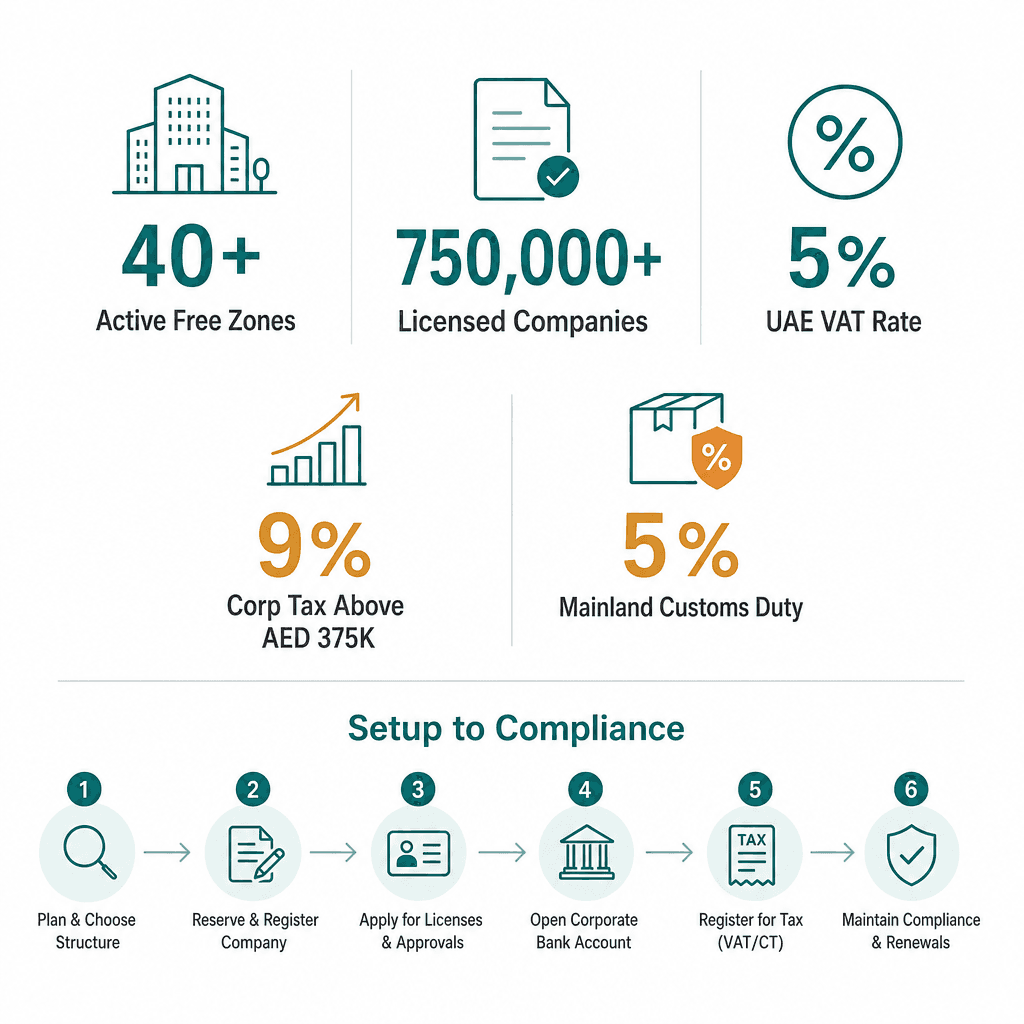
As of 2026, more than 40 active free zones operate across the UAE, collectively licensing over 750,000 companies. Choosing the right zone for your specific activity and target market is a critical early decision that affects everything from costs to compliance.
By Editorial Team, UAE business setup specialists with direct experience across Dubai South and multiple UAE free zone formations. Full bio →
In 2026, over 40 active free zones operate across the UAE (UAE Ministry of Economy, 2026). More than 750,000 companies hold free zone licenses across those zones. The UAE ranked 16th globally in the World Bank's Ease of Doing Business index before the index was retired (World Bank, 2020, still accurate as of 2026 for structural context). UAE VAT sits at just 5%, one of the lowest rates globally. Corporate tax under Federal Decree-Law No. 47 of 2022 applies at 9% on taxable income above AED 375,000, effective for financial years starting on or after 1 June 2023 (UAE Ministry of Finance, 2023). Standard UAE customs duty on most goods entering the mainland from a free zone is 5% ad valorem (UAE Customs Authority, 2024). Late VAT registration carries a fixed AED 10,000 penalty.
Getting your free zone license is step one. Actually doing business in a Dubai free zone, managing clients, issuing invoices, hiring staff, opening bank accounts, filing taxes, and staying compliant, is the ongoing reality that determines whether your company thrives or stalls. This guide covers everything you need to know about running a business in a Dubai free zone: what you can and cannot do, how to legally reach UAE mainland customers, how invoicing and VAT work, corporate tax obligations, staffing and visa management, bank account operations, and the annual compliance calendar that keeps your license in good standing.
Free Zone Company vs. Mainland Company: Key Operating Differences
Feature | Free Zone Company | Mainland Company |
|---|---|---|
Foreign Ownership | ✅ 100% foreign ownership, no local sponsor required | ✅ 100% foreign ownership now permitted in most activities under 2021 Commercial Companies Law reform |
Direct UAE Mainland Trade | ❌ Not permitted without a distributor, mainland branch, or customer collection arrangement | ✅ Full direct access to all UAE mainland customers and government entities |
Corporate Tax Rate | ✅ 0% on qualifying income for Qualifying Free Zone Persons (QFZPs); 9% on non-qualifying income | 9% on all taxable income above AED 375,000; no preferential rate available |
Customs Duties (Imports/Exports) | ✅ Zero duties on goods imported into or exported from the free zone | Standard 5% ad valorem duty applies on most imported goods |
Visa Processing Authority | ✅ Handled directly by the free zone authority, typically faster, single-window process | Processed via DET and MoHRE, more steps, longer average timeline |
Setup Speed | ✅ As fast as 3–5 business days for standard licenses at many free zones | Typically 2–4 weeks depending on activity type and DET workload |
International Trading Freedom | ✅ Full freedom to trade internationally with no customs involvement on free zone transactions | International trade permitted but standard customs procedures apply on imports |
What Is a Dubai Free Zone Company and How It Actually Operates
A Dubai free zone company is a legal entity licensed within a designated economic zone that offers 100% foreign ownership, zero import/export duties, and full profit repatriation. It can freely trade internationally but faces restrictions on direct commercial activity inside the UAE mainland without a separate arrangement or branch. If you're still building your foundational understanding, the guide on what is a free zone in Dubai is a solid starting point before working through the operational detail here.
The Core Advantages That Make Free Zones Attractive
Doing business in a Dubai free zone starts with a genuinely strong structural foundation. The advantages aren't marketing language, they're codified in each free zone's enabling legislation and enforced by the respective free zone authority.
100% foreign ownership: No local sponsor or Emirati partner required. You own your company outright.
Zero customs duties: Goods imported into or exported from the free zone move duty-free. This is a material cost advantage for trading and logistics businesses.
Full profit repatriation: Transfer your earnings internationally without currency controls or withholding taxes.
Single-regulator setup: Your free zone authority handles licensing, visa quotas, and office leasing in one place, far simpler than coordinating across multiple government departments.
Consider a US-based logistics consultant setting up in Dubai South Free Zone. She holds 100% ownership, needs no local partner, and routes all international invoices without UAE customs involvement. Over 40 free zones now operate across the UAE (UAE Ministry of Economy, 2026), each with its own sectoral focus, fee structure, and visa quota system.
The One Restriction Every Free Zone Owner Must Understand
Here's the thing most founders discover too late: free zone companies cannot directly sell goods or services to UAE mainland customers without a specific legal arrangement. This is the single most misunderstood aspect of doing business in a Dubai free zone, and ignoring it creates real legal and financial exposure.
Warning: Shipping goods directly from your free zone to a Dubai mainland buyer, without a licensed distributor, mainland branch, or the buyer physically collecting from the free zone, is classified as a customs violation under UAE law. Penalties include fines, license suspension, and customs penalties.
The restriction applies only to UAE mainland trade. Your international clients, whether in the US, UK, or anywhere outside the UAE, are completely unaffected. You can invoice them, ship to them, and contract with them without any additional arrangement.
How to Legally Sell to UAE Mainland Customers When Running a Business in a Dubai Free Zone
Free zone companies have three legal routes to reach UAE mainland customers: appoint a registered local distributor or commercial agent, establish a mainland branch of the free zone company, or have the mainland customer physically collect goods from the free zone. Each route has different cost, speed, and operational implications. Running a business in a Dubai free zone doesn't mean you're locked out of the UAE domestic market, it just means you need the right structure.
Route 1: Using a Local Distributor or Commercial Agent
You appoint a UAE mainland-licensed distributor who purchases goods from your free zone company and resells them on the mainland. The distributor takes legal title to the goods, handles VAT obligations on mainland sales, and manages customs clearance when goods cross into the mainland. Your free zone entity simply invoices the distributor at wholesale price.
A Dubai South-based food importer, for example, sells pallets to a Dubai mainland distributor. That distributor then supplies supermarket chains across the emirate. The free zone company never touches mainland customs, the distributor absorbs that complexity. For formal protection, commercial agency agreements must be registered with the UAE Ministry of Economy under Federal Law No. 18 of 1981 (as amended). Without registration, your agency arrangement has limited legal enforceability.
This route works best for product-based businesses with high volumes and no need to maintain direct customer relationships on the mainland.
Route 2: Opening a Mainland Branch of Your Free Zone Company
A free zone company can open a mainland branch licensed by the Department of Economic Development (DET). The branch trades directly with mainland customers, signs contracts, and issues invoices in the UAE market under its own DET license. Following the 2021 Commercial Companies Law reform, most activities now permit 100% foreign ownership on the mainland, so you won't necessarily need a local service agent.
A free zone consulting firm, for instance, opens a DET professional branch in Dubai to sign contracts directly with UAE government clients who require a mainland-licensed entity. Branch setup typically takes 2–4 weeks and adds annual renewal costs on top of your free zone license fees. It's the most flexible long-term option if UAE domestic revenue is a significant part of your business model.
Route 3: Customer Collection from the Free Zone
Mainland customers can legally purchase goods by physically entering the free zone and collecting the merchandise themselves. When those goods cross into the mainland, the customer bears the customs duty, currently 5% ad valorem on most goods (UAE Customs Authority, 2024), and handles their own customs clearance.
A UAE construction contractor regularly collects specialist equipment from a designated free zone supplier this way, self-clearing customs on each visit. It works well for B2B buyers with their own customs capability. For retail or high-frequency small-order scenarios, it's not practical.
Invoicing, VAT, and Corporate Tax Obligations for Free Zone Businesses
Free zone companies must register for UAE VAT once taxable supplies exceed AED 375,000 annually. Corporate tax applies at 9% on taxable income above AED 375,000, though Qualifying Free Zone Persons meeting specific conditions can access a 0% rate on qualifying income. Invoicing rules differ for domestic versus international transactions, and getting this wrong is an easy way to attract FTA penalties when operating in a Dubai free zone.
How to Invoice Clients as a Free Zone Company
Your invoicing approach depends entirely on where your client is located:
International clients (outside UAE): Standard commercial invoice. No VAT required unless the supply is specifically taxable in the UAE.
UAE mainland B2B clients: Must include your VAT registration number, the VAT amount (5%), and comply with the Federal Tax Authority (FTA) tax invoice format.
Invoice currency: No restriction, USD, EUR, and AED are all acceptable. Your contract determines the currency.
Record-keeping: The FTA requires VAT invoices and supporting records to be retained for a minimum of 5 years.
A Dubai South tech company invoices its US client in USD with no VAT. The same company invoices a Dubai mainland client in AED, adds 5% VAT, and remits that amount to the FTA quarterly. UAE VAT at 5% is among the lowest rates globally.
VAT Registration and Filing for Free Zone Companies
Mandatory VAT registration kicks in when your taxable supplies or imports exceed AED 375,000 in any 12-month period. Voluntary registration is available from AED 187,500, and it's worth considering at launch if you're incurring significant startup costs, since registration lets you reclaim input VAT. A newly licensed free zone e-commerce company that voluntarily registers at launch can reclaim AED 28,000 in input VAT on fit-out and equipment purchases, a meaningful cash flow benefit in year one.
VAT returns are filed quarterly (or monthly for large taxpayers) via the FTA portal. Missing the mandatory registration threshold triggers a fixed AED 10,000 penalty. For a full walkthrough of the process, the UAE VAT registration guide covers every step.
Corporate Tax: What Free Zone Companies Owe
Under Federal Decree-Law No. 47 of 2022, UAE corporate tax at 9% applies to taxable income above AED 375,000 for financial years starting on or after 1 June 2023 (UAE Ministry of Finance, 2023). Here's where doing business in a Dubai free zone creates a real structural advantage: Qualifying Free Zone Persons (QFZPs) can access a 0% rate on qualifying income.
To qualify as a QFZP, your company must meet economic substance requirements, maintain audited accounts, and not opt into the standard tax regime. The 0% rate applies only to qualifying income. Non-qualifying income, including revenue from direct mainland sales, is taxed at 9% even for QFZPs. A free zone logistics company that qualifies as a QFZP pays 0% corporate tax on its international freight income but 9% on the portion earned from direct mainland contracts. Small Business Relief is available for taxable persons with revenue under AED 3 million (UAE Ministry of Finance, 2023). All free zone companies must register with the FTA for corporate tax regardless of income level. See the full breakdown in our UAE corporate tax explained guide.
6 Steps to Hire Staff and Manage Visas from Your Free Zone License
Free zone companies can sponsor employment visas directly through their free zone authority. The number of visas available depends on your license package and office space. The process involves six key steps: obtaining an establishment card, applying for an entry permit, completing a medical test, Emirates ID registration, and labour contract registration. This is one area where free zone business operations in the UAE genuinely outperform mainland processes for speed.
Step 1 to Step 3: Setting Up Your Employer Profile and Entry Permits
Your visa quota is tied directly to your office space category. A Dubai South startup on a flexi-desk package typically has a 3-visa quota. Upgrading to a private office unit can increase that quota to 10 visas or more, depending on the free zone authority's current policy.
Step 4 to Step 6: Emirates ID, and Labour Registration
Investor and owner visas follow a similar path but are filed under the partner or investor category rather than employment. Dependant visas for a spouse or children can be sponsored once the primary residence visa is active. A free zone company founder who sponsors their own investor visa through Dubai South Business Hub Free Zone's business support team, then sponsors three employee visas in the same quarter, can typically complete all four within 10 working days, faster than most equivalent mainland processes.
What's the difference between a free zone visa and a mainland visa?
Free zone visas are processed by the free zone authority under a single-window system, while mainland visas route through DET and MoHRE separately. In practice, free zone processing is faster for most standard employment categories, with fewer interdepartmental handoffs and a dedicated immigration portal per zone.
Opening a Bank Account and Managing Day-to-Day Free Zone Business Operations
Free zone companies can open corporate bank accounts with UAE commercial banks or international digital banks. UAE banks apply enhanced due diligence and may request a business plan, proof of activity, and source-of-funds documentation. Multi-currency accounts are widely available and recommended for companies billing in USD, EUR, and AED. Understanding how free zone business works in Dubai means treating banking as an operational priority from day one, not an afterthought.
Choosing the Right Bank for Your Free Zone Company
Major UAE banks serving free zone companies include Emirates NBD, Mashreq, ADCB, and RAKBank, each with different minimum balance requirements and service tiers. Digital banks like Wio Bank and Mashreq NEO BIZ have changed the landscape for early-stage companies: faster onboarding, lower (sometimes zero) minimum balances, and fully digital account management.
A new free zone media company, for example, opens a Wio Business account within 5 business days using digital onboarding, avoiding the 4–6 week timeline typical of traditional bank applications. Every bank will require your trade license, Memorandum and Articles of Association (MOA/AOA), passport copies of all shareholders, proof of business activity, and often a business plan. Multi-currency accounts are essential if you're billing international clients in USD or EUR, since conversion fees on AED-only accounts add up quickly.
Day-to-Day Operations: Contracts, Payments, and Record-Keeping
Contracts with international clients can be governed by UAE law, English law, or DIFC law, your contract specifies the governing jurisdiction. Payment processing is unrestricted: wire transfers, SWIFT payments, and international payment gateways including Stripe and PayPal are all available to free zone companies operating in Dubai.
Accounting records must be maintained under International Financial Reporting Standards (IFRS), which the UAE has adopted as its accounting standard. Audited financial statements are required annually for corporate tax filings and for most free zone license renewals. A Dubai South e-commerce company that uses Xero for real-time bookkeeping, prepares IFRS-compliant accounts with a UAE-registered auditor each December, and submits them with its January license renewal is running a textbook-compliant operation. Cloud tools like Xero, QuickBooks, and Zoho Books are widely used by UAE free zone SMEs for exactly this workflow.
Do free zone companies need an auditor?
Yes, in most cases. Audited financial statements are required for corporate tax compliance under Federal Decree-Law No. 47 of 2022, and most free zone authorities require them at annual license renewal. Your auditor must be registered and licensed in the UAE. Budget AED 3,000–AED 15,000 annually depending on company size and complexity.
Annual License Renewal and the Compliance Calendar Every Free Zone Business Needs
Free zone business licenses must be renewed annually, typically 30–60 days before expiry. Renewal requires up-to-date lease agreements, paid government fees, and registered financial statements for corporate tax purposes. Missing renewal deadlines triggers fines and can lead to visa cancellations and company deregistration. Doing business in a Dubai free zone long-term means treating compliance as a scheduled process, not a reactive one. The company compliance calendar UAE guide maps this out in full detail.
Citations
Federal Tax Authority.. tax.gov.ae. FTA UAE, 2023.
UAE Ministry of Economy and Tourism.. moet.gov.ae. MOET UAE, 2024.
Dubai Economy and Tourism.. dubaidet.gov.ae. DET Dubai, 2024.
Federal Authority for Identity, Citizenship, Customs and Port Security.. icp.gov.ae. ICP UAE, 2024.
UAE Cabinet.. uaecabinet.ae. UAE Cabinet, 2023.
Frequently Asked Questions