
Topic Summary
Visa Quota Is Tied to Your License
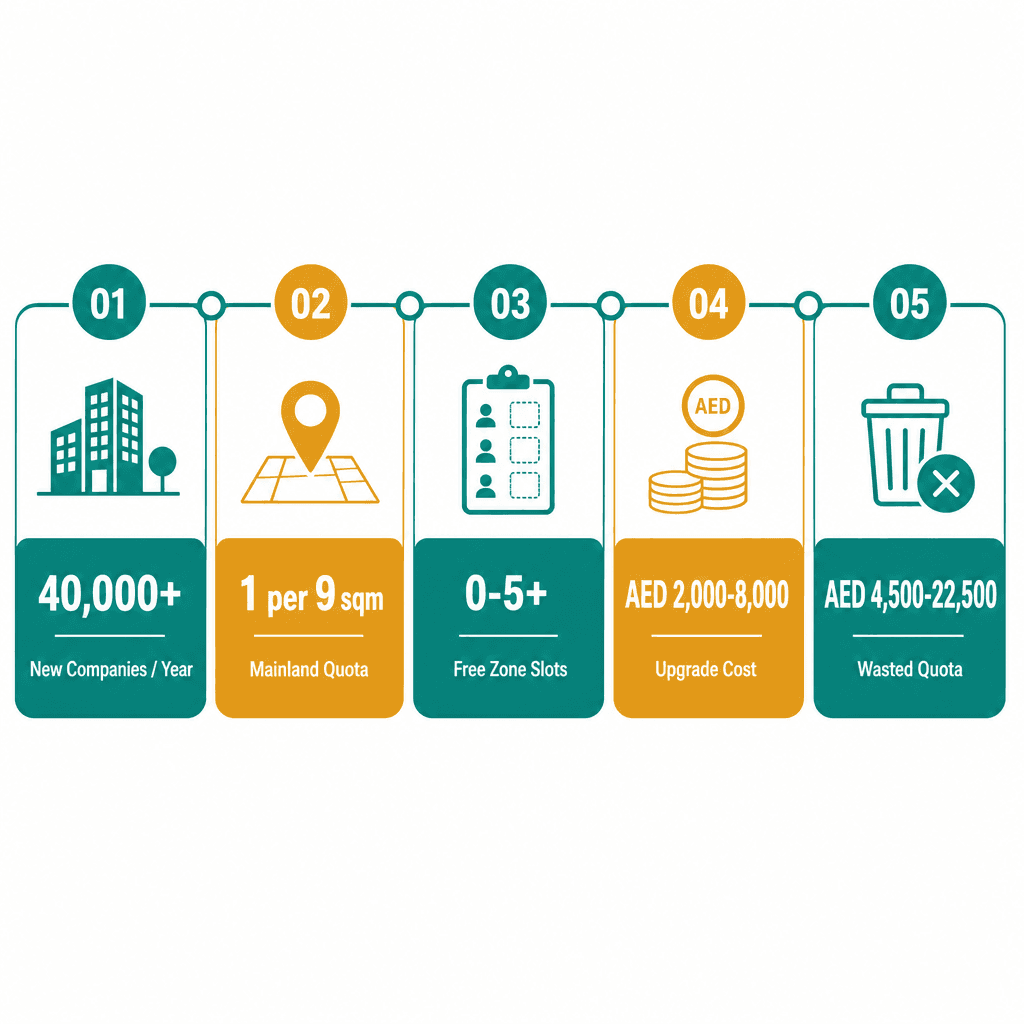
Your Dubai company's visa entitlement is set at incorporation based on license type, jurisdiction, and workspace, not your intended headcount. The relevant authority records this ceiling, and you cannot issue more active visas than your quota allows.
Mainland Quota Follows Office Square Footage
DET mainland companies receive roughly one visa per 9 sq m of Ejari-registered office space. This means your physical lease size directly determines how many employees or dependants you can sponsor.
Free Zone Packages Offer Fixed Visa Tiers
Free zone visa allocations are bundled into package tiers, typically ranging from zero slots on a basic flexi-desk up to five or more on larger workspace plans. Upgrading mid-year is possible but triggers additional fees and processing delays of three to seven working days.
Undershooting Your Quota Blocks Hiring
A solo founder on a one-visa package cannot issue employee visas without a formal upgrade, which costs more than sizing up correctly at the start. Mid-year quota upgrades commonly run AED 2,000–8,000 in additional fees.
Overshooting Wastes Money Every Year
Annual visa slot fees at major free zones range from AED 500 to AED 2,500 per unused slot. Three unused slots across a three-year license cycle can silently drain AED 4,500–22,500 from your budget.
Plan for 12–18 Months of Realistic Need
Treat visa quota like office square footage and size it for near-term growth, not just day-one headcount. Some zones require jumping to a full package tier to access extra slots, meaning you may pay for workspace you don't need just to get the visas you do.
By Editorial Team, UAE company formation specialists with hands-on experience across mainland DET and free zone license structures. Full bio →
In 2026, Dubai registers over 40,000 new companies annually, and a significant share of founders discover too late that their license package includes fewer visas than their business actually needs. Free zone packages range from 0 to 5+ visa slots depending on workspace tier. Mainland quota runs at roughly 1 visa per 9 sq m of Ejari-registered office space. Mid-year quota upgrades can cost AED 2,000–8,000 in additional fees. Three unused visa slots over a three-year license cycle can waste AED 4,500–22,500. Getting this number wrong in either direction costs real money.
Understanding how many visas with Dubai company setups you can obtain, and planning for that number before you sign a license, is one of the most consequential decisions in your setup process. Too few visas and you can't hire staff or sponsor family. Too many and you're paying for quota you'll never use. This guide covers how visa quota works across mainland and free zone structures, what drives your allocation, what each visa type covers, and exactly how to calculate the right number for your situation. For more detail, see our guide on understanding the Dubai visa quota.
What Is a Visa Quota and Why It's the First Number You Should Confirm
A visa quota is the maximum number of residency visas a UAE company is authorised to sponsor under its trade license. It covers investor, employee, and family dependent visas. The quota is set at incorporation and depends on your license type, jurisdiction, and workspace arrangement, not on how many people you plan to hire.
How the Quota Is Tied to Your License, Not Your Headcount
The UAE government links visa entitlement to physical workspace and license package, not intended headcount. Your quota is recorded with the relevant authority at incorporation, the free zone authority for free zone companies, or the Dubai Department of Economic Development (DET) for mainland entities.
It's worth distinguishing two separate concepts here:
Visa entitlement: the ceiling, the maximum number of visas your license allows
Active visa count: the number of visas actually issued and currently valid under your company
You can have an entitlement of 5 and only 2 active visas. But you cannot have 4 active visas on a 3-visa entitlement, the system blocks it. Consider this scenario: a solo consultant sets up a 1-visa flexi-desk package at a free zone, then wins a contract requiring two on-site staff. They cannot issue those employee visas without a formal package upgrade first, which triggers additional fees and processing time of 3–7 working days.
Why Getting the Quota Wrong Costs You Money in Both Directions
Undershooting your quota means you can't sponsor employees or family until you upgrade. Mid-year upgrades almost always cost more than sizing up correctly at the start. Annual visa slot fees at major free zones range from AED 500 to AED 2,500 per slot, and if you overshoot, you pay those fees whether the slots are used or not.
Think of visa quota like office square footage. Size it for 12–18 months of realistic need, not day-one headcount. A client at Dubai South Business Hub purchasing a 5-visa package for a two-person operation pays for three unused visa slots every year, a cost that compounds quietly across a three-year license cycle. Some zones allow partial upgrades; others require jumping to the next full package tier, which can mean paying for workspace you don't need just to access the visa slots you do.
Calculate your business setup cost including visas before committing to a package tier.
Mainland vs Free Zone: How Visa Quota Is Calculated Differently
Mainland companies in Dubai receive visa quota based on office space: typically one visa per 9 sq m of leased area under DET and Ejari rules. Free zone companies receive a fixed quota tied to their license package tier, flexi-desk, shared desk, or dedicated office, regardless of physical square footage.
Mainland Quota: The Office-Space Formula
Dubai mainland quota is governed by DET and the Ministry of Human Resources and Emiratisation (MoHRE): roughly one visa per 9 sq m of Ejari-registered office space. The formula is straightforward:
Office area (sq m) ÷ 9 = approximate visa quota
A trading company renting a 72 sq m office in Business Bay registers with Ejari and is eligible for approximately 8 employee visas under this standard DET formula. Visa allocations vary by free zone and package. The space must be a genuine commercial tenancy, virtual addresses do not qualify for mainland quota. Professional license holders (sole proprietors) face additional caps regardless of space size, so confirm your specific license category with DET before signing a lease.
Free Zone Quota: Package Tiers Replace the Space Formula
Free zones don't apply the sq m formula. Visa quota is bundled into license packages, and the workspace type you select determines which tier you can purchase. Typical tiers across most zones run: 0-visa (virtual/no-desk), 1-visa, 2-visa, 3-visa, 5-visa, and custom enterprise packages. Dubai South Business Hub Free Zone allows a maximum of 6 visa allocations per license. Published packages offer 0, 1 or 2 visas, and visas are charged separately from the license.
Over 40 free zones operate in the UAE as of 2026, each setting its own quota tiers independently, there is no single federal standard.
Visa Quota by Workspace Type, Free Zone vs Mainland
Workspace Type | Free Zone Visa Quota | Mainland Visa Quota |
|---|---|---|
Virtual / No-Desk Package | 0 visas (not included) | Not applicable, physical space required |
Flexi-Desk / Hot-Desk | Visa allocations vary by free zone and package. | Not applicable |
Dedicated Desk | 2–3 visas | Not applicable |
Private Office (small, ~20–30 sq m) | 3–5 visas | 2–3 visas (≈20–27 sq m ÷ 9) |
Private Office (mid, ~50 sq m) | 5–10 visas (zone policy) | ~5–6 visas |
Private Office (large, ~100 sq m) | 10–20 visas (zone policy) | ~11 visas |
Custom / Enterprise | Negotiated with zone authority | Based on Ejari sq m |
Neither system is inherently more generous. Mainland scales linearly with space, useful for incremental growth. Free zones offer fixed bundles that can be more cost-efficient for small teams, provided you pick the right tier from the start. Ready to calculate your business setup cost? Start by confirming which workspace tier matches your visa needs.
What Each Visa Type Can Be Used For
Your Dubai company's visa quota can be used for three main categories: investor or partner visas for company owners, employee visas for hired staff, and family dependent visas sponsored through a qualified visa holder. Each investor and employee visa draws from the same company quota pool, but family dependent visas do not.
Investor and Partner Visas
The investor (or partner) visa is typically the first visa issued under a new company, it covers the owner or shareholders. Investor visas through free zones typically grant 2-year residency, renewable with the license; mainland investor visas generally run 3 years. Each partner in a company requires their own investor visa, and each consumes one quota slot.
This catches co-founders off guard more often than you'd expect. A husband-and-wife team co-founding a consultancy at a free zone with a 2-visa package will use both slots on their own investor visas, leaving zero quota for employee hires without an upgrade. Investor visa costs run AED 3,500–7,000 all-in, depending on the zone and medical/Emirates ID fees. For a full breakdown of partner residency rights, see the partner visa Dubai guide.
Employee Visas and Family Dependent Visas
Employee visas are sponsored by the company. The employee's salary must meet minimum MoHRE thresholds if they intend to sponsor their own family as dependants (AED 4,000/month minimum to sponsor a spouse).
Here's the misconception that trips up nearly every first-time founder: family dependent visas do not consume your company's visa quota. A spouse, children, or parents sponsored by a visa holder sit under that individual's personal sponsorship, not the company's allocation. The company must first issue the holder's investor or employment visa, but after that, dependent visas are entirely separate.
Practical example: a company with a 3-visa package sponsors the founder (investor visa, slot 1), a sales hire (slot 2), and an operations hire (slot 3). The founder then sponsors their spouse and two children as dependants. Those four family visas don't touch the company's quota at all. Dependent visa validity typically matches the sponsor's residency term. For full processing detail, read the employee visa sponsorship in Dubai guide.
How to Calculate How Many Visas You Need Before You Apply
To calculate how many visas you need with your Dubai company, count every person requiring UAE residency through your company: each investor or partner, every planned employee hire in the next 12–18 months, and any owner who intends to sponsor family. Add a one-visa buffer. That total is your minimum quota. Do not count family dependants, they sit outside company quota.
Step-by-Step: The Five-Minute Visa Needs Assessment
Example: a founder relocating to Dubai with one planned hire in year one needs 1 (investor) + 1 (employee) + 1 (buffer) = 3-visa package. A 2-visa flexi-desk would leave no room to grow without paying upgrade fees mid-year.
Common Scenarios and the Right Package for Each
Scenario B, Two co-founders, no staff: 2-visa minimum; 3-visa if one partner wants to sponsor a parent.
Scenario C, Small trading company (founder + 2 employees): 3-visa minimum; 5-visa if growth is likely within 18 months.
Scenario D, Regional office of a foreign company: 5-visa or enterprise package; dedicated office required in most zones.
A US-based SaaS company opening a regional sales office in Dubai with a country manager and two account executives needs at minimum a 3-visa package, but a 5-visa dedicated office package gives room to add a fourth hire without a disruptive mid-year upgrade. Upgrading from a 2-visa to a 5-visa package mid-year costs AED 3,000–10,000 in combined zone and government fees. Sizing up at the start is nearly always cheaper. Use the cost calculator to model your total setup cost including visa slots.
How Free Zone Visa Quotas Work, and Why Each Zone Sets Its Own Rules
Each UAE free zone is an independent authority with the power to set its own visa quota rules, package structures, and upgrade fees. Different zones operate different tiers, and there is no single federal free zone visa standard. Always confirm the specific quota policy with your chosen zone before committing to a license package.
Zone-by-Zone Differences You Need to Know
Dubai South Business Hub (Dubai South Business Hub Free Zone): flexi-desk packages include defined visa allocations; dedicated offices open access to higher tiers. Contact Dubai South Business Hub Free Zone directly for current quota details.
Visa allocations vary by free zone and package.
Logistics and industrial free zones: certain zones tie visa quotas to warehouse or office size rather than fixed package tiers, reflecting their operational focus.
Dubai South Business Hub: packages structured by workspace tier with transparent quota per level, founders know exactly what they get without hidden per-slot fees.
DIFC: premium financial zone; quota based on licensed entity type and office size.
A founder who sets up in one free zone with a 3-visa flexi-desk package and then opens a second entity in another zone may find that equivalent workspace types carry similar headline quotas, but the upgrade paths and costs differ significantly. Quota differences between equivalent workspace types can vary by 1–2 slots and AED 2,000–5,000 per slot annually across zones, making it essential to compare policies carefully before committing.
Can You Add More Visas After Your Company Is Set Up?
Yes, most free zones allow quota upgrades, but the process and cost vary by zone. You have three main options:
Option 1: Upgrade your workspace tier (e.g., move from flexi-desk to dedicated office), increases your base quota.
Option 2: Purchase additional visa slots where the zone allows à la carte additions.
Option 3: Renew at a higher package tier at the next license renewal cycle, almost always cheaper than a mid-year upgrade.
A company at Dubai South Business Hub starting on a 2-visa flexi-desk package and winning a contract six months in that requires two additional hires will face a workspace upgrade fee plus pro-rated slot fees for the remaining license period. Mid-year upgrade costs run AED 1,500–8,000 depending on the zone and slots added. Most free zones process quota upgrades within one working day for eligible activities. The practical tip: if you're approaching your ceiling, initiate the upgrade before you need it, not after you've already offered someone a role. Explore Dubai South Business Hub Free Zone residency services for end-to-end visa processing support.
What Happens If You Exceed Your Visa Quota
If you attempt to sponsor more visas than your quota allows, the immigration or free zone authority will reject the application outright. You cannot exceed your quota without a formal upgrade. Attempting to work around quota through unofficial arrangements carries serious legal risk in the UAE, including company suspension and personal fines.
The Formal Upgrade Path vs the Risks of Workarounds
The correct path is straightforward: apply for a quota upgrade through your free zone authority or DET before submitting the additional visa application. Free zones handle enforcement through their own immigration desks, applications are blocked at the portal level when quota is exhausted. Mainland enforcement runs through MoHRE's Tash
Citations
Dubai Economy and Tourism.. dubaidet.gov.ae. DET Dubai, 2024.
General Directorate of Residency and Foreigners Affairs Dubai.. gdrfad.gov.ae. GDRFA Dubai, 2024.
Ministry of Human Resources and Emiratisation.. mohre.gov.ae. MoHRE UAE, 2024.
Federal Authority for Identity, Citizenship, Customs and Port Security.. icp.gov.ae. ICP UAE, 2024.
UAE Cabinet.. uaecabinet.ae. UAE Cabinet, 2023.
Frequently Asked Questions