Topic Summary
Unmatched Airport-Port Logistics Corridor
Dubai South sits just 15 km from Jebel Ali Port, which processes over 14 million TEUs annually, and is co-located with Al Maktoum International Airport, targeting 260 million passengers at full capacity. A freight business can physically position its warehouse within 2 km of both the airport cargo apron and the main road artery to the port.
100% Foreign Ownership and Full Profit Repatriation
Businesses licensed in Dubai South Free Zone retain complete ownership without requiring a local partner, and can repatriate all profits out of the UAE. 0% personal income tax and 0% corporate tax on qualifying income apply on top of these ownership rights, subject to applicable Corporate Tax rules.
Affordable Entry Costs for SMEs
Free zone licenses start from AED 12,500, making Dubai South accessible to startups and small businesses, not just large multinationals. Trading, service, industrial, and e-commerce license categories are all available through Dubai South Business Hub.
Purpose-Built Sector Districts Under One Jurisdiction
The zone is divided into interconnected precincts including an Aviation District for aerospace and MRO, a Logistics District for freight and warehousing, and a Business Park for service companies. This cluster model means businesses operate alongside relevant partners, suppliers, and clients rather than in a generic industrial estate.
4.5 Billion People Within an 8-Hour Flight
Approximately 4.5 billion people fall within a single 8-hour flight radius of Dubai South, making it a genuine supply-chain asset rather than a marketing claim. That market reach is embedded in the physical address itself.
Direct Metro Access Reduces Workforce Dependency on Roads
The Route 2020 Metro extension has connected Dubai South to the wider Dubai transport grid since 2021, giving employees and visitors a public transit option. This infrastructure was planned in parallel with the zone, not retrofitted afterward.
A Live Ecosystem of 25,000+ Active Businesses
A growing community of businesses were actively operating across Dubai South's 145 sq km master-planned city as of 2025, meaning the commercial ecosystem is already functioning at scale. New entrants join an established network of tenants, logistics operators, and service providers rather than an early-stage development.
In 2026, over 25,000 active businesses operate across Dubai South's 145 sq km master-planned city. Al Maktoum International Airport is targeting a build-out capacity of 260 million passengers annually (Dubai Airports, 2023). Jebel Ali Port, just 15 km away, processes over 14 million TEUs every year (DP World, 2024). Free zone licenses start from AED 12,500. And a single 8-hour flight radius from the zone puts approximately 4.5 billion people within reach. Numbers like those are why the dubai south free zone benefits conversation keeps coming up whenever entrepreneurs and SMEs compare UAE jurisdictions.
This article breaks down the concrete, Dubai-South-specific advantages you gain by setting up in this free zone, from its unmatched multimodal logistics corridor and 100% ownership structure to its sector clusters, scalable facilities, and proximity to the world's largest airport project, so you can decide whether it belongs at the top of your shortlist.
What Are the Dubai South Free Zone Benefits That Set It Apart?
Dubai South free zone benefits include 100% foreign ownership, 0% personal income tax and 0% corporate tax on qualifying income, full profit repatriation, and a unique position on the world's largest airport-port logistics corridor. Unlike generic free zones, Dubai South is purpose-built around Al Maktoum International Airport and Jebel Ali Port, giving logistics, aviation, and trade businesses unmatched physical infrastructure. That last point is the one worth dwelling on: most UAE free zones offer the same headline ownership and tax perks. The generic free-zone benefits are table stakes. What Dubai South adds is a physical address that does real commercial work for you.
How Dubai South Free Zone Is Structured
Dubai South is a master-planned city spanning 145 sq km, governed as a distinct jurisdiction by Dubai South (Business Hub), or Dubai South Business Hub Free Zone. It's not a single industrial estate, it's a city-within-a-city, with the free zone sitting at its core, directly adjacent to Al Maktoum International Airport's cargo and passenger terminals.
Within that structure, distinct precincts serve specific purposes: the Aviation District for aerospace and MRO businesses, the Logistics District for freight and warehousing, the Business Park for service companies, and the Residential City for the workforce that supports them all. Every district is designed to interconnect, not operate in isolation. Dubai South Business Hub Free Zone issues trading, service, industrial, and e-commerce licenses, with entry costs from AED 12,500. With 25,000+ active businesses already operating here, the ecosystem is live, not aspirational. Read the full Dubai South free zone guide for the operational detail.
A freight-forwarding SME that sets up in the Logistics District can physically locate its warehouse within 2 km of both the airport cargo apron and the road artery feeding Jebel Ali. No other UAE free zone geography replicates that.
Why Location Inside This Free Zone Is a Structural Advantage, Not a Marketing Claim
Dubai South is the only free zone in the UAE built co-located with a greenfield mega-airport, not retrofitted next to an existing urban hub, but planned in parallel with it from the ground up. That distinction matters for infrastructure quality. The Route 2020 Metro extension has been operational since 2021 (RTA, 2021), connecting the zone directly to Dubai's wider transport grid. So even your workforce and visitors aren't dependent on road access alone.
That 8-hour flight radius covering approximately 4.5 billion people isn't a marketing line, it's a supply-chain fact. Your market access is built into the address. Contrast that with free zones in older industrial corridors, where 21st-century logistics needs are being squeezed into infrastructure designed decades earlier. Dubai South doesn't have that problem.
How Does the Airport-Port Corridor Give You a Logistics Edge?
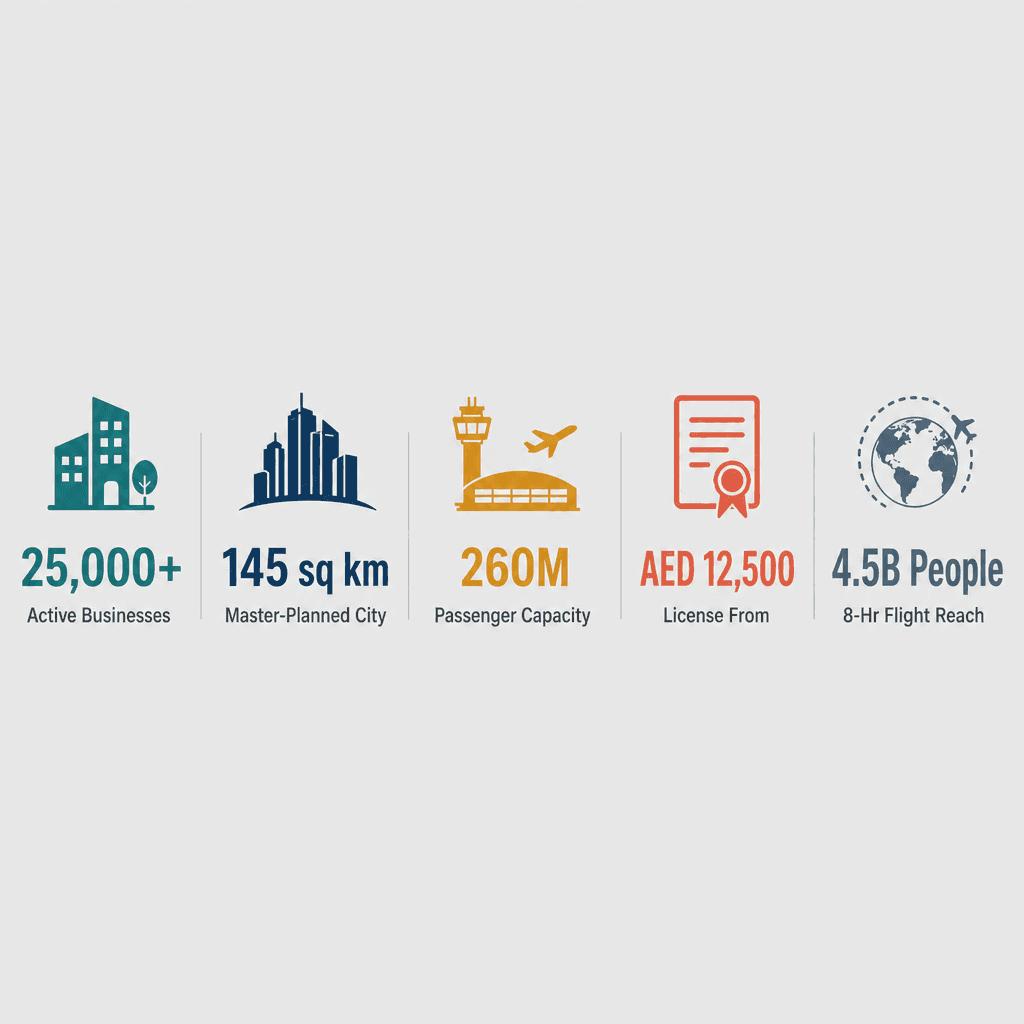
Dubai South sits between Al Maktoum International Airport, targeting 260 million passengers and 12 million tonnes of cargo at full capacity, and Jebel Ali Port, which handles over 14 million TEUs annually. No other UAE free zone offers direct, road-connected access to both a mega-airport and the region's largest container port simultaneously. That's the core of the benefits of dubai south for any business that physically moves goods.
Al Maktoum International Airport: What the Scale Means for Your Business
Al Maktoum is targeting 260 million passengers and 12 million tonnes of cargo at full build-out (Dubai Airports, 2023). Phase 1 of the new terminal is already underway. Businesses setting up now are positioning ahead of the capacity ramp-up, which means you're entering a growing ecosystem, not a mature one with fixed competitive dynamics.
The airport's cargo hub is already operational. You're not waiting for future infrastructure; you're plugging into live operations today. An e-commerce fulfilment operator using Dubai South's Logistics District can clear customs and move goods from the airport cargo terminal to a bonded warehouse within the same free zone in a single short road movement, a workflow that simply isn't replicable in free zones located across Dubai. Aviation-adjacent businesses (MRO, ground handling, aerospace manufacturing, air cargo logistics) gain the added benefit of physical proximity that cuts drayage time and cost in a direct, measurable way.
Jebel Ali Port and the Multimodal Connectivity Stack
Jebel Ali Port sits 15 km from Dubai South and handles over 14 million TEUs annually (DP World, 2024), making it the largest port in the Middle East and among the top 10 globally. That proximity gives dubai south free zone advantages a sea-freight dimension that airport-only free zones simply can't offer.
The transport modes available from a single Dubai South base include:
Air: Al Maktoum International Airport cargo hub, on-site
Sea: Jebel Ali Port, 15 km by road
Road: Direct arterial access to the UAE highway network
Rail: Etihad Rail integration planned for the corridor
For importers and re-exporters, receiving sea freight at Jebel Ali and air-freighting high-value or time-sensitive components from Al Maktoum, all within a 15 km radius, compresses supply chains in a way that spreadsheets can model but competitors can't easily replicate. This corridor is the core reason why Dubai South is not interchangeable with other UAE free zones for logistics-dependent businesses. See why businesses choose Dubai South for the broader location picture.
What Ownership and Incentive Structures Come With a Dubai South License?
A Dubai South free zone license gives you 100% foreign ownership, zero corporate tax on qualifying free zone income, zero personal income tax, and full repatriation of profits and capital. These are standard free-zone incentives in the UAE, but Dubai South pairs them with purpose-built logistics infrastructure that generic free zones can't match. The incentives matter; so does where they're attached.
100% Ownership, Tax Position, and Profit Repatriation
100% foreign ownership is available without a local sponsor, that's been the position for UAE free zones for years, and Dubai South upholds it fully. Under the UAE's corporate tax framework (effective June 2023), qualifying free zone businesses benefit from a 0% rate on qualifying income. Specific structuring matters here, and professional tax advice is recommended before you rely on that rate (UAE CT Law, 2023).
Zero personal income tax applies to founders and employees alike. Full repatriation of profits and capital with no currency restrictions is a genuine operational benefit for international SMEs managing cross-border treasury. For the full picture of what these incentives mean across UAE free zones generally, see our guide to benefits of free zones in Dubai. This article stays focused on what Dubai South adds on top of that baseline.
Scalable Facilities: From a Flexi-Desk to a Full Warehouse
Dubai South offers a genuine facility spectrum: flexi-desks and shared offices for startups, private offices for growing teams, and warehouse and industrial units for logistics and manufacturing operations. This scalability within a single jurisdiction means you don't need to re-license or relocate as your operation grows, a practical advantage that saves both time and legal cost.
Warehouse units within the Logistics District are built to Dubai South Business Hub Free Zone specifications, with loading bays, appropriate clearance height, and bonded-zone capability suited to cargo-handling businesses. A trading startup might begin with a flexi-desk license at AED 12,500 to test a new market, then transition to a warehoused unit in the Logistics District as volumes grow, all under the same Dubai South Business Hub Free Zone authority, with no jurisdiction change. Use the cost calculator to model your specific combination of license, facility, and visa allocation.
Which Sector Clusters Make Dubai South Free Zone Advantages Concrete?
Dubai South's free zone advantages are most tangible for businesses in logistics, aviation and aerospace, e-commerce fulfilment, and international trade. Each of these sectors benefits from co-location with Al Maktoum Airport and Jebel Ali Port. The zone's purpose-built clusters mean your suppliers, clients, and regulators are often within the same precinct, and that proximity has a direct cost and speed benefit.
6 Sector Groups That Gain the Most From Setting Up in Dubai South
A European aerospace components distributor relocated its regional hub to Dubai South's Aviation District specifically to reduce lead times to MRO clients at Al Maktoum. That's a cluster-effect benefit that no non-aviation free zone could replicate, regardless of how competitive its license pricing might be.
How the Cluster Effect Compounds Your Business Case
When your suppliers, freight partners, and customers are co-located in the same free zone, transaction costs fall. Fewer border crossings, shorter delivery windows, and shared regulatory familiarity all reduce friction in day-to-day operations. The ISIC framework (UN, 2008) classifies logistics, transport, and storage under Section H, and wholesale and retail trade under Section G, both are primary activity clusters in Dubai South, meaning the zone's infrastructure directly supports the most trade-intensive ISIC divisions globally recognised for statistical reporting.
A concentration ofa growing community of businesses means a live local market for B2B services, not just a license address. Cluster density also attracts talent: workers in logistics, aviation, and trade increasingly look to Dubai South as a natural employment hub, which reduces your recruitment friction as you scale. For more on the business-location case, see why businesses choose Dubai South.
What Does the Setup Process Actually Look Like?
Setting up in Dubai South free zone typically involves choosing your license type, selecting a facility, submitting documents to Dubai South Business Hub Free Zone, and receiving your license, a process that can be completed in a few working days for straightforward applications. Costs start from AED 12,500 for a license, with facility and visa costs adding to the total. The process itself isn't the differentiator here; what you get at the end of it is.
License Types and Activity Selection
Dubai South Business Hub Free Zone issues four main license types: trading, service, industrial, and e-commerce. Your permitted activities are defined at the license level, so getting this right at the outset matters more than most applicants realise. Multiple activities can be added to a single license, which is useful for businesses that trade and provide services in parallel.
Activity classification under the Dubai South Business Hub Free Zone framework aligns broadly with ISIC Revision 4 categories (UN, 2008), so businesses with internationally standardised activity descriptions will find the mapping straightforward. Choosing the wrong license type can create compliance complications later, consult a registered agent or business setup adviser before submitting. Use the cost calculator to model your exact license and facility combination.
Documents, Timelines, and What to Prepare
Standard documentation includes passport copies, a business plan or activity description, and shareholder and director details. Requirements vary by license type and applicant nationality. Dubai South Business Hub Free Zone has streamlined its application process; straightforward service or trading licenses can be approved within a matter of working days.
Visa allocations are tied to your facility choice, flexi-desk, private office, and warehouse units each carry different entitlements.
Fast-track approvals are available for standard applications.
All documentation is submitted through the Dubai South Business Hub Free Zone application portal.
Dubai South Free Zone vs. Key UAE Free Zone Competitors
Feature | Dubai South Free Zone | other UAE free zones / other UAE free zones / other UAE free zones |
|---|---|---|
Airport adjacency (Al Maktoum International) | On-site; cargo hub operational now, 260M passenger capacity at full build-out (Dubai Airports, 2023) | other UAE free zones is adjacent to DXB (passenger-dominated); other UAE free zones have no airport adjacency |
Sea port road access (Jebel Ali Port, 15 km) | 15 km by direct road; Jebel Ali handles 14M+ TEUs annually (DP World, 2024) | other UAE free zones is co-located with Jebel Ali; other UAE free zones have no sea port proximity |
Bonded warehousing available on-site | Yes, Logistics District units with bonded-zone capability and loading-bay specifications | other UAE free zones: yes; other UAE free zones: limited land for warehousing; other UAE free zones: no warehousing infrastructure |
Aviation and aerospace cluster | Dedicated Aviation District with MRO facilities and growing aerospace supply-chain ecosystem | other UAE free zones has some aviation adjacency; other UAE free zones have no aviation cluster |
License entry cost from AED 12,500 | From AED 12,500; scalable from flexi-desk to warehouse under one authority | other UAE free zones entry costs are generally higher; other UAE free zones entry costs vary by activity type |
Scalable facilities: flexi-desk to warehouse | Full spectrum within one jurisdiction, no re-licensing required as you scale | other UAE free zones: warehouse-focused, limited desk options; other UAE free zones: office-focused; other UAE free zones: office and serviced space only |
How Do Dubai South Free Zone Benefits Compare to Other UAE Free Zones?
Dubai South free zone benefits are most competitive for logistics, aviation, trade, and e-commerce businesses. Compared to other UAE free zones, Dubai South adds airport adjacency. Compared to other UAE free zones, it adds deep-water port access and warehousing scale. For businesses that need multimodal connectivity, air, sea, and road from one address, Dubai South has no direct equivalent in the UAE.
Dubai South vs. other UAE free zones: Where Each Wins
other UAE free zones: Strongest for sea freight and heavy industry, co-located with Jebel Ali Port (14M+ TEUs, DP World 2024). But it lacks airport adjacency and has no aviation cluster. Right choice for port-dependent businesses with no air cargo requirement.
other UAE free zones (other UAE free zones): Strong airport connectivity to DXB, but DXB is a passenger-dominated hub with limited cargo warehousing land. No sea port proximity. Right for air cargo businesses tied to DXB specifically.
other UAE free zones: Dominant for commodities trading and financial services. No logistics infrastructure at all. Not the right jurisdiction for physically moving goods.
Dubai South: The only zone that combines an active cargo airport, sea port road access, bonded warehousing, and an aviation cluster in one jurisdiction (Dubai Airports, 2023; DP World, 2024). The right choice for logistics-dependent and trade-heavy businesses.
When Dubai South Is Not the Right Choice
Worth being direct about this: if your business is purely financial services, commodities trading, or technology with no physical goods movement, other specialist jurisdictions calibrated for those sectors may serve you better. The regulatory environment, peer network, and talent pool in those zones are built around those activities in a way Dubai South isn't, Dubai South is purpose-built for logistics, aviation, trade, and e-commerce, and that focus is where it delivers the strongest value.
If your primary market is Dubai city centre or Abu Dhabi and you have no logistics component, the location may not justify the choice. Dubai South's advantages are structural and physical. If your business model doesn't interact with those physical advantages, you're paying for infrastructure you won't use. Sector fit matters more than headline license cost when evaluating free zones. For a broader comparison of UAE free zone options, see our Dubai free zone benefits guide
Citations
Dubai Airports.. dubaiairports.ae. Dubai Airports, 2024.
DP World.. dpworld.com. DP World, 2024.
UAE Ministry of Economy and Tourism.. moet.gov.ae. MOET UAE, 2024.
Dubai Economy and Tourism.. dubaidet.gov.ae. DET Dubai, 2024.
Federal Tax Authority.. tax.gov.ae. FTA UAE, 2023.
Frequently Asked Questions