Topic Summary
Choose the Right E-commerce Activity Code
Dubai trade licenses are tied to specific ISIC activity codes based on what you sell, not how you sell it. Picking the wrong code means you cannot legally sell that product type, and fixing it later costs time and money.
Understand the Mainland vs Free Zone Trade-off
Mainland licenses let you sell directly to any UAE customer or government body but require a physical office and carry a 9% corporate tax above AED 375,000. Free zone licenses offer 100% foreign ownership and potential 0% corporate tax, but direct B2C sales to UAE residents may require a local distributor.
Verify QFZP Status Before Banking on Tax Savings
Free zone companies can qualify for 0% corporate tax, but only under Qualifying Free Zone Person (QFZP) conditions set by the UAE Federal Tax Authority. Always confirm eligibility with a UAE tax adviser before structuring your business around that benefit.
Pick Sales Platforms That Work in the Gulf
Regional marketplaces like Amazon.ae and Noon are widely used by UAE consumers and support local fulfilment. Your trade license activity code must cover the product types you list on these platforms.
Connect a UAE-Approved Payment Gateway from Day One
Operating legally in Dubai requires a UAE-approved payment gateway linked to a local business bank account. Getting your license and banking setup right at the start prevents delays in accepting customer payments.
Factor in VAT Obligations from the Start
The UAE applies VAT to most goods and services sold online, and registration requirements apply once you cross the relevant revenue threshold. Understanding your VAT obligations before launch keeps you compliant and avoids penalties.
Leverage Dubai's Logistics Infrastructure for Fulfilment
Dubai South Business Hub sits near Al Maktoum International Airport and Jebel Ali Port, giving e-commerce sellers fast access to Gulf-wide and international shipping routes. Bonded warehouse options at these hubs can reduce fulfilment costs for cross-border sellers.
The UAE e-commerce market is projected to reach USD 9 billion by 2026 (Statista, 2024). Dubai's online retail base grew by double digits every year from 2020 to 2024. The city has 0% personal income tax. Free zone companies can qualify for 0% corporate tax (conditions apply). And the UAE dirham is pegged to the US dollar at a fixed rate of 3.67. For US-based sellers, those five facts alone make an e-commerce business setup in Dubai worth a serious look.
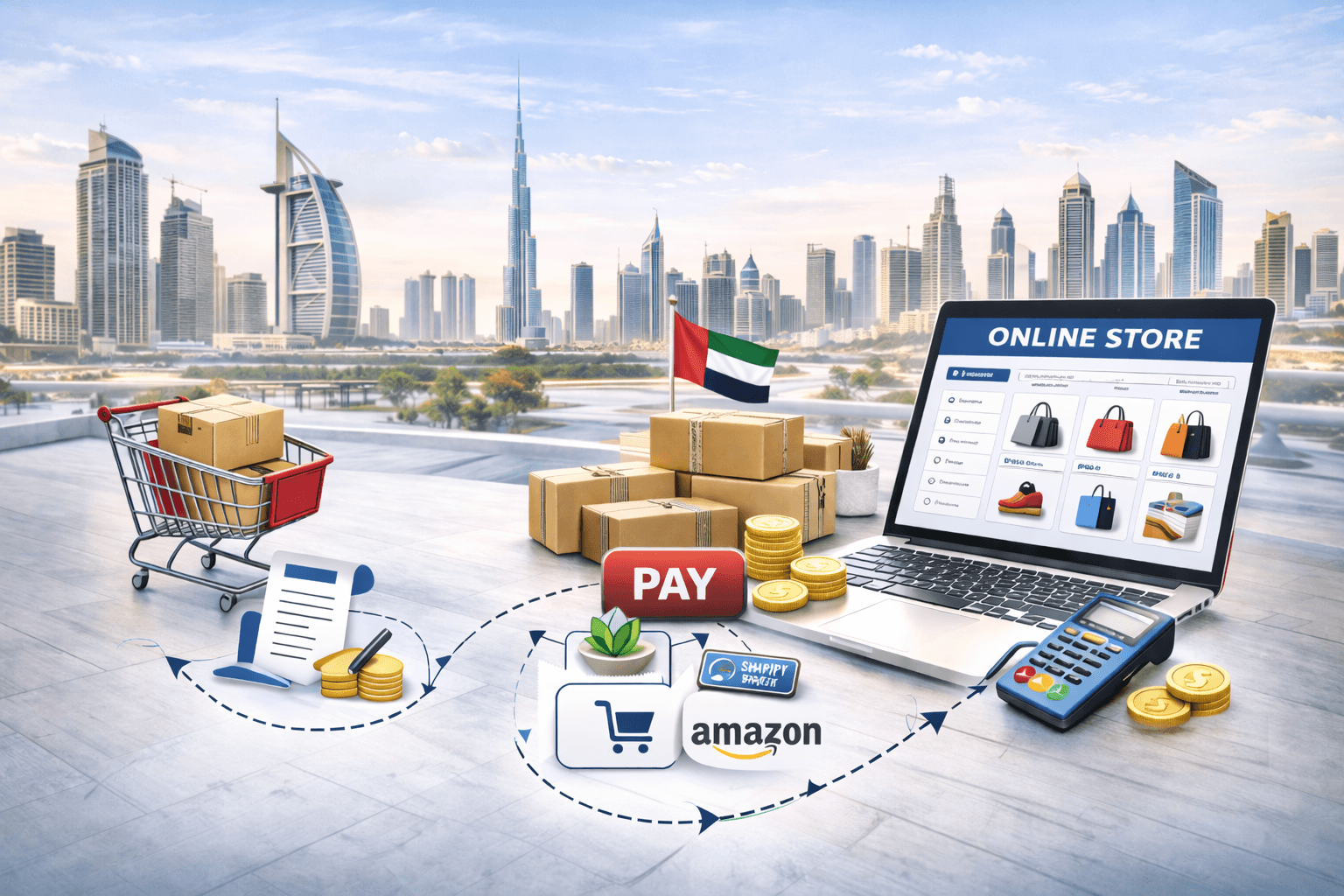
This guide covers what you need to complete an e-commerce business setup in Dubai: the right license type, which sales platforms work best in the Gulf, how to connect a payment gateway, and what VAT rules apply from day one. By the end, you will know exactly what to do next and what mistakes to skip. For more detail, see our guide on e-commerce business setup guide for Dubai.
What Is E-commerce Business Setup in Dubai and Why It Matters
An e-commerce business setup in Dubai means getting a trade license that lets you sell goods or services online, picking a sales platform, and connecting a UAE-approved payment gateway. It gives your store a legal base, lets you open a business bank account, and lets you ship across the UAE and abroad.
What the License Actually Covers
A Dubai e-commerce license lets you sell products or services through a website, app, or marketplace such as Amazon.ae or Noon. It covers both B2C and B2B online sales.
The license is tied to a specific activity code. Pick the wrong one and you cannot legally sell that product type. Under ISIC Rev.4, online sales are classified by the nature of goods sold, not the channel (UN Statistics Division, 2008).
Retail of clothing online: retail clothing activity code
Retail of food products online: retail food activity code
Retail of electronics online: retail electronics activity code
Mixed product range: general trading code covers multiple lines
A founder selling skincare through Instagram and Shopify needs a retail cosmetics activity code, not a generic e-commerce code. Getting this right at the start saves a costly amendment later. You can browse the full list of business activities in Dubai to find the right code for your product type.
Why Dubai Is a Strong Base for Online Sellers
0% personal income tax across the UAE (u.ae)
0% corporate tax for qualifying free zone companies (QFZP status required)
100% foreign ownership in a free zone, no local partner needed
Access to Jebel Ali Port and Al Maktoum International Airport for fast fulfilment
English-language contracts and a USD-pegged currency cut foreign exchange risk
A US apparel brand setting up at Dubai South Business Hub (DSBH) can own 100% of the company, invoice Gulf clients in USD, and ship from a bonded warehouse near Al Maktoum Airport. Confirm QFZP status with a UAE tax adviser before you file.
Mainland vs Free Zone: Which Setup Fits Your Store
Mainland licenses (issued by DET) let you sell directly to UAE government and retail customers with no restrictions. Free zone licenses suit international sellers and digital brands. Free zones offer faster setup, 100% foreign ownership, and simpler admin. Direct B2C sales to UAE residents from a free zone may need a local distributor, so confirm this with your free zone authority before you commit.
Mainland License: Pros and Limits
Sell to any UAE customer or government body directly
Physical office address in Dubai required (flexi-desk options exist)
Corporate tax at 9% on taxable income above AED 375,000
Good fit for UAE warehouse operators and retail pick-up points
A US electronics distributor supplying Dubai government schools needs a mainland DET license to invoice government entities directly.
Free Zone License: Pros and Limits
100% foreign ownership, no UAE sponsor needed
0% corporate tax for qualifying companies (QFZP status required)
Direct B2C sales to UAE mainland may need a local agent, verify first
DSBH licenses start from AED 12,500
Same-day digital license issuance available
A US founder launching a supplement brand for Gulf markets sets up at DSBH, ships via Al Maktoum Airport, and sells through Amazon.ae using a third-party fulfilment agent for UAE mainland delivery. Use the business setup cost calculator to get an exact fee for your activity and visa count.
Feature | Mainland (DET) | Free Zone (DSBH) |
|---|---|---|
Foreign ownership | 100% since 2021 amendments (most activities) | 100%, no sponsor needed |
Direct UAE retail sales | Yes, unrestricted | May need a mainland agent for B2C |
Corporate tax | 9% on income above AED 375,000 | 0% for qualifying companies (QFZP) |
Setup speed | 5 – 10 working days typically | Same day with digital submission |
Physical office requirement | Registered address mandatory | Flexi-desk options available |
Best for | B2G sales, UAE retail, government supply | International sellers, cross-border brands |
How to Get Your Dubai E-commerce License: 6 Steps
To get a Dubai e-commerce license: choose mainland or free zone, pick your activity code, reserve your trade name, submit your application and documents, pay the license fee, then open a UAE business bank account. Most free zone setups complete in 3 to 5 working days with digital document submission. For more detail, see our guide on online business setup at Dubai South Free Zone. For more detail, see our guide on e-commerce advantages at Dubai South Free Zone.
Step 1 to Step 3: Name, Activity, and Structure
Step 1, check your trade name: Use the DSBH portal or DET name search to confirm your name is free. You can run a trade name availability search in minutes online.
Step 2, pick your activity code: Choose the code that matches what you sell. Retail of clothing, electronics, food, or a general trading code if you sell across categories.
Step 3, choose your legal structure: Most solo founders pick a Free Zone Establishment (FZE), one shareholder, full control. Partnerships use a Free Zone Company (FZCO).
A founder selling both tech accessories and home goods picks a general trading code at DSBH rather than two separate activity codes. One code, one license fee, full coverage.
Step 4 to Step 6: Documents, Fees, and Bank Account
Step 4, submit your papers: Passport copy (valid 6 or more months), passport photo, and a completed application form. No notarised documents needed for most DSBH e-commerce applications.
Step 5, pay your license fee: DSBH e-commerce and trading licenses start from AED 12,500. Use the cost calculator to get an exact figure.
Step 6, open a UAE business bank account: You need your trade license, Memorandum of Association, and Emirates ID (or entry stamp). Most UAE banks take 2 to 4 weeks for account approval.
A US national applying remotely submits scanned documents through the DSBH digital portal and receives a digital license the same day. No in-person visit needed at the application stage.
What documents do you need for a Dubai e-commerce license?
For most DSBH free zone applications, you need a passport copy valid for at least 6 months, a recent passport photo, and a completed application form. No notarised documents are required at the application stage. Your trade license, Memorandum of Association, and Emirates ID are needed later to open a UAE business bank account.
Choosing the Right E-commerce Platform for Your Dubai Store
Shopify, WooCommerce, and Salla are the most common platforms for Dubai-based online stores. Shopify suits international sellers wanting fast setup. Salla is built for Arabic-language Gulf markets. WooCommerce fits sellers who want full control over hosting.
Platforms That Work Well in the Gulf
Shopify: Supports Arabic, integrates with UAE payment gateways (Telr, PayTabs, Stripe UAE) and shipping providers. Plans start at USD 29 per month.
Salla: Saudi-built, designed for Gulf Arabic sellers. Strong on WhatsApp integration and cash on delivery (COD), which accounts for around 30% of UAE online orders.
WooCommerce: Open-source, hosted on your own server, no monthly platform fee. Best for sellers with a developer on hand.
Amazon.ae and Noon: Marketplace options that let you sell without a standalone storefront. Useful for testing a product range before building your own site.
A US skincare brand entering the Gulf chooses Shopify with an Arabic-language theme, connects Telr as its payment gateway, and lists its top 5 SKUs on Amazon.ae in parallel to build reviews fast.
Domain, Hosting, and Arabic Content Rules
A.ae domain requires a UAE trade license, get your license before building your site
Arabic is not mandatory for B2B stores, but it lifts conversion for UAE consumer brands
UAE Consumer Protection rules require clear pricing in AED, a returns policy, and contact details on the site (u.ae)
Hosting inside the UAE is not legally required but reduces page load time for Gulf shoppers
Payment Setup: Gateways, Bank Accounts, and Currency
Dubai e-commerce stores need a UAE-licensed payment gateway and a UAE business bank account to accept online payments legally. Telr, PayTabs, and Stripe UAE are the most common gateways. Each requires your trade license and bank account details before activation. Setup takes 5 to 10 working days on average.
Which Payment Gateway to Use
Telr: UAE-founded, supports 120 or more currencies, integrates with Shopify and WooCommerce. No setup fee on standard plans. Requires a UAE trade license.
PayTabs: Strong on recurring billing and B2B invoicing. Good for subscription-based e-commerce or SaaS products sold from Dubai.
Stripe UAE: Launched in 2023. Familiar interface for US founders. Supports Apple Pay and Google Pay. Requires a UAE entity and bank account.
PayPal: Widely trusted by US shoppers but has limited UAE merchant support. Do not rely on it as your primary gateway for UAE sales.
Tabby and Tamara: Buy-now-pay-later (BNPL) options popular with UAE consumers aged 18 to 35. Add as a checkout option, not a primary gateway.
Opening a UAE Business Bank Account for Your Store
You need a UAE business bank account before any payment gateway will activate. Here is what most UAE banks ask for.
Trade license and Memorandum of Association
Passport copies of all shareholders
Proof of address and a business plan summary
Emirates ID (or entry stamp for new arrivals)
Digital banks such as Wio Business approve faster, sometimes within a week, and suit early-stage e-commerce founders with lower transaction volumes. Traditional UAE banks (Emirates NBD, Mashreq, ADCB) take longer but offer multi-currency accounts and higher transaction limits. The AED is pegged to the USD at 3.67, so there is no currency risk for US founders receiving AED and converting to USD. You can read more about opening a UAE bank account as part of your setup.
How long does payment gateway activation take in the UAE?
Most UAE payment gateways (Telr, PayTabs, Stripe UAE) activate within 5 to 10 working days once you submit your trade license and UAE business bank account details. Digital bank accounts such as Wio Business can be opened in as little as one week, which speeds up the gateway activation process for early-stage founders.
VAT and Tax Rules for Dubai Online Stores
UAE VAT applies at 5% on most goods and services sold to UAE customers. You must register for VAT once your taxable turnover exceeds AED 375,000 in a 12-month period. Free zone e-commerce companies that meet FTA Qualifying Free Zone Person criteria may qualify for a 0% corporate tax rate on qualifying income.
VAT Registration and Filing
Register at tax.gov.ae once taxable turnover hits AED 375,000 in any 12-month period
Voluntary registration is allowed from AED 187,500
VAT is 5% on standard-rated goods and services; digital services sold to UAE consumers are standard-rated
Late VAT registration carries an AED 10,000 penalty (FTA)
File VAT returns quarterly through the FTA's EmaraTax portal
Exports of goods out of the UAE are zero-rated, key for brands shipping from a Dubai warehouse to Saudi Arabia or Kuwait
Corporate tax
UAE corporate tax applies at 9% on taxable income above AED 375,000 for mainland companies. Free zone companies can pay 0% on qualifying income, but only if they meet the FTA's QFZP conditions. Confirm this with a UAE tax adviser before you file.
All UAE companies must register with the FTA for corporate tax from the moment the company exists
Keep financial records for at least 7 years; the FTA can audit at any time
Logistics, Fulfilment, and Customs for Dubai E-commerce
Dubai e-commerce businesses can fulfil orders through third-party logistics (3PL) providers, marketplace warehouses like Amazon FBA UAE, or their own bonded warehouse. Imports into the UAE attract a 5% customs duty on most goods. Free zone warehouses let you store goods duty-free until they enter the UAE mainland market.
3PL vs Your Own Warehouse
3PL providers (Aramex, Fetchr, Quiqup): Handle pick, pack, and last-mile delivery. No warehouse lease needed. Good for sellers under AED 1 million annual revenue.
Amazon FBA UAE: Store inventory in Amazon's fulfilment centre. Amazon handles delivery and returns. Best for sellers already active on Amazon.ae.
Own bonded warehouse in a free zone: Suits high-volume sellers who need inventory control, custom packaging, or cold-chain storage. DSBH sits 5 minutes from Al Maktoum International Airport (Dubai South, 2024).
Dubai South logistics cluster: Gives e-commerce brands direct access to air cargo and sea freight, useful for sellers importing from Asia and re-exporting to the wider Gulf.
A US supplements brand imports 10,000 units from a Chinese manufacturer into a DSBH bonded warehouse, stores them duty-free, and ships direct to Saudi Arabia and Kuwait without paying UAE import duty. If you want to explore the right license for this kind of operation, see the options for an import export license in Dubai.
Customs Duty and Import Rules
Standard UAE customs duty is 5% on most imported goods, calculated on CIF value (cost plus insurance plus freight)
Some goods attract higher rates or are banned: alcohol, pork products, certain chemicals; check Dubai Trade before shipping
Use an HS code to classify your product correctly; wrong codes cause delays and fines at the border
Dubai Customs' online portal lets you file import declarations and check duty rates in advance
Key Facts: E-commerce Business Setup in Dubai at a Glance
A Dubai e-commerce license costs from AED 12,500 at DSBH. Setup takes 3 to 5 working days in a free zone. VAT registration is needed above AED 375,000 turnover. Free zone companies may qualify for 0% corporate tax on qualifying income, subject to applicable Corporate Tax rules. A UAE business bank account is required to activate any payment gateway.
License fee (DSBH, from) | AED 12,500 |
|---|---|
Setup time (free zone) | 3 to 5 working days with digital submission |
VAT registration threshold | AED 375,000 taxable turnover in 12 months (FTA) |
Corporate tax rate (mainland) | 9% on taxable income above AED 375,000 |
Frequently Asked Questions