
Topic Summary
Know Which Companies the Quota Covers
Private sector firms with 50 or more employees must fill a rising percentage of skilled roles with UAE nationals, targeting 10% by 2026. Companies with 20 to 49 employees face a separate flat obligation of at least one UAE national hire per calendar year.
Understand the AED 6,000 Monthly Fine
Employers with 50+ staff are fined AED 6,000 per unfilled skilled position every month they remain non-compliant. This figure escalates automatically each year under Cabinet Resolution No. 13 of 2022, making delays increasingly costly.
NAFIS Registration Does Not Replace Quota Compliance
Registering on NAFIS to claim Emirati salary subsidies is a separate process from meeting your headcount quota. A company can receive salary support and still owe monthly fines if its skilled-role ratio falls short.
Ghost Hires Carry Severe Separate Penalties
Fictitious or paper-only Emirati employees attract a dedicated fine of AED 20,000 per ghost hire, plus full work permit cancellation. MOHRE actively enforces this rule, so only genuine, NAFIS-registered hires count toward the quota.
Skilled Roles Determine Your Quota Denominator
The emiratisation percentage is calculated against Skill Levels 1–4 positions only; unskilled roles are excluded from the denominator. Misclassifying your workforce can lead to an incorrectly low target and unexpected non-compliance.
Persistent Non-Compliance Risks Company-Wide Permit Suspension
Outstanding fines block all work permit renewals, and continued non-compliance can trigger a full suspension of new permit approvals across the entire company. This operational risk makes emiratisation a balance-sheet issue, not just an HR matter.
Act Now With a Practical Compliance Checklist
HR teams should audit their skilled-role headcount ratio each quarter and confirm every qualifying Emirati hire is registered on nafis.gov.ae. Tracking fines and permit status through the Tawteen portal helps catch shortfalls before monthly penalties accumulate.
In 2026, private sector employers in the UAE who miss even a single Emirati hire in a skilled role face a monthly fine of AED 6,000 per unfilled position (UAE Cabinet, 2022). That figure rises automatically each year under the Cabinet's escalation schedule. The policy covers all 14 sectors identified by MOHRE (MOHRE, 2023). Companies with 20 or more staff now fall within scope, following Cabinet Resolution No. 17 of 2023. Persistent non-compliance triggers work permit suspension for the entire company. Ghost hires attract a separate AED 20,000 fine per fictitious employee. And the annual target itself climbs by 1 percentage point each year until it reaches 10% in 2026.
This guide covers exactly which companies the emiratisation quota applies to, how the current emiratisation percentage is calculated against skilled roles, what the monthly fine structure looks like, what counts as a genuine qualifying hire, and how anti-circumvention rules are enforced. You'll also find a practical compliance checklist your HR team can act on today.
What Are Emiratisation Targets in the UAE and Why They Matter for Employers
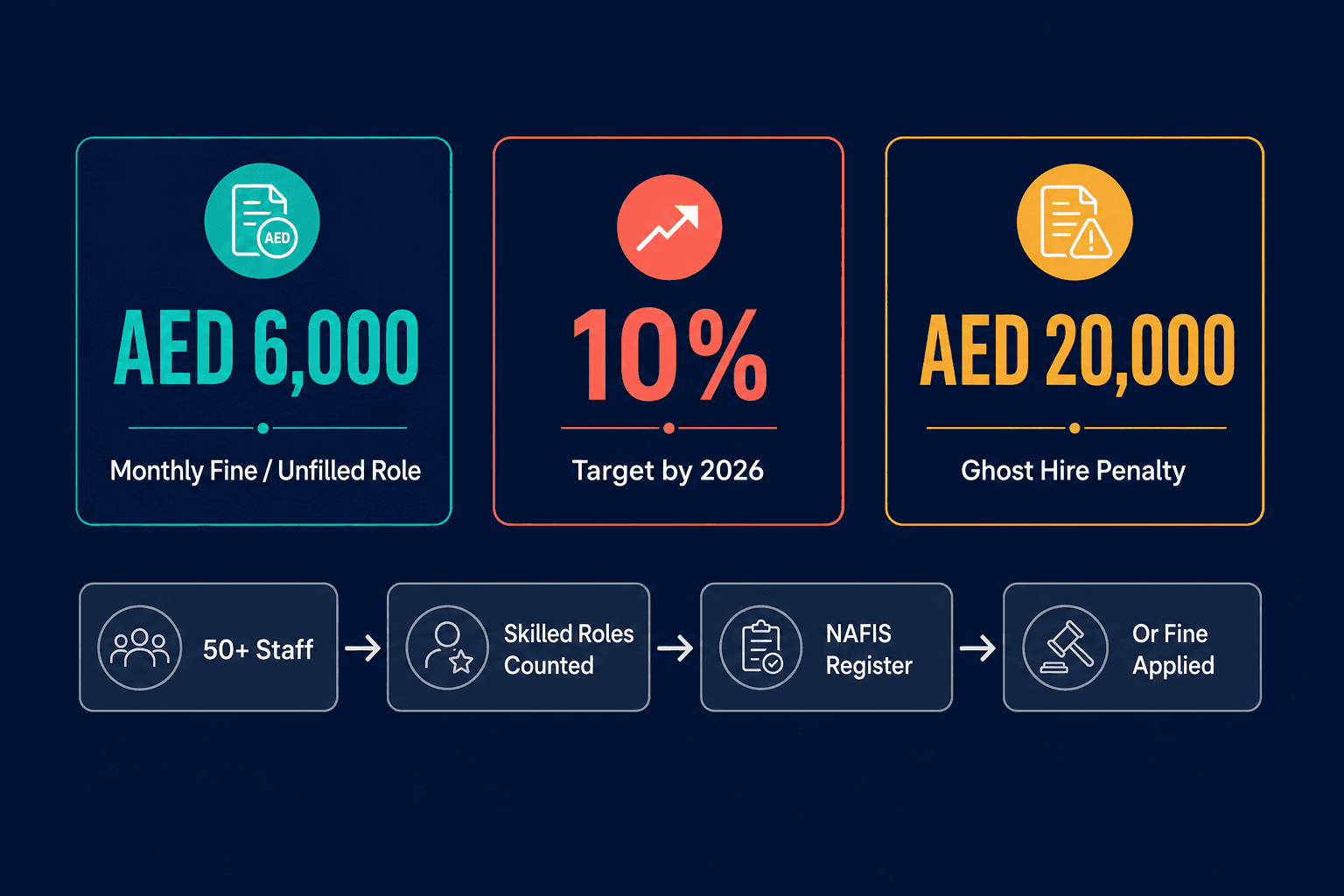
Emiratisation targets in the UAE are mandatory government quotas requiring private sector companies with 50 or more employees to hire a set percentage of UAE nationals in skilled roles. Missing the target triggers a monthly financial penalty per unfilled position, making compliance a direct cost-control issue for every qualifying employer.
Emiratisation Quota and Fine Summary by Company Size
Feature | 20–49 Employees | 50+ Employees |
|---|---|---|
Minimum annual Emirati hire requirement | 1 UAE national per calendar year | Percentage of skilled roles (rising 1pp per year to 10% by 2026) |
Quota calculation basis | Flat headcount obligation, 1 hire regardless of role mix | Skilled roles only (Skill Levels 1–4); unskilled roles excluded from denominator |
Monthly fine per unfilled position | Fine applies; confirm current rate on mohre.gov.ae | AED 6,000 per unfilled skilled position per month, escalating annually |
Work permit suspension risk | Yes, outstanding fines block all permit renewals | Yes, MOHRE can suspend all new permit approvals company-wide |
NAFIS registration required | Yes, hire must be registered on nafis.gov.ae to count | Yes, NAFIS registration is mandatory for all qualifying hires |
The Policy in Two Sentences: What NAFIS Adds
Emiratisation is a federal workforce nationalisation policy administered by MOHRE. NAFIS, launched in 2021, is the financial support platform that subsidises Emirati salaries in the private sector, but it is a parallel incentive, not a replacement for quota compliance. For a full programme overview, see our NAFIS programme guide for employers; this article focuses exclusively on quotas and penalties.
Here's a scenario that illustrates why the distinction matters. A 60-person IT consultancy registered on NAFIS to claim salary support, but did not separately track its skilled-role headcount ratio. At the next quarterly review, it discovered it still owed AED 12,000 in monthly fines for two unfilled positions. The support subsidy and the penalty are calculated independently, receiving one does not offset the other.
Why the Quota Is a Financial Risk, Not Just an HR Obligation
Three compounding risks make emiratisation targets in the UAE a balance-sheet issue, not just an HR calendar item:
Fines accrue monthly and the per-position rate escalates automatically each year under the Cabinet schedule, so delay makes the liability larger, not smaller.
MOHRE can suspend all new work permit approvals for non-compliant companies, blocking every hire, Emirati and expatriate alike, until arrears are cleared.
MOHRE publishes compliance status publicly, and an increasing number of government procurement contracts require a clean emiratisation record as a pre-qualification condition.
Which Companies Must Meet the Emiratisation Quota
The emiratisation quota currently applies to private sector companies with 50 or more employees across all sectors. Companies with 20 to 49 employees face a separate, lower-tier obligation introduced in 2023. Firms below 20 staff are exempt from the percentage target but must still register Emirati hires correctly with MOHRE.
The 50-Plus Rule: Sectors and Exemptions
The primary obligation sits with private sector establishments employing 50 or more workers, regardless of industry. The policy covers all 14 targeted sectors identified by MOHRE, including financial services, technology, manufacturing, retail, and healthcare. The quota calculation methodology applies uniformly across all of them: it's based on skilled roles, not total headcount.
Worth flagging for any employer with a free zone license: free zone companies are not exempt. They are subject to the same federal emiratisation requirements as mainland employers. A 55-person logistics company operating in a free zone assumed the quota did not apply because of its free zone status. MOHRE confirmed at inspection that the federal obligation applies across all jurisdictions, resulting in backdated fines. Government-owned entities and public sector bodies operate under separate frameworks and fall outside the MOHRE penalty regime.
The 20-to-49 Employee Band: Smaller Businesses Are Not Exempt
Cabinet Resolution No. 17 of 2023 extended the emiratisation obligation to companies with 20 to 49 employees, requiring at least one UAE national to be hired per calendar year. Non-compliance in this band also attracts a monthly fine, though the per-position rate structure differs from the 50-plus band, confirm current figures directly on mohre.gov.ae before your next payroll cycle.
HR teams in mid-size businesses frequently overlook this tier entirely. If your headcount sits anywhere between 20 and 49 on the MOHRE register, you're in scope. Audit your numbers against both thresholds now, not at year-end. You can check your current MOHRE status through the MOHRE inquiry portal.
What Are the Current Emiratisation Targets in the UAE and How Do They Increase
The current emiratisation target for companies with 50 or more employees is 2% of skilled workers per year, rising by 1 percentage point annually until it reaches 10% by 2026. The target is calculated against skilled positions only, not total headcount, meaning the compliance pool is smaller than many employers assume.
How the Percentage Is Calculated Against Skilled Roles
The emiratisation percentage applies only to skilled positions, defined by MOHRE as roles classified at Skill Levels 1 to 4 under the UAE's occupational classification framework. Unskilled or semi-skilled roles (Level 5 and below) are excluded from the denominator entirely. That means the actual number of positions subject to the quota is lower than your total staff count.
Here's a worked example. A 100-person manufacturing company with 40 unskilled production-line workers calculates its quota against the remaining 60 skilled roles, not 100. At a 2% annual target, that's 1.2 positions, rounded up to 2 qualifying hires required. Getting this calculation wrong in either direction creates a compliance gap or unnecessary recruitment pressure, so map every role to its MOHRE skill classification before running the numbers.
The Annual Escalation Schedule Through 2026
The target increases by 1 percentage point each calendar year. It started at 1% in 2022, moved to 2% in 2023, and continues rising incrementally to a stated 10% by 2026 (MOHRE, 2022). Each year's obligation is assessed against the previous 31 December headcount, with MOHRE's Tawteen portal as the official tracking system.
One detail that catches employers out: you cannot carry surplus hires forward. If you over-hire in one year, that excess does not offset the following year's obligation. Each annual cycle resets independently, so planning must happen year by year.
How Emiratisation Fines Are Calculated and What Happens If You Ignore Them
The emiratisation fine is AED 6,000 per month for each unfilled skilled position below the required quota. The rate escalates annually under Cabinet Resolution No. 13 of 2022. Persistent non-compliance leads to work permit suspension, preventing any new staff from being hired until the shortfall is corrected and arrears are settled.
The Monthly Fine Per Unfilled Position
The base monthly fine is AED 6,000 per skilled position that remains unfilled below the required quota, charged from the first month the shortfall is identified. Fines are cumulative: a company three positions short pays AED 18,000 per month. MOHRE bills fines quarterly through the Tawteen portal, and outstanding balances block work permit renewals immediately.
Consider a 200-person financial services firm required to have 4 qualifying Emirati hires but with only 1 on record. That's a 3-position shortfall, costing AED 18,000 per month, or AED 216,000 annually, before the escalation uplift is applied. That figure alone justifies the cost of a dedicated Emiratisation hire programme.
How the Fine Rate Escalates Each Year
Cabinet Resolution No. 13 of 2022 set the escalation mechanism: the per-position monthly fine increases annually in line with the rising quota target (UAE Cabinet, 2022). The intent is deliberate. The financial cost of non-compliance grows faster than the operational cost of hiring, which removes any rational business case for simply paying the fine and ignoring the quota.
MOHRE also has the authority to escalate enforcement to the UAE Public Prosecution for repeat or egregious violators. That's not a theoretical risk, it's a documented enforcement pathway. If your Tawteen portal shows outstanding notices, address them before the next quarterly billing cycle.
What Counts as a Qualifying Emirati Hire: The Rules You Must Know
A qualifying Emirati hire must hold UAE nationality, be registered in the NAFIS system, occupy a skilled role at Skill Level 1 to 4, receive a salary at or above the NAFIS minimum wage threshold, and be on a full employment contract. Part-time roles and arrangements below the salary floor do not count toward the emiratisation quota.
The Five Conditions a Hire Must Meet
All five conditions must be satisfied simultaneously. Missing any one of them means the hire does not count toward your nafis quota, regardless of how long the employee has been on payroll.
UAE nationality confirmed by Emirates ID registered with MOHRE.
Active NAFIS registration on nafis.gov.ae, without this, the hire does not count, full stop.
Skill Level 1 to 4 role classification under MOHRE's occupational framework.
Salary at or above the NAFIS minimum threshold, currently AED 4,000 per month for most private sector roles (verify on nafis.gov.ae before acting on this figure).
Full-time employment contract, secondments from government bodies and part-time arrangements do not qualify.
It's also worth noting that the NAFIS salary support your company may receive for an Emirati hire is separate from whether that hire counts toward your emiratisation quota. Both systems run in parallel. For detail on accessing the salary subsidy, see our guide to NAFIS salary support in the UAE.
Anti-Circumvention Rules: Ghost Hires and Fake Emiratisation
MOHRE actively investigates "ghost" Emiratisation, where a UAE national is listed on payroll but performs no genuine work. Penalties are severe: cancellation of all work permits, a AED 20,000 fine per ghost hire, and referral to the Public Prosecution (MOHRE, 2023). In 2023, MOHRE publicly confirmed enforcement actions against employers using fictitious Emirati hires, with penalties including full permit suspension affecting both Emirati and expatriate staff rosters.
Salary payments must be processed through the Wage Protection System (WPS) and match the NAFIS record exactly. Cash payments to Emirati employees are a red-flag trigger for inspection. Third-party payroll arrangements where an Emirati is technically employed by a shell entity but assigned to the real employer are explicitly prohibited under Cabinet Resolution No. 13 of 2022.
Retain evidence of genuine employment for a minimum of two years: job description, attendance records, performance reviews, and WPS payroll data. If MOHRE inspectors arrive, these are the first documents they'll request.
Emiratisation Compliance Checklist: Eight Steps for HR Teams
To stay compliant with emiratisation targets in the UAE, employers must confirm company headcount thresholds, map skilled roles by MOHRE classification, calculate the required quota, register qualifying hires on NAFIS, verify WPS salary payments, retain employment records, monitor Tawteen portal status monthly, and audit annually before 31 December.
Steps 1 to 4: Establish Your Baseline
Step 1: Count total MOHRE-registered employees. Determine whether you fall in the 20–49 band or the 50-plus band. Both carry separate obligations under different Cabinet Resolutions.
Step 2: Map every role to its MOHRE skill classification level. Exclude Level 5 and below from your quota calculation denominator.
Step 3: Apply the current year's emiratisation percentage to your skilled-role count. This gives you your minimum qualifying hire number for the year.
Step 4: Cross-check each existing Emirati employee against all five qualifying conditions, nationality, NAFIS registration, skill level, salary floor, and full-time contract. A hire that fails any one condition does not count.
Steps 5 to 8: Maintain Ongoing Compliance
Step 5: Register every qualifying hire on NAFIS immediately upon onboarding. Do not wait until the quarterly MOHRE review, late registration can create a compliance gap in the assessment window.
Step 6: Confirm WPS payroll records match NAFIS salary data every month. Discrepancies between the two systems trigger inspection flags automatically.
Step 7: Check your Tawteen portal dashboard monthly for compliance status and outstanding fine notices. Don't wait for a quarterly bill to discover a shortfall.
Step 8: Run a formal annual audit before 31 December. That date sets the headcount baseline for the following year's quota calculation. Missing it means you're calculating next year's obligations on incorrect data.
If you need help navigating MOHRE processes, the MOHRE inquiry system guide covers how to access your company's compliance record and submit queries directly to the labour department.
Emiratisation Targets in the UAE: Common Employer Questions
Common employer questions about emiratisation targets in the UAE cover which company sizes are exempt, how fines are billed, whether part-time nationals qualify, what happens during a MOHRE inspection, how NAFIS salary support interacts with the fine system, and what records must be kept to prove genuine compliance.
Do Emiratisation Quotas Apply to Free Zone Companies?
Yes. The federal emiratisation obligation applies across all UAE jurisdictions, including free zones. Free zone status does not create an exemption. MOHRE has confirmed this position through direct enforcement actions, including backdated fines against free zone employers who assumed otherwise. If your company holds a free zone license and employs 20 or more staff, you are in scope.
Does Receiving NAFIS Salary Support Exempt a Company from Emiratisation Fines?
No. NAFIS support and MOHRE fines are calculated completely independently. A company can receive NAFIS salary subsidies for an Emirati hire and still owe monthly fines for other unfilled positions below the quota. Both systems run in parallel. Registering on NAFIS is a condition for a hire to qualify, not a substitute for meeting the full quota.
Quotas, Fines, and Qualifying Hires: Further Questions
Can a part-time Emirati hire count toward the quota? No. Only full-time employment contracts with WPS-verified salary payments qualify. Part-time arrangements, regardless of hours worked, do not meet the
References
UAE Cabinet (uaecabinet.ae)
MOHRE (mohre.gov.ae)
Frequently Asked Questions