
Topic Summary
Entry Permit Is Just the Starting Gate
The entry permit authorises you to enter the UAE or begin a status-change process — nothing more. It does not grant residency, work rights, or the ability to sponsor dependants.
The 60-Day Clock Starts Immediately
Your entry permit is valid for 60 days from the date of issue, not from when you actually land in the UAE. Missing this distinction is one of the most common and costly mistakes first-time founders make.
Residence Visa Comes After a Five-Step Sequence
To get your residence visa stamped, you must complete entry or status change, a medical fitness test, and Emirates ID biometrics enrollment before GDRFA Dubai finalises the stamp. Skipping or delaying any step can cause your entry permit to expire mid-process.
Only the Residence Visa Grants Full Legal Rights
Once stamped into your passport, the residence visa gives you the right to live, work, open a UAE bank account, and sponsor dependants. Investor and partner visas through free zones are typically valid for two to three years and are renewable.
Free Zone Packages Don't Cover Everything
Formation packages that include a visa allocation cover only the investor or partner visa slot itself. Entry permit fees, medical tests, Emirates ID enrollment, and stamping costs are always quoted separately.
Overstay Fines Apply If the Permit Expires
If your entry permit lapses before the residence visa is stamped, daily overstay fines begin to accrue and you must obtain a new permit to restart the process. Tracking the issue date — not your arrival date — is essential.
Sponsors and Employees Follow the Same Chain
Company founders sponsoring staff must run each employee through the same entry permit to residence visa sequence. Employees also require a labour card before their work rights are fully activated.
The entry permit is not a residence visa, and the residence visa is not an entry permit. These are two separate legal documents issued at different stages of the UAE immigration process. The entry permit is stage one: it lets you enter the UAE or change your immigration status while you're already in the country. The residence visa is stage two: it's the document stamped in your passport that formally grants you the right to live, work, and sponsor dependants in the UAE.
Most first-time founders conflate the two, and that confusion costs real money when permits expire before the process is complete. This guide explains exactly what each document does, how long it lasts, the correct five-step sequence from permit to stamped visa, the mistakes that derail the process, and what you need to know as a company owner sponsoring staff through the same chain.
What an Entry Permit and a Residence Visa Actually Are
An entry permit is a short-term immigration document that authorises you to enter the UAE or change your status inside the country. A residence visa is the long-term document stamped in your passport that formally grants UAE residency. The entry permit is stage one; the residence visa is stage two.
Defining the Entry Permit
The entry permit (sometimes called a residence visa pre-approval) is issued by the General Directorate of Residency and Foreigners Affairs (GDRFA Dubai). It is valid for 60 days from the date of issue, not from the date you enter the UAE. That distinction matters: the clock starts the moment the permit is generated, regardless of when you land.
The permit gives you permission to enter the UAE or, if you're already in the country, to begin the status-change process. It does not confer residency. It does not grant the right to work. Think of it as an authorisation to begin the process, nothing more.
The permit is issued to the sponsoring company first. Take a founder who has just incorporated a free zone company: they receive an entry permit as the investor-visa beneficiary. That permit authorises them to enter Dubai and begin the medical and biometric steps. It is not yet a visa.
Defining the Residence Visa
The residence visa (formally: UAE residence permit) is stamped into your passport after you complete the full sequence: entry or status change, medical fitness test, Emirates ID biometrics enrollment, and final stamping by GDRFAD. Investor and partner visas issued through free zone companies are typically valid for two or three years and are renewable (u.ae).
Once that same founder passes the medical fitness test and completes Emirates ID enrollment, GDRFA Dubai stamps a two- or three-year residence visa into their passport. Only at that point do they hold UAE residency, with full rights to live, work, and sponsor dependants attached to their visa category.
The residence visa is linked to a specific sponsor. For free zone founders, that sponsor is their own company. Worth flagging: free zone formation packages that include a visa allocation cover the investor or partner visa slot only. Entry permit fees, status change, medical, Emirates ID, and stamping are always quoted separately from the package price.
Entry Permit vs Residence Visa: Key Differences at a Glance
Feature | Entry Permit | Residence Visa |
|---|---|---|
Document purpose | Authorises entry into the UAE or the start of a status-change process | Formally grants UAE residency rights to the holder |
Issuing authority | GDRFA Dubai (via the sponsoring company or free zone authority) | GDRFA Dubai (stamped into passport after full sequence is complete) |
Typical validity | 60 days from date of issue | Two to three years (renewable) |
What it permits | Entry into the UAE or initiation of status change inside the country | Right to live, work, open a bank account, and sponsor dependants in the UAE |
Work rights | None. The entry permit is an immigration gateway only | Yes, once stamped (employees also require a labour card) |
On expiry | Overstay fines accrue per day; a new permit is required to restart | Renewal must be initiated before expiry to avoid overstay penalties |
Entry Permit vs Visa: Side-by-Side Comparison
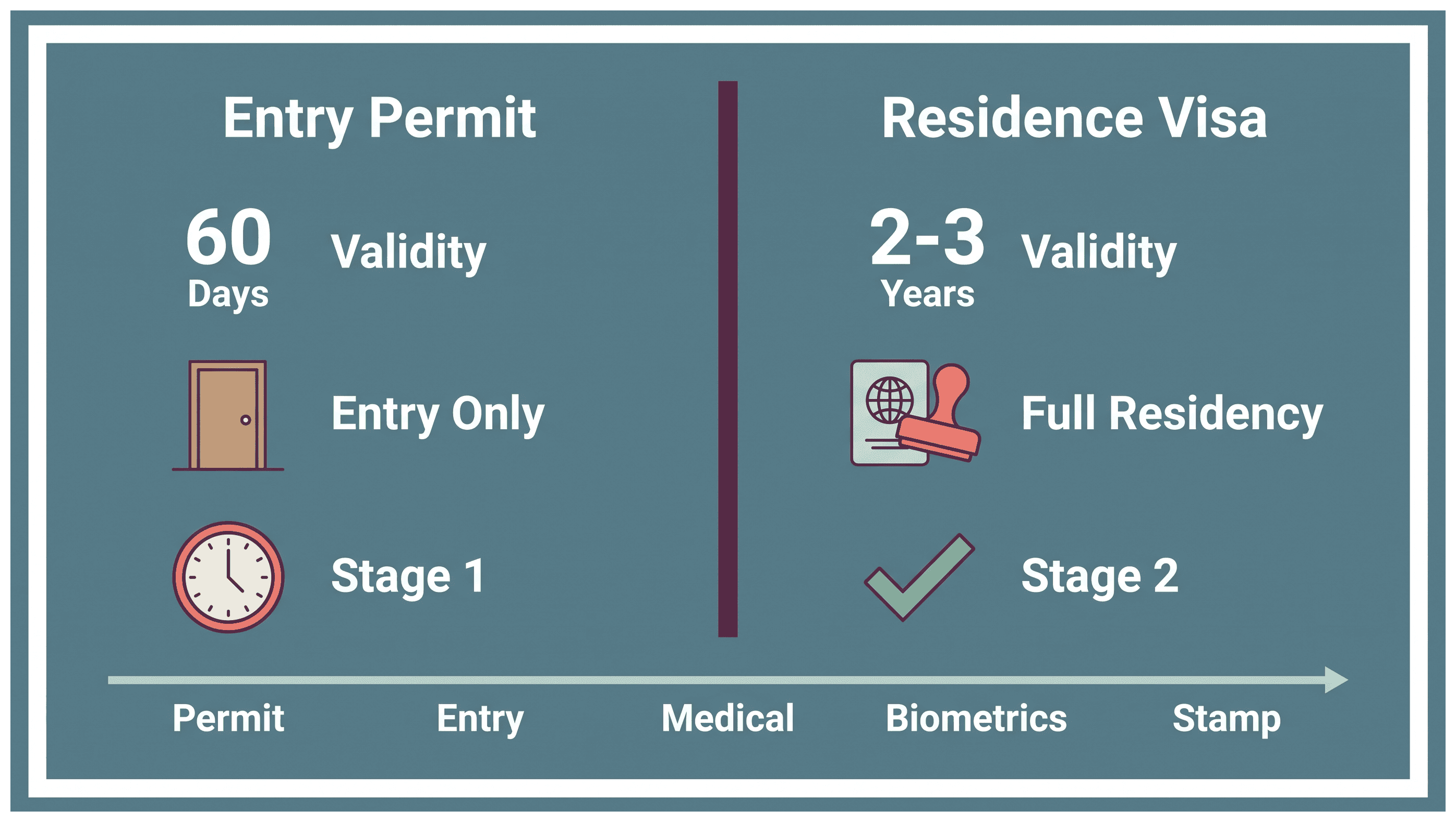
The entry permit and residence visa differ in purpose, validity, and what they permit. The entry permit is a short-term gateway document (typically 60 days) that starts the process. The residence visa is the long-term outcome (two to three years) that grants residency, work rights, and the ability to sponsor dependants.
How to Read the Comparison Table
The table above covers the six dimensions where the entry permit vs visa distinction matters most in practice: document purpose, issuing authority, typical validity, what each document permits, work rights, and what happens on expiry. Read it column by column rather than row by row if you want a clear picture of each document's scope.
The single most important row is work rights. The entry permit does not permit work. That right activates only after the residence visa is stamped. A co-founder already in Dubai on a tourist visa can apply for a status change once the entry permit is issued: no need to fly out and re-enter. But until the stamped visa is in their passport, they cannot legally invoice a client or sign a contract under their trade license.
The comparison applies equally to an investor-founder and to any employee they later sponsor. Same document types, same sequence, same GDRFA Dubai rules.
Key Points to Carry Forward
Entry permit validity: 60 days from issue date, confirmed by GDRFA Dubai procedures.
Residence visa validity: two to three years for investor and partner visas.
Change of status inside the UAE without exiting is available. You do not need a border run.
The entry permit vs visa distinction applies to founders and employees alike.
Visa allocation in a formation package covers the slot only. Processing fees are separate.
The Full Residency Sequence: Five Steps in Order
The UAE residency process runs in five fixed steps: entry permit issued, entry into the UAE or status change, medical fitness test, Emirates ID biometrics enrollment, then residence visa stamping in the passport. Each step must be completed in this order and within the entry permit's 60-day validity window.
Step 1: Entry Permit Issued by the Sponsor
The sponsoring company applies to GDRFA Dubai for the entry permit on behalf of the beneficiary. For free zone companies, this is initiated through the free zone authority or a registered PRO service. The permit is issued digitally, and the 60-day validity window starts from the issue date, not from the date the beneficiary enters the country or triggers a status change.
A UK-based founder who has incorporated a Dubai South free zone company can have the entry permit issued while they're still in London. The permit arrives digitally. The 60-day clock is already running.
Step 2: Entry Into the UAE or Status Change
If you're outside the UAE, you enter on the entry permit. If you're already in the country on a valid visa or prior permit, you apply for a status change inside the UAE: no exit required. This is confirmed by GDRFA Dubai procedures and is the standard route for founders already resident or visiting.
The status change must be completed while the entry permit is still valid. Miss that window and you'll need to exit and re-enter on a new permit, restarting the sequence and incurring additional costs.
Step 3: Medical Fitness Test
After entering or completing the status change, you attend a Dubai Health Authority (DHA)-approved or MOHAP-approved medical centre for a standard fitness test: blood tests and a chest X-ray. Results are typically returned within one to three working days. The medical must happen after entry or status change, not before. Approved centres are listed on the DHA and MOHAP portals.
Step 4: Emirates ID Biometrics and Step 5: Visa Stamping
After a clear medical result, you enroll at a Federal Authority for Identity, Citizenship, Customs and Port Security (ICP) approved centre for Emirates ID biometrics: fingerprints and photograph. The Emirates ID card is a legal requirement to carry once issued.
Visa stamping is the final step. GDRFA Dubai stamps the residence visa into your passport, completing the process. A founder who entered Dubai on their entry permit, passed the medical on day 10, and completed Emirates ID enrollment on day 14 typically receives their stamped residence visa within a further five to seven working days: well within the 60-day window.
For free zone founders, every step in this sequence is priced separately from the package. The visa allocation in your package covers the investor or partner visa slot. Entry permit, status change, medical, Emirates ID, and stamping fees are quoted on request.
Common Mistakes That Derail the Entry Permit vs Visa Process
The three most common mistakes are: travelling outside the UAE on an expired entry permit (which triggers overstay fines and potential entry bans), missing the status change window while already in the country, and assuming the entry permit alone authorises the holder to work. None of these are recoverable without cost.
Travelling on an Expired Entry Permit
An expired entry permit at a UAE port of departure triggers an overstay record with GDRFAD. Overstay fines are charged per day from the date of expiry. Airlines may refuse boarding for passengers whose UAE immigration status is irregular at check-in. The fine must typically be settled with GDRFA Dubai before the individual can re-enter the UAE or apply for a new permit.
Here's a real scenario: a co-founder delayed her medical appointment and assumed the entry permit was still valid. It had expired two days earlier. She was flagged at Dubai International Airport and had to pay an overstay fine before her return flight was permitted. The medical delay cost her both the fine and a new permit application.
The practical rule: book the medical appointment within the first two weeks of the entry permit being issued. Don't leave it to the final stretch.
Missing the Status Change Window and Assuming the Entry Permit Permits Work
Founders already in the UAE who receive an entry permit must initiate the status change before the permit expires. There is no automatic extension. If the window is missed, you may need to exit and re-enter on a new permit, adding cost and delay to what should be a straightforward process.
The entry permit does not grant the right to work. Work rights attach to the residence visa and, for employees, to the labour card issued after stamping. Founders who start conducting business: signing contracts, invoicing clients, operating under a trade license, while holding only an entry permit are operating outside their authorised status. That puts both the individual and the sponsoring company at regulatory risk. If you want to explore business activities while your visa is being processed, limit yourself to preparatory, non-revenue work until the residence visa is stamped.
What Company Owners Must Know When Sponsoring Staff
When a company sponsors an employee's UAE residency visa, the same five-step sequence applies: entry permit, entry or status change, medical, Emirates ID. The company is the legal sponsor and carries liability for overstay or compliance failures. Visa allocation in packages covers the investor slot only: employee visas are separate.
The Sponsor's Legal Obligations
The sponsoring company is responsible for initiating the entry permit application for each staff member and for ensuring the full sequence is completed within the permit's validity. If an employee overstays or their visa lapses, the sponsoring company may face fines and restrictions on future visa applications.
For free zone companies, the establishment card is required before employee visas can be processed. It is the company's immigration identity document. At Dubai South Business Hub, the establishment card is included in the 1 Visa Package (AED 16,350) and the 2 Visa Package (AED 18,200). The 0 Visa Package (AED 12,500) includes the license, Articles of Association, share register, flexi-desk space, but no visa allocation or establishment card.
Free zone employees fall under the free zone authority's labour framework. For staff working on the UAE mainland, MoHRE services govern employee visa eligibility criteria and labour cards.
Visa Allocation vs Visa Processing: What the Package Covers
The visa allocation in the 1 Visa Package and 2 Visa Package is the investor or partner visa slot. In the 2 Visa Package, it is the allocation for two individuals, not two separate visas processed within the package price. Entry permit fees, status change fees, medical fitness test fees, Emirates ID fees, and stamping fees are all quoted separately.
A founder taking the 2 Visa Package at AED 18,200 receives the license, Articles of Association, share register, flexi-desk space, lease agreement, establishment card, and visa allocation for two people. But the entry permits, medicals, Emirates IDs, and stamping for both individuals are quoted and invoiced separately. Use the business setup cost calculator to estimate the full outlay before committing.
Key Questions on Entry Permit vs Visa
The most-searched questions on entry permit vs visa in the UAE cover whether the entry permit allows work (it does not), whether you can change status without exiting (you can), and what happens if the entry permit expires before the visa is stamped.
Can I Work on an Entry Permit Alone?
No. The entry permit is an immigration gateway document, not a work authorisation. Work rights attach to the residence visa and, for employees, to the labour card issued after stamping. Conducting business before the residence visa is stamped puts the individual and the sponsoring company at regulatory risk. Limit yourself to preparatory, non-revenue activities until the stamp is in your passport.
What Happens If My Entry Permit Expires Before I Complete the Steps?
If the entry permit expires before the medical, Emirates ID, or stamping is completed, you're in an irregular immigration status. Overstay fines accrue from the day of expiry and must be settled with GDRFA Dubai before any new permit or visa can be issued. In some cases, you'll need to exit and re-enter on a new entry permit, restarting the sequence entirely. The lesson is straightforward: start the medical within the first two weeks of the entry permit being issued, not the last. Free zone founders face the same expiry rules as all UAE visa applicants. The free zone authority cannot extend GDRFA Dubai entry permit validity.
The entry permit vs visa distinction is not a technicality. It is the difference between having permission to begin a process and having the legal right to live and work in the UAE. The entry permit opens the door; the residence visa is the document that matters for everything that follows: banking, dependant sponsorship, operating under your trade license, and renewing your status.
Get the sequence right. Start the medical early. Never assume the entry permit alone is enough. If you're planning to set up a company and want to understand exactly what your visa package covers before you commit, request a detailed breakdown that separates the allocation from the processing costs. Speak to a business support consultant to get an accurate quote covering your entry permit, medical, Emirates ID, and stamping costs alongside your chosen package.
References
Frequently Asked Questions