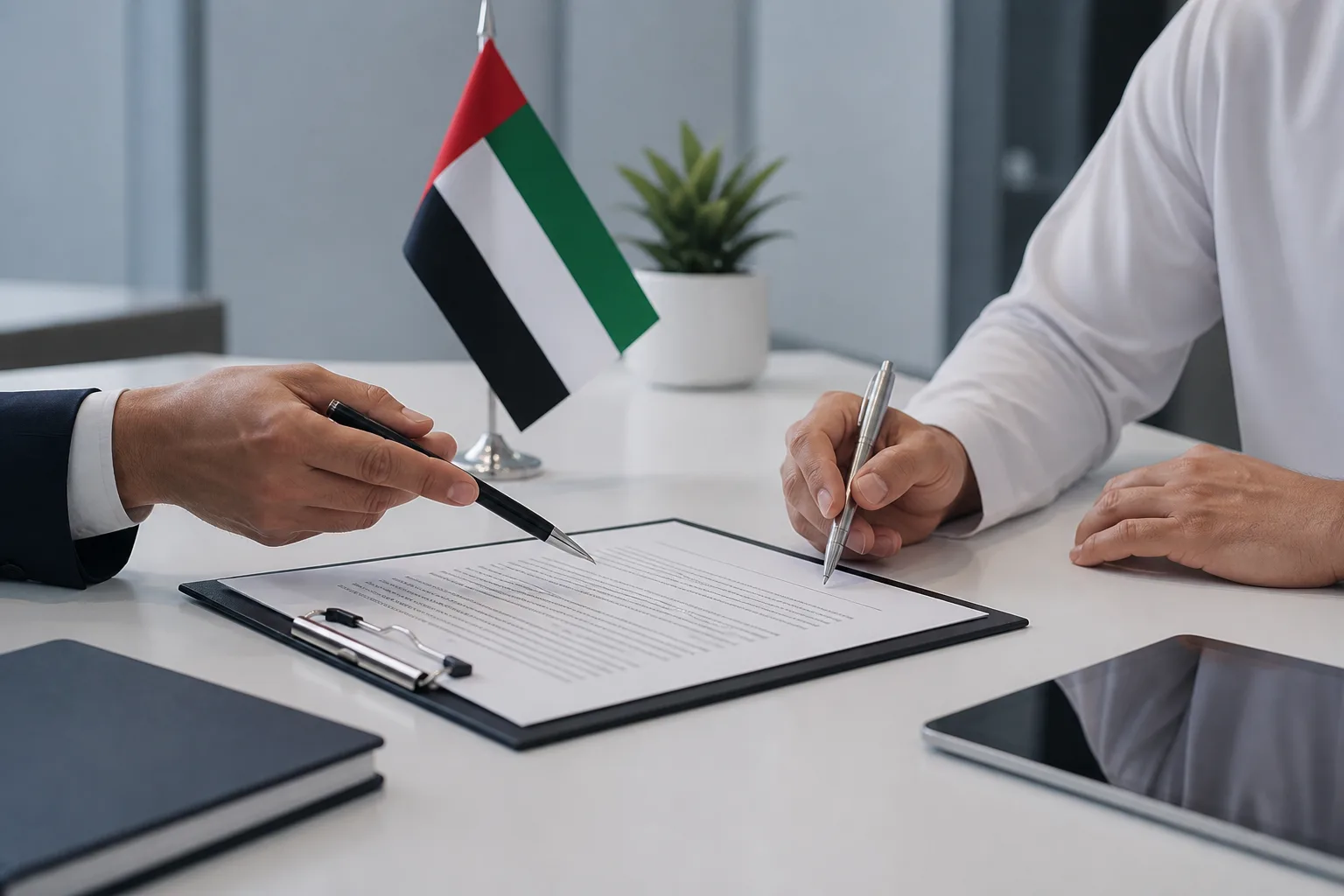
Topic Summary
Equity and Vesting Protect Every Founder
A vesting schedule of three to four years with a 12-month cliff ensures founders earn their shares over time rather than walking away with full ownership early. Anti-dilution rights further protect existing founders when new shares are issued.
IP Assignment Must Be Explicit and Written
UAE Federal Law No. 36 of 2021 does not automatically transfer founder-created intellectual property to the company, so a formal IP assignment clause is essential. Without it, a departing founder could legally retain rights to core technology or branding.
Good-Leaver and Bad-Leaver Terms Set Fair Exit Prices
A bad leaver who resigns early or breaches the agreement typically receives only nominal value for their shares, while a good leaver receives fair market value. Defining these terms upfront removes ambiguity and reduces the risk of costly litigation.
Compliance Duties Should Be Assigned by Name
Naming a specific founder responsible for corporate tax registration, VAT registration, and license renewals avoids the flat AED 10,000 late registration penalty that applies to both taxes. Clear accountability in the agreement means deadlines are far less likely to be missed.
Founder Agreement and Articles Must Stay Consistent
The Articles of Association are a public statutory filing, while the founder agreement is a private contract, but contradictions between the two create legal risk and can delay license issuance. Reviewing both documents together before filing prevents costly inconsistencies.
Dispute Resolution Clauses Prevent Deadlocks
Specifying an arbitration institution such as DIAC or DIFC-LCIA, the governing law, and a last-resort mechanism like a Russian roulette clause gives founders a clear path when disagreements escalate. Over 40 percent of UAE startups that dissolve within three years cite co-founder disputes as a primary cause, making this clause critical.
Speed of Incorporation Is a Drafting Risk
UAE free zone licenses can be issued in as little as one business day, which tempts founders to skip the private agreement entirely. Rushing incorporation without a signed founder agreement leaves equity, roles, and exit rights unprotected from day one.
Over 40% of early-stage UAE startups that dissolve within three years cite co-founder disputes as a primary cause (MAGNiTT, 2024). A well-drafted founder agreement company UAE could prevent most of those disputes before the license is even issued. UAE free zone licenses can be issued in as little as 1 business day [1]. The UAE corporate tax late registration penalty is a flat AED 10,000 [2]. VAT late registration carries the same AED 10,000 penalty [2]. UAE Federal Law No. 2 of 2015 governs mainland commercial companies [3]. IP rights for UAE companies fall under Federal Law No. 36 of 2021 on Industrial Property [4].
This guide covers what a founder agreement is, the key clauses you need, UAE-specific legal considerations, how corporate tax obligations affect your drafting, and the step-by-step process to get your company incorporated with the right documents in place from day one. For more detail, see our guide on minor shareholder documents for a UAE company. For more detail, see our guide on shareholder agreement clauses for UAE business owners.
What Is a Founder Agreement for a UAE Company and Why It Matters
A founder agreement for a UAE company is a private contract between co-founders that governs equity ownership, roles, decision-making, and exit rights before or at the time of incorporation. It sits alongside the Articles of Association and prevents disputes by recording each founder's commitments, contributions, and obligations in legally enforceable terms.
Founder Agreement Key Clauses: What Each One Covers
Clause | What It Covers |
|---|---|
Equity and Vesting | Share percentages, vesting schedule (typically 3 to 4 years), 12-month cliff period, and anti-dilution rights on new share issuances |
Roles and Authority | Named operational roles (CEO, CTO, CFO), decision thresholds requiring unanimous versus majority consent, and deadlock resolution mechanics |
IP Assignment | Formal transfer of all founder-created intellectual property to the company entity; UAE law does not do this automatically |
Share Transfer Restrictions | Right of first refusal, drag-along rights requiring minority to sell in an acquisition, and tag-along rights protecting minority stakeholders |
Good-Leaver or Bad-Leaver | Share price a departing founder receives based on circumstances; bad leavers (breach or early resignation) receive nominal value; good leavers receive fair market value |
Compliance Responsibility | Named founder accountable for corporate tax registration, VAT registration, and license renewal deadlines, avoiding the AED 10,000 late registration penalty |
Dispute Resolution | Governing law (UAE law standard), arbitration institution (DIAC or DIFC-LCIA), language of proceedings, and exit mechanism of last resort (Russian roulette clause) |
How a Founder Agreement Differs from the Articles of Association
The Articles of Association are a public, statutory document filed with the free zone or mainland authority. A founder agreement is a private contract between named individuals. That distinction matters more than most first-time founders realise.
The Articles govern the company's relationship with the outside world. The founder agreement governs the founders' relationship with each other. Both documents must be consistent, contradictions between them create legal risk and can delay license issuance.
Here's a concrete example. Two co-founders incorporating a technology consultancy at a UAE free zone file Articles of Association recording a 50/50 share split. Their founder agreement records a four-year vesting schedule, a 12-month cliff, and a right of first refusal. None of those terms appear in the public filing. The Articles tell the authority who owns what today; the founder agreement tells both founders what happens if one wants out in year two.
Founder agreements are not filed with the authority but are fully enforceable under UAE contract law (u.ae, 2024). Articles of Association are mandatory for all free zone companies in the UAE.
Why First-Time Founders in Dubai Need This Document
Speed is the trap. Dubai South Business Hub Free Zone issues licenses in 1 business day, and that pace means founders sometimes skip the private agreement entirely. They regret it later. For more detail, see our guide on silent partner agreement for a Dubai business.
Without a founder agreement, UAE default company law governs any dispute, and that default position may not reflect what the founders actually agreed over coffee six months earlier. Here are the four reasons you need this document before you set up a company:
UAE default company law may not match your actual intentions.
Investors, banks, and accelerators request it during due diligence.
UAE banks often require a signed shareholders' or founder agreement as a KYC document before opening a business account.
IP assignment belongs here, without it, the company may not legally own the product being built.
The compliance angle is worth flagging too. The UAE corporate tax late registration penalty is a one-time flat AED 10,000 charge (Federal Tax Authority, 2023). Naming one founder as the compliance lead in the agreement is a simple way to ensure nobody assumes the other person handled it.
Core Legal Clauses in a Founder Agreement Company UAE
The essential clauses in a founder agreement for a UAE company include equity allocation and vesting schedules, founder roles and decision-making authority, IP assignment to the company, non-compete and confidentiality obligations, share transfer restrictions, and exit or buyout mechanics. Each clause must align with UAE contract law and the company's Articles of Association.
Equity Allocation, Vesting, and the Cliff Period
Equity split should reflect actual contribution, capital invested, IP brought in, or sweat equity committed going forward. A 60/40 split where one founder contributes cash and the other contributes a proprietary platform is entirely reasonable, but it needs to be written down.
Vesting schedules protect the company if a founder departs early. A typical structure runs four years with a 12-month cliff, meaning no shares vest in the first year. UAE company law does not automatically impose vesting, it must be written into the founder agreement explicitly. For more detail, see our guide on shareholder structure in a Dubai company.
Consider this scenario: Founder A contributes AED 50,000 capital; Founder B contributes proprietary software. Their founder agreement records a 60/40 equity split with a four-year vest and 12-month cliff for both founders, regardless of who contributed cash versus IP. Anti-dilution provisions and pre-emption rights on new share issuances should also sit in this clause. Dubai South Business Hub Free Zone allows up to six visa allocations, with published packages offering 0, 1 or 2 per license, worth noting when drafting founder roles tied to UAE residency.
Decision-Making, Roles, and Deadlock Resolution
Define which decisions require unanimous consent versus simple majority. Debt above a threshold, new share issuances, and changes to the business activity are natural candidates for unanimous consent. Day-to-day operations should not require a co-founder vote on every line item.
Unanimous consent: taking on debt, issuing new shares, changing the business activity.
Simple majority: hiring decisions below a salary threshold, signing contracts below an agreed value.
Named roles: CEO, CTO, CFO, each with clear authority limits.
Deadlock clauses specify what happens when co-founders cannot agree. Two equal co-founders who disagree on a AED 200,000 credit facility, where their agreement requires unanimous consent for debt above AED 100,000, trigger a 30-day mediation period before either party can force a buyout. UAE courts apply the principle of freedom of contract, and mediation is encouraged under UAE Civil Procedure Law before litigation proceeds.
IP Assignment, Confidentiality, and Non-Compete Clauses
Any IP a founder creates for the business must be formally assigned to the company. UAE Federal Law No. 36 of 2021 on Industrial Property governs IP rights for UAE companies, but it does not automatically transfer pre-incorporation work into company ownership. A co-founder who built the proprietary platform before incorporation must sign an IP assignment clause, otherwise the company is effectively licensing technology it does not legally own, which creates a critical gap in any investor due diligence process.
Confidentiality obligations should survive the founder's departure and cover trade secrets, client lists, and product roadmaps. Non-compete scope must be reasonable, specify geography, duration, and activity type. A non-solicitation clause covering employees and clients is often more enforceable than a blanket non-compete.
Share Transfer and Exit Mechanics in a UAE Founder Agreement
Share transfer clauses in a UAE founder agreement govern how and when a founder can sell or transfer their equity. Standard provisions include right of first refusal, drag-along rights, tag-along rights, and buyout pricing formulas. These clauses protect all founders and prevent unwanted third parties from acquiring shares without consent.
Right of First Refusal and Pre-Emption Rights
Right of first refusal requires a departing founder to offer their shares to existing founders before selling to an outside party. Pre-emption rights on new share issuances allow existing founders to maintain their percentage ownership when new investors come in. Both need a clearly stated timeline, a 30-day window is common in UAE practice.
Say Founder B receives an offer from an outside investor for their 40% stake. Under the right of first refusal clause, Founder A has 30 days to match that offer at the same price before the shares can leave the founding team. Without this clause, a co-founder could sell to a competitor or an unknown third party with no recourse. Pre-emption rights are standard in professional term sheets from UAE-based investors and accelerators.
Free zone share transfers require authority approval, typically processed within 5 to 10 business days. Your transfer restriction clauses must be realistic within that regulatory timeline.
Drag-Along, Tag-Along, and Good-Leaver or Bad-Leaver Provisions
Drag-along: majority founders can require minority founders to sell in an acquisition on the same terms.
Tag-along: minority founders can join any sale a majority founder makes, on the same terms.
Good-leaver: a founder who departs for legitimate reasons (illness, mutual agreement) receives fair market value for their shares.
Bad-leaver: a founder who resigns within the cliff period or breaches their obligations typically receives nominal value.
A UAE tech startup receives an acquisition offer. The drag-along clause means the 70% majority can require the 30% minority to sell, ensuring the acquirer gets 100% of the company without a holdout problem. Drag-along clauses must be explicitly written, UAE law does not imply them. Good-leaver or bad-leaver distinctions are increasingly standard in UAE venture-backed companies.
Seven Key Steps to Formalise a Founder Agreement Company UAE
To formalise a founder agreement for a UAE company, founders should: agree on equity and roles, draft the agreement with a UAE-qualified lawyer, align it with the Articles of Association, sign before or at incorporation, file the Articles with the free zone authority, obtain the trade license, and store the signed agreement securely with all parties holding a copy.
Steps 1 to 4: From Negotiation to Drafting
Step 1: Hold a structured co-founder conversation. Cover equity, roles, capital contributions, and what happens if someone leaves. Write down the outcomes before engaging a lawyer. Two founders planning to incorporate at Dubai South Business Hub Free Zone who agree informally on a 60/40 split should spend two hours documenting their assumptions about roles, working hours, and exit scenarios, that document becomes the brief for their lawyer.
Step 2: Engage a UAE-qualified lawyer. The founder agreement must comply with UAE Federal Law No. 2 of 2015 (Commercial Companies Law) for mainland entities, or the relevant free zone regulations. Free zones operate under their own regulatory frameworks.
Step 3: Draft all core clauses. Equity and vesting, roles and authority, IP assignment, confidentiality, non-compete, share transfer restrictions, exit mechanics, and dispute resolution. Each clause should be reviewed against the others for internal consistency.
Step 4: Cross-check against the Articles of Association. Any conflict between the two documents creates legal uncertainty. The license at Dubai South Business Hub Free Zone is issued in 1 business day, drafting must be complete before that day.
Steps 5 to 7: Signing, Filing, and Incorporating
Step 5: All founders sign the founder agreement. Consider having signatures witnessed or notarised, especially if founders are in different countries. A three-founder ICT company incorporating at Dubai South Business Hub Free Zone signs their private agreement the day before submitting incorporation documents, so the license, Articles of Association, share register, and founder agreement all carry the same effective date.
Step 6: Submit the incorporation application. Include the Articles of Association, passport copies, and any required business plan or business activities description to the chosen free zone authority.
Step 7: Receive the trade license and store documents securely. Every Dubai South Business Hub Free Zone package includes the license, Articles of Association, share register, flexi-desk space as standard. Ensure every co-founder holds a certified copy of the signed founder agreement.
Package pricing at Dubai South Business Hub Free Zone (2026): the 0 Visa Package is AED 12,500; the 1 Visa Package is AED 16,350 (adds one investor or partner visa allocation and an establishment card); the 2 Visa Package is AED 18,200 (adds two visa allocations and an establishment card, the maximum available). Visa processing, entry permit, status change, medical, Emirates ID, is always quoted separately. You can calculate your business setup cost before committing.
Tax and Compliance Clauses Every Founder Agreement Company UAE Should Cover
A UAE founder agreement should address each founder's obligations around corporate tax registration, VAT registration if applicable, and profit distribution timing. The UAE corporate tax late registration penalty is a one-time flat AED 10,000 charge. Founders should agree in writing who is responsible for ensuring the company meets all Federal Tax Authority deadlines. For more detail, see our guide on who has signing authority in a Dubai company.
Assigning Compliance Responsibility Between Founders
The founder agreement should name a specific founder as the compliance officer. That person owns tax registration, annual filings, and license renewal. Without that assignment, both founders assume the other handled it, and neither does.
Consider what happens when two co-founders with equal authority both assume the other has registered for corporate tax. Neither does. The result is a AED 10,000 penalty that a single sentence in the founder agreement could have prevented. UAE corporate tax registration is mandatory for all UAE companies (Federal Tax Authority, 2023). VAT registration is required once taxable turnover exceeds AED 375,000; the late registration penalty is also AED 10,000. Free zone license renewals are typically due 30 days before expiry.
What does the founder agreement need to say about corporate tax?
The founder agreement should name one founder as the designated compliance lead, specify the deadline for corporate tax registration after incorporation, require the compliance lead to notify all founders of any Federal Tax Authority correspondence within five business days, and confirm which founder signs off on audited financials required for Qualifying Free Zone Person status.
Profit Distribution, Capital Calls, and Founder Salaries
Founder salaries: specify whether founders take salaries, dividends, or a combination, and who approves changes.
Capital calls: state whether founders are obligated to contribute pro-rata when the company needs additional funding, or whether they can decline and face dilution.
Profit distribution timing: quarterly or annual, agree this in writing before the company is profitable.
A profitable two-founder company with no distribution agreement faces a predictable conflict: one founder wants to reinvest; the other needs income. A clause setting annual distribution at 50% of net profit after a minimum cash reserve removes this conflict before it starts. The UAE corporate tax rate for non-qualifying income above AED 375,000 is 9%. Qualifying Free Zone Person status requires qualifying income, adequate substance, no election out of the regime, and audited financials, four conditions the founder agreement's compliance clause should explicitly reference. For banking and taxation guidance specific to free zone companies, review the requirements before drafting this section.
Worth noting: Dubai South Business Hub Free Zone is not a designated zone and carries no designated-zone customs or VAT benefit. Goods are duty-suspended, not duty-exempt. Founders should reflect this accurately in any financial projections or investor materials referenced in the agreement.
Dispute Resolution and Governing Law in a UAE Founder Agreement
A UAE founder agreement should specify the governing law (UAE law is standard for UAE-incorporated companies), the seat of arbitration or mediation (DIAC or DIFC-LCIA are common choices), and the language of proceedings. A clear dispute resolution clause reduces the cost and time of resolving founder conflicts significantly compared to litigation.
Choosing Between Arbitration, Mediation, and UAE Courts
UAE courts: apply UAE law; proceedings are in Arabic; workable for straightforward disputes but slower for complex commercial matters.
DIAC arbitration: faster, confidential, and commercially focused.
DIFC-LCIA arbitration: English-language proceedings, common-law framework, widely recognised for international commercial disputes in the UAE.
Mediation first: increasingly encouraged; can resolve disputes in weeks rather than months.
A UAE free zone company with one founder based in Europe and one in Dubai chooses DIFC-LCIA arbitration, English-language proceedings, and UAE law as governing law. That combination gives both parties confidence in the process regardless of where they are located. The founder agreement should set out the sequence clearly: mediation first, then arbitration if mediation fails, with the named arbitral institution specified.
Deadlock Triggers and the Exit Mechanism of Last Resort
A Russian roulette (or shotgun) clause is the exit mechanism of last resort. One founder names a price for the whole company; the other must either buy at that price or sell at that price. It forces
References
Frequently Asked Questions