
Topic Summary
Bookkeeping Is Legally Mandated, Not Optional
Every UAE free zone company must maintain a double-entry ledger under Federal Decree-Law No. 47 of 2022. Over 40% of FTA audit queries stem from missing or disconnected records, not absent VAT returns.
VAT Registration Kicks In at AED 375,000
Once your taxable turnover crosses AED 375,000, VAT registration and quarterly filing become mandatory. Missing a return triggers FTA penalties starting at AED 1,000 per filing.
Corporate Tax Registration Is Universal
All UAE entities must register for corporate tax, even those with qualifying free zone status and a 0% rate. The 9% rate applies on taxable income above AED 375,000.
Annual IFRS Financial Statements Are Required
Free zone companies must produce annual financial statements prepared under IFRS for both corporate tax filing and license renewal. Some free zones also mandate fully audited accounts regardless of company size.
Five-Year Record Retention Starts Immediately
All financial documents must be stored and retrievable for FTA review from the end of the relevant tax period. This obligation begins from day one of trading, not after your first audit.
Basic Packages Often Leave Critical Gaps
Entry-level accounting packages typically cover only bookkeeping or management accounts, leaving out VAT filing, corporate tax, and IFRS statements. A business with AED 900,000 in revenue has at least four distinct legal obligations to meet.
Match Your Package Tier to Your Compliance Needs
Tier 1–2 packages range from AED 500–2,500 per month and suit pre-revenue or very early-stage businesses. Tier 3–4 packages, priced from AED 2,000–5,500 per month, are needed once VAT, corporate tax, and annual filings come into play.
By Editorial Team, Business setup and UAE tax compliance specialists with direct experience advising free zone companies across Dubai, Abu Dhabi, and the Northern Emirates. Full bio →
Over 40% of UAE free zone companies that face Federal Tax Authority (FTA) audit queries cite incomplete or disconnected accounting records as the root cause, not missing VAT returns, but the absence of a proper ledger behind them. The UAE now has more than 40 active free zones (UAE Ministry of Economy, 2024), each with distinct compliance rules. Corporate tax at 9% applies on taxable income above AED 375,000 (Federal Decree-Law No. 47 of 2022). VAT registration is mandatory once turnover crosses AED 375,000 (Federal Tax Authority, 2018, still accurate as of 2026). FTA late-filing penalties start at AED 1,000 per return. And the five-year record retention rule applies from day one. For more detail, see our guide on audit services and registration in the UAE.
As a free zone business owner, your accounting needs in year one are simpler than you might think, but they're still legally mandated. This guide breaks down exactly what free zone accounting packages UAE should include, how the tiers differ, what you should expect to pay, and how to spot providers who'll leave you exposed when it matters most.
Free Zone Accounting Package Tiers: Feature and Cost Comparison
Feature | Tier 1–2 (Basic to Management) | Tier 3–4 (VAT + Corporate Tax Compliance) |
|---|---|---|
Monthly Cost Range (AED) | AED 500–2,500/month | AED 2,000–5,500/month |
Bookkeeping / Ledger Maintenance | ✅ Included in both tiers | ✅ Included, connected to tax filings |
Management Accounts (P&L, Balance Sheet) | ✅ Tier 2 only (quarterly or monthly) | ✅ Included in both Tier 3 and 4 |
VAT Return Preparation and FTA Filing | ❌ Not included in Tier 1 or 2 | ✅ Included from Tier 3 upward |
Corporate Tax Registration and Filing | ❌ Not included | ✅ Tier 4 only; includes annual return |
Annual Financial Statements (IFRS) | ❌ Not typically included | ✅ Included in Tier 4 packages |
Audit Preparation Support | ❌ Not included | ✅ Available in select Tier 4 packages |
What Free Zone Companies Are Actually Required to Do
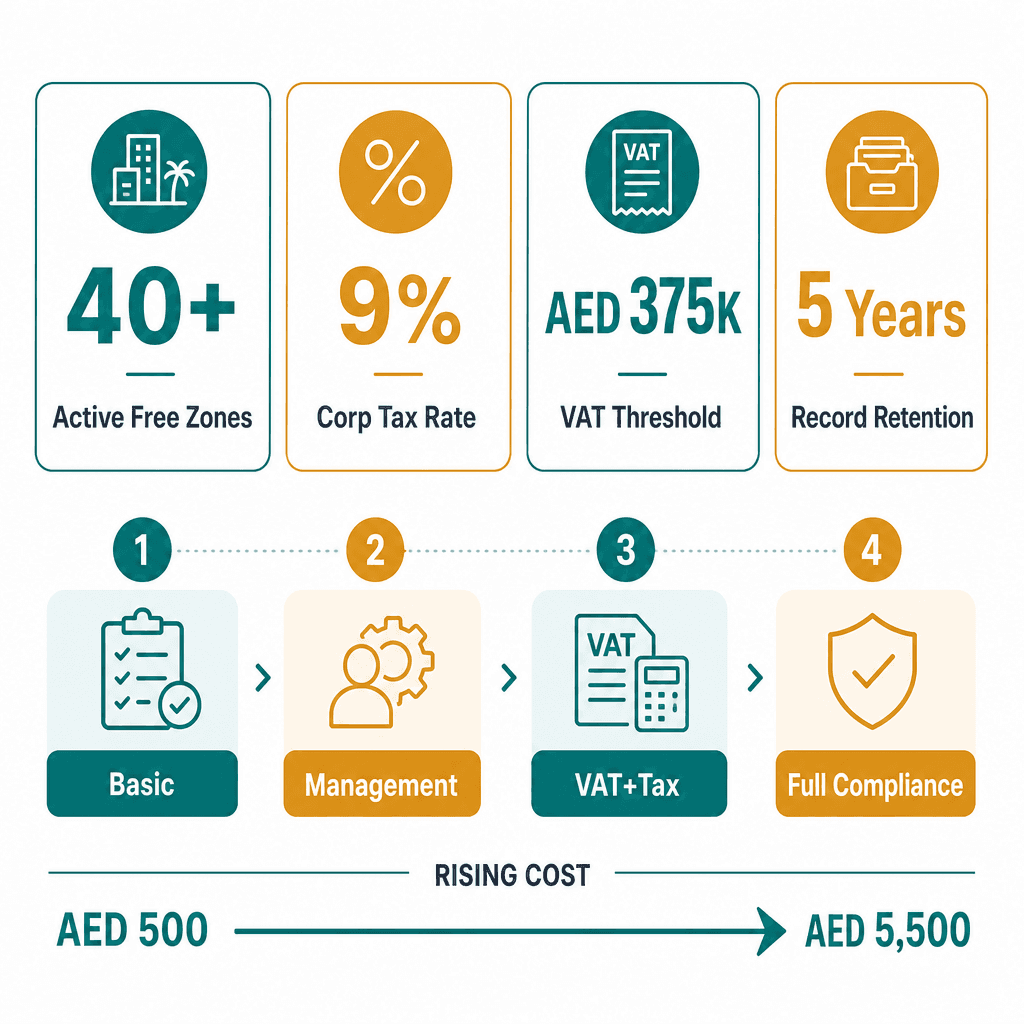
UAE free zone companies are legally required to maintain IFRS-compliant financial records, retain them for five years, register for corporate tax, file VAT returns if turnover exceeds AED 375,000, and produce annual financial statements. Some free zones also mandate audited accounts regardless of company size. Choosing the right free zone accounting packages UAE means understanding these obligations before you shop for a provider. For more detail, see our guide on audit documents for a Dubai company.
Core Accounting Obligations Every Free Zone Business Carries
Here's the baseline every UAE free zone company must meet, regardless of size or industry:
Bookkeeping: Recording every transaction in a structured double-entry ledger is legally mandated under Federal Decree-Law No. 47 of 2022, not just good practice.
Annual financial statements: Prepared under IFRS, required for corporate tax filing and typically for free zone license renewal.
VAT registration and quarterly filing: Mandatory once taxable turnover exceeds AED 375,000.
Corporate tax registration: All UAE entities must register, even those with 0% qualifying income status under the Qualifying Free Zone Person (QFZP) rules.
Five-year record retention: All financial documents must be kept and retrievable for FTA review from the end of the relevant tax period.
A trading company at Dubai South with AED 900,000 annual revenue needs bookkeeping, quarterly VAT returns, corporate tax registration, and annual IFRS-compliant financial statements, at minimum. That's four distinct obligations, and most entry-level accounting services free zone Dubai providers only cover one or two of them. For more detail, see our guide on company liquidation costs in Dubai.
Which Free Zones Require Audited Financial Statements
other UAE free zones (other UAE free zones), other UAE free zones (other UAE free zones Authority), and DIFC (Dubai International Financial Centre) all mandate annual audited accounts from a UAE-approved auditor. The audit requirement is typically tied directly to license renewal, no audited accounts, no renewed license.
Even free zones that don't mandate audits may still require them if you open a corporate bank account or apply for trade financing. Your accounting package must be structured to produce audit-ready records from day one, not just year-end summaries. For example, a free zone-licensed consultancy that skips its annual audit loses its license renewal eligibility, regardless of whether its VAT returns are filed correctly. Check your specific free zone's requirements against the company compliance calendar UAE. For more detail, see our guide on financing eligibility for UAE startups.
Bookkeeping vs. Management Accounting: Why the Difference Matters for Your Package Choice
Bookkeeping records what happened, every invoice, payment, and bank transaction entered into a ledger. Management accounting interprets those records to inform decisions: cash flow forecasts, profitability by product line, budget variance. Free zone companies need both, but most entry-level bookkeeping packages free zone UAE only deliver the first. Understanding the gap is essential for accounting for small business Dubai owners choosing their first package.
What Bookkeeping Actually Covers
Recording sales invoices, purchase invoices, bank transactions, and expense receipts into a double-entry ledger.
Reconciling bank statements monthly to catch errors, duplicate charges, and missing entries.
Maintaining accounts payable and receivable ledgers so you know exactly who owes you and what you owe.
Producing the foundational data without which VAT returns, management accounts, and financial statements cannot be produced accurately.
A Dubai South free zone consultancy with 30 transactions per month can be fully bookkeeping-compliant with a basic cloud ledger updated weekly. But that ledger must exist, be reconciled, and use accrual accounting, not a founder's cash-basis spreadsheet.
What Management Accounting Adds and When You Need It
Management accounts typically include a profit and loss (P&L) statement, balance sheet, and cash flow statement produced monthly or quarterly. They let you track profitability by project or product line, spot cost overruns early, and present financials to investors or banks.
Most free zone startups don't need monthly management accounts in year one, quarterly is usually sufficient. But here's the thing: if you're applying for a business bank account or trade finance, UAE banks will request management accounts as standard. An e-commerce company at a UAE free zone applying for an AED 500,000 trade finance facility will be asked for 12 months of management accounts. A basic bookkeeping-only package won't produce these. Review the Dubai South Business Hub Free Zone banking and taxation services page to understand what banks typically require from free zone entities.
What UAE Corporate Tax Law Requires from Your Records
UAE Corporate Tax Law requires all businesses, including free zone companies, to maintain IFRS-compliant financial records for a minimum of five years, register for corporate tax regardless of income level, and file an annual tax return. Qualifying Free Zone Persons must still meet these record-keeping obligations to retain their 0% tax status. This is where small business accounting UAE owners most commonly fall short, and where the right free zone accounting packages UAE make the biggest difference. For more detail, see our guide on accounting services for small businesses in the UAE.
IFRS-Compliant Records: What That Means in Practice
Accrual accounting: Revenue and expenses are recorded when earned or incurred, not when cash moves.
Correct chart of accounts: Must align with IFRS categories, assets, liabilities, equity, revenue, expenses.
No cash-basis spreadsheets: These are not IFRS-compliant and will fail an FTA audit.
Accepted platforms: Xero, QuickBooks, and Zoho Books are widely used and IFRS-compatible when configured correctly for UAE requirements.
A free zone IT services company that invoices in December but receives payment in February must record the revenue in December under IFRS accrual rules. A cash-basis spreadsheet records it in February, creating a mismatch that an FTA auditor will flag immediately. IFRS is mandated for UAE corporate tax record-keeping under Federal Decree-Law No. 47 of 2022 (UAE Ministry of Finance, 2022). See the UAE corporate tax guide 2024 for a full breakdown of filing obligations.
The Five-Year Retention Rule and What It Covers
All financial records, invoices, bank statements, contracts, expense receipts, must be retained for five years from the end of the relevant tax period.
Digital records are acceptable but must be retrievable in legible form for FTA review at any point during that window.
Retention applies to both VAT records and corporate tax records, these are separate obligations with overlapping document sets.
Your accounting package provider should have a documented data retention and backup policy, ask for it in writing before you sign.
A free zone company incorporated in 2022 must retain all 2022 financial records until at least 2027, even if the company is dissolved before then. Five-year retention is specified under both UAE VAT Federal Decree-Law No. 8 of 2017 and Corporate Tax Law No. 47 of 2022 (UAE Ministry of Finance, 2022).
4 Accounting Package Tiers Available in the UAE Market
UAE free zone accounting packages UAE typically fall into four tiers: basic bookkeeping only (AED 500–1,200/month), bookkeeping with management accounts (AED 1,200–2,500/month), full compliance including VAT filing (AED 2,000–3,500/month), and comprehensive packages with corporate tax filing (AED 3,000–5,500/month). Each tier suits a different company stage, and the right choice for your bookkeeping packages free zone UAE depends on your current revenue and obligations.
Tier 1: Basic Bookkeeping Only (AED 500–1,200/Month)
Covers transaction recording, bank reconciliation, and basic ledger maintenance.
Suitable for pre-revenue companies or those with fewer than 50 transactions per month.
Does not include VAT filing, management accounts, or financial statement preparation.
Often offered by independent bookkeepers, verify credentials and ask specifically about UAE regulatory knowledge.
Key risk: leaves you responsible for VAT returns and corporate tax filing separately, creating coordination gaps that compound over time.
A newly incorporated free zone media company with minimal transactions in its first six months may reasonably start at Tier 1, but should plan to upgrade before its first VAT return is due.
Tier 2 and Tier 3: Management Accounts and VAT Filing (AED 1,200–3,500/Month)
Tier 2 (AED 1,200–2,500/month): Adds monthly or quarterly management accounts, P&L, balance sheet, cash flow, to the bookkeeping base.
Tier 3 (AED 2,000–3,500/month): Adds VAT return preparation and FTA filing to Tier 2 coverage.
Tier 3 is the minimum recommended package for any free zone company with taxable turnover above AED 375,000.
Insist on providers who connect VAT returns directly to the ledger, not those who prepare returns independently of your accounting records.
A Dubai South free zone trading company turning over AED 1.2 million annually needs Tier 3 at minimum: bookkeeping, quarterly management accounts, and quarterly VAT returns all connected to one ledger. See accounting and tax compliance at Dubai South for an example of how this works in practice.
Tier 4: Full Compliance with Corporate Tax Filing (AED 3,000–5,500/Month)
Covers all of Tier 3 plus corporate tax registration, annual tax return preparation, and FTA filing.
Typically includes annual IFRS financial statement preparation.
Some Tier 4 packages include audit preparation or direct liaison with a UAE-approved auditor.
Best suited for free zone companies with active operations, multiple revenue streams, or investor reporting requirements.
Corporate tax return filing deadline: 9 months after the end of the relevant tax period (UAE Ministry of Finance, 2022).
A free zone-licensed logistics company with 200+ monthly transactions, VAT obligations, and a mandatory audit requirement needs a Tier 4 package. Managing these across multiple separate providers creates costly reconciliation failures, and leaves no single accountant accountable when the FTA comes calling.
How to Evaluate a Free Zone Accounting Provider
Evaluate UAE accounting services free zone Dubai providers on four criteria: UAE-qualified accountants (ACCA, CPA, or CMA credentials), FTA-registered tax agent status for VAT and corporate tax work, demonstrated experience with your specific industry, and use of cloud accounting software that connects bookkeeping directly to tax filings. This is the standard for quality accounting for small business Dubai operations.
Qualifications and Registrations to Verify Before You Sign
Only FTA-registered tax agents can legally represent you before the FTA for VAT and corporate tax matters, verify registration directly on the FTA portal before signing any contract.
Look for professional credentials: ACCA (Association of Chartered Certified Accountants), CPA, CMA, or CA, not just "experienced accountants."
Ask specifically about free zone company experience and your industry sector. An accountant experienced in retail may not understand QFZP substance requirements for a professional services company.
Verify the firm carries professional indemnity insurance, this protects you if an error in their filing creates an FTA penalty.
Mazeed, the accounting and tax compliance at Dubai South partner for Dubai South Business Hub Free Zone, holds FTA tax agent registration and provides integrated bookkeeping, VAT, and corporate tax services specifically structured for free zone entities. That kind of single-provider integration removes the coordination risk that trips up most small free zone businesses.
Red Flags That Signal a Provider Will Leave You Exposed
Offers VAT returns as a standalone service without access to your accounting ledger, this is the single most common gap that exposes companies in FTA audits.
No cloud accounting platform in use, spreadsheet-only providers cannot produce audit-ready records efficiently or reliably.
Pricing under AED 400/month for "full compliance", typically signals offshore staff with no working UAE regulatory knowledge.
Can't name the specific accountant assigned to your
Citations
Federal Tax Authority.. tax.gov.ae. FTA UAE, 2023.
UAE Cabinet.. uaecabinet.ae. UAE Cabinet, 2023.
Dubai Economy and Tourism.. dubaidet.gov.ae. DET Dubai, 2024.
UAE Ministry of Economy and Tourism.. moet.gov.ae. MOET UAE, 2024.
Dubai International Financial Centre.. difc.ae. DIFC, 2024.
Frequently Asked Questions