Topic Summary
Freelance Permit and Visa Are Different Documents
A freelance permit is the commercial authorization to work as self-employed, while the residency visa is the immigration status that lets you live in the UAE. You need both documents to operate legally, and confusing them is one of the most common costly mistakes independent professionals make.
Permit Fees Range From AED 7,500 to 15,000
The issuing authority determines how much you pay upfront, with free zone and mainland options sitting at different price points within that range. Annual renewal fees typically mirror the initial application cost, making authority selection a long-term financial decision.
Health Insurance Is a Mandatory Recurring Cost
Valid health insurance is an eligibility requirement for a freelance visa in the UAE, adding AED 600 to AED 3,000 per year depending on the plan. The medical fitness test fee also recurs at every visa renewal cycle, which happens every two to three years.
Tax Obligations Kick In Above AED 375,000
A 9% corporate tax applies once taxable income exceeds AED 375,000, and late registration for VAT or corporate tax carries a flat AED 10,000 penalty. Choosing the right structure from the start helps freelancers stay compliant without unexpected tax bills.
Most Knowledge-Economy Professions Qualify
Writers, developers, designers, consultants, data analysts, and education professionals are among the eligible categories for a freelance visa UAE. Regulated professions like healthcare and legal advisory require an additional approval from the relevant sector regulator on top of the standard permit.
Free Zone Licenses Offer a Scalable Alternative
A free zone trade license at Dubai South Business Hub Free Zone can be issued in one business day from AED 18,350 all-in for a sole founder with one visa, with zero paid-up share capital required. This structure provides a formal, compliant foundation that can grow alongside a freelancer's income and client base.
In 2026, the UAE hosts more than 60,000 registered independent professionals, yet many pay significantly more than necessary for their residency status because they choose the wrong structure at the start. The freelance visa UAE market is more layered than most guides admit: permit fees range from AED 7,500 to AED 15,000 depending on the issuing authority, health insurance adds AED 600 to AED 3,000 per year, and a 9% corporate tax applies once taxable income exceeds AED 375,000 (Federal Tax Authority, 2026). Late registration for VAT or corporate tax carries a flat AED 10,000 penalty each. A free zone trade license at Dubai South Business Hub Free Zone (DSBH) gives independent professionals a formal, scalable structure from AED 18,350 all-in for a sole founder with one visa, issued in one business day, with zero paid-up share capital required.
This article breaks down the freelance visa UAE cost in full, explains who qualifies, compares permit types, and shows how a DSBH free zone license works as a compliant, scalable alternative.
What Is a Freelance Visa in the UAE and Who Qualifies
A freelance visa UAE is a residency permit tied to a self-employment or freelance permit rather than an employer. It lets independent professionals live and work legally in the UAE. Eligibility typically requires a verified professional activity, a clean immigration record, and valid health insurance, with costs ranging from AED 7,500 to AED 15,000 depending on the issuing authority.
Definition: Freelance Permit vs. Residency Visa
These two documents are not the same thing, and confusing them is one of the most common mistakes independent professionals make. A freelance permit is the commercial authorization to operate as a self-employed individual. The residency visa is the immigration status that lets you stay in the UAE. You need both to live and work here legally.
Permits are issued by free zones or mainland authorities (overseen by MoHRE for mainland self-employment). Visas are issued by ICP under the General Directorate of Residency and Foreigners Affairs (GDRFA). The permit is the anchor document; the visa application is built on top of it. Residency visas are typically issued for two or three years, renewable before expiry.
A graphic designer based in Dubai, for example, holds a freelance permit from a free zone and a two-year residency visa issued by ICP: two separate documents, one legal identity.
Professional Categories That Qualify
Most knowledge-economy and creative professions qualify for a freelance visa UAE. The main categories include:
Creative and media professionals: writers, designers, photographers, video producers
Technology and ICT professionals: developers, UX designers, data analysts, cybersecurity consultants (see ICT license options at DSBH)
Business and management consultants: strategy advisors, HR specialists, marketing professionals
Education and training professionals: tutors, curriculum developers, e-learning content creators
Regulated professions require dual approval. Legal advisors, healthcare practitioners, and financial advisors need both the issuing authority's license and a separate approval from the named sector regulator. A freelance nutritionist, for instance, must hold both a free zone license for her consultancy activity and a separate approval from the Dubai Health Authority (DHA) before she can see clients.
Freelance Visa UAE Cost: One-Off vs. Recurring Expenses
Cost Item | One-Off Costs | Recurring Costs |
|---|---|---|
Permit or license application fee | Paid once at initial application; AED 7,500–AED 15,000 depending on authority | Annual renewal fee applies each year; typically similar to the initial fee |
Medical fitness test fee | Paid once at initial visa application at an approved health facility | Required again at each visa renewal cycle (every 2–3 years) |
Entry permit and visa stamping fee | Paid once when entering the UAE on the new permit or license | Paid again at each residency visa renewal (every 2–3 years) |
Emirates ID issuance | Paid once at initial registration; fee varies by card duration | Renewed in line with each visa renewal cycle |
Document attestation (if required) | One-off cost for educational certificates; required for select regulated activities | Not typically recurring unless documents change or expire |
Annual permit or license renewal | Not applicable, this is a recurring cost only | Due every 12 months; must be renewed to maintain legal status |
Residency visa renewal (every 2–3 years) | Not applicable, this is a recurring cost only | Includes medical test, Emirates ID renewal each cycle |
Freelance Visa UAE Cost: Full Price Breakdown
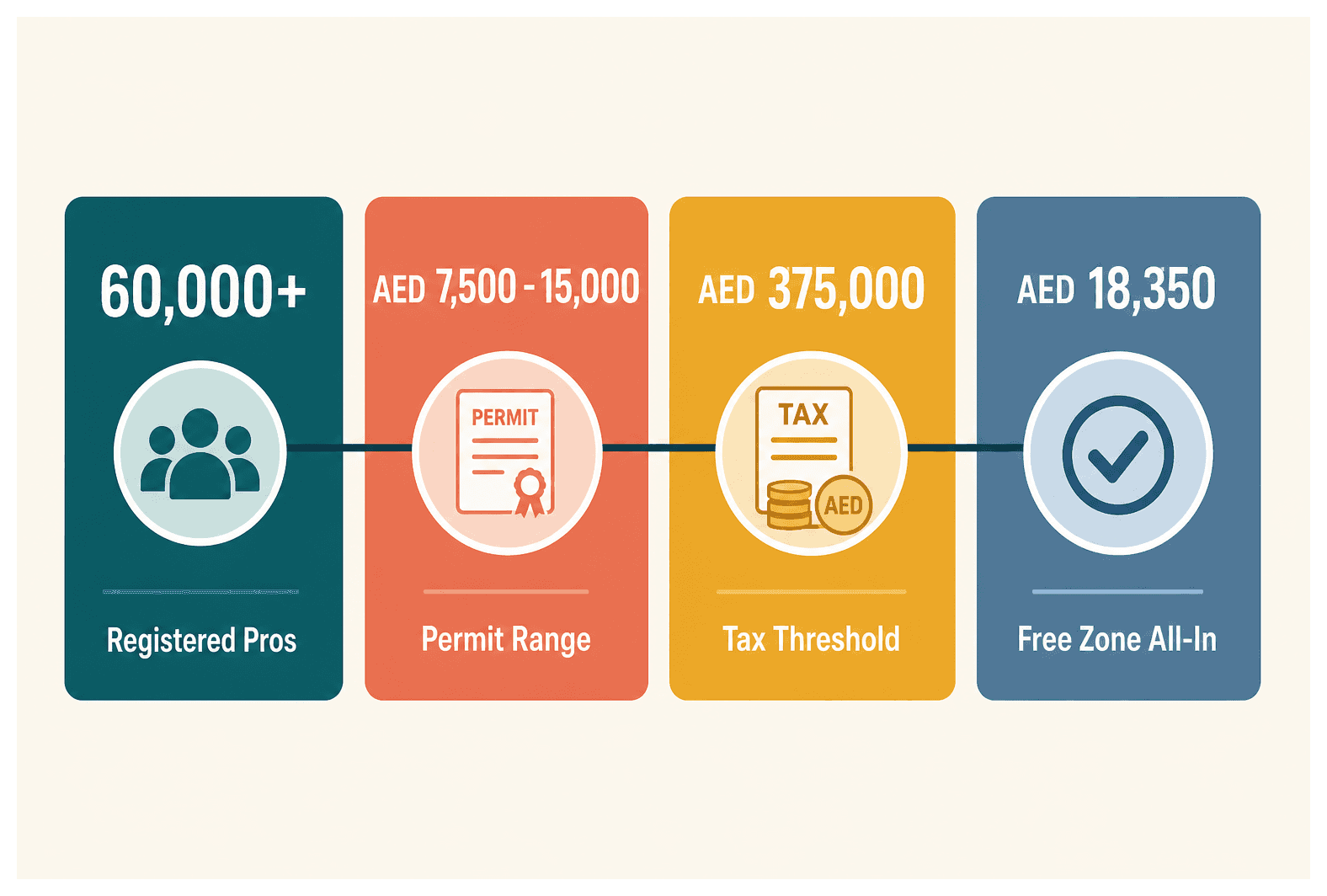
The freelance visa UAE cost ranges from AED 7,500 to AED 15,000 depending on the authority and activity. One-off costs include the permit fee and medical fitness test. Recurring annual costs include the permit renewal and visa renewal. Health insurance and Emirates ID are additional and mandatory but not bundled into most permit packages (UAE Government Portal, 2026).
One-Off vs. Recurring Cost Categories
Budgeting only for the permit fee is a mistake that catches many independent professionals off guard. A freelance UX designer who plans only for her permit fee discovers mid-year that Emirates ID, health insurance, and the medical fitness test add another AED 3,000 to AED 4,000 she had not accounted for.
One-off costs at setup include: the permit or license application fee, the medical fitness test (paid directly to an approved health facility, UNVERIFIED: exact figure, confirm before publishing), the entry permit fee, Emirates ID issuance (UNVERIFIED: exact figure, confirm before publishing), and document attestation where required. These are paid once and do not recur until the visa renewal cycle.
Recurring costs are the ones that trip up long-term planning. Annual permit renewal, residency visa renewal every two or three years, and health insurance premiums all come back. Health insurance is legally mandatory for all UAE residents and is never bundled into a permit fee. Budget AED 600 to AED 3,000 per year depending on the plan and provider.
What Is NOT Included in the Permit Fee
No issuing authority in the UAE bundles health insurance into its permit package. It is a separate legal requirement that each resident must arrange independently. Here is what the permit fee does not cover:
Health insurance: mandatory under UAE law; arranged and paid separately
Emirates ID fees: paid to ICP at issuance and each renewal
Medical fitness test: paid directly to the approved health facility
Bank account opening fees: where applicable, not covered by any permit package
Regulatory approval fees: DHA, KHDA, and SCA approvals are paid separately to the relevant regulator
Use the DSBH cost calculator to model your first-year total with all mandatory costs included, not just the license fee.
How a Free Zone License Compares to a Freelance Permit
A free zone trade license gives independent professionals a formal company structure, the ability to sponsor their own residency visa, and the option to add business activities as their work grows. A freelance permit is simpler but typically restricts the holder to a single activity and offers fewer expansion options. Both require separate health insurance and Emirates ID.
DSBH Free Zone License: Key Figures
Dubai South Business Hub Free Zone (DSBH) launched in September 2025 and is designed specifically for independent professionals and small businesses. Key figures:
License from AED 12,500
First-year all-in cost for a sole founder with one visa: from AED 18,350
Zero paid-up share capital required
License issued in one business day
Each additional activity beyond the first five: AED 2,000
A solo marketing consultant who sets up at DSBH pays from AED 18,350 in year one, holds a formal free zone license, and sponsors her own two-year residency visa without a local partner or any share capital deposit. The visa is always an additional cost and is never described as included in the license fee.
When a License Makes More Sense Than a Permit
A freelance software developer billing a multinational client is often asked to provide a company trade license and a bank account in a business name. A freelance permit alone will not satisfy most corporate procurement requirements. That is a practical reality worth knowing before you commit to a structure.
A professional license at DSBH covers consultancy and professional service activities. For technology professionals, an ICT license at DSBH is available. UAE banks typically require a trade license to open a business account in a company name. And if you want to add a second or third service line later, a license with multiple activities is far more flexible than a single-activity permit. Check the full list of business activities in Dubai at DSBH before deciding.
How the UAE Residency Visa Process Works for Independent Professionals
Independent professionals in the UAE apply for a residency visa after securing either a freelance permit or a free zone license. The process runs through ICP and the GDRFA and involves a medical fitness test, Emirates ID registration. The full process typically takes five to ten business days once documents are in order.
Step 1: Secure the Permit or License First
The residency visa application cannot begin until the commercial permit or free zone license is active.
At DSBH, the license is issued in one business day, so the visa process can begin almost immediately after approval.
Gather all supporting documents before applying: passport copy, passport-sized photos, proof of accommodation, and a valid health insurance policy.
A freelance consultant receives her DSBH license confirmation on a Tuesday and submits her entry permit application the same afternoon. That turnaround is realistic because the license is issued digitally within one business day.
Step 2: Medical Fitness Test and Emirates ID
All UAE residency applicants must pass a medical fitness test at an approved health facility. The test fee is paid directly to the facility (UNVERIFIED: exact figure, confirm before publishing).
Health insurance must be in place before the visa is stamped. It is a legal requirement, not optional.
Emirates ID registration is completed during or shortly after the visa stamping process. The Emirates ID fee is paid to ICP (UNVERIFIED: exact figure, confirm before publishing).
GDRFA handles physical visa stamping in Dubai; ICP manages the national residency system.
Step 3: Visa Stamping and Residency Confirmation
Once the medical test is cleared and Emirates ID is registered, the visa is stamped into the passport.
Residency visas for free zone license holders are typically issued for two years, renewable before expiry. Missing the renewal window triggers overstay fines.
UAE residency visa services at DSBH are available through the beyond-hub residency services team.
After visa stamping, the holder can open a UAE bank account in their own name.
Is the freelance visa UAE process the same for all free zones?
Yes. Free zone license holders sponsor their own residency visa through ICP and GDRFA regardless of which free zone issues the license. The steps are identical: license first, then entry permit, medical test, Emirates ID. Visa fees are always additional to the license fee, never bundled.
Tax and Compliance Obligations for UAE Freelancers
UAE freelancers and free zone license holders must register for corporate tax if their taxable income exceeds AED 375,000. VAT registration is required once taxable turnover reaches AED 375,000 per year. Late registration for either carries an AED 10,000 penalty each. The corporate tax late registration penalty is a one-time flat charge, not a monthly fee (Federal Tax Authority, 2026).
Corporate Tax: What the 9% Rate Means for You
The UAE corporate tax rate is 9% on taxable income above AED 375,000, introduced under Federal Decree-Law No. 47 of 2022. A DSBH license holder earning AED 500,000 per year must register for corporate tax and file returns. If she misses the registration deadline, she faces a AED 10,000 flat penalty, paid once, not monthly.
A Qualifying Free Zone Person (QFZP) may access a 0% rate on qualifying income, but only if all four of these conditions are met simultaneously: the entity is incorporated in a qualifying free zone; it maintains adequate substance in that free zone; it earns qualifying income as defined by the Ministry of Finance; and it has not elected to be subject to the standard 9% rate. All four conditions must be satisfied. Never describe the UAE as tax-free, and never cite the 0% rate without these four conditions attached.
For banking and taxation guidance specific to your structure, DSBH's beyond-hub team can walk you through registration requirements before your first filing deadline.
VAT Registration Thresholds and Penalties
VAT registration is mandatory once your taxable turnover reaches AED 375,000 in any 12-month period. The UAE VAT rate is 5%. Late VAT registration triggers an AED 10,000 penalty from the Federal Tax Authority, the same flat amount as the corporate tax late registration penalty, but a separate charge.
If you provide services internationally, review zero-rating rules with a qualified tax advisor before assuming you are exempt. Free zone status does not exempt a business from VAT obligations unless specific designated-zone rules apply. DSBH is not a designated zone and carries no designated-zone VAT benefit.
Five Eligibility Checks Before You Apply for a Freelance Visa UAE
Before applying for a freelance visa UAE, confirm five things: your professional activity is on the approved list for your chosen authority, your passport has at least six months' validity, you have valid health insurance arranged, your educational qualifications are attested if required, and you have a UAE address or tenancy contract ready for Emirates ID registration (UAE Government Portal, 2026).
The Five-Point Eligibility Checklist
Activity eligibility: confirm your professional activity is recognized by the issuing authority. Check the full list of business activities in Dubai at DSBH before committing.
Passport validity: your passport must have at least six months of remaining validity at the time of application. No exceptions.
Health insurance: a valid UAE health insurance policy must be in place before the visa is stamped. Arrange this before, not after, submission.
Qualification attestation: some authorities require attested educational certificates for specific professional activities. Check requirements for your activity category before you apply.
UAE address: a tenancy contract or proof of accommodation is required for Emirates ID registration. A business address alone is not sufficient for residential registration.
A consultant who submits her visa application without an active health insurance policy faces rejection and must resubmit, delaying her residency by two to three weeks. Getting these five checks right the first time saves significant time and cost.
Regulated Activities: Dual Approval Is Non-Negotiable
If your activity is regulated, you need both the trade license from DSBH and a separate approval from the named sector regulator. The license alone is not sufficient. Sector regulators by activity:
Healthcare:Dubai Health Authority (DHA) or the relevant emirate health authority
Education and training: Knowledge and Human Development Authority (KHDA) for Dubai
References
Frequently Asked Questions