
Topic Summary
Standard 30-Day Grace Period for Most Visas
Employment, family, and investor residency visa holders get 30 calendar days from the cancellation date to leave, transfer sponsors, or change status. The clock starts on the cancellation date itself, so day one is already consumed the moment processing is complete.
Golden Visa Holders Get Up to Six Months
Long-term residency Golden Visa holders receive a significantly longer grace period of up to six months after cancellation. This extra runway makes a meaningful difference when planning business restructuring, company liquidation, or international relocation.
Tourist and Visit Visas Have Zero Grace Period
Unlike residency visas, visit and tourist visas carry no grace period whatsoever. Overstay fines begin accruing from the moment the visa expires, not from any formal cancellation date.
Overstay Fines Accumulate Fast
Missing the grace period deadline by even one day triggers an AED 25 per day fine plus a one-time AED 100 administrative charge. Prolonged overstay can also result in an entry ban ranging from one year to permanent.
Your Practical Options During the Grace Period
Within the 30-day window you can legally transfer to a new employer, change your visa status, or simply depart the country with no overstay recorded. Acting early in the window rather than at the last moment reduces the risk of missing the deadline.
Dubai and Federal Emirates Use Different Portals
Dubai and the Northern Emirates are processed through GDRFA, while Abu Dhabi and other federal entities fall under ICP. Both apply the standard 30-day rule, but the portal you use to check your status and pay any fines differs by emirate.
Always Verify Your Specific Grace Period with ICP
The applicable grace period is tied to your visa category code in the government system, not just the general rule. Confirming your exact window directly with ICP or GDRFA is the safest way to avoid an accidental overstay fine.
The grace period after visa cancellation in the UAE is 30 calendar days for most residency visa holders. That window starts on the cancellation date itself, not the following morning. During those 30 days you can legally remain in the country, transfer to a new employer, change your visa status, or depart with no overstay fine recorded against your name.
Miss that deadline by a single day and an AED 25 per day fine starts accumulating, plus a one-time AED 100 administrative charge. Prolonged overstay can trigger an entry ban lasting anywhere from one year to permanent. The rules are set by the Federal Authority for Identity, Citizenship, Customs and Ports Security (ICP) and, for Dubai specifically, by the General Directorate of Residency and Foreigners Affairs Dubai (GDRFA).
This article covers exactly how the grace period is counted, which visa categories get a different window, what overstay costs you, and what your practical options are, including employer transfer, status change, and a clean departure and re-entry.
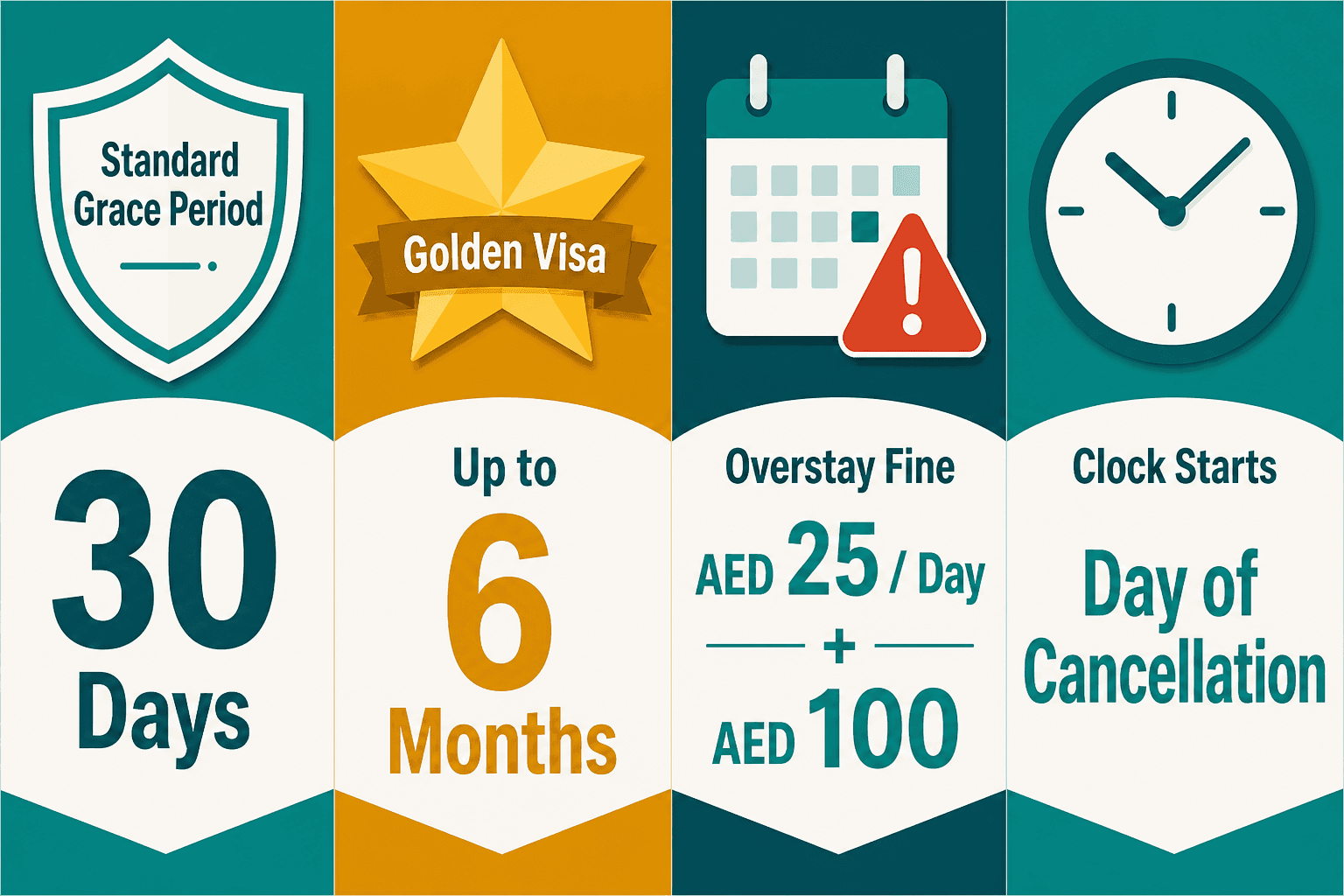
The grace period after visa cancellation in the UAE is typically 30 days for most residency visa holders. During this window, you can legally remain in the country, transfer to a new sponsor, change your visa status, or depart without incurring an overstay fine. Some visa categories carry shorter or longer periods, so your specific visa type matters. For more detail, see our guide on UAE visa validity and grace period guide.
The Standard 30-Day Rule Explained
Most employment, family, and investor residency visas carry a 30-calendar-day grace period from the date of cancellation recorded in the ICP system or stamped in the passport. The clock starts on the cancellation date itself, not the day after. Day one is already consumed the moment the cancellation is processed.
It's also worth clarifying what "grace period" actually means here. It is not an extension of your visa validity. If your visa had already expired before the cancellation was formally processed, the grace period does not reset the clock from the expiry date. The 30 days run from the cancellation date, full stop.
Take a concrete example: a finance manager in Abu Dhabi whose employment visa is cancelled on 1 March has until 30 March to leave, transfer to a new sponsor, or change status. Not 31 March. That single-day difference has cost people AED 25 in avoidable fines.
Which Visa Categories Get a Different Grace Period
Not every visa type follows the 30-day rule. Here is how the UAE visa cancellation grace period breaks down by category:
Standard employment, family, and investor residency visas: 30 calendar days (per ICP guidelines)
Golden Visa (long-term residency): up to 6 months, reflecting the premium nature of the visa category
Visit and tourist visas: no grace period at all. Fines accrue from the day the visa expires, not from any cancellation date
Mission visas and certain government-sponsored visas: bespoke terms set by the sponsoring authority. Always verify directly with ICP or GDRFA
A Golden Visa holder whose investor visa is cancelled following a business liquidation has up to 6 months to arrange new status or depart. That is considerably more planning time than the 30-day window available to a standard employment visa holder, and it changes the calculus around company restructuring or relocation entirely.
Always verify your specific grace period with ICP because the applicable period is tied to the visa category code in the system, not just the general rule you may have read online.
How the Grace Period Is Counted and What Varies by Emirate
The UAE visa cancellation grace period is counted in calendar days starting from the cancellation date recorded in the government system. Dubai and the Northern Emirates are processed through GDRFA, while Abu Dhabi, Sharjah (outside free zones), and other federal entities fall under ICP. Both authorities apply the standard 30-day rule, but the portal you use to check your status and pay any fines differs.
ICP Versus GDRFA: Which Authority Governs Your Grace Period
Dubai residency visas are administered by GDRFA Dubai. All other emirates fall under ICP at the federal level. Both apply the same 30-day grace period for standard residency visas, but the platform where you verify your status is different.
If your visa was cancelled in Dubai, check your status on the GDRFA Dubai smart app or at gdrfad.gov.ae. If you are outside Dubai, use the ICP smart app or the ICP website. Cross-emirate situations, such as a visa cancelled in Abu Dhabi while the holder lives in Dubai, are still governed by the issuing authority's records.
An HR manager in Dubai whose team member's visa is cancelled through a GDRFA-processed request should direct that employee to the GDRFA portal immediately to confirm the exact cancellation date and the remaining grace days. Do not assume both portals show identical information on the same day.
Why the Cancellation Date in the System Is the Date That Counts
The system-recorded date is the legally operative date. Not the passport stamp. Not the verbal confirmation from your employer. The date the cancellation is registered in the ICP or GDRFA database is what immigration will use to calculate any overstay fine.
This matters because delays between an employer submitting cancellation paperwork and the system updating can shorten your effective window without warning. An employee told verbally that their visa was cancelled on a Monday may find the system date is actually the Thursday the paperwork was processed, reducing the effective grace period by three days.
Confirm your cancellation date digitally within 24 hours of your employer notifying you. Do not wait for a physical stamp. The ICP smart app and the GDRFA portal both show real-time status and are the only records that count.
What Happens on Day One of Overstay After Visa Cancellation in the UAE
If you remain in the UAE beyond the grace period after visa cancellation, an overstay fine of AED 25 per day applies from day one after the grace period ends. A one-time administrative fine of AED 100 is also levied. Fines accumulate daily and must be settled before you can exit the country or transfer your visa status.
The Daily Fine Structure and How Costs Accumulate
The numbers add up faster than most people expect. A job-seeker who misjudges the end of their 30-day grace period by two weeks accumulates AED 350 in overstay fines (14 days multiplied by AED 25) plus the AED 100 administrative charge, for a total of AED 450 payable before departure. Stretch that to 60 days of overstay and the daily fines alone reach AED 1,500, with the administrative charge on top bringing the minimum to AED 1,600.
Fines must be paid to ICP or GDRFA before an exit stamp is issued. Airlines will not board a passenger with an unresolved overstay flag in the system. You can check and pay fines online before reaching the airport, which is strongly preferable to discovering the issue at check-in. See the UAE overstay fine check guide for a step-by-step walkthrough of the online payment process.
Travel Bans and Future UAE Entry Restrictions from Overstay
Paying the fine does not automatically resolve everything. Prolonged overstay can result in a UAE entry ban ranging from one year to permanent, depending on the duration and circumstances. Even short overstays are recorded in immigration systems and can affect future visa applications, including, in some cases, applications to other GCC countries whose systems are linked.
A professional who overstays by three months, pays the fine at the airport, and departs may still find their next UAE employment visa application flagged during the immigration check, requiring additional sponsor intervention to resolve. Paying the fine clears the financial liability. It does not erase the record. Act within the grace period rather than assuming a fine payment closes the matter entirely.
6 Steps to Take During the Grace Period After Visa Cancellation in the UAE
During the UAE visa cancellation grace period, your priority is to confirm your cancellation date digitally, obtain your cancellation certificate, assess your options, settle outstanding employer obligations, arrange the necessary documents, and execute your chosen path before day 30. Here is how to do that methodically.
Step 1: Confirm Your Cancellation Date and Obtain Your Certificate
Log into the ICP smart app or GDRFA Dubai portal immediately and confirm the system-recorded cancellation date. Both platforms show real-time status. Do not rely on verbal confirmation from your employer. Verify digitally.
Request your visa cancellation certificate from your former employer or sponsor. You will need this document for any subsequent visa application, status change, or employer transfer. Note the exact expiry date of your grace period and set a calendar reminder for day 25 as your personal action deadline, giving yourself five days of buffer for processing delays.
A marketing executive in Sharjah who logs into the ICP app the morning after her employer confirms cancellation may find the system date is one day earlier than she assumed, leaving her 29 remaining days rather than 30. That one-day discrepancy is worth catching on day one, not day 29.
Step 2: Assess Your Three Main Options Before the Grace Period Ends
You have three realistic paths during the grace period after visa cancellation in the UAE:
A software engineer with a confirmed job offer should pursue Option A immediately. Someone still in negotiations may prefer Option C, departing and re-entering on a 30-day visit visa to buy additional time. Each path has different timelines and costs, so assess before committing.
Steps 3 to 6: Documents, Employer Obligations, Departure, and Confirmation
Step 3: Gather documents. Passport, Emirates ID, cancellation certificate, and any offer letter or company formation documents for your chosen next step.
Step 4: Settle employer obligations. Ensure your employer has paid your final salary, end-of-service gratuity, and any outstanding allowances per MOHRE rules before you depart or transfer. A teacher transferring from one school to another should have her new employer submit the MOHRE transfer request by day 10, giving both parties 20 days of buffer.
Step 5: Execute your chosen option. Submit the transfer application, file the status change, or book departure travel, all before day 28 to allow for processing delays.
Step 6: Confirm resolution. After departure or transfer, verify in the ICP or GDRFA system that your previous visa record is closed and no fines are showing before you travel.
Your Options During the Grace Period After Visa Cancellation in the UAE
During the UAE visa cancellation grace period, you can transfer to a new employer, change your visa status to an investor or dependent visa, or exit and re-enter on a fresh entry permit. Each route has different processing times, costs, and eligibility criteria. Starting your chosen option by day 10 maximises your chances of completing it within the window.
UAE Visa Cancellation Grace Period by Visa Type
Visa Type | Grace Period |
|---|---|
Standard employment residency visa | 30 calendar days from system-recorded cancellation date |
Family / dependent residency visa | 30 calendar days (tied to principal visa cancellation; verify each dependent separately on ICP portal) |
Investor residency visa | 30 calendar days from cancellation date |
Golden Visa (long-term residency) | Up to 6 months, significantly more time to arrange new status or depart |
Visit / tourist visa | 0 days, AED 25 per day fine accrues from visa expiry date, not a separate cancellation date |
Mission / special government visa | Terms set by sponsoring authority, confirm directly with ICP before assuming any standard period applies |
Transferring to a New Employer Within the Grace Period
A new employer can sponsor a visa transfer through MOHRE without you needing to exit the UAE, provided the transfer is initiated within the grace period. The new employer submits an offer through the MOHRE online portal; once approved, ICP issues a new residency visa linked to the new sponsor. Processing typically takes 5 to 10 working days, so start no later than day 10 to avoid a race against the deadline.
A logistics coordinator who receives a new offer on day 5 of their grace period should have their new employer file the MOHRE transfer immediately, targeting approval well before day 30. Waiting until day 20 to start a process that takes up to 10 working days is a gamble you do not need to take.
Changing Status to an Investor or Company Visa During the Grace Period
If you are considering setting up a business in the UAE, a free zone company license with a linked residency visa package can be the most efficient status-change route. The UAE residency visa services at Dubai South Business Hub Free Zone include investor visa packages tied directly to a free zone license, and the license application can often be initiated well within the 30-day window.
An entrepreneur whose employment contract ends and whose visa is cancelled can initiate a free zone company formation on day 3 of the grace period, with the investor residency visa application submitted before day 15. Status change to an investor visa does not require departure if the application is processed in-country before the grace period expires. No exit, no re-entry cost, no gap in your UAE presence.
Exiting and Re-Entering on a New Entry Permit
If neither a transfer nor a status change can be arranged in time, departing before the grace period ends is the cleanest option available. No fines. No overstay record. You can re-enter the UAE on a new 30-day or 60-day visit visa, giving additional time to finalise a new employer or company formation from inside the country.
A British national whose 30-day grace period is nearly exhausted and who has no confirmed new sponsor can fly to a neighbouring country, re-enter on a 30-day visit visa, and continue job negotiations or company setup from within the UAE. Some nationalities receive a visa on arrival; others need to apply for an e-visa through ICP before re-entry. Confirm your eligibility with ICP or GDRFA before booking travel.
Grace Period After Visa Cancellation in the UAE: Common Questions Answered
The UAE visa cancellation grace period raises consistent questions among expatriates: does exiting reset the clock, what happens to your Emirates ID, are dependent visas affected, and can you pay fines online? Here are direct answers.
Does Exiting the UAE During the Grace Period Reset the Clock?
No.
References
Federal Authority for Identity, Citizenship, Customs and Ports Security (ICP) (icp.gov.ae)
General Directorate of Residency and Foreigners Affairs Dubai (GDRFA) (gdrfad.gov.ae)
MOHRE (mohre.gov.ae)
Citations
Ministry of Human Resources and Emiratisation.. mohre.gov.ae. MOHRE UAE, 2025.
Federal Authority for Identity, Citizenship, Customs and Port Security.. icp.gov.ae. ICP UAE, 2025.
General Directorate of Residency and Foreigners Affairs Dubai.. gdrfad.gov.ae. GDRFA Dubai, 2025.
UAE Government Portal.. u.ae. UAE Government, 2025.
Frequently Asked Questions