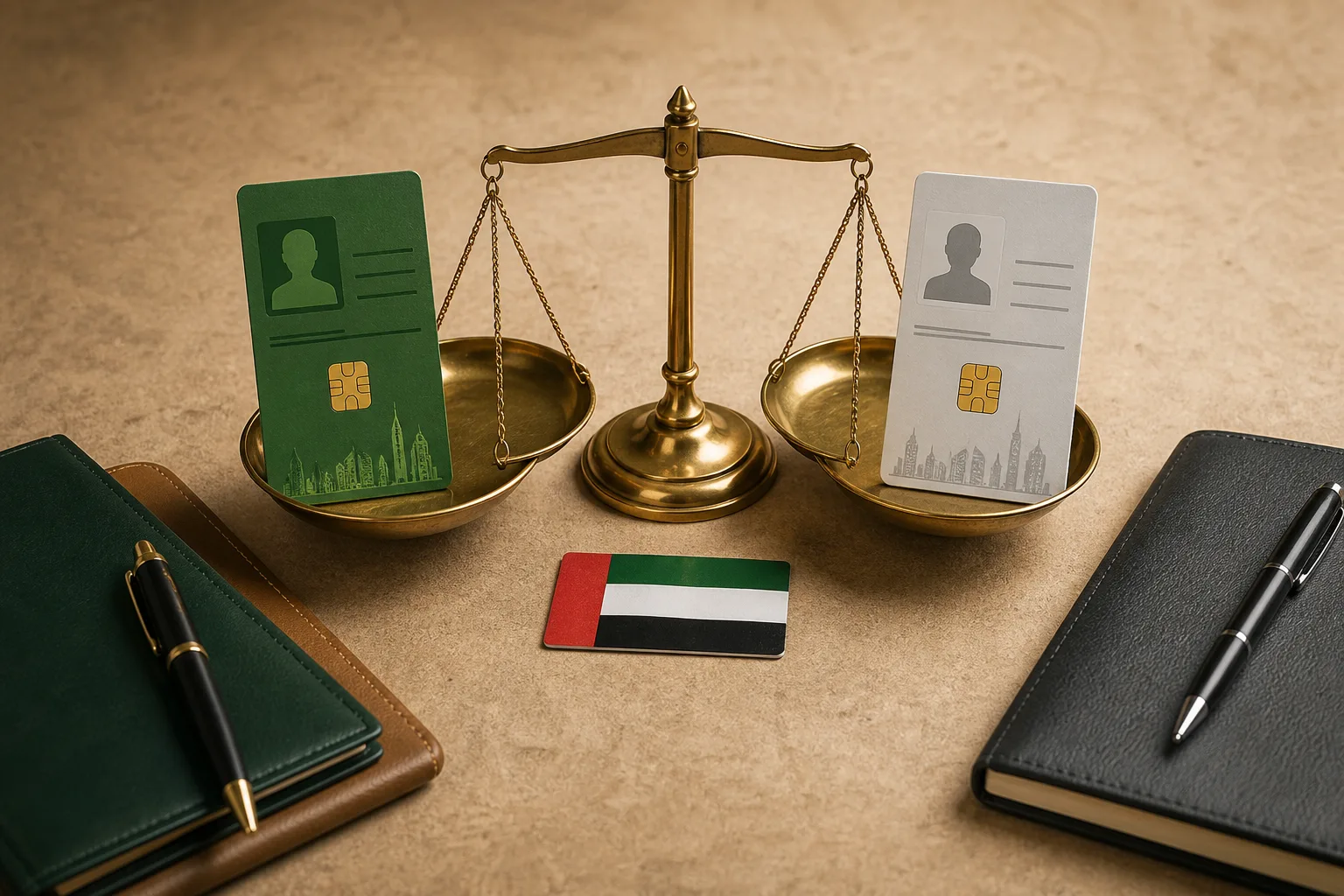
Topic Summary
Sponsorship Control: The Fundamental Difference
On a standard employment visa, your employer is your legal sponsor and controls your residency status. The UAE Green Visa makes you your own sponsor, giving you independent residency for five years regardless of where you work.
Job Loss Grace Period Is Three Times Longer
Employment visa holders get just 60 days to find a new employer or leave the UAE after losing their job. Green Visa holders receive 180 days, giving significantly more time to explore options without residency pressure.
Upfront Costs Fall on Different Parties
Green Visa applicants pay AED 3,500 to AED 5,500 out of their own pocket. Standard employment visa costs of AED 5,000 to AED 8,000 are typically covered by the sponsoring employer.
Green Visa Has Strict Eligibility Requirements
To qualify for the skilled employee track, applicants must earn at least AED 15,000 per month, hold a degree from an accredited institution, and meet a Skill Level 1 or 2 classification under the MoHRE occupational framework.
Changing Jobs Is Far Simpler on a Green Visa
Employment visa holders must coordinate visa cancellation and reissuance between two employers when switching jobs, a process involving paperwork and HR departments on both sides. Green Visa holders face no such dependency when changing employers.
Employment Visa Covers the Vast Majority of Expats
The standard employment visa underpins residency for most of the UAE's roughly 9 million expatriate workforce. The Green Visa, launched in April 2022, has grown to cover an estimated 200,000 skilled professionals as of 2026.
By Editorial Team, UAE business setup and residency specialists with direct experience across Dubai, Abu Dhabi, and free zone formations. Full bio →
In 2026, an estimated 200,000+ skilled professionals in the UAE hold a Green Visa, a number that has grown sharply since the visa launched in April 2022 under UAE Cabinet Resolution No. 65. The standard employment visa, by contrast, covers the vast majority of the UAE's roughly 9 million expatriate workforce (UAE Government Portal, 2024). Both give you the legal right to live and work in the UAE. But they are fundamentally different instruments in one critical respect: who controls your residency status. On an employment visa, that control belongs to your employer. On a Green Visa, it belongs to you.
The cost difference is real, Green Visa applicants pay AED 3,500 to AED 5,500 out of pocket, while employment visa costs are typically absorbed by the employer at AED 5,000 to AED 8,000. The job-loss grace period gap is equally stark: 60 days on an employment visa versus 180 days on a Green Visa. This guide breaks down the green visa vs employment visa UAE decision across every dimension that matters, so you can choose the residency structure that actually fits your situation.
What Is the Green Visa vs Employment Visa UAE Difference
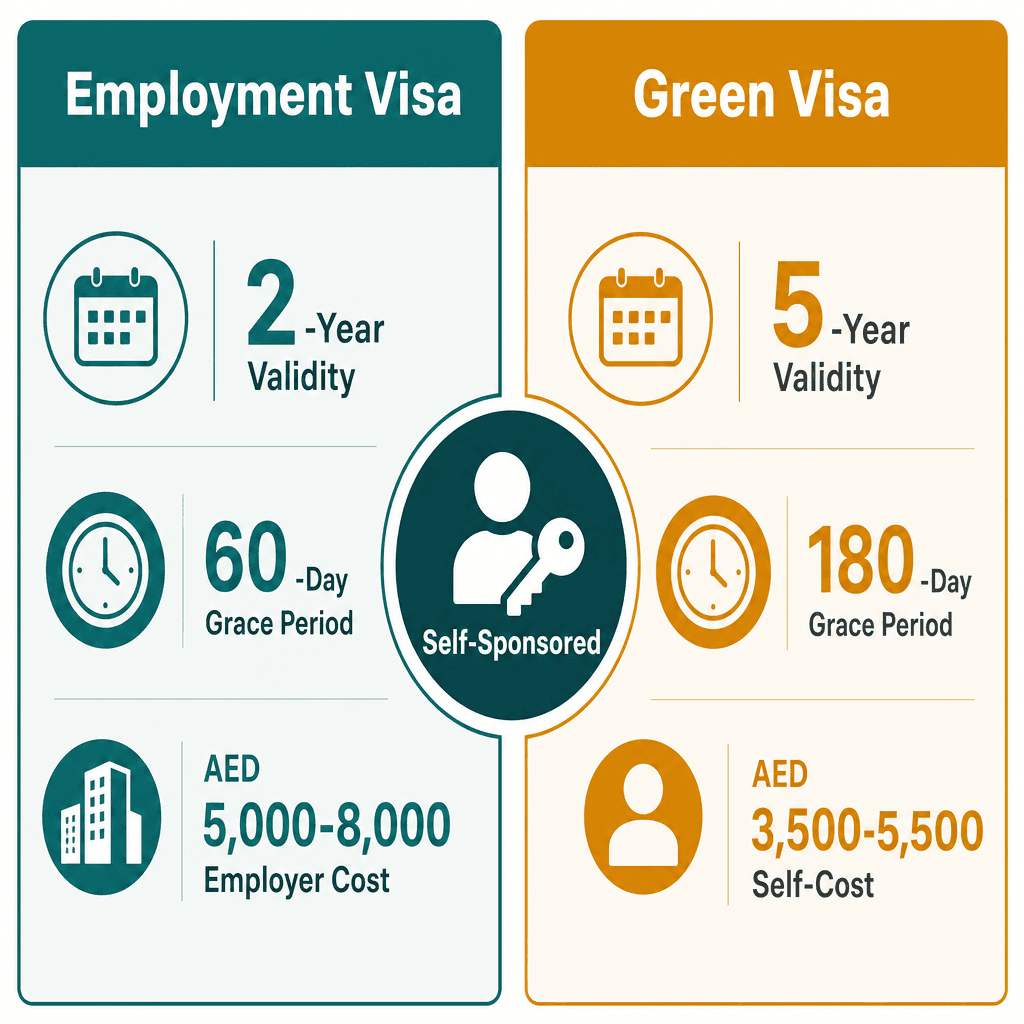
The core difference between the green visa vs employment visa UAE is sponsorship. A standard employment visa ties your residency to your employer, they are your legal sponsor. The UAE Green Visa makes you your own sponsor, giving you independent residency status valid for five years regardless of where you work. That single structural difference cascades into everything else: how long you can stay if you lose your job, whether you need permission to start a business, and how much control you have over your own Emirates ID and residency status. For a full breakdown of all UAE residency options, see our types of visas in the UAE guide.
The Standard Employment Visa: How Sponsorship Works
Your UAE employer is your legal sponsor. They apply for your residency, hold the liability, and can cancel your visa if employment ends. Visa validity is tied directly to your employment contract, typically 2 years, renewable only while you remain with the same employer.
If you resign or are terminated, you enter a grace period. For most worker categories, that's 60 days to either secure a new employer or leave the UAE. Changing jobs requires the new employer to cancel the old visa and issue a new one, a process that takes time, paperwork, and coordination between two HR departments.
Consider a software engineer hired by a Dubai-based tech firm. Her residency exists because her employer sponsors it. If that firm downsizes and terminates her contract, her legal right to remain in the UAE begins a countdown immediately, 60 days, regardless of her seniority or how long she's lived in the country.
The UAE Green Visa: Self-Sponsored Residency Explained
The Green Visa, introduced in April 2022 under UAE Cabinet Resolution No. 65, gives eligible skilled workers self-sponsored residency for 5 years. You are your own sponsor, no employer needs to initiate, hold, or cancel your visa.
The skilled employee track has three firm requirements: a minimum monthly salary of AED 15,000, a degree from an accredited institution, and a Skill Level 1 or 2 classification under the Ministry of Human Resources (MoHRE) occupational framework. Roles like engineers, accountants, doctors, senior managers, and financial analysts typically qualify. For a complete eligibility walkthrough, read our UAE Green Visa guide. For more detail, see our guide on UAE Green Visa for marketing managers.
A marketing director earning AED 22,000 per month with a bachelor's degree qualifies for this track. She applies directly through the ICP (Federal Authority for Identity, Citizenship, Customs and Port Security) portal, and once approved, her residency belongs to her, not her employer.
Green Visa vs Standard Employment Visa UAE: Side-by-Side Comparison
Feature | UAE Green Visa | Standard Employment Visa |
|---|---|---|
Sponsorship | Self-sponsored, you hold your own residency | ❌ Employer is legal sponsor; they control your status |
Visa Validity | 5 years, renewable independently | 2 years, renewed only by employer |
Job-Loss Grace Period | 180 days (6 months) to find new role or start business | ❌ 60 days, then exit or new employer required |
Business Rights | Start a company or invest, no NOC needed | ❌ Employer NOC typically required for side ventures |
Eligibility Threshold | AED 15,000/month salary + degree + Skill Level 1 or 2 | Any valid job offer from a licensed UAE employer |
Who Pays Visa Costs | Applicant pays: AED 3,500 to 5,500 | Employer typically covers AED 5,000 to 8,000 in fees |
Family Sponsorship | Allowed; AED 4,000/month minimum income threshold | Allowed; same AED 4,000/month income threshold |
Green Visa vs Employment Visa UAE: Full Head-to-Head Comparison
Comparing the green visa vs employment visa UAE across sponsorship, job-loss protection, business rights, validity, and cost reveals that the Green Visa gives significantly more independence and flexibility, while the employment visa is simpler to obtain and typically employer-funded. The right choice depends on your salary, qualifications, and career plans.
Sponsorship, Job-Loss Protection, and Business Rights
Here's where the green visa benefits vs employment visa gap becomes most concrete. On an employment visa, losing your job means your visa status is immediately at risk, you have 60 days to resolve the situation. On a Green Visa, the same event triggers a 180-day grace period, giving you six months to find a new employer, switch sectors, or explore new opportunities, without leaving the UAE and without changing your sponsor, because you are your own sponsor.
Ahmed, a project manager in Abu Dhabi, was made redundant in March 2024. On an employment visa, he had 60 days before facing exit. A colleague on a Green Visa in the same redundancy round had 6 months to explore options, negotiate offers, and evaluate new directions, without leaving the country. That 120-day difference is not abstract: it's the difference between accepting the first offer out of urgency and holding out for the right one.
The business rights gap is equally significant:
Employment visa holders need a No Objection Certificate (NOC) from their current employer to start a side business or hold shares in a new company, and many employers refuse or delay this.
Green Visa holders can incorporate a company or invest in a startup without notifying their employer at all.
Family Sponsorship, Daily Life, and Practical Equivalence
Both visa types allow you to sponsor dependants. The minimum monthly salary to sponsor a spouse and children is AED 4,000 (or AED 3,000 plus employer-provided accommodation), and that threshold is identical regardless of whether you hold a Green Visa or an employment visa. For detailed guidance on sponsoring a spouse, see our partner visa Dubai guide.
In daily life, the two visas are functionally identical. UAE driving license conversion, bank account opening, tenancy contracts, school enrolment, and health insurance requirements are the same for both. A Green Visa holder and an employment visa holder living in Dubai Marina face identical processes when enrolling children in school or converting a foreign driving license, the visa type does not change the outcome in these everyday scenarios.
Green Visa Benefits vs Employment Visa: Where the Gap Is Largest
The green visa benefits vs employment visa gap is most significant in three areas: residency independence (self-sponsorship vs employer dependency), job-loss buffer (6 months vs 60 days), and entrepreneurial freedom (no NOC required vs employer permission needed). For high-earning skilled professionals, these differences are material and worth the additional application cost.
Residency Independence and Career Mobility
On an employment visa, your entire UAE residency, your Emirates ID, your ability to legally remain in the country, your family's status, depends on one employer maintaining your sponsorship. The Green Visa removes that dependency entirely. Your residency becomes a standalone asset that survives job changes, company closures, and sector switches.
Career mobility follows directly. Green Visa holders can negotiate job offers from a position of security rather than urgency. A fintech analyst whose Dubai employer was acquired in 2023 had his employment visa cancelled during the transition. He spent 45 of his 60-day grace period waiting for HR processes at both companies to resolve before a new offer was formalised. A Green Visa would have given him 6 months and zero dependency on either company's HR timeline, a structurally different negotiating position.
Entrepreneurial Freedom Without Employer Permission
Employment visa holders who want to start a company, take a board seat, or hold shares in a new venture typically need a written NOC from their current employer. Many employers refuse or delay this, particularly in sectors where non-compete concerns are common.
Green Visa holders face no such restriction. They can incorporate a company or invest in a startup without notifying their employer at all. A supply chain manager on a Green Visa launched a logistics consultancy on the side while continuing full-time employment, no NOC needed, no employer approval. The same move on an employment visa would have required written permission that her employer was unlikely to grant.
Ready to combine entrepreneurship with independent UAE residency? Find out how to start your business and get your residence visa at Dubai South.
How to Qualify: Green Visa vs Employment Visa UAE Eligibility Requirements
Qualifying for a standard UAE employment visa requires only a valid job offer from a licensed UAE employer. The Green Visa skilled employee track requires a minimum monthly salary of AED 15,000, a recognised university degree, and a Skill Level 1 or 2 classification under the UAE Ministry of Human Resources occupational framework. If you don't meet all three criteria, the employment visa is your default path.
Step 1: Check Your Green Visa Eligibility Before Comparing Costs
Step 2: Understand Who Pays and What It Costs
The cost structure is one of the most practical differences in the green visa vs employment visa UAE comparison. On a standard employment visa, the employer typically covers all costs, medical fitness test, Emirates ID, visa fees, and entry permit, making it zero out-of-pocket for the employee in most cases.
On the Green Visa, you pay everything directly. Total costs including medical fitness, Emirates ID, ICP fees, and typing centre charges typically range from AED 3,500 to AED 5,500 depending on emirate and service channel. That sounds significant, but the maths changes when you account for the 5-year validity.
Priya, a senior HR manager in Dubai, paid approximately AED 4,200 out of pocket for her Green Visa in 2023. She calculated that across a 5-year visa, that works out to less than AED 70 per month, a reasonable price for full residency independence. Worth noting: some employers now offer Green Visa cost reimbursement as a negotiable benefit. If you qualify, it's worth asking.
For a full step-by-step application breakdown, see our UAE Green Visa guide.
Should I Get a Green Visa or Employment Visa UAE: Decision Framework
You should get the Green Visa if you earn AED 15,000 or more, hold a recognised degree, and value residency independence, entrepreneurial freedom, or a longer job-loss buffer. Stick with the employment visa if you don't meet Green Visa thresholds, prefer zero upfront cost, or your employer's sponsorship carries no practical risk for your career plans.
Four Scenarios Where the Green Visa Is the Clear Choice
Can I switch from an employment visa to a Green Visa without leaving the UAE?
Yes. If you meet the eligibility criteria, AED 15,000 monthly salary, recognised degree, and Skill Level 1 or 2 classification, you can apply for the Green Visa while your current employment visa is active. The transition is processed through the ICP portal, and you do not need to exit the UAE or cancel your existing visa before applying.
When the Standard Employment Visa Makes More Sense
You earn below AED 15,000 per month or hold a diploma rather than a degree, the eligibility gates are firm and non-negotiable.
You're early in your UAE career with strong job security and no immediate plans to start a business.
Your employer covers all visa costs and you're on a short-term assignment of 1 to 2 years, a 5
Citations
General Directorate of Residency and Foreigners Affairs Dubai.. gdrfad.gov.ae. GDRFA Dubai, 2024.
Federal Authority for Identity, Citizenship, Customs and Port Security.. icp.gov.ae. ICP UAE, 2024.
Ministry of Human Resources and Emiratisation.. mohre.gov.ae. MoHRE UAE, 2024.
UAE Cabinet.. uaecabinet.ae. UAE Cabinet, 2023.
Dubai Economy and Tourism.. dubaidet.gov.ae. DET Dubai, 2024.
Frequently Asked Questions