Topic Summary
What Is How to File a UAE Corporate Tax Return: Step by Step and Why It Matters
Filing a UAE corporate tax return means submitting your annual taxable income declaration to the FTA through the EmaraTax portal. You report revenue, deductions and tax payable for each tax period, then pay any balance within nine months of the period end.
Who Must File and When the Deadline Falls
Who Must File and When the Deadline Falls
Documents to Prepare Before You Start
Gather financial statements, trial balance, general ledger, bank statements, contracts and related-party records. Keep them for seven years, because the FTA can request them anytime. Your corporate tax return depends on clean source files.
Step-by-Step Guide to File a UAE Corporate Tax Return: Step by Step
Log in to EmaraTax, open your corporate tax account, select the right period, enter figures, attach documents, declare accuracy, submit and pay. Save the acknowledgement. Need registration first? See corporate tax registration on EmaraTax.
Free Zone Rules That Change Your Corporate Tax Return
A free zone corporate tax return gets 0% on qualifying income only if you meet QFZP conditions: substance, qualifying income, audited accounts and transfer pricing compliance. Breach the de minimis limit and you face 9% above AED 375,000 plus five periods of disqualification (Ministry of Finance, 2023). Compare UAE corporate tax rates and filing.
Common Filing Mistakes and Penalties to Avoid
Common errors are missing the deadline, skipping audited accounts, misreporting qualifying income and ignoring nil returns. Late filing costs AED 500 monthly for twelve months, then AED 1,000.
Staying Compliant After You File
After you file a UAE corporate tax return, keep the acknowledgement, retain records for seven years and watch EmaraTax for FTA notices. Start next year's return on day one.
In 2026, more than 350,000 businesses are registered with the Federal Tax Authority (FTA) [1]. Each must file a UAE corporate tax return: step by step, this guide shows free zone owners and finance managers how, from deadlines to EmaraTax submission. The 0% band covers taxable income up to AED 375,000, and 9% applies above it [2]. Late filing costs AED 500 a month [1].
What Is How to File a UAE Corporate Tax Return: Step by Step and Why It Matters
Filing a UAE corporate tax return means submitting your annual taxable income declaration to the FTA through the EmaraTax portal. You report revenue, deductions and tax payable for each tax period, then pay any balance within nine months of the period end.
What the Return Actually Covers
The registered taxable person files it, not the licensing authority. Picture a Dubai South trading company with AED 2 million revenue. It builds taxable income from audited accounts, applies the 0% band to the first AED 375,000 and 9% to the rest.
Corporate Tax Filing Deadlines and Penalties at a Glance
Item | Requirement |
|---|---|
Filing deadline | 9 months after period end (30 September for a 31 December year end) |
Payment deadline | Same date as filing |
Late filing penalty, first 12 months | AED 500 per month |
Late filing penalty after 12 months | AED 1,000 per month |
Record retention | 7 years |
Why Accuracy Matters for Free Zone Companies
Errors can cost Qualifying Free Zone Person (QFZP) status. One company misclassified non-qualifying income and lost the 0% rate, with disqualification lasting five tax periods. Penalties apply even when no tax is due.
Who Must File and When the Deadline Falls
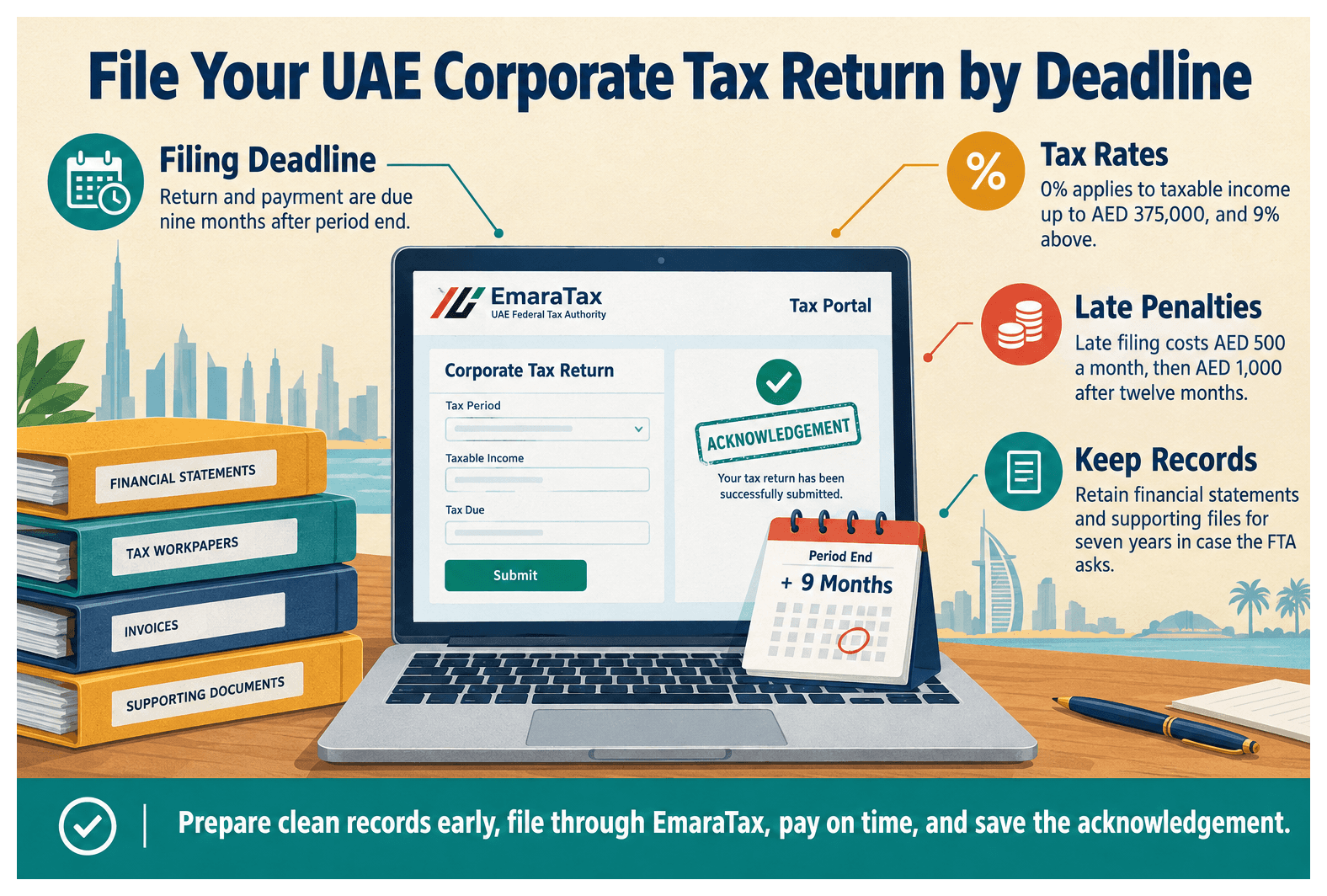
Every registered taxable person must file, including free zone companies with zero tax due. The deadline is nine months after period end, so a 31 December year end means 30 September. Read more on corporate tax filing deadlines for Dubai companies.
Who Is Required to File
All registered taxable persons, mainland and free zone.
Dormant and zero-revenue companies too.
A new consultancy with no income still submits a nil return.
Confirm your registration is active first.
How to Calculate Your Deadline
Use your registered tax period, not your license date. Then set an internal deadline six weeks earlier. That buffer absorbs audit delays.
Documents to Prepare Before You Start
Gather financial statements, trial balance, general ledger, bank statements, contracts and related-party records. Keep them for seven years, because the FTA can request them anytime. Your corporate tax return depends on clean source files.
Core Financial Records
Statements under IFRS or IFRS for SMEs.
Trial balance reconciled to the ledger.
Revenue and expense schedules.
Supporting Evidence for Free Zone Status
Audited financial statements (required for QFZP).
Lease, payroll and board records in one folder.
Transfer pricing files where relevant.
Step-by-Step Guide to File a UAE Corporate Tax Return: Step by Step
Log in to EmaraTax, open your corporate tax account, select the right period, enter figures, attach documents, declare accuracy, submit and pay. Save the acknowledgement. Need registration first? See corporate tax registration on EmaraTax.
Step 1: Log In and Select Your Tax Period
Sign in with UAE Pass or FTA credentials, open the Corporate Tax tile and choose the period matching your registration, such as the year ending 31 December.
Step 2: Complete the Return Sections
Enter revenue, expenses, exempt income and reliefs. Complete the free zone section and report qualifying and non-qualifying income separately. Check the auto-calculated tax at 9% above AED 375,000.
Step 3: Submit, Pay and Save Proof
Declare accuracy, submit, generate the payment reference and pay by the filing date. Download and archive the acknowledgement.
Free Zone Rules That Change Your Corporate Tax Return
A free zone corporate tax return gets 0% on qualifying income only if you meet QFZP conditions: substance, qualifying income, audited accounts and transfer pricing compliance. Breach the de minimis limit and you face 9% above AED 375,000 plus five periods of disqualification (Ministry of Finance, 2023). Compare UAE corporate tax rates and filing.
Qualifying Versus Non-Qualifying Income
Non-qualifying income must stay under 5% of revenue or AED 5 million, whichever is lower.
Tag each invoice by income type during the year, as one logistics firm does.
Substance and Audit Requirements
Carry out core income-generating activities in the UAE, with adequate staff, premises and spending. A Dubai South licensee should document its lease, payroll and expenses before filing, and submit audited statements.
Does a free zone company still need to file if it pays 0% tax?
Yes. Registration creates the filing duty, whatever the rate. A QFZP with only qualifying income still submits a return and audited accounts, and it can be penalised for filing late.
Common Filing Mistakes and Penalties to Avoid
Common errors are missing the deadline, skipping audited accounts, misreporting qualifying income and ignoring nil returns. Late filing costs AED 500 monthly for twelve months, then AED 1,000.
Late Filing and Late Payment Penalties
AED 500 a month for the first 12 months.
AED 1,000 a month after that.
A company four months late pays AED 2,000 before any tax penalty.
How to Correct an Error After Submission
Submit an amended return through EmaraTax as soon as you spot the mistake, with working papers as evidence. A firm that missed a deduction can fix it this way. See corporate tax return amendment in the UAE.
Staying Compliant After You File
After you file a UAE corporate tax return, keep the acknowledgement, retain records for seven years and watch EmaraTax for FTA notices. Start next year's return on day one.
Build a Year-Round Compliance Calendar
Close the books monthly.
Review income types quarterly.
Book the audit for July if your deadline is 30 September.
When to Get Professional Help
Get an adviser for mixed free zone income, first filings and related-party deals. A fee costs far less than months of penalties. Explore corporate tax filing services in Dubai.
Your Next Move
To file a UAE corporate tax return: step by step, confirm your period, prepare audited records, complete the EmaraTax return, pay within nine months and keep proof. Check your QFZP conditions every year. Review your registration and set your deadline today, then speak with the Dubai South Business Hub team about your license and compliance setup.
References
Federal Tax Authority, Corporate Tax guidance, 2026
Ministry of Finance, Federal Decree-Law No. 47 of 2022 on Corporate Tax, 2023
Frequently Asked Questions