
Topic Summary
What Is Approval From the CBUAE for a Fintech or Payments Business and Why It Matters
To get a CBUAE approval for a fintech or payments business, you need a free zone trade license plus separate Central Bank authorisation. The license lets you incorporate and operate from Dubai South. The approval permits regulated activities such as holding funds, issuing wallets, or processing payments. You need both before launching.
Which Fintech and Payments Activities Need CBUAE Approval
Which Fintech and Payments Activities Need CBUAE Approval
How the Dubai South Free Zone License and CBUAE Approval Work Together
The Dubai South fintech trade license establishes your legal entity, office, and visa eligibility. CBUAE approval then authorises the regulated activity. Most founders secure the license first, file the Central Bank application with entity documents, and start regulated operations only after approval. Our Dubai South business license process explains the first stage.
Step-by-Step Process to Get a CBUAE Approval for a Fintech or Payments Business
To get a CBUAE approval for a fintech or payments business: define your activity, set up the entity, prepare your compliance framework, submit, answer queries, secure in-principle approval, meet capital conditions, then receive the final license.
Typical Timelines, Costs, and Capital Requirements
Free zone setup takes days to a few weeks. CBUAE review commonly runs several months. A CBUAE payment service provider license also brings regulator fees, minimum capital, advisers, and compliance staff. Confirm current thresholds with the Central Bank before budgeting.
Common Mistakes That Delay CBUAE Approval
Delays usually come from launching early, vague activity descriptions, weak AML frameworks, and slow replies. Align license wording with your category and document safeguarding clearly. That's the fastest route to a fintech license UAE regulators will approve.
Key Benefits of Getting It Right From the Start
Founders who get a CBUAE approval for a fintech or payments business correctly gain legal certainty, bank access, and investor confidence. They also avoid rework and enforcement risk.
The UAE hosts over 800 active fintech firms (Magnitt, 2025). Any that hold customer funds or issue payment instruments need Central Bank sign-off first. This guide is for Dubai South founders who want to get a CBUAE approval for a fintech or payments business. You'll see which activities are covered, how it sits beside your trade license, and what the process looks like.
What Is Approval From the CBUAE for a Fintech or Payments Business and Why It Matters
To get a CBUAE approval for a fintech or payments business, you need a free zone trade license plus separate Central Bank authorisation. The license lets you incorporate and operate from Dubai South. The approval permits regulated activities such as holding funds, issuing wallets, or processing payments. You need both before launching.
Two Layers: Trade License and Regulatory Approval
The trade license covers incorporation and your commercial activity on paper. The CBUAE authorisation is a separate license issued by the regulator, and running regulated services on a trade license alone is a breach.
Picture a founder who incorporates a payments startup, then learns wallet issuance can't begin until the Central Bank grants a Stored Value Facilities license. It happens more than you'd think.
Why Central Bank Authorisation Protects Your Business
Banks and acquirers ask for proof of licensing.
Merchants and investors trust licensed firms.
You avoid penalties and forced closure.
Current rules sit on the Central Bank of the UAE site.
Which Fintech and Payments Activities Need CBUAE Approval
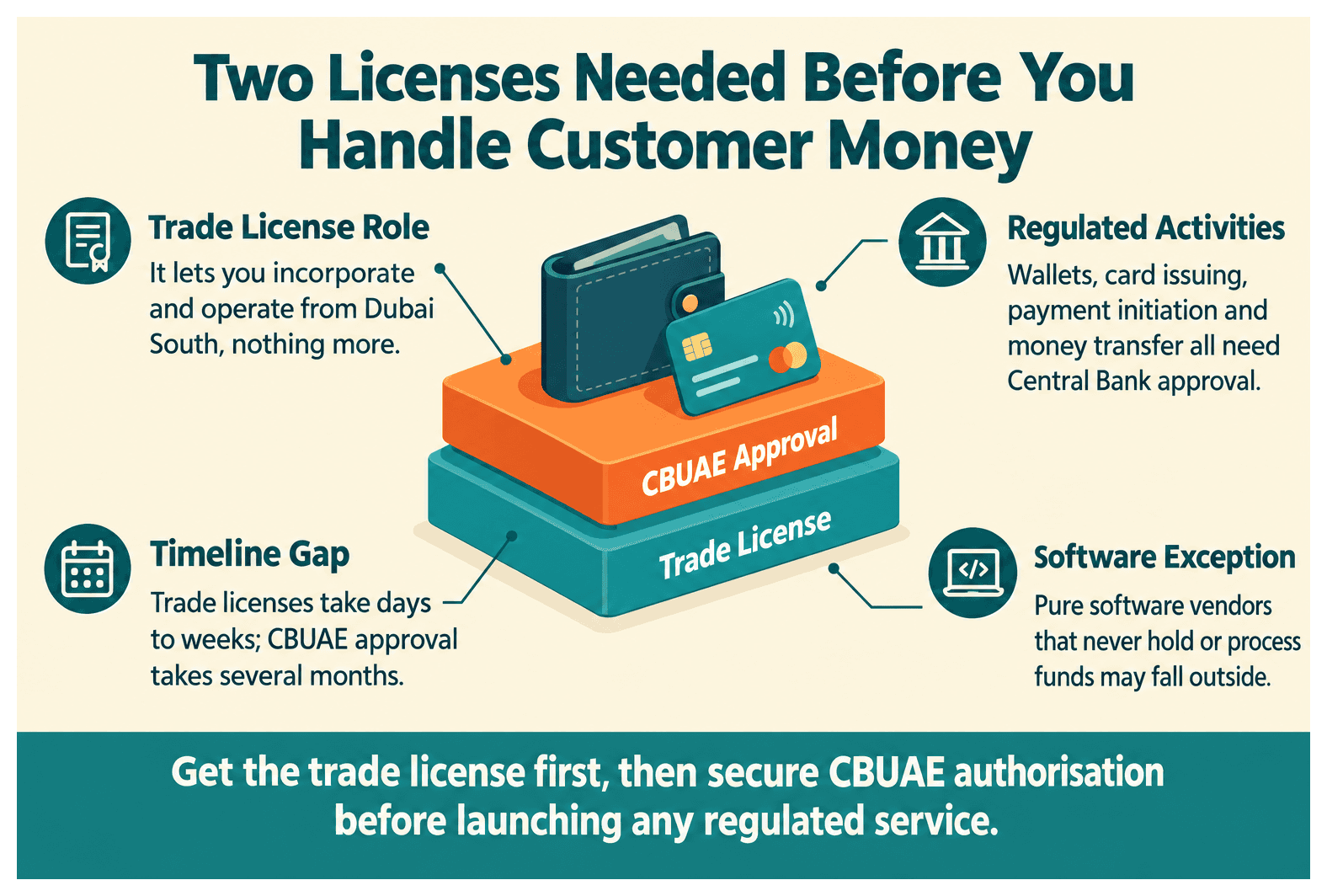
CBUAE approval applies to activities that touch customer money or payment infrastructure. These include stored value facilities, digital wallets, retail payment services, payment initiation, card issuing, and money transfer. Pure software vendors that never hold or process funds may fall outside the perimeter. Any fintech license UAE plan starts with this test.
Activities Inside the Regulatory Perimeter
Retail payment services and card schemes (2021 Retail Payment Services and Card Schemes Regulation).
Stored value facilities and digital wallets.
Payment initiation and remittance-type services.
Judged on what you do, not what you call it.
A wallet app that lets users top up and pay merchants holds stored value. It needs authorisation. See our digital wallet electronic payments business license guide.
Free Zone License vs CBUAE Approval for Fintech and Payments
Feature | Dubai South Trade License | CBUAE Approval |
|---|---|---|
Issuing body | Dubai South free zone authority | Central Bank of the UAE |
What it authorises | Company formation, office, visa eligibility | The regulated payment or wallet activity itself |
Needed before holding customer funds | Necessary, but not enough | Mandatory |
Typical timeline | Days to a few weeks | Several months, by category and file quality |
Ongoing obligations | Annual renewal, from AED 12,500 per year | Capital, AML/CFT, safeguarding, regulatory reporting |
Activities That May Fall Outside It
A dashboard-software vendor that never settles funds may only need a technology trade license. Pure consultancy and software licensing fit here too. Still, confirm your status in writing with the CBUAE before launch.
Where Digital Wallets and Gateways Fit
A gateway that settles merchant funds through its own account sits differently from one routing to a licensed acquirer. The first likely needs authorisation. Read our payment services provider business license in Dubai guide.
How the Dubai South Free Zone License and CBUAE Approval Work Together
The Dubai South fintech trade license establishes your legal entity, office, and visa eligibility. CBUAE approval then authorises the regulated activity. Most founders secure the license first, file the Central Bank application with entity documents, and start regulated operations only after approval. Our Dubai South business license process explains the first stage.
What the Free Zone License Covers
You get company formation, a trade license from AED 12,500 per year, and residency visa packages tied to it. Choose activity wording that matches your later CBUAE filing.
What It Does Not Cover
No permission to hold customer funds.
No substitute for CBUAE authorisation.
Lock activity, trade name, and visas before filing.
About 65% of stalled setups cite unresolved activity, name, and visa decisions. A pilot with real customer balances before approval can trigger enforcement.
Step-by-Step Process to Get a CBUAE Approval for a Fintech or Payments Business
To get a CBUAE approval for a fintech or payments business: define your activity, set up the entity, prepare your compliance framework, submit, answer queries, secure in-principle approval, meet capital conditions, then receive the final license.
Step 1: Define Your Regulated Activity and Entity
Map your product to a CBUAE license category.
Incorporate with matching activity wording.
Line up directors and a compliance officer.
Step 2: Prepare the Application Pack
Business plan and financial projections.
AML/CFT policies, risk framework, IT security documents.
Shareholder and director due diligence files.
Customer fund safeguarding arrangements.
Weak AML manuals trigger repeat queries.
Step 3: Submit, Respond, and Secure Final License
Submit through CBUAE channels and pay the fees listed on centralbank.ae. Answer queries within days, not weeks. After in-principle approval, inject capital, receive the final license, then update your free zone license and bank setup. Our guide to start a fintech and digital payments business in Dubai covers the wider picture.
Typical Timelines, Costs, and Capital Requirements
Free zone setup takes days to a few weeks. CBUAE review commonly runs several months. A CBUAE payment service provider license also brings regulator fees, minimum capital, advisers, and compliance staff. Confirm current thresholds with the Central Bank before budgeting.
How Long Each Stage Takes
Incomplete files restart the clock. A clean first submission moves faster than one needing three rounds of clarification. Timelines vary by category, so verify with the CBUAE.
Budgeting for Capital and Compliance
Minimum capital varies by license category.
Compliance officer, MLRO, and audit costs.
Technology and security assessments.
A buffer for post-approval audits.
Common Mistakes That Delay CBUAE Approval
Delays usually come from launching early, vague activity descriptions, weak AML frameworks, and slow replies. Align license wording with your category and document safeguarding clearly. That's the fastest route to a fintech license UAE regulators will approve.
Application Quality Errors
Generic plans without UAE detail.
Missing fit-and-proper evidence.
Inconsistent wording across documents.
A business plan describing lending under a payments license draws queries.
Sequencing and Banking Errors
About 40% of new Dubai online store applications stall at banking or payment integration (Statista-style sector tracking, 2026). A payments startup that opens bank talks late can wait months for a safeguarding account. Review restricted business activities in Dubai and their approvals early.
Key Benefits of Getting It Right From the Start
Founders who get a CBUAE approval for a fintech or payments business correctly gain legal certainty, bank access, and investor confidence. They also avoid rework and enforcement risk.
Commercial Credibility and Market Access
Acquirers and merchants want licensed counterparties.
Funding rounds go better.
Enterprise merchants onboard faster.
Long-Term Operational Stability
Reporting expectations are clear. A licensed provider can add products by variation rather than starting afresh.
Your Next Step
To get a CBUAE approval for a fintech or payments business, pair a Dubai South trade license with Central Bank authorisation, prepare a complete file, and plan for months of review. Start your Dubai South company formation, align your activity wording with your CBUAE category, and ask the Dubai South Business Hub team about residency visa packages tied to your license.
References
Frequently Asked Questions