Topic Summary
What Is a Cryptocurrency or Virtual Asset License in the UAE and Why It Matters
To get a cryptocurrency or virtual asset license in the UAE, a company needs regulatory authorisation for activities like exchange, custody, brokerage, transfer or advisory involving digital assets. It sits on top of a standard trade license. You need it before serving any customer.
Which Regulator Covers Your Crypto Activity
Which Regulator Covers Your Crypto Activity
License Categories and Activities You Can Choose From
Virtual asset licenses are activity-based. Categories include exchange, broker-dealer, custody, transfer and settlement, advisory, and management. Each carries different capital and compliance expectations, so pick the narrowest category that supports launch. That keeps your virtual asset service provider UAE application focused.
Step-by-Step Process to Get a Cryptocurrency or Virtual Asset License in the UAE
To get a cryptocurrency or virtual asset license in the UAE, define your activities, set up a free zone company, build your compliance framework, submit the application, answer queries, and launch only after approval. Each stage builds on the last.
Setting Up Your Dubai South Company Before Regulatory Approval
A Dubai South Business Hub free zone company gives you the entity, trade license and residency visa route you need before submission. It doesn't replace authorisation, but it's the operating base regulators expect. Crypto business setup Dubai South starts here.
Documents, Capital and Compliance Requirements to Prepare
Applicants typically prepare a business plan, owner and director identification, financial projections, AML policies, cybersecurity documentation and proof of capital. VARA license requirements vary by activity, so check the current rulebook before filing.
Common Mistakes That Delay a Virtual Asset License
Delays mostly come from unclear scope, weak compliance files, launching early and inconsistent answers. If you want to get a cryptocurrency or virtual asset license in the UAE on schedule, prepare a precise activity map and a consistent file.
Dubai Law No. 4 of 2022 created a dedicated virtual asset regulator, and it changed how founders approach crypto in the emirate. If you want to get a cryptocurrency or virtual asset license in the UAE, a trade license alone won't do it. This guide is for Dubai South entrepreneurs. You'll see which regulators apply, how the free zone fits in, and what stalls applications.
What Is a Cryptocurrency or Virtual Asset License in the UAE and Why It Matters
To get a cryptocurrency or virtual asset license in the UAE, a company needs regulatory authorisation for activities like exchange, custody, brokerage, transfer or advisory involving digital assets. It sits on top of a standard trade license. You need it before serving any customer.
Defining a Virtual Asset and a VASP
A virtual asset is a digital representation of value that can be traded, transferred or used for payment or investment. A virtual asset service provider (VASP) performs regulated activities with those assets for others. A startup matching token buyers and sellers is a VASP. A firm that only buys hardware wallets as stock is not.
Why Licensing Matters for Founders
Unlicensed activity risks fines and enforcement.
Banks run enhanced due diligence on crypto clients.
Payment partners ask for proof of authorisation.
Investors trust licensed firms more.
I've seen a founder launch a token-swap product early, then watch banking access freeze during due diligence. Costly.
Trade License Versus Regulatory Approval
The free zone trade license lets your company exist and trade commercially. Regulatory authorisation covers the specific virtual asset activity. You need both, and sequencing matters. A company licensed for consultancy can add regulated custody later. For wider context, read our guide to starting a blockchain and web3 business in Dubai, and see adoption data on Statista.
Which Regulator Covers Your Crypto Activity
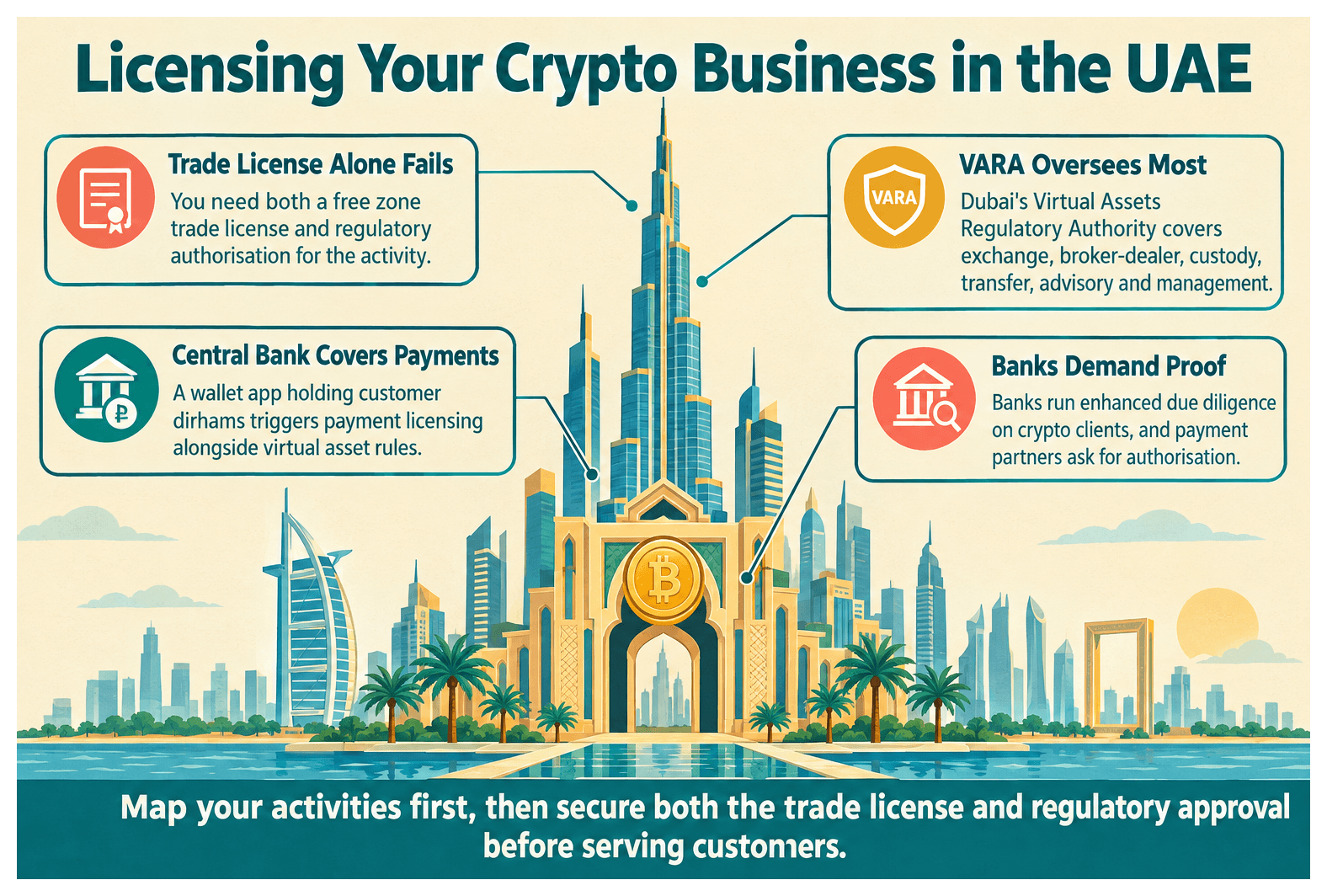
The right regulator depends on what your business does. Dubai's Virtual Assets Regulatory Authority (VARA) oversees most crypto service activity in the emirate. The Central Bank of the UAE covers payment services and stored value. Confirm your activity map first. That's the foundation of any virtual asset license UAE application.
Dubai's Virtual Asset Regulator and Its Remit
It covers exchange, broker-dealer, custody, transfer, advisory and management.
Each activity has its own rulebook requirements.
It expects real presence and qualified staff.
When the Central Bank of the UAE Applies
A wallet app holding customer dirhams triggers payment licensing alongside virtual asset rules. Fiat on-ramps often need a licensed payment partner. If that's your model, see the digital wallet electronic payments business license route.
Common Virtual Asset Activities and What They Involve
Feature | Lighter Entry Activities | Heavier Operational Activities |
|---|---|---|
Typical activity examples | Advisory, portfolio management | Exchange, broker-dealer, custody |
Compliance burden | Client suitability and AML basics | Market surveillance, transaction monitoring, travel-rule controls |
Technology requirements | Standard secure IT and client records | Matching engines, key management, wallet segregation |
Capital expectations | Lower, per current rulebook | Higher, per current rulebook |
Suggested launch stage | First 6 to 12 months | After proven compliant operations |
Mapping Your Business Model to the Right Rulebook
List every service planned for the first 24 months.
Flag overlaps across regulators.
Get written advice where unclear.
One founder split a product into phases so launch needed only one authorisation.
Can one license cover every crypto activity?
No. Licenses are activity-based, so each service needs its own authorisation and requirements. Most founders start with one narrow activity, prove compliant operations, and add others later.
License Categories and Activities You Can Choose From
Virtual asset licenses are activity-based. Categories include exchange, broker-dealer, custody, transfer and settlement, advisory, and management. Each carries different capital and compliance expectations, so pick the narrowest category that supports launch. That keeps your virtual asset service provider UAE application focused.
Exchange and Broker-Dealer Activities
Exchange means operating a trading venue. Broker-dealer means executing trades for clients. Both carry heavier surveillance and capital requirements. A retail platform might choose a virtual assets broker dealer license first, then add a virtual assets exchange business license.
Advisory, Custody and Transfer Services
Advisory is the lighter entry point.
Custody needs strong key management.
Transfers need travel-rule and AML systems.
A consultancy can build a track record with a virtual assets advisory services business license before applying for custody.
Choosing a Phased Licensing Strategy
Start with one activity. Align scope with your funding runway. One founder staged launch from advisory to brokerage over 18 months. And never describe unlicensed activities in marketing.
Step-by-Step Process to Get a Cryptocurrency or Virtual Asset License in the UAE
To get a cryptocurrency or virtual asset license in the UAE, define your activities, set up a free zone company, build your compliance framework, submit the application, answer queries, and launch only after approval. Each stage builds on the last.
Step 1: Define Your Activities and Structure
Confirm services, customers and token types.
Decide the shareholder and director structure.
Draft a one-page activity map.
Step 2: Set Up Your Free Zone Company
Register and obtain a Dubai South trade license.
Arrange office space and visas.
Open a corporate bank account early.
Step 3: Build Your Compliance Framework
Draft AML/CFT and KYC policies.
Appoint a compliance officer and MLRO.
Commission an independent cyber review.
Step 4: Submit, Respond and Launch
File the business plan, financials and fit-and-proper documents.
Keep a query log so answers match your plan.
Launch only after written authorisation.
Setting Up Your Dubai South Company Before Regulatory Approval
A Dubai South Business Hub free zone company gives you the entity, trade license and residency visa route you need before submission. It doesn't replace authorisation, but it's the operating base regulators expect. Crypto business setup Dubai South starts here.
Choosing the Right Trade License Activity
Pick an activity consistent with your planned service. Avoid wording that implies regulated services before approval. A technology-services or investments consultancy business license can be a sensible start while your file is prepared.
Residency Visas for Founders and Key Staff
Visa packages are tied to your license. Compliance officers and senior managers usually need UAE residency, so plan quotas around hiring.
Banking and Substance Considerations
Banks want physical presence and clear source-of-funds evidence. Prepare ownership charts and transaction flows, and expect longer reviews for crypto clients. Market context is available from Dubai Chamber.
Documents, Capital and Compliance Requirements to Prepare
Applicants typically prepare a business plan, owner and director identification, financial projections, AML policies, cybersecurity documentation and proof of capital. VARA license requirements vary by activity, so check the current rulebook before filing.
Core Application Documents
Business plan with product and revenue model.
Organisation chart and fit-and-proper details.
Projections and capital evidence.
AML, KYC and Risk Policies
Cover due diligence, sanctions screening, transaction monitoring and suspicious activity reporting. Be travel-rule ready. A transfer service might integrate blockchain analytics into its monitoring policy.
Technology, Custody and Cybersecurity Controls
Key management and wallet segregation.
Penetration testing and audit evidence.
Disaster recovery plans.
A custody applicant might show a multi-signature architecture with a third-party audit. Funding trends are tracked by Magnitt.
Common Mistakes That Delay a Virtual Asset License
Delays mostly come from unclear scope, weak compliance files, launching early and inconsistent answers. If you want to get a cryptocurrency or virtual asset license in the UAE on schedule, prepare a precise activity map and a consistent file.
Vague Business Plans and Scope Creep
Vague plans invite repeated queries. One applicant added a staking product mid-review and had to resubmit sections. Be specific about tokens, customers and flows.
Marketing or Trading Before Approval
Promotion without authorisation risks enforcement.
Waitlists can still count as activity.
Keep pre-approval messaging factual.
Underestimating Staffing and Timelines
Compliance hires can take months. One founder hired the compliance officer early and avoided a three-month delay. Budget buffer time and ongoing audit costs.
Your Next Step
To get a cryptocurrency or virtual asset license in the UAE, you need the right company base, a defined scope, a credible compliance framework and patience through review. Start by setting up your Dubai South Business Hub company and trade license with a residency visa package, then build your application on it. Speak with the team to map your first steps.
References
Frequently Asked Questions