
Topic Summary
Take Advantage of Zero Personal Income Tax
The UAE charges 0% personal income tax, meaning entrepreneurs keep far more of what they earn compared to most Western countries. This alone makes Dubai one of the most financially attractive places in the world to run a business.
Choose Between Free Zone and Mainland Setup
Free zones like Dubai South Business Hub offer 100% foreign ownership, faster setup, and lower starting costs from AED 12,500, while mainland licenses allow unrestricted UAE trading. Your choice depends on whether your customers are primarily local or international.
Confirm Your Business Activity Before Anything Else
Dubai requires you to declare your specific economic activity before receiving a license, and this decision shapes your license type, costs, and legal scope. Getting this right from the start prevents costly amendments down the line.
Own 100% of Your Company Legally
Federal Decree-Law No. 26 of 2020 removed the requirement for a local sponsor across most business activities, giving foreign founders full ownership. This is a fundamental shift that makes Dubai far more accessible to international entrepreneurs than it was just a few years ago.
Plan for a Six-to-Eight Week Launch Timeline
From making the decision to actively trading, most entrepreneurs complete the full setup process in six to eight weeks. Free zone registrations can move even faster, with some approvals issued within one to two business days.
Tap Into Dubai's Expat-Majority Market
Over 88% of Dubai's population is expatriate, creating a large, internationally minded customer base that is receptive to global products and services. This demographic reality gives new businesses an immediate audience without needing to build brand awareness from scratch.
Align Your Business With Dubai's D33 Growth Plan
Dubai's D33 agenda targets doubling the economy by 2033, backed by AED 32 trillion in planned investment, with a strong focus on tech, consulting, e-commerce, and media. Entrepreneurs entering these sectors are building directly into the city's stated economic priorities.
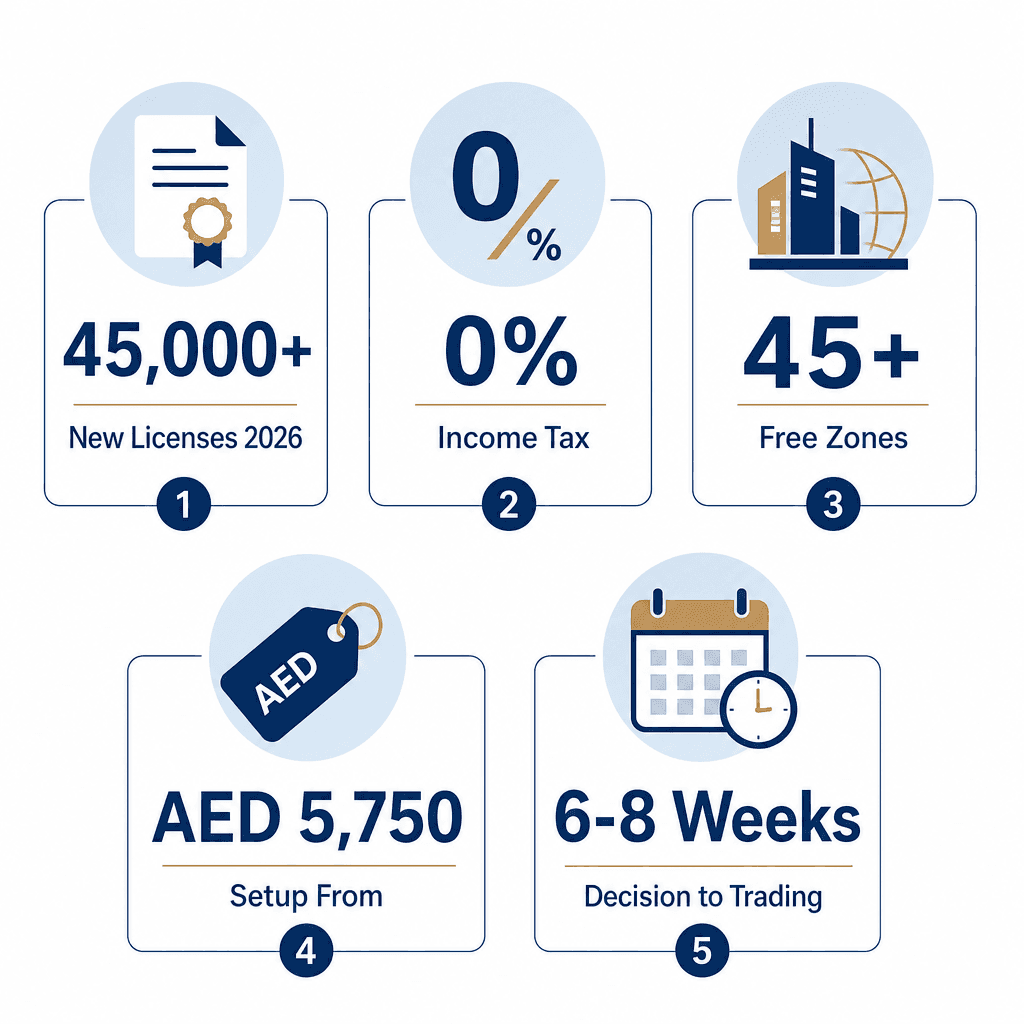
In 2026, Dubai is on track to issue over 45,000 new business licenses, and a growing share belong to first-time entrepreneurs from the United States, the UK, and Australia. The UAE has 0% personal income tax [1]. Over 45 free zones operate across the country [2]. Foreign ownership is now 100% legal for most activities following Federal Decree-Law No. 26 of 2020 [3]. Setup at Dubai South Business Hub (Dubai South Business Hub) starts from AED 12,500 [4]. And the full process, from decision to trading, takes six to eight weeks [5]. If you've been thinking about how to start your own business in Dubai, this is the year to stop thinking and act.
This guide walks you through every real decision you'll face, from choosing your business activity to receiving your license, opening a bank account, and sending your first invoice. It's practical, honest, and written for people who are finally ready to take the first step. Want to calculate your business setup cost now? Read on.
Why Now Is the Right Time to Start Your Own Business in Dubai
Dubai's D33 agenda targets doubling the economy by 2033, 100% foreign ownership is now law, and over 45 free zones make setup faster than ever. For entrepreneurs ready to own a business in Dubai, the regulatory environment, tax structure, and market access have never been more favorable. The window is open, and it's wider than it's ever been.
Four Reasons Dubai Is the Right Move Right Now
D33 Economic Agenda: Dubai's government has committed AED 32 trillion in economic investment by 2033 (Dubai Media Office, 2023). That's active infrastructure your business grows into, not a promise, a plan already in motion.
100% foreign ownership: Federal Decree-Law No. 26 of 2020 amended the UAE Commercial Companies Law. Most activities no longer require a local sponsor. You own 100% of your company, full stop.
Digital economy momentum: Dubai's digital economy contributes approximately 9.2% of GDP and is a stated government priority for expansion (UAE Ministry of Economy, 2023). Tech, consulting, e-commerce, and media businesses are exactly what the city is building for.
Expat-majority market: Over 88% of Dubai's population is expatriate (Dubai Statistics Center, 2023), creating a dense, internationally minded market for both B2B and B2C services from day one.
A US-based marketing consultant who relocated to Dubai in 2023 set up a free zone company in under two weeks, retained 100% ownership, and now serves clients across the GCC and Europe from a single license. That's not an outlier. That's the system working as designed. If you're asking can foreigners start a business in Dubai?, the answer is yes, and it's never been simpler.
Free Zone vs. Mainland: Which Is Right for Your Own Business in Dubai?
Feature | Free Zone (Dubai South Business Hub) | Mainland (DET) |
|---|---|---|
Foreign Ownership | ‚úÖ 100%, no local sponsor required | ‚úÖ 100% for most activities (post-2020 law) |
Setup Speed | ‚úÖ Same-day to 1-2 business days | ‚ùå Typically 2-4 weeks |
Starting License Cost | ‚úÖ From AED 12,500 at Dubai South Business Hub | ‚ùå Typically AED 12,000-25,000+ |
UAE Mainland Trading | ⚠️ Requires distributor or local agent for some goods | ✅ Unrestricted trading across the UAE |
Physical Office Required | ‚úÖ No, flexi-desk options available | ‚ùå Yes, physical premises required |
Visa Allocation | ‚úÖ Included in most packages | ‚úÖ Available, tied to office space size |
Best For | Consultants, digital businesses, solo founders, international traders | Retail businesses, UAE-focused services, companies needing walk-in premises |
The First Three Decisions You Need to Make
Before registering your business in Dubai, you must decide: what economic activity your company will conduct, whether a free zone or mainland license fits your model, and how much capital you can commit upfront. These three choices determine your license type, costs, and operational scope from day one. Get them right and everything else flows naturally.
Decision One: What Will Your Business Do?
Dubai uses a structured activity classification system aligned with international standards, specifically the ISIC (International Standard Industrial Classification) framework used globally for economic reporting. You must select the specific activity or activities your company will conduct before your license is issued.
Activities fall into clear categories: trading, services, consulting, manufacturing, and industrial. Each carries its own license type. And the detail matters more than most founders expect. "Marketing consultancy" and "digital marketing services" are different classifications, they affect what you can legally invoice for and how banks categorize your account.
Here's a practical example: a Dubai-based e-commerce entrepreneur selling beauty products online needs a trading license specifying retail of cosmetics, not a general trading license. Getting this wrong creates compliance problems at customs and with banking. Dubai South Business Hub offers over 1,500 approved business activities and assigns a support manager to help you choose correctly from the start.
Decision Two: Free Zone or Mainland?
For most consultants, coaches, digital businesses, and service providers, a free zone license is the faster, more affordable starting point. Free zone companies offer 100% foreign ownership, setup in as little as one to two days at Dubai South Business Hub, and no mandatory physical office. The trade-off: trading directly with UAE mainland consumers requires a distributor or local agent for certain goods categories. For more detail, see our guide on starting your own business in Dubai.
Mainland companies are licensed through the Dubai Department of Economic Development (DET). They can trade freely across the UAE without restriction, but setup is more complex, slower, and typically costs AED 6,500 or more annually above a comparable free zone option. A US-based software developer setting up remotely chose Dubai South Business Hub specifically because 95% of his clients were outside the UAE. The free zone structure was cleaner legally and significantly cheaper.
Dubai South Business Hub sits adjacent to Al Maktoum International Airport, a genuine operational advantage for logistics, trading, and aviation-adjacent businesses. You can learn more about the step by step business setup in Dubai process to compare both routes in detail.
Decision Three: How Much Are You Willing to Invest Upfront?
The realistic minimum to start your own business in Dubai is AED 15,000-25,000. That covers your license, investor visa, Emirates ID, and medical fitness test. No minimum share capital is required at most free zones including Dubai South Business Hub, you don't need to deposit funds into a blocked account before trading.
Factor in year-two renewal costs from the start. License, visa, and Emirates ID all renew annually, typically at 60-80% of your first-year setup cost. Bank account setup is free, but most UAE banks require a minimum balance of AED 10,000-50,000 depending on the institution and your business activity.
An entrepreneur from Texas budgeted AED 20,000 for her first year at Dubai South Business Hub, covering her license, one visa, and Emirates ID, and was operational within three weeks. Her first invoice went out before the end of month one. Use the calculate your business setup cost tool to build your own projection before committing.
Your Own Business Setup Timeline: Week by Week
Starting your own business in Dubai takes approximately six to eight weeks from decision to active trading. Week one covers structure and activity selection. Weeks one to two: license application. Week two: license issued. Weeks two to three: visa application. Weeks three to five: visa and Emirates ID. Month two: bank account and first invoices. Here's what each stage actually looks like.
A four-stage process timeline showing the key milestones from deciding to set up a business in Dubai to active trading, typically completed in six to eight weeks. Dubai Business Setup: Week-by-Week Timeline 1 Week 1-2 License Issued Choose activity + apply at Dubai South Business Hub 2 Week 2-3 Visa Application Investor visa tied to license 3 Week 3-5 Emirates ID Medical + biometrics + ID card issued 4 Month 2+ Bank + Trading Account open + first invoice
Typical Dubai business setup timeline for free zone companies, 2026. Actual timelines vary by free zone and individual circumstances.
Step 1: Weeks One and Two, License and Application
Week one is all about foundations: finalizing your business activity, confirming free zone versus mainland, and locking in your budget. Don't skip this step, every delay later usually traces back to an unclear decision made here.
In weeks one to two, submit your company formation application at Dubai South Business Hub. You'll need a passport copy, your chosen business name, and your selected activity. That's it for the initial submission. Dubai South Business Hub offers a same-day license option for eligible activities, some founders receive their trade license within 24 hours of submitting a complete application.
You don't need to be physically present in Dubai to apply. A UK-based consultant submitted her Dubai South Business Hub application remotely on a Monday and received her trade license by Wednesday. She was legally a Dubai business owner before the end of her first week.
Step 2: Weeks Two Through Five, Visa and Emirates ID
Once your license is issued, apply for your UAE investor visa. This is the residency visa tied directly to your company license, it's what allows you to live legally in Dubai as a business owner.
Weeks three to five cover the medical fitness test, biometrics, and Emirates ID application. Your Emirates ID is required before any UAE bank will open a corporate account for you, so don't treat this as optional. Visa stamping typically takes 5-10 working days through the ICP (Federal Authority for Identity, Citizenship, Customs and Port Security) portal.
Dubai South Business Hub packages typically include one or more visa allocations. Once your own visa is activated, you can apply for employee visas if your team is growing. The launch your own company at Dubai South Business Hub Free Zone page outlines exactly what's included in each package.
Step 3: Month Two Onward, Bank Account and Active Trading
Month two is banking. Bring your trade license, Emirates ID, passport, and proof of address to your chosen bank. Most major UAE banks, Emirates NBD, Mashreq, RAKBANK, and Abu Dhabi Commercial Bank, accept free zone company applications.
Banking is the step that requires the most patience. Account activation typically takes two to six weeks depending on the bank and your business activity. Approach two or three banks simultaneously to avoid a single point of failure. One Dubai South Business Hub founder from California had clients ready to pay but no active account for six weeks. Her solution: she used a payment processor as a bridge until her corporate account was live.
Once your account is active, you can invoice in AED, USD, EUR, or GBP, receive international transfers, and begin trading. At that point, your own business in Dubai is real, legal, and operational.
What Your Own Business in Dubai Actually Gives You
Owning a business in Dubai gives you 100% of your profits, UAE residency via an investor visa, 0% personal income tax, access to global markets from a strategically located hub, and professional credibility that opens doors across the Middle East, Africa, and Asia. Here's what that looks like in practice.
Financial and Residency Benefits That Change Your Life
100% profit ownership: No mandatory profit-sharing with a local sponsor under free zone law or the amended mainland Companies Law.
0% personal income tax: Every dirham you earn stays yours. The UAE Federal Tax Authority confirmed this remains unchanged in 2026.
UAE investor visa: Live legally in Dubai, sponsor family members, and access world-class healthcare and infrastructure.
Corporate tax threshold: UAE corporate tax of 9% applies only to annual profits above AED 375,000 (UAE Federal Tax Authority, 2023). Below that threshold, the rate is 0%.
Free capital movement: Repatriate profits and capital without restriction, no exchange controls, no withholding tax on dividends.
Market Access and Professional Credibility
Dubai sits at the geographic intersection of Europe, Asia, and Africa. Al Maktoum International Airport, adjacent to Dubai South Business Hub, is designed to become the world's largest airport by passenger capacity when fully operational (Dubai Airports, 2024). Same-day flights reach markets covering over 2.5 billion people.
A UAE trade license gives you immediate credibility with enterprise clients across the GCC, India, and Africa who actively prefer dealing with locally registered entities. You can invoice in USD, EUR, GBP, and AED from the same corporate account. And Dubai's business community is genuinely dense, accelerators, sector-specific hubs, and weekly networking events give first-time founders real traction faster than almost any other market.
Key Stats: Why Dubai for Your Own Business in 2026
A visual stat card infographic summarising the top data points that make Dubai the right choice for first-time business owners in 2026.
AED 32 trillion: Dubai D33 economic investment target by 2033 (Dubai Media Office, 2023)
88%+: Expatriate share of Dubai's population (Dubai Statistics Center, 2023)
0%: Personal income tax rate in the UAE
AED 375,000: Corporate tax-free profit threshold (UAE Federal Tax Authority, 2023)
45+: Free zones operating across the UAE
AED 12,500: Starting license cost at Dubai South Business Hub Free Zone
The Honest Part: Challenges to Expect When Starting Your Own Business in Dubai
Starting your own business in Dubai comes with real challenges: banking takes longer than the license, your first clients typically come from your existing network, and year-two renewal costs catch many founders off-guard. Knowing these upfront lets you plan cash flow, set realistic timelines, and avoid the surprises that derail new businesses. For more detail, see our guide on mistakes to avoid when starting a business in Dubai.
Three Real Challenges and How to Handle Them
Banking takes time. Corporate bank account opening in Dubai requires documentation review, compliance checks, and often a relationship-building conversation with a branch manager. Budget four to eight weeks and approach two or three banks simultaneously. Don't wait for one bank to reject you before trying the next.
First clients come from your network. Dubai doesn't hand you clients. Your first three to five will almost certainly be people who already know your work. Plan your sales pipeline before you arrive, ideally with one or two confirmed projects lined up. The city rewards people who show up with momentum.
Year-two renewal costs are real. Your trade license, visa, and Emirates ID all renew in year two. Budget approximately 60-80% of your year-one setup cost as an annual operating expense. This surprises founders who only planned for the initial outlay.
Practical rule: keep three months of operating costs in reserve before you go live. That buffer is the difference between a business that survives its first year and one that doesn't. Use the calculate your business setup cost tool to model your full two-year cost picture before committing.
How Dubai South Business Hub Supports First-Time Business Owners
Dubai South Business Hub Free Zone offers first-time founders a guided setup process, a dedicated relationship manager, same-day license options, and transparent pricing starting from AED 12,500. If you're figuring out how to start your own business in Dubai without prior UAE experience, Dubai South Business Hub is built specifically for that situation.
Why Dubai South Business Hub Works for Solo Founders and Small Teams
Dedicated support manager: Dubai South Business Hub assigns a relationship manager to your application. They handle activity classification, document review, and government liaison, you don't have to figure out the bureaucracy alone.
Same-day license option: For eligible activities, your trade license can be issued within 24 hours of a complete application. That's the fastest legal path to owning a business in Dubai.
No mandatory office rental: Flexi-desk options are available, and visa allocations are built into packages, keeping your first-year costs predictable.
Strategic location: Adjacent to Al Maktoum International Airport, Dubai South Business Hub gives logistics, trading, and aviation-adjacent businesses a genuine operational edge over free zones in central Dubai.
Over 1,500 approved business activities: Covering consulting, technology, media, trading, and professional services, more than enough for most solo founders and small teams.
A first-time founder from Chicago described the Dubai South Business Hub process as "the closest thing to a business setup concierge I've encountered." Her license was issued the same day she submitted her complete application. Her visa was stamped within two weeks. She was invoicing clients before the end of her first month. That's what a well-supported setup looks like. Ready to start your own business in Dubai the right way?
Useful Resources
remote-first consultancy license
Citations
UAE Ministry of Economy and Tourism.. moet.gov.ae. MOET UAE, 2024.
Federal Authority for Identity, Citizenship, Customs and Port Security.. icp.gov.ae. ICP UAE, 2024.
Federal Tax Authority.. tax.gov.ae. FTA UAE, 2023.
Dubai Economy and Tourism.. dubaidet.gov.ae. DET Dubai, 2024.
Dubai Airports.. dubaiairports.ae. Dubai Airports, 2024.
Frequently Asked Questions