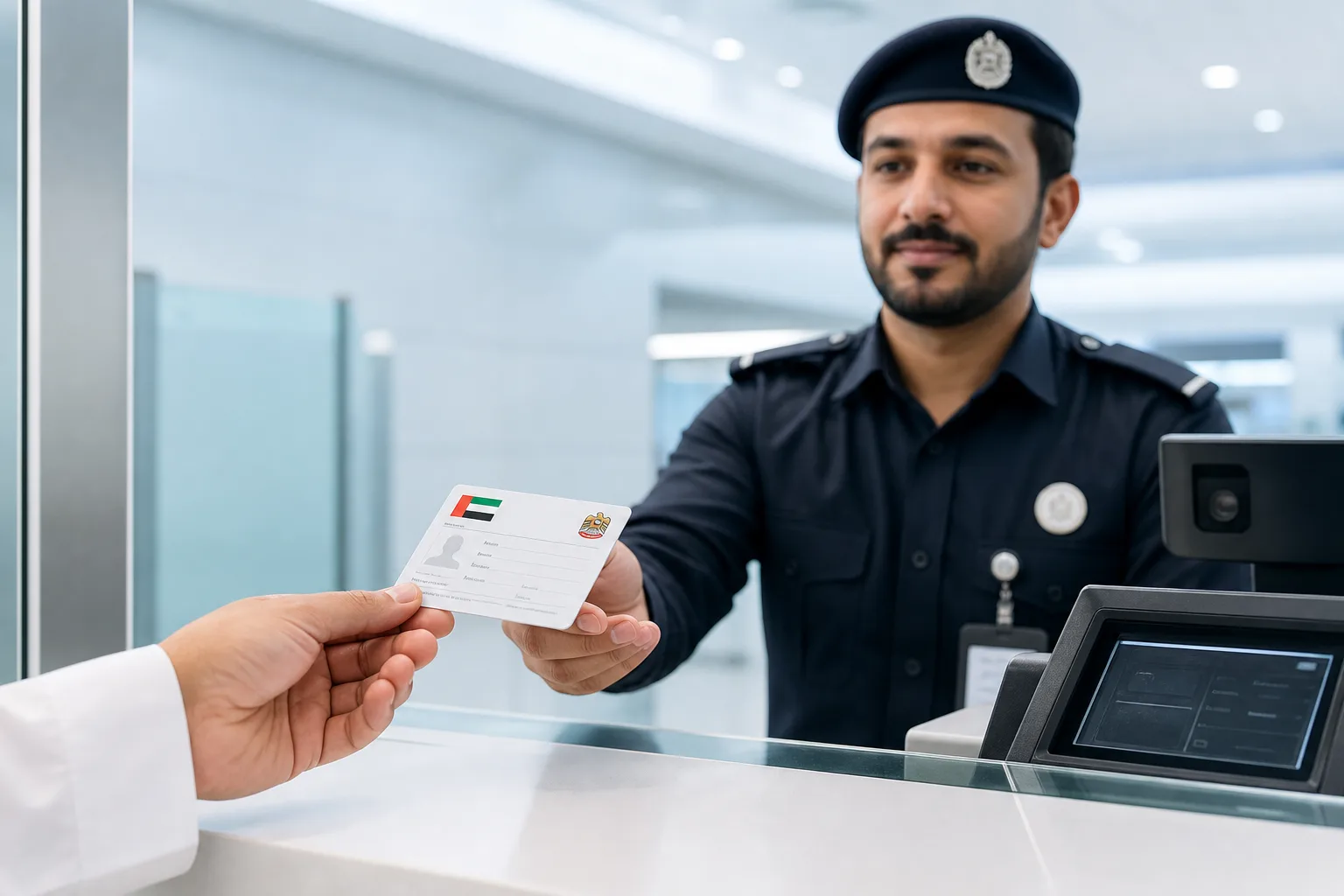
Topic Summary
What the UAE Immigration Card Actually Is
The UAE immigration card is a digital federal record held by the ICP, not a physical card you carry. It logs every entry and exit, your visa type, permit number, and current residency status for every person who enters the country.
How It Differs from Your Emirates ID
Your Emirates ID is a physical card you carry, while the immigration card is a backend data record linked to it. You must have a valid immigration record before the ICP will issue or renew your Emirates ID.
Who Must Have an Immigration Card Record
Every foreign national who enters the UAE — tourists, employees, investors, and dependents — gets an immigration card record created automatically. UAE nationals have a separate citizen record, but all 9 million-plus foreign residents are covered by the system.
What the System Logs at Every Border Crossing
Each time you cross a UAE border, the system reads and updates your visa type, entry and exit dates, permit status, any outstanding fines, and your Emirates ID link. Smart border gates at all UAE airports connect directly to this federal database.
Overstays and Fines Are Flagged Automatically
If you stay past your permitted date, the ICP system flags the overstay without any manual input, and daily fines begin from the first hour. Checking for travel bans is free through the ICP Smart app on iOS or Android.
Emirates ID Costs and Visa Renewal Timelines
Emirates ID fees range from AED 100 to AED 370 per person depending on visa duration. Free zone residence visas run for two or three years before requiring renewal, making timely record updates essential.
How to Check or Correct Your Immigration Record
You can check your immigration card details for free using the ICP Smart app or the icp.gov.ae portal. To fix an error, visit an ICP service centre in person with your passport and Emirates ID.
In 2026, the UAE hosts over 9 million foreign residents (u.ae, 2026). Every one of them interacts with the immigration card system each time they cross a UAE border. Most people see the smart gate open and move on. They do not know what the system just read, what it logged, or what could have stopped them. The immigration card UAE is a federal data record. It sits behind every visa, every entry stamp, and every residency renewal you make in the country. Emirates ID costs range from AED 100 to AED 370 per person (ICP, 2026). Overstay fines run daily from the first hour past your permitted stay. Visa-on-arrival covers passport holders from over 50 countries. Free zone residence visas run for 2 or 3 years before renewal. Travel ban checks are free on the ICP Smart app. This guide explains what the immigration card UAE is, who needs it, how it works at borders and ports, and what you must do to keep your records correct.
Immigration Card UAE: Key Facts at a Glance
Detail | Information |
|---|---|
Issued by | Federal Authority for Identity, Citizenship, Customs and Port Security (ICP) |
Who has one | Every person who enters the UAE, resident or visitor |
What it records | Visa type, entry and exit dates, permit status, fines, and Emirates ID link |
How to check it | ICP Smart app (App Store or Google Play) or icp.gov.ae portal |
How to fix an error | Visit an ICP service centre with your passport and Emirates ID |
Linked documents | UAE residence visa, Emirates ID, trade license (for investors) |
What Is an Immigration Card UAE and Why It Matters
An immigration card UAE is a digital record the ICP holds for every person who enters or lives in the country. It logs your entry dates, visa type, and residency status. Authorities use it to track your legal right to be in the UAE and to flag overstays or bans.
The Official Definition
An immigration card is a file the ICP keeps on each person in the UAE. It links to your passport and Emirates ID. It is not a physical object you carry.
The record logs every entry and exit you make. It stores the visa type used, the permit number, and your current residency status. Authorities read it at every port and border crossing.
The ICP (icp.gov.ae) is the federal body that owns and updates this record. It manages identity and residency records for all 9 million-plus foreign residents in the UAE. The system links directly to the smart border gates at all UAE airports.
Consider a real example. A business owner from India enters Dubai on an investor visa. The ICP system logs the entry date, the visa number, and the permit class. When she renews her residence visa, the same record is updated. If she overstays, the system flags it without any manual input.
How It Differs from an Emirates ID
These two things are easy to mix up. Here is the key difference:
The Emirates ID is a physical card you carry. The immigration card is a backend data record.
Your Emirates ID number links to your immigration card, but they are two separate things.
You need a valid immigration record before the ICP will issue or renew your Emirates ID.
Losing your Emirates ID does not delete your immigration card record.
Emirates ID is mandatory for all UAE residents over 15 years old. The cost ranges from AED 100 to AED 370 per person, depending on the visa duration (ICP, 2026).
Here is how the process works in practice. A new employee joins a Dubai free zone company. His employer files for his residence visa. The GDRFA stamps his passport and the ICP creates his immigration card record. Only then can he apply for his Emirates ID at an ICP centre.
Who Needs an Immigration Card in the UAE
Every person who enters the UAE, whether as a tourist, an employee, an investor, or a dependent, gets an immigration card record. UAE nationals have a separate citizen record. Foreign residents, long-stay visitors, and anyone holding a UAE residence visa all have an active immigration card on the ICP system.
Residents and Visa Holders
Anyone holding a UAE residence visa has an active immigration card. This covers:
Employees on a work-sponsored visa
Investors and company owners
Dependents on a family-sponsored visa
Domestic workers
Free zone company owners with a visa tied to their license
The record stays active as long as the visa is valid. It closes when the visa is cancelled. Dependents on a sponsored visa each get their own separate immigration card record.
Take a practical example. A UK national uses UAE residency services at Dubai South Business Hub and takes a 2-year investor visa. The ICP creates her immigration card when GDRFA processes the visa. The record shows her visa class, the issue date, and the expiry date. Free zone residence visas typically run for 2 or 3 years, depending on the package.
Visitors and Short-Stay Entrants
Tourists and short-stay visitors also get an immigration card record when they enter the UAE. The record logs their entry date and the permitted stay period.
Once they leave and their stay ends, the record closes.
If they overstay, the ICP flags the record.
A fine runs daily until they depart.
Visa-on-arrival is available to passport holders from over 50 countries (u.ae, 2026).
A US passport holder enters Dubai for 30 days on visa-on-arrival. The ICP logs her entry at the airport gate. If she stays 35 days, the system records 5 days of overstay. The GDRFA collects the fine when she exits (gdrfad.gov.ae, 2026).
How the Immigration Card UAE Works at Borders
When you pass through a UAE airport or land border, smart gates and officer terminals read your passport and pull your immigration card record in real time. The system checks your visa type, entry count, and any flags such as a travel ban or overstay. The whole check takes seconds.
Smart Gates and Biometric Checks
UAE airports use smart gates that scan your passport chip and your fingerprint. The gate pulls your immigration card record from the ICP system in real time.
If your record is clear, the gate opens in seconds.
If there is a flag, the system alerts an officer.
Dubai, Abu Dhabi, and Sharjah airports all use this system.
Land borders use officer terminals that run the same check.
The UAE launched biometric smart gates at major airports as part of its digital border programme. The ICP system processes millions of entry and exit transactions each year.
Here is what that looks like for a regular traveller. She enters Dubai International Airport and walks to the e-gate lane. She scans her passport, places her finger on the reader, and the gate opens in under 10 seconds. The ICP system has read her immigration card, confirmed her visa is valid, and logged the entry.
Flags, Bans, and Holds
A travel ban, an unpaid fine, or a cancelled visa can all appear as a flag on your immigration card. If your record carries a flag, the gate will not open.
An officer handles flagged cases manually.
You can check your own record before travel via the ICP Smart app.
The ICP portal at icp.gov.ae also shows active flags.
Sorting a flag before you fly is far easier than at the gate.
Outstanding fines must be cleared before entry is allowed.
A former UAE resident left the country after his visa expired, but before paying a traffic fine. The fine was linked to his immigration card. When he tried to re-enter two years later, the system flagged the outstanding amount at the gate. He paid it at the airport before he could proceed.
Can you check for a travel ban before you fly?
Yes. Run a travel ban check on the ICP Smart app or at icp.gov.ae before every international trip. The GDRFA Dubai app (gdrfad.gov.ae) also offers this check free of charge. It takes under 2 minutes and can save a serious problem at the gate.
5 Things Your Immigration Card UAE Records
Your UAE immigration card records five key data points: your visa type and number, your entry and exit dates, your residency permit status, any fines or bans on your record, and your Emirates ID link. Authorities use all five to confirm your legal status in the UAE at any point.
The Five Data Points Explained
Visa type and number: the class of visa you hold (investor, employee, or tourist) plus the permit number
Entry and exit dates: every border crossing is logged with the date and port
Residency permit status: whether your permit is active, expired, or cancelled
Fines and flags: any travel ban, overstay record, or unpaid fine linked to your identity
Emirates ID link: your Emirates ID number ties to your immigration card so all records match
All 5 data points are visible to ICP officers, GDRFA officers, and authorised employers via official portals. Employers can also check employee immigration records via the MOHRE and ICP portals (mohre.gov.ae, 2026).
Here is how that plays out in practice. A company PRO checks an employee's immigration card before filing her visa renewal. The record shows her current permit expires in 14 days, she has made 3 entries this year, and her Emirates ID is linked and valid. The PRO uses that data to file the renewal on time.
What You Cannot See Yourself
Some data on your immigration card is restricted to government officers only.
Court orders and criminal flags are not shown in the self-service portal.
National security holds are also hidden from the public view.
If you believe your record has an error, visit an ICP centre or the GDRFA in person.
Bring your passport and Emirates ID. An officer can review the full record with you.
ICP service centres operate across all seven emirates.
A business owner found his ICP portal showed his visa as cancelled, but he had never filed for cancellation. He visited the ICP centre with his passport and Emirates ID. The officer found a data entry error from a previous employer and corrected it on the spot. You can also raise some correction requests online via icp.gov.ae before visiting in person.
Data point | Who can see it | How to check |
|---|---|---|
Visa type and number | ICP officers, GDRFA, employers (via portal) | ICP Smart app or icp.gov.ae |
Entry and exit dates | ICP officers, GDRFA, you (via app) | ICP Smart app |
Residency permit status | ICP officers, GDRFA, authorised employers | ICP Smart app or icp.gov.ae |
Fines and flags | ICP officers, GDRFA | ICP Smart app, GDRFA Dubai app |
Court orders and security holds | Government officers only | In-person at ICP service centre |
How to Check and Update Your Immigration Card UAE
You can check your UAE immigration card record on the ICP Smart app or at icp.gov.ae. Log in with your Emirates ID number and passport details. The portal shows your visa status, entry history, and any active flags. To correct an error, visit an ICP service centre with your original documents.
Using the ICP Smart App
Step 1, download the app: Get the ICP Smart app from the App Store or Google Play.
Step 2, log in: Use your Emirates ID number, date of birth, and passport number.
Step 3, check your record: The app shows your visa status, permit expiry date, and entry and exit log.
Step 4, check for flags: Run a travel ban check before you book any international flight.
The ICP Smart app is available in Arabic and English. It also lets you pay select fines and book ICP service centre appointments (ICP, 2026).
A finance manager based in Dubai uses the ICP Smart app every year before his annual leave. He checks his residency permit expiry date and confirms there are no flags on his record. It takes him under 2 minutes. That small check has saved him a potential problem at the airport more than once.
Correcting Errors on Your Record
If your record shows the wrong visa type, a wrong date, or a status that does not match your documents, act quickly.
Go to the nearest ICP service centre.
Bring your passport, Emirates ID, and any supporting papers (your visa copy or entry stamp).
An officer reviews the issue and files a correction internally.
Do not wait. An error can block a visa renewal or trigger a flag at the border.
ICP service centres in Dubai are open Saturday to Thursday.
A dependent visa holder found her immigration card showed an exit date she never made. Her sponsor's PRO officer helped her raise the issue at the ICP centre. The officer corrected the record within one working day after checking the border log. If you use business support and PRO services at Dubai South Business Hub, the team can help you manage this process from start to finish.
Immigration Card UAE and Your Business Setup
When you set up a company in the UAE and take a residence visa, the ICP creates your immigration card at that point. Your visa class, permit number, and entry rights are all tied to your company's trade license. If the license lapses, your immigration card record changes to reflect the visa cancellation.
Visa Packages and Immigration Records
A free zone trade license can include a residence visa package for the owner and staff. Each visa issued creates a separate immigration card record for that person.
The ICP links each record to the company's license number.
Any change to the license can affect the visa status.
Renewing your license on time keeps your visa and immigration card record active.
Most free zone residence visas run for 2 or 3 years and must be renewed with the license.
A logistics consultant sets up at Dubai South Business Hub and takes a 3-year investor visa as part of his package. The ICP creates his immigration card linked to his DSBH license. He also sponsors his spouse. The ICP creates a second record for her, linked to his as the sponsor. If you want to set up a company in a UAE free zone and need a residence visa alongside it, the DSBH team can walk you through the full process.
What Happens When You Cancel a License
If you cancel your trade license, you must also cancel the residence visas tied to it. The ICP updates each immigration card record to show the visa as cancelled.
After cancellation, you have a grace period to leave or transfer to a new visa.
Staying beyond the grace period adds an overstay flag to your immigration card.
A daily fine runs until you depart or transfer.
Grace periods vary. Confirm the current period with the ICP or GDRFA at the time of cancellation (gdrfad.gov.ae, 2026).
A free zone company owner decided to close his business. His PRO filed the license cancellation and the visa cancellation together. The ICP updated his immigration card to show the visa as cancelled with a grace period. He used that window to transfer to a new employer's visa. Overstay fines are charged per day and collected by the ICP or GDRFA on exit.
Frequently Asked Questions