Topic Summary
Self-Sponsored Residency Through Company Ownership
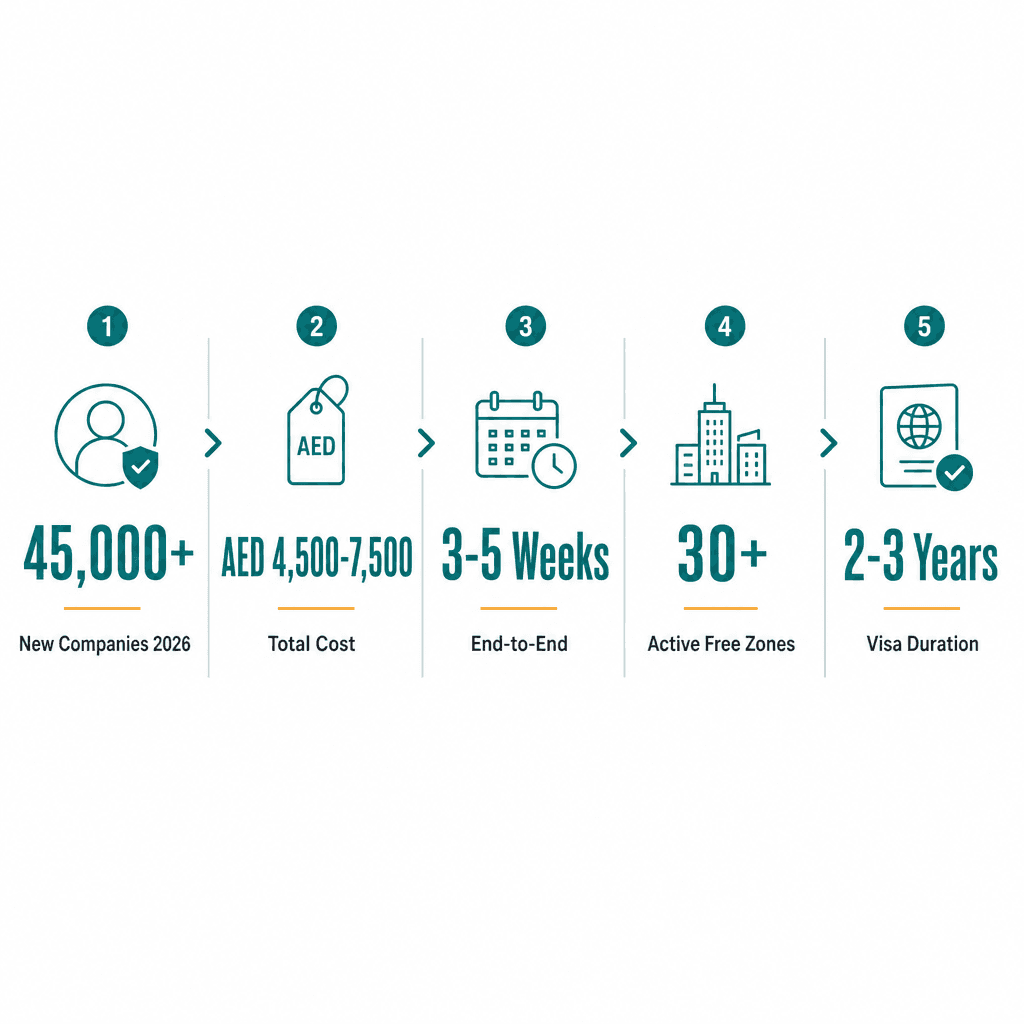
Named shareholders on a Dubai free zone trade license qualify for a UAE investor visa with no employer, local sponsor, or minimum salary required. Your equity stake in the company is the legal trigger for residency rights.
Total Cost Ranges From AED 4,500 to 7,500
The full investor visa free zone Dubai pathway costs between AED 4,500 and AED 7,500 based on ICP fee schedules for 2025. This is a one-time setup cost, not an ongoing monthly expense.
Visa Lasts 2–3 Years Tied to Your License
Most Dubai free zones issue a 2-year investor visa, while Dubai South offers a 3-year visa aligned to its trade license term. The visa stays valid as long as your trade license remains active and renewed.
100% Foreign Ownership Is Fully Legal
Federal Decree-Law No. 26 of 2020 addressed 100% foreign ownership for mainland companies. Free zone ownership comes from the relevant free zone regulations and is not granted by that decree. This means international entrepreneurs can own their company outright and hold their own residency visa simultaneously.
Sponsor Dependants Including Spouse and Children
Investor visa holders can sponsor spouses, children under 18, and in some cases parents, without the salary minimums that apply to employment visa holders. This makes it a more flexible option for relocating families.
You Control Renewal, Not an Employer
Unlike an employment visa that lapses within 30 days of leaving a job, the investor visa renewal is entirely in your hands. Renew your trade license and your visa renewal follows directly from that.
Over 30 Free Zones Offer This Pathway in Dubai
Dubai hosts more than 30 active free zones, each with its own visa rules and license structures. With over 45,000 new free zone companies expected to register in Dubai in 2026, the investor visa pathway is widely used and well-established.
By Editorial Team, UAE company formation specialists with direct experience processing free zone investor visas across Dubai South and leading UAE free zones. Full bio →
One of the most valuable benefits of setting up a free zone company in Dubai is the investor visa it entitles you to. In 2026, over 45,000 new free zone companies are expected to register in Dubai alone (Dubai Free Zones Council, 2025). Every named shareholder on those trade licenses qualifies for a UAE residency visa, no employer, no local sponsor, no minimum salary required. The investor visa free zone Dubai pathway costs AED 4,500–7,500 in total (ICP fee schedules, 2025). The process takes 3–5 weeks end to end. Over 30 active free zones operate in Dubai, each with its own visa rules (UAE Ministry of Economy, 2024). Federal Decree-Law No. 26 of 2020 addressed 100% foreign ownership for mainland companies. Free zone ownership comes from the relevant free zone regulations and is not granted by that decree. That means you can own your company outright and hold your own residency visa, simultaneously.
This guide covers everything you need to know about the investor visa free zone Dubai pathway: what it is, who qualifies, the exact step-by-step process, a full AED cost breakdown, realistic timelines, how many visas one company can issue, and how renewal works. For more detail, see our guide on Dubai South investor partner visa guide.
Investor Visa Free Zone Dubai vs. Employment Visa: Key Differences
Feature | Investor Visa (Free Zone) | Employment Visa (Employer-Sponsored) |
|---|---|---|
Sponsorship Requirement | ✅ Self-sponsored via company ownership | ❌ Requires an employer to act as sponsor |
Visa Duration | ✅ 2–3 years (aligned to trade license) | 2 years (tied to employment contract) |
Tied to Employer | ✅ No, tied to your own company license | ❌ Yes, lapses within 30 days of resignation |
Eligibility Trigger | ✅ Named on free zone trade license and MoA | Signed employment contract with UAE employer |
Dependent Sponsorship Rights | ✅ Spouse, children under 18, parents (case by case) | Spouse and children, minimum salary AED 4,000–10,000/month required |
Renewal Control | ✅ You control it, renew your license, renew your visa | ❌ Employer initiates renewal, you have no direct control |
Typical Total Cost (AED) | AED 4,500–7,500 (one-time setup) | AED 3,000–6,000 (borne by employer, but salary minimums apply) |
What Is the Investor Visa for Free Zone Companies in Dubai
The investor visa free zone Dubai is a 2–3 year renewable UAE residency visa issued to shareholders listed on a free zone trade license and Memorandum of Association (MoA). It gives you the legal right to live in the UAE tied directly to your company ownership, no employer sponsorship required. This is your residence visa free zone company pathway: own equity, get residency.
The Legal Basis: Ownership Equals Residency Rights
UAE immigration regulations formally categorise this as a "partner/investor visa." The qualifying trigger is equity ownership in a licensed free zone entity, not a job offer, not a salary, not a local sponsor. Federal Decree-Law No. 26 of 2020 addressed 100% foreign ownership for mainland companies. Free zone ownership comes from the relevant free zone regulations and is not granted by that decree.
Visa validity is typically 2 years for most free zones. Dubai South offers 3-year investor visas, aligned to the trade license duration. Because the visa is anchored to your shareholding, it stays valid as long as your license is active and renewed.
Take this scenario: a US-based consultant sets up at Dubai South Free Zone and receives an investor visa valid for 3 years, matching the license term exactly, with zero involvement from a local employer or sponsor. That's the system working as designed.
Visa validity: 2 years (most free zones) or 3 years (Dubai South and select zones)
Free zone ownership comes from free zone regulations
Visa remains active as long as the trade license is current
Who Qualifies for the Free Zone Investor Visa UAE
Any individual shareholder named on the free zone trade license and MoA qualifies. Nationality restrictions are minimal across most Dubai free zones. The shareholding threshold varies: most zones require a minimum of one share (or AED 1 in paid-up capital), though some set a floor of 5–10% equity, always confirm with your specific zone before incorporating.
Corporate shareholders (a holding company owning the free zone entity) do not qualify directly, the visa is issued to named natural persons only
Existing shareholders added to the MoA post-incorporation can apply for the investor visa immediately after the amendment is processed
Over 30 active free zones operate in Dubai, each with its own shareholder visa eligibility rules (UAE Ministry of Economy, 2024)
Here's a practical example: two co-founders from the UK and Canada each hold 50% of a free zone-licensed trading company. Both are listed on the MoA. Both are entitled to apply for their own investor visa free zone Dubai, independently, at the same time, without waiting for the other to complete the process first.
Worth noting: visa validity varies by free zone — Dubai South offers 3-year investor visas, while many other zones issue 2-year visas. Always verify the specific zone's visa policy before you commit. You can start your business and get your investor visa at Dubai South through a single integrated process.
Investor Visa Free Zone Dubai vs. Employment Visa: Why the Distinction Matters
The investor visa free zone Dubai is self-sponsored through company ownership and remains valid regardless of whether you draw a salary. An employment visa is tied to an employer and lapses if you leave that job. For entrepreneurs, the investor route offers significantly more stability and independence, and that difference matters enormously in practice.
Stability and Control You Don't Get With an Employment Visa
An investor visa can't be cancelled by a third-party employer. You control renewal entirely, as long as your company license stays active. That's a fundamentally different position than holding an employment visa, where a single resignation or termination triggers a 30-day grace period to exit the country or change visa status.
You can also sponsor dependants on an investor visa, spouse, children under 18, and in some cases parents, giving your family a UAE residency path through your company. Employment visas allow dependent sponsorship too, but they require a minimum monthly salary of AED 4,000–10,000 depending on the dependant category. The investor visa carries no such salary floor.
Consider this real scenario: an American entrepreneur previously held an employment visa through a UAE company. When she resigned, she had 30 days to leave or change status. After setting up her own free zone LLC and obtaining an investor visa free zone Dubai, she's renewed it twice, on her own schedule, her own terms. For anyone building a business or planning long-term UAE residency, that control is worth far more than it might initially appear. You can read our UAE Golden Visa guide if you're looking for 5–10 year residency options beyond the standard investor visa. For more detail, see our guide on Dubai entrepreneur visa and investor visa guide.
What Else You Should Know
Free zone companies can hold both investor visas (for shareholders) and employment visas (for hired staff) simultaneously, they're separate quota categories
The free zone investor visa UAE does not require you to work inside the UAE, you can live abroad and hold UAE residency through your company ownership
Investor visa holders gain access to UAE banking, a UAE driving license, and the right to purchase property, benefits that don't automatically come with a tourist visa or visit visa
Step-by-Step Process to Get Your Investor Visa Free Zone Dubai
Getting an investor visa through a free zone involves six steps: apply for an entry permit, travel to the UAE on that permit, complete a medical fitness test, submit biometrics at an ICP centre, collect your Emirates ID, and get the visa stamp. The full process to get your investor visa through a free zone typically takes 3–5 weeks, though founders using Dubai South's on-site immigration service have completed it in as few as 11 calendar days.
Step 1: Entry Permit Application
A Canadian shareholder setting up at Dubai South Free Zone had her entry permit issued within 5 business days of license issuance. She received it by email while still in Toronto and booked her flight to Dubai the same afternoon.
Step 2: Medical Fitness Test, Biometrics, and Emirates ID
At Dubai South Free Zone, the entire post-entry sequence, medical test, biometrics, runs through an integrated PRO service. Shareholders complete all steps at a single location, rather than queuing at multiple government offices across the city. That's a meaningful time saving.
For a detailed walkthrough of the partner visa route, see our partner visa Dubai step-by-step guide.
Full AED Cost Breakdown for Your Free Zone Investor Visa UAE
The total cost of a free zone investor visa UAE typically ranges from AED 4,500 to AED 7,500, covering the entry permit (AED 500–800), medical fitness test (AED 320–500), Emirates ID: AED 100 per year of residence, plus a one-off AED 100 smart application fee,000), and mandatory health insurance (AED 650–3,500 annually depending on plan).
Government Fees vs. Service Fees: What You're Actually Paying
There are two distinct cost categories here, and mixing them up is one of the most common mistakes founders make when budgeting for their investor visa free zone Dubai.
Entry permit: AED 500–800 (government fee, fixed by ICP)
Medical fitness test: AED 320–500 (MOHAP-approved centre)
Emirates ID: AED 370 (2-year) or AED 570 (3-year), ICP fixed fee
Visa stamping: AED 500–1,000 (ICP fixed fee)
Health insurance: AED 650/year minimum (mandatory under Dubai Health Authority regulations since 2014); comprehensive plans run AED 2,500–5,000/year
Free zone PRO service fees: AED 1,000–2,500 for a full-service package
Hidden costs to watch: Expedited processing (AED 300–500 extra), in-country status change from tourist visa (approximately AED 1,000 additional)
Here's a real example: a solo founder registering at a typical UAE free zone in 2025 paid AED 750 for the entry permit, AED 420 for the medical test, AED 100 per year of residence for the Emirates ID (2-year card), AED 680 for visa stamping, and AED 800 for basic health insurance — AED 3,020 in government and insurance fees, plus AED 1,200 in PRO service fees. Total: AED 4,220. That's at the lower end of the range, and it's achievable if you choose basic health coverage and use a free zone with efficient in-house PRO services.
Free Zone Investor Visa UAE: Cost Summary Table
Cost Item | AED Range | Fee Type |
|---|---|---|
Entry Permit | AED 500–800 | Government (ICP) |
Medical Fitness Test | AED 320–500 | Government (MOHAP) |
Emirates ID | AED 370–570 | Government (ICP) |
Visa Stamping | AED 500–1,000 | Government (ICP) |
Health Insurance (annual) | AED 650–3,500 | Mandatory (DHA) |
Free Zone PRO Service | AED 1,000–2,500 | Service Fee |
Total Estimated Range | AED 4,500–7,500 | All-in |
Dubai South Free Zone bundles investor visa processing into its setup packages, which can reduce total out-of-pocket costs compared to free zones that charge each step separately. Explore Dubai South Business Hub Free Zone residency services for current bundled pricing.
How Many Investor Visas Can One Free Zone Company Issue
References
Editorial sources available on request. Full citation list is being compiled.
Citations
General Directorate of Residency and Foreigners Affairs Dubai.. gdrfad.gov.ae. GDRFA Dubai, 2024.
Federal Authority for Identity, Citizenship, Customs and Port Security.. icp.gov.ae. ICP UAE, 2024.
UAE Ministry of Economy and Tourism.. moet.gov.ae. MOET UAE, 2024.
UAE Cabinet.. uaecabinet.ae. UAE Cabinet, 2023.
Ministry of Human Resources and Emiratisation.. mohre.gov.ae. MoHRE UAE, 2024.
For related guidance, see our page on investor visa Dubai free zone.
Frequently Asked Questions