Topic Summary
Three Distinct Ban Types Can Trap Workers
UAE workers may face a MOHRE labour ban, an ICP/GDRFA immigration ban, or a court-issued travel ban — each issued by a different authority and blocking a different action. Clearing one system does not mean you are clear across all three.
Standard Labour Ban Lasts One Year
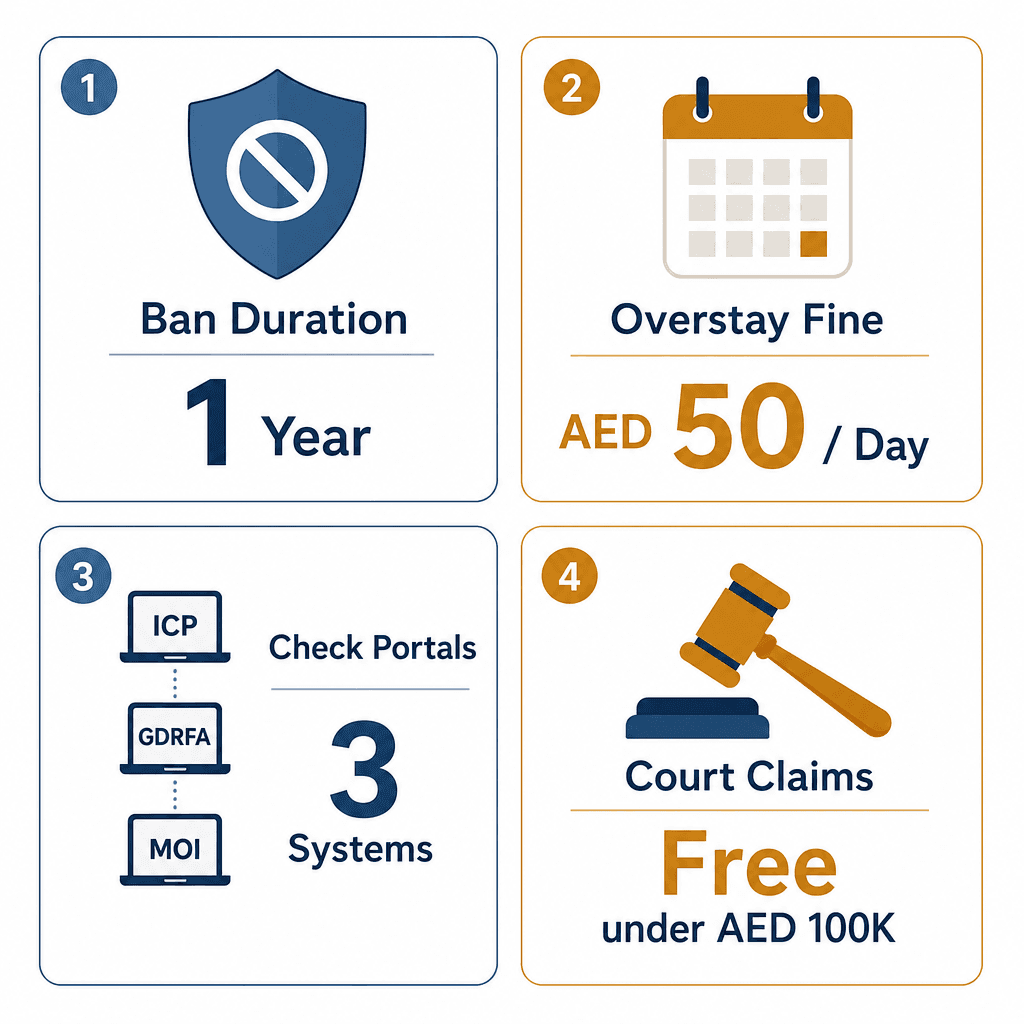
Under Article 28(1) of Cabinet Resolution No. 1 of 2022, most labour ban triggers result in a one-year restriction on new work permit issuance. The 1980 law frequently cited elsewhere is fully superseded and should not be relied upon.
Check Three Separate Portals for Your Status
Workers must independently query mohre.gov.ae, icp.gov.ae, and gdrfad.gov.ae to get a complete picture of any active bans. A clean result on one portal gives no guarantee about the others.
Only MOHRE Can Record or Lift a Labour Ban
Employers cannot directly impose a labour ban — they can file a report, such as an absconding report, that triggers the MOHRE process. The decision to record or remove the ban rests entirely with MOHRE.
Removal Paths Include Free Court Escalation
Workers can pursue removal through employer withdrawal via MOHRE, a formal MOHRE grievance, or escalation to the UAE Labour Court. Labour Court referrals are free for claims below AED 100,000.
Bans Are Often Discovered Too Late
In 2026, many workers only learn of an active labour ban when a new employer attempts to process their work permit, sometimes weeks or months after it was recorded. No direct notification is sent to the worker when a ban is logged.
Overstay Fines Add Up at AED 50 Per Day
Overstay fines are standardised nationwide at AED 50 per day, calculated from the end of the grace period. This rate was confirmed across the UAE in February 2026.
What You Need to Know
A labour ban in the UAE is a MOHRE-issued restriction blocking new work permit issuance, governed by Federal Decree-Law No. 33 of 2021 and Cabinet Resolution No. 1 of 2022, typically lasting one year.
There are three distinct ban types: a labour ban (MOHRE), an immigration ban (ICP/GDRFA), and a travel ban (courts). Clearing one does not clear the others.
To check your labour ban status in the UAE, query three separate portals: mohre.gov.ae, icp.gov.ae, and gdrfad.gov.ae. Once your labour ban is removed, you can legally start a new job, switch employers, or set up your own business in the UAE.
Removal paths include employer withdrawal through MOHRE, a formal MOHRE grievance, or escalation to the UAE Labour Court, which is free for claims below AED 100,000.
In 2026, thousands of workers in the UAE discover an active labour ban only when a new employer attempts to process their work permit, weeks or months after the ban was recorded without any direct notification to the worker. The standard ban duration is one year (Cabinet Resolution No. 1 of 2022, Art. 28(1)). Overstay fines run at AED 50 per day from the grace period end date, standardised nationwide in February 2026. Labour Court referrals are free for claims below AED 100,000. Three separate government portals, mohre.gov.ae, icp.gov.ae, and gdrfad.gov.ae, must each be checked independently. Clearing one system does not confirm you are clear across all three.
This guide explains exactly what a labour ban in the UAE is, which law governs it, the three types of ban you may face, the consequences for workers and employers, the step-by-step removal process, how to check your status across official portals, and the practical steps that keep you compliant from day one.
The Legal Definition and Governing Articles
A labour ban in the UAE is, specifically, a MOHRE-recorded restriction on new work permit issuance. It is not a visa ban, not a residency ban, and not a travel restriction. Those are separate instruments issued by separate authorities, and they operate on entirely different systems.
The governing legislation is Federal Decree-Law No. 33 of 2021 on the Regulation of Labour Relations, which came into effect in February 2022, and Cabinet Resolution No. 1 of 2022 as the implementing regulation. Both Federal Law No. 8 of 1980 and Ministerial Resolution No. 721 of 2006 are fully superseded. You'll still find competitor articles citing the 1980 law; that's an error. Do not rely on any guidance that references either of those instruments.
Only MOHRE has the authority to record or lift a labour ban. An employer cannot impose one directly. What an employer can do is file a report, such as an absconding report, that triggers the MOHRE process. The decision to record the ban, and to lift it, sits entirely with MOHRE. Article 28(1) of Cabinet Resolution No. 1 of 2022 sets the standard one-year duration for most ban triggers.
Here's how it plays out in practice: a worker on a limited contract at a logistics firm in Dubai resigns after eight months without a qualifying reason under Article 44. The employer files an absconding report. MOHRE records a one-year ban. The worker's next employer only discovers it when submitting the work permit application, weeks later.
The Three Types of Ban a UAE Worker Can Face
Most workers assume "ban" means one thing. It doesn't. There are three distinct types, each issued by a different authority and each blocking a different action. Clearing one does not clear the others.
Labour ban: Issued by MOHRE. Recorded on the work permit system. Blocks new work permit issuance across all employers in all seven Emirates.
Immigration ban: Issued by ICP (Federal Authority for Identity, Citizenship, Customs and Port Security) or GDRFA (General Directorate of Residency and Foreigners Affairs) in Dubai. Blocks entry into the UAE or prevents a new residency visa from being stamped. Entirely separate from the MOHRE system.
Travel ban: Issued by UAE courts. Usually linked to financial disputes or criminal matters. Blocks the worker from leaving the UAE. This is not a MOHRE or immigration authority function.
A worker who leaves the UAE with an unpaid loan may find a court-ordered travel ban waiting upon re-entry, entirely separate from any MOHRE labour ban on their record. Each ban type must be checked and resolved independently.
Labour Ban vs Immigration Ban vs Travel Ban: Key Differences
Feature | Labour Ban | Immigration Ban | Travel Ban |
|---|---|---|---|
Issuing Authority | MOHRE (Ministry of Human Resources and Emiratisation) | ICP (Federal) or GDRFA (Dubai) | UAE Courts (civil or criminal) |
What It Blocks | New work permit issuance with any UAE employer | Entry into the UAE or new residency visa stamping | Departure from the UAE |
Typical Duration | 1 year (standard); longer for serious misconduct | Varies; indefinite until resolved with ICP/GDRFA | Until court order is lifted or matter settled |
How It Is Removed | Employer withdrawal via MOHRE portal, or MOHRE/Labour Court order | Application to ICP or GDRFA; resolution of underlying issue | Court order; auto-lifted under Zero Government Bureaucracy initiative on case resolution |
Relevant Official Portal | UAE Courts portal or relevant emirate court |
The Current Legal Framework Governing Employment Bans in the UAE
The employment ban framework in the UAE is set by Federal Decree-Law No. 33 of 2021 on the Regulation of Labour Relations and Cabinet Resolution No. 1 of 2022. These replaced all prior labour legislation and introduced specific conditions under which a ban is triggered, including early resignation from a limited contract and absconding.
Which Actions Trigger a Labour Ban Under the 2021 Law
Not every departure from a job triggers a ban. The law is specific about which actions create grounds for MOHRE to record one. Here are the main triggers:
Early resignation from a limited contract without a valid reason under Article 44 of Federal Decree-Law No. 33 of 2021. An accountant on a two-year limited contract who leaves after 14 months citing personal reasons, where those reasons don't meet the qualifying exceptions in Article 44, will find MOHRE records a one-year ban. The key word is "qualifying." Simply wanting to leave is not enough.
Absconding: Seven consecutive unauthorised working days triggers an absconding report under Article 28(1) of Cabinet Resolution No. 1 of 2022, which in turn activates a ban. This is one of the most common triggers, and often the most contested, because employers sometimes file absconding reports prematurely or incorrectly.
Serious misconduct as listed in Article 44, including disclosing trade secrets, causing significant financial loss to the employer, or being found under the influence of alcohol or controlled substances at work.
Working for a different employer without a No Objection Certificate or formal permit during a notice period. This catches workers who start a new role before their current visa and permit are formally cancelled.
When a Labour Ban Cannot Be Imposed: Worker Protections
The 2021 law includes real protections. Workers on unlimited contracts who resign after completing one full year of service are fully protected from a labour ban under Article 43 of Federal Decree-Law No. 33 of 2021. If you've served your year and you're on an unlimited contract, you can resign with the correct notice period and MOHRE cannot record a ban.
Workers of any contract type who can demonstrate the employer violated the contract first are also protected. Non-payment of wages is the clearest example. Ministerial Resolution No. 340 of 2026 sets the first day of each month as the unified salary due date for all private sector employers, making delayed payment straightforward to document through the Wage Protection System. An HR manager whose employer has not paid wages for two consecutive months, in breach of Ministerial Resolution No. 340 of 2026, can resign and successfully contest a ban by presenting the wage protection records to MOHRE.
Two additional protections are worth flagging. Workers who report a workplace safety hazard and leave as a result cannot be banned. And if an employer already has an active MOHRE complaint or wage protection violation recorded against them, MOHRE may decline to record a new ban request from that employer entirely.
Consequences of a Labour Ban in the UAE for Workers and Employers
A labour ban in the UAE immediately blocks the affected worker from obtaining any new work permit, effectively preventing legal employment anywhere in the country for its duration. The worker's current visa is cancelled, overstay fines of AED 50 per day accrue from the grace period end date, and a concurrent immigration ban may block re-entry.
What Happens to the Employee After a Ban Is Recorded
The consequences stack up quickly. Here's the sequence:
A retail worker whose employer files an absconding report on day eight of an unauthorised absence faces a simultaneous MOHRE labour ban and a GDRFA immigration ban. They must resolve both independently before legally re-entering the UAE workforce. The 1 year ban in the UAE is the standard, but the immigration layer is what catches most workers off guard.
What Happens to the Employer If They File or Receive a Ban
Employers are not immune from consequences. Hiring a worker with an active labour ban without resolving it first is a MOHRE violation and attracts fines. More significantly, employers who file a ban in bad faith, for example to prevent a worker from claiming end-of-service gratuity or to retaliate for a complaint, face a Labour Court counterclaim and potential financial liability.
A construction company that files an absconding report to avoid paying end-of-service gratuity is a pattern the Labour Court sees regularly. When the worker successfully contests the ban, the court can order the gratuity paid in full plus compensation for losses suffered during the ban period. MOHRE also maintains a restricted employer list; companies with a pattern of ban filings that are subsequently overturned find their future permit applications scrutinised more closely.
Employers must process work permit cancellations through MOHRE formally. Informal arrangements, where both parties agree the worker has left but no formal cancellation is submitted, are not recognised and create liability for both sides.
How to Remove a Labour Ban in the UAE: Step-by-Step Resolution Paths
There are three paths to labour ban removal in the UAE: the employer withdraws the ban directly through MOHRE, the worker raises a formal grievance through the MOHRE complaint portal, or the worker escalates to the UAE Labour Court. Each path has specific steps, timelines and documentation requirements that must be followed in order.
Path 1: Employer Withdrawal Through MOHRE
This is the fastest route. If you and your former employer can reach an agreement, the ban can be removed in as little as three to five working days.
A practical example: a worker and former employer reach a mutual settlement of AED 8,000 for unpaid annual leave. As part of the written agreement, the employer withdraws the labour ban through the MOHRE portal. The worker's new employer proceeds with permit processing within a week. Worth flagging: if an absconding report was also filed, the employer must withdraw that separately. Lifting the ban does not automatically withdraw the absconding status. Both must be cancelled.
Path 2: MOHRE Grievance and Escalation to the Labour Court
If the employer refuses to cooperate, the formal grievance path is your next step. It costs nothing for claims below AED 100,000 and the process is structured.
A nurse on a limited contract whose employer withheld her passport and refused to pay three months of wages filed a MOHRE grievance citing Article 44 protections. MOHRE mediation failed. The Labour Court found in her favour, ordered the ban lifted, and awarded her full unpaid wages plus end-of-service gratuity. The process took approximately three months from complaint to court order.
How to Check Your Labour Ban Status Online in the UAE
To check a labour ban in the UAE, you must query three separate official portals: the MOHRE app or mohre.gov.ae for work permit bans, the ICP smart services portal at icp.gov.ae for immigration bans, and the GDRFA portal at gdrfad.gov.ae for Dubai-specific residency holds. Clearing one system does not confirm you are clear across all three.
Checking Your Status on the MOHRE, ICP and GDRFA Portals
Here's how to check labour ban status in the UAE across each system:
A teacher returning to the UAE after a one-year absence checked all three portals before accepting a new offer. MOHRE showed clear. ICP showed clear. But GDRFA flagged a residency overstay hold from her previous visa, which she resolved at a service centre before her new employer submitted the work permit application. That sequence, check all three first, saved her from a failed permit application and the delays that follow.
What to Do If Your Status Shows an Active Ban You Did Not Expect
Don't accept a new job offer or allow an employer to submit a work permit application until the ban is resolved. The application will fail, and a failed application can create additional complications with the employer and with MOHRE's records.
Contact your previous employer first. Confirm whether they filed a ban and whether they'll withdraw it voluntarily. If they're unresponsive or refuse, file a MOHRE grievance immediately. Delays matter: overstay fines accrue at AED 50 per day from the grace period end date, and those fines must be cleared before any new visa is processed (verify current rates with ICP, as figures are subject to change).
Keep your employment contract, payslips, and any written communication from the employer. These documents are your primary evidence in both a MOHRE grievance and a Labour Court case. A MOHRE grievance can be filed online without a lawyer, which makes early action genuinely practical.
How to Avoid a Labour Ban in the UAE: Numbered Practical Tactics
To avoid a labour ban in the UAE, serve your full notice period as required by your contract and the law, obtain written confirmation of resignation acceptance, ensure all financial entitlements are settled before your visa is cancelled, and never leave a job without a formal MOHRE-recorded termination. Document every step in writing.
Seven Steps Every Worker Should Take Before Leaving a Job
A software developer on an unlimited contract submitted written resignation giving 45 days notice, received written acknowledgement the same day, collected a salary settlement statement, and checked all three portals on his last working day. He started his new role the following month with no ban on record and no delays in permit processing. The process worked because every step was documented.
What Employers Must Do to Avoid Triggering an Unjustified Ban
Pay wages by the first of each month as required by Ministerial Resolution No. 340 of 2026. This applies to all private sector employers. Wage violations recorded in the Wage Protection System will undermine any ban filing the employer later attempts, because MOHRE will have the payment history on record.
Process work permit cancellations through MOHRE formally and within the legal timeframe after a worker leaves. Informal arrangements are not recognised. And do not file an absconding report as a substitute for a proper termination process. A wrongly filed report can be contested, reversed by the Labour Court, and can expose the employer to court costs and compensation orders. Maintain signed copies of all employment contracts, amendments, and termination letters; these are required evidence if
Citations
Ministry of Human Resources and Emiratisation.. mohre.gov.ae. MOHRE UAE, 2024.
UAE Cabinet.. uaecabinet.ae. UAE Cabinet, 2023.
General Directorate of Residency and Foreigners Affairs Dubai.. gdrfad.gov.ae. GDRFA Dubai, 2024.
Federal Authority for Identity, Citizenship, Customs and Port Security.. icp.gov.ae. ICP UAE, 2024.
Dubai Economy and Tourism.. dubaidet.gov.ae. DET Dubai, 2024.
For related guidance, see our page on labour ban UAE.
Frequently Asked Questions