
Topic Summary
File Through MoHRE Before Going to Court
MoHRE complaint is the mandatory first step for mainland UAE private-sector employees, and it costs nothing to file. Most disputes reach a first outcome within 14 to 30 days, making it significantly faster than court proceedings.
Know the One-Year Limitation Deadline
Article 54 of Federal Decree-Law No. 33 of 2021 sets a strict one-year limitation period for bringing a labour claim, and no extensions are granted. Missing this window means losing your legal right to pursue the dispute entirely.
Employee Court Claims Under AED 100,000 Are Free
Employees filing Labour Court claims valued under AED 100,000 pay zero court fees, removing a major financial barrier to seeking justice. Employers, however, may still incur fees at the court stage.
Avoid Informal Threats That Weaken Your Case
Actions like threatening to involve the police or walking off the job without notice can seriously damage your legal standing in a dispute. Sticking to the formal MoHRE and court process protects your rights far more effectively.
Always Get a Written Employment Contract
UAE law requires employers to issue written contracts within 14 days of an employee's start date, and failing to do so creates significant legal exposure if a dispute arises. A missing contract was cited as a costly mistake in a real Al Quoz logistics case.
DIFC and ADGM Follow Separate Dispute Rules
Employees working in free zones like DIFC or ADGM cannot use the MoHRE complaint route or mainland Dubai Courts, as these jurisdictions operate under entirely separate legal frameworks. Misunderstanding this distinction is a common and expensive error for claimants.
Court Judgments Carry Full Enforcement Powers
Unlike a MoHRE settlement, a Dubai Labour Court judgment is legally binding and enforceable, including through asset seizure if necessary. Enforcement typically takes 30 to 60 days after judgment, and parties can appeal within 30 days to the Court of Appeal.
By Editorial Team, UAE business setup and employment law specialists with over a decade of experience advising employers and employees across mainland and free zone jurisdictions. Full bio →
Workplace disputes are a reality of business in Dubai, and whether you're an employer managing a difficult termination or an employee chasing three months of unpaid wages, knowing the formal process protects your rights. Informal approaches, like threatening to "go to the police" or simply walking off the job, can seriously weaken your legal position. The UAE Ministry of Human Resources and Emiratisation (MoHRE) handles a significant volume of workplace complaints annually across sectors from construction and hospitality to finance and technology. Federal Decree-Law No. 33 of 2021 came into force on 2 February 2022, replacing the old Labour Law entirely. For more detail, see our guide on employee termination process in the UAE.
The UAE private sector employs an estimated 5 million workers (ILO, 2023). Labour Court claims under AED 100,000 carry zero court fees for employees. The one-year limitation period under Article 54 of the Decree-Law is strictly enforced, no extensions. For more detail, see our guide on enforcing non-compete agreements in the UAE. For more detail, see our guide on probation period in UAE employment. For more detail, see our guide on UAE sick leave and annual leave rights. For more detail, see our guide on enforcing non-compete clauses in the UAE.
This guide walks you through both main resolution routes, the MoHRE complaint process and Dubai Courts, so you know exactly what to do, in what order, and how long each stage takes.
MoHRE Complaint Route vs Dubai Labour Court: Key Differences
Feature | MoHRE Complaint (Mediation) | Dubai Labour Court |
|---|---|---|
Cost to File | ✅ Free for both parties | ✅ Free for employees on claims under AED 100,000; employers may incur fees |
Time to First Outcome | 14–30 days from filing to resolution or referral | 3–6 months to first-instance judgment |
Legal Representation Required | ✅ Not required, most employees self-represent | ❌ Strongly recommended; complex cases need a UAE-licensed lawyer |
Binding Decision | Only if both parties sign a settlement agreement | ✅ Yes, court judgment is legally binding and enforceable |
Enforcement Mechanism | Signed settlement enforceable via courts; WPS sanctions for non-compliant employers | ✅ Full court enforcement including asset seizure; 30–60 days post-judgment |
Applies To | All mainland UAE private-sector employees; mandatory first step | Mainland employees after failed MoHRE mediation; DIFC/ADGM use separate tribunals |
Right of Appeal | ❌ No appeal, either settle or proceed to court | ✅ Appeal within 30 days to Court of Appeal; further appeal to Court of Cassation |
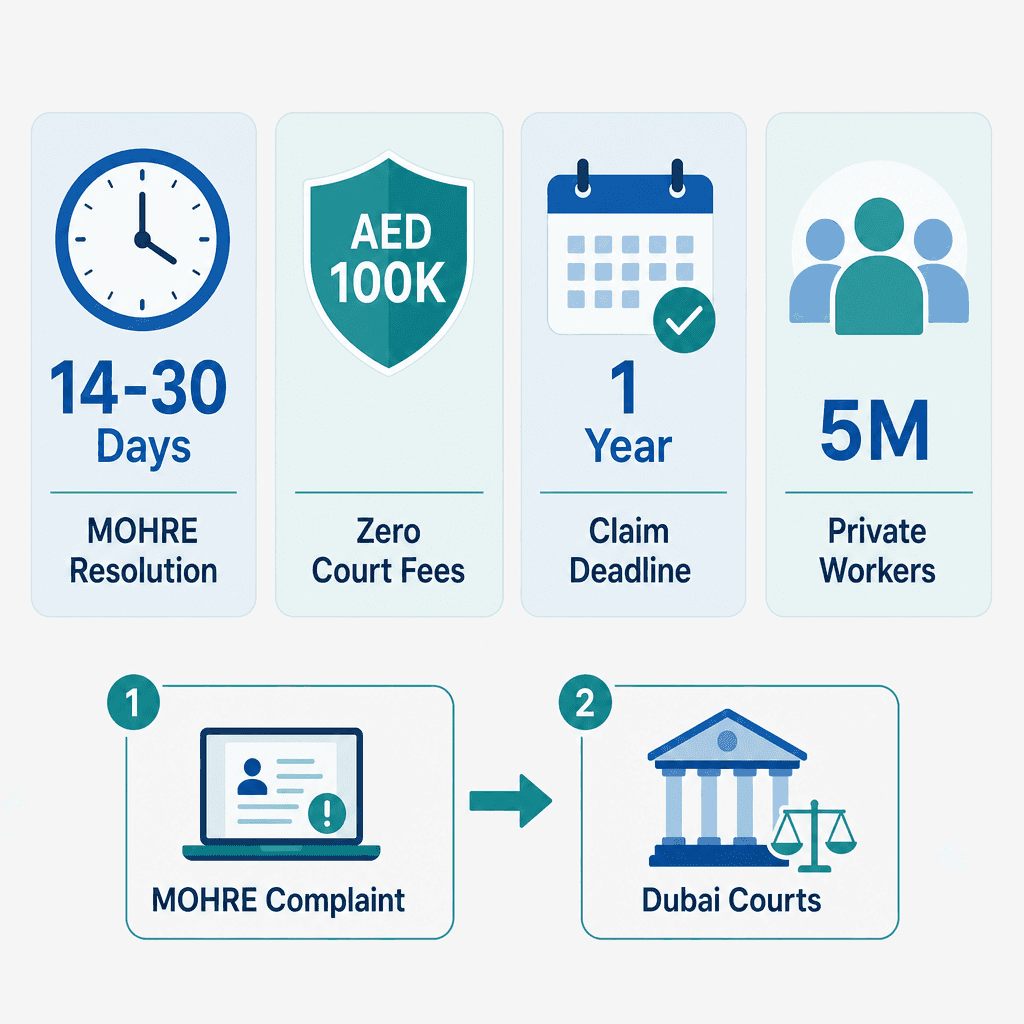
A labour dispute in Dubai is any disagreement between an employer and employee over rights or obligations under UAE employment law, including unpaid wages, wrongful termination, gratuity, or contract terms. These disputes are governed by Federal Decree-Law No. 33 of 2021 and resolved through MoHRE or Dubai Courts. For more detail, see our guide on UAE employment contract verification.
The Legal Framework Governing Workplace Disputes in the UAE
Federal Decree-Law No. 33 of 2021 is the cornerstone of every employment dispute UAE parties encounter in the private sector. It came into force on 2 February 2022, replacing Labour Law No. 8 of 1980 and introducing material changes to termination rights, gratuity calculations, flexible work arrangements, and dispute procedures. The law applies to all private-sector employers and employees on mainland UAE. Free zones like DIFC and ADGM operate under entirely separate jurisdiction, a distinction that trips up a surprising number of claimants.
Employers must register all employees on the MoHRE system and issue written contracts within 14 days of the employment start date. Skipping that step is a costly mistake. A logistics company in Al Quoz, for example, failed to issue a written contract to a warehouse worker. When an employment dispute UAE-side arose over overtime pay, the absence of any written agreement was treated as evidence in the employee's favour under Article 14 of the Decree-Law, and the employer had no documentation to counter the claim. For a full breakdown of employer obligations, see our UAE labour law guide for employers.
Common Types of Labour Disputes Filed in Dubai
The most frequently filed categories at MoHRE include:
Unpaid or delayed salary, the single most common complaint type
Arbitrary or unfair termination, dismissal without cause or proper notice
End-of-service gratuity disputes, underpayment or outright non-payment
Contract violations, unilateral changes to job title, salary, or role
Annual leave encashment and ticket allowance disputes
Gratuity entitlement kicks in after one full year of continuous service. A retail employee in Deira terminated after three years with no gratuity payment has a clear claim: under Article 51 of the Decree-Law, she's entitled to 21 days' basic salary per year for the first five years, a figure MoHRE can enforce directly. Our end of service benefits Dubai guide covers the calculation methodology in detail.
MoHRE Complaint UAE: The Mandatory First Step for Most Disputes
Filing a MoHRE complaint in the UAE is the mandatory first step for most mainland labour disputes before a case can proceed to court. The process is free of charge, handled online or via the MoHRE app, and typically begins with a mediation session between the employer and employee. For more detail, see our guide on filing a labour complaint with MoHRE. For more detail, see our guide on resolving an absconding case in the UAE. For more detail, see our guide on recovering bad debt and resolving disputes in the UAE.
Why MoHRE Mediation Comes Before the Courts
UAE law requires parties to attempt MoHRE-facilitated resolution before accessing Dubai Courts for most private-sector disputes. This isn't optional, skip it, and the court will send you back. The MoHRE process costs nothing for either party, and most cases receive a response within 48 hours of filing. A mediation session is typically scheduled within two to four weeks.
Here's what happens when an employer ignores the process: a software developer in Business Bay filed a MoHRE complaint after three months of unpaid salary. Within 48 hours, his employer received a formal notification. The employer didn't respond. MoHRE referred the case to the Labour Court automatically, and a court date was set within weeks, no additional action required from the employee. MoHRE has historically resolved a high proportion of complaints at the mediation stage without court referral.
What Happens If an Employer Does Not Respond to a MoHRE Complaint
Non-response isn't a safe option for employers. If a company ignores MoHRE notifications, the ministry treats the case as unresolved and refers it directly to the competent court. The employee loses no rights whatsoever, every entitlement is preserved through the referral.
The consequences for non-responsive employers go further. A restaurant chain in Jumeirah that ignored four separate MoHRE notifications from former kitchen staff over unpaid wages found itself escalated to the Labour Court and simultaneously flagged in the Wages Protection System (WPS), triggering a hiring freeze. WPS covers all private-sector employers with 10 or more employees, and non-compliance can result in fines starting at AED 5,000 per affected employee. For more on your rights in this process, see our guide to employee grievance procedures in UAE. For more detail, see our guide on UAE employee grievance procedure. For more detail, see our guide on absconding rules and consequences in the UAE.
5 Steps to File a Labour Complaint in Dubai Through MoHRE
To file a labour complaint in Dubai through MoHRE, submit your case online via the MoHRE portal or mobile app, attend the scheduled mediation session, and allow the ministry to negotiate a resolution. If mediation fails, MoHRE refers the dispute to the Labour Court, at no cost to the employee.
Step 1: Submit Your Complaint Online or via the MoHRE App
Visit mohre.gov.ae or download the MoHRE UAE app (available on iOS and Android, both support English and Arabic). Select "Labour Complaints" from the services menu. You'll complete an online form requiring your Emirates ID number, employment contract details, and a clear description of the dispute. Upload your supporting documents: employment contract, payslips, relevant WhatsApp or email exchanges, and your passport copy. A case reference number is issued immediately, save it. Filing is entirely free.
Step 2: MoHRE Notifies the Employer and Schedules Mediation
MoHRE formally notifies the employer within one to two working days of your submission. The employer then has three working days to respond and confirm availability for a mediation session. MoHRE assigns a neutral labour inspector or mediator, both parties attend in person or, increasingly, via video call. The mediator's job is to broker a settlement, not to rule on the merits. Mediation sessions are typically scheduled within 14 calendar days of filing.
Step 3: Mediation Outcome, Settlement or Court Referral
If both parties agree, MoHRE documents the settlement and it becomes legally binding, enforceable exactly like a court order. If two mediation attempts produce no agreement, MoHRE issues a formal referral letter to the Labour Court. Employees pay no court fees on claims below AED 100,000. Keep that referral letter safe, it's the document that opens your court file. From referral to first hearing, expect four to six weeks depending on the court's caseload. Judgments on straightforward salary disputes typically follow within three to four months of the first hearing.
When a Labour Dispute in Dubai Escalates to the Courts
If MoHRE mediation fails to produce a settlement, the dispute is referred to the Dubai Labour Court, a specialised division of Dubai Courts. Employees filing claims under AED 100,000 pay no court fees. Judgments can be appealed to the Court of Appeal and, ultimately, the Court of Cassation.
How the Dubai Labour Court Process Works
Dubai Courts has a dedicated Labour Court handling all employment disputes referred from MoHRE for mainland companies. Proceedings are conducted in Arabic, but certified English translations of contracts and documents are accepted. The court can order reinstatement, compensation, unpaid wages, gratuity, and notice-period pay in a single judgment, you don't need separate filings for each head of claim.
Consider what happened to a mid-level marketing manager at a DWTC-area company, dismissed with two days' notice after five years of service. MoHRE mediation failed. The Labour Court awarded her three months' notice pay, five years of gratuity calculated at 21 days' basic salary per year, and arbitrary dismissal compensation of three months' salary, a combined award exceeding AED 120,000. The employer appealed but lost. Either party has 30 days from judgment to file an appeal; the appellate process adds three to six months.
The Role of Lawyers in UAE Labour Disputes
MoHRE stage: Legal representation isn't required. Many employees handle mediation successfully on their own.
Labour Court stage: A UAE-licensed labour lawyer significantly improves outcomes, particularly for wrongful termination or high-value gratuity claims.
Fees: Expect AED 3,000 to AED 15,000 for a straightforward case, agree terms in writing before engagement.
Free legal aid: Available for low-income employees through the Dubai Legal Affairs Department (MoHRE).
Cost orders: Courts can direct the losing party to contribute to the winner's legal costs at the judge's discretion.
For a full overview of employer obligations under the current law, our UAE labour law guide for employers is a useful companion read.
Free Zone Labour Disputes: DIFC and ADGM Have Their Own Rules
Employees working in specialist financial centre setup are not covered by mainland UAE labour law or MoHRE jurisdiction. DIFC has its own Employment Law and Employment Tribunal; ADGM has a separate Employment Division. Both operate under common law principles with English-language proceedings, entirely independent of the MoHRE process.
DIFC Employment Tribunal: How It Handles Workplace Disputes
The DIFC Employment Tribunal operates under DIFC Law No. 2 of 2019 and handles all workplace dispute resolution for companies registered in the Dubai International Financial Centre. Filing costs USD 200 for claims under USD 200,000, considerably lower than equivalent common law jurisdictions. Proceedings are in English; legal representation is encouraged but not mandatory for smaller claims.
Here's a concrete example of why jurisdiction matters. A compliance officer at a DIFC-registered bank was dismissed without cause. She filed correctly with the DIFC Employment Tribunal rather than MoHRE. The Tribunal awarded six months' compensation plus unpaid end-of-service benefits, enforced directly against the employer's DIFC-registered assets, a clean, efficient outcome that wouldn't have been possible through the mainland route.
ADGM and Other Free Zones: What Employees Need to Know
ADGM (Abu Dhabi Global Market) operates its own Employment Regulations 2019 and an Employment Division within ADGM Courts. Employees there must file with ADGM, not MoHRE. But here's the important distinction most people miss: most other UAE free zones, including other UAE free zones, and Dubai South, are subject to mainland UAE labour law and MoHRE jurisdiction. Only DIFC and ADGM have fully independent employment court systems.
If you're unsure which system applies to you, check your employment contract's governing law clause. It will specify UAE Federal Law, DIFC Law, or ADGM Law. Businesses operating from Dubai South fall under MoHRE jurisdiction. If you're setting up there, you can start your business at Dubai South Business Hub Free Zone with clarity on exactly which employment framework will apply.
Which jurisdiction applies to your free zone employment dispute?
If your employment contract specifies UAE Federal Law as the governing law, file with MoHRE. If it specifies DIFC Law, file with the DIFC Employment Tribunal (difccourts.ae). If it specifies ADGM Law, file with the ADGM Employment Division. Filing in the wrong forum wastes time and can prejudice your claim.
Timelines and What to Expect at Each Stage of a Labour Dispute in Dubai
A labour dispute in Dubai typically takes two to eight weeks at the MoHRE mediation stage. If referred to the Labour Court, expect three to six months to a first-instance judgment, with appeals adding a further three to six months. DIFC and ADGM tribunals follow similar timelines under their own procedures.
MoHRE Complaint Timeline: Day-by-Day Breakdown
A settlement signed at mediation becomes legally binding within days. Total MoHRE process time from filing to referral: typically 14 to 30 days.
Dubai Labour Court Timeline: First Hearing to Final Judgment
First hearing: four to six weeks after MoHRE referral.
Simple salary disputes with clear documentation: two to three hearings over three to four months.
Complex termination disputes or counterclaims: six to twelve months.
Court of Appeal: adds three to six months.
Court of Cassation (final appeal): adds a further three to nine months.
Enforcement of judgment: a separate process, typically 30 to 60 days after the judgment is final.
Worth flagging: the UAE has no
Citations
Ministry of Human Resources and Emiratisation.. mohre.gov.ae. MoHRE UAE, 2024.
Dubai International Financial Centre.. difc.ae. DIFC, 2024.
UAE Cabinet.. uaecabinet.ae. UAE Cabinet, 2023.
UAE Ministry of Economy and Tourism.. moet.gov.ae. MOET UAE, 2024.
Dubai Economy and Tourism.. dubaidet.gov.ae. DET Dubai, 2024.
Frequently Asked Questions