Topic Summary
UAE Logistics Market Is Massive in 2026
The UAE logistics market is valued at AED 110 billion in 2026, supported by over 8,500 freight and logistics companies operating across free zones and mainland. This scale gives businesses access to a dense, competitive supplier network that keeps service costs in check.
Jebel Ali Port Dominates Regional Sea Freight
Jebel Ali Port processes over 14 million TEUs annually across 67 berths with connections to 140+ shipping lines, making it the largest port in the Middle East and Africa. A Dubai-based importer sourcing from Shenzhen can achieve door-to-door delivery in roughly 22 days using consolidated sea freight through this hub.
Dubai Airport Leads Global Air Cargo
Dubai International Airport handles 2.7 million metric tonnes of air cargo per year, ranking it as the world's busiest international air cargo hub. This capacity makes the UAE a practical choice for businesses shipping high-value or time-sensitive goods across 190+ connected countries.
Standard Import Duty Rate Is 5% CIF
The GCC Common Customs Law sets a standard import duty rate of 5% on the CIF (cost, insurance, and freight) value for most goods entering the UAE. Knowing this baseline rate upfront helps businesses accurately model landed costs before committing to a supply chain structure.
ISIC Codes Directly Affect Customs Registration Speed
Logistics businesses in the UAE are classified under ISIC Revision 4 Section H, with freight forwarding under Group 522 and warehousing under Group 521. Registering under the wrong activity code delays customs code assignment and warehouse licensing, making correct classification a critical first step.
Free Zone Infrastructure Supports Regional Distribution
Dubai South has become a preferred base for regional distribution operations due to its proximity to Al Maktoum International Airport and its purpose-built logistics facilities. Businesses using free zone infrastructure can streamline re-export across the GCC while benefiting from simplified customs procedures.
In 2026, the UAE logistics market is valued at AED 110 billion (UAE Ministry of Economy, 2026). Jebel Ali Port alone processes over 14 million TEUs annually, making it the largest port in the Middle East and Africa (DP World, 2026). Dubai International Airport handles 2.7 million metric tonnes of air cargo per year (Dubai Airports, 2026). Over 8,500 freight and logistics companies operate across UAE free zones and mainland (Dubai Chamber, 2026). The GCC Common Customs Law sets a standard import duty rate of 5% CIF value on most goods. These numbers tell one story: logistics for UAE businesses runs on world-class infrastructure that most markets simply can't match.
Logistics for UAE businesses operates through a structured system covering customs clearance, licensed warehousing, last-mile delivery, and free zone infrastructure. This guide breaks down every layer, what each step costs in AED, and how to set up supply chain operations in UAE without compliance gaps or costly delays. Whether you're importing from Shenzhen, distributing across the GCC, or building an e-commerce fulfilment operation, you'll find the specific numbers and steps you need here.
UAE Logistics Landscape in 2026
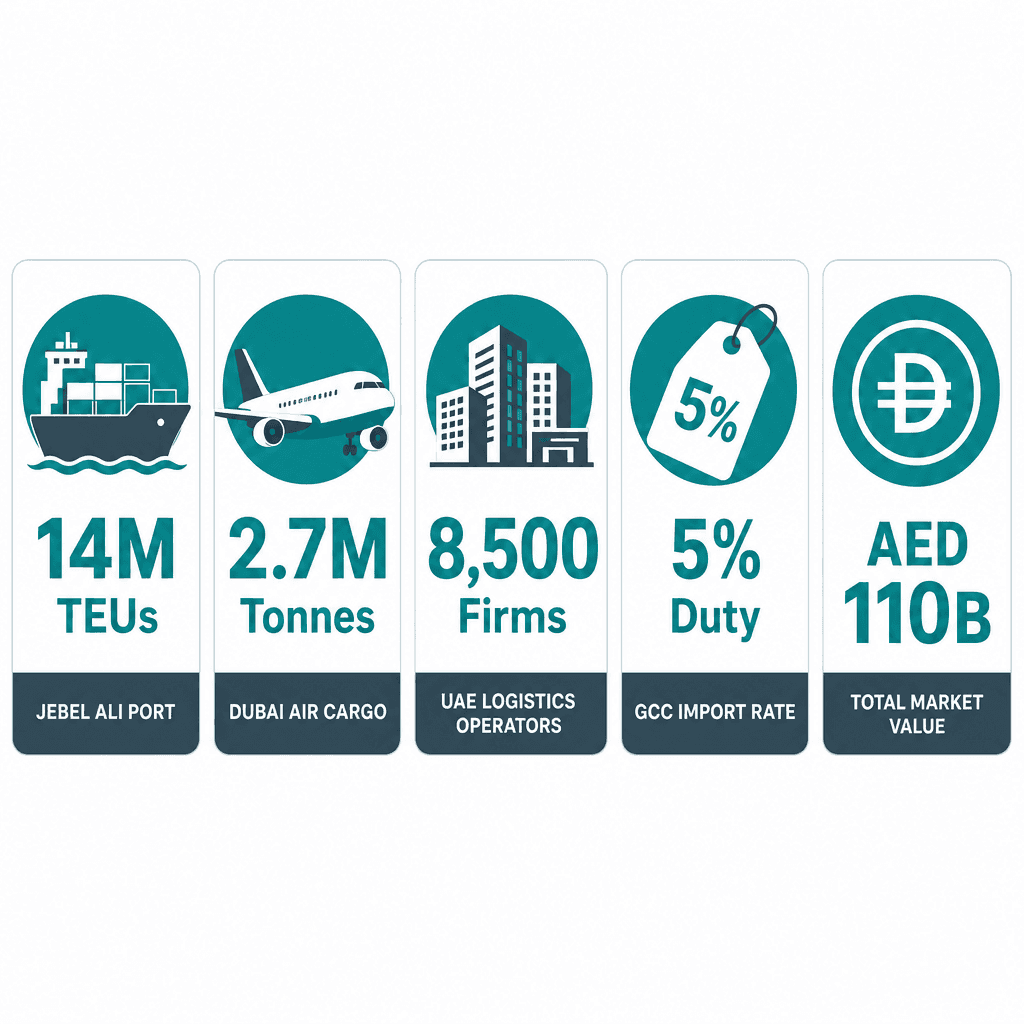
Logistics for UAE businesses operates across a network of sea, air, and road infrastructure ranked among the world's most efficient. The UAE processes over 14 million TEUs annually at Jebel Ali, operates the world's busiest international cargo airport at Dubai, and connects 190+ countries through licensed freight and customs channels. The supply chain UAE framework is built on three decades of deliberate infrastructure investment, and it shows in every transit time and clearance benchmark. For more detail, see our guide on cargo and freight consultancy license in Dubai. For more detail, see our guide on Al Maktoum International Airport and UAE logistics.
Why the UAE Is a Global Logistics Powerhouse
The UAE ranked 13th globally in the World Bank Logistics Performance Index 2023, a position that has strengthened through sustained infrastructure spending into 2026. Jebel Ali Port runs 67 berths with direct connections to 140+ shipping lines, processing those 14+ million TEUs annually (DP World, 2026). Dubai International Airport's cargo terminals process over 2.7 million metric tonnes of freight per year, making it the world's busiest international air cargo hub (Dubai Airports, 2026).
A Dubai-based e-commerce importer sourcing from Shenzhen can clear goods through Jebel Ali and deliver to a Dubai warehouse within 22 days door-to-door using consolidated sea freight. That's a benchmark most Southeast Asian or European logistics corridors struggle to match at comparable cost. The UAE's geographic position between Europe, Asia, and Africa means 190+ countries are reachable through its cargo networks, which is why the Dubai South logistics district has become a preferred base for regional distribution operations. For more detail, see our guide on Dubai South warehouse solutions.
How ISIC Classification Affects Your Logistics Business Registration
Here's something many new importers miss: your business activity code at registration directly affects how fast you get a customs code. Logistics and freight businesses in UAE are classified under ISIC Revision 4 Section H, which covers all transportation, warehousing, and postal activities. The Dubai Economic Department (DET) and free zone authorities use ISIC-derived activity codes to assign the correct trade license category. For more detail, see our guide on global trade opportunities at Dubai South Free Zone.
Freight forwarding falls under ISIC Group 522; warehousing under ISIC Group 521. Getting this wrong delays customs code assignment and warehouse licensing. A trading company importing electronics, for example, must register under the correct ISIC-derived activity code with DET or its free zone authority before applying for an importer code at dubai.customs.gov.ae. Misclassification is one of the top 3 causes of customs registration delays in UAE (Federal Customs Authority, 2025). Free zones offering logistics-specific activity codes aligned directly with ISIC Section H typically process registrations faster than mainland equivalents. For more detail, see our guide on getting an import export license in Dubai. For more detail, see our guide on Dubai free zone warehouse costs and budgeting. For more detail, see our guide on warehouse lease guide for UAE trading companies.
Key Logistics Infrastructure in Dubai
Dubai's logistics infrastructure includes Jebel Ali Port, Dubai International Airport cargo terminals, Al Maktoum International Airport, the Dubai South logistics district, and a network of bonded and free zone warehouses. Together these assets connect businesses to over 190 countries with customs-cleared transit times as short as 24 hours. Understanding how business logistics Dubai actually flows means knowing which gateway to use for which cargo type.
Sea, Air, and Road Gateways
Dubai's four primary logistics gateways each serve a distinct purpose:
A pharmaceutical importer, for instance, uses Dubai International Airport's cargo terminal for temperature-sensitive shipments, clearing through Dubai Customs in under 6 hours using the Green Channel designation. That's how logistics works Dubai-style: each gateway is optimised for a specific cargo profile, and choosing the right one cuts both time and cost.
Dubai South as a Strategic Logistics Hub
The Dubai South logistics district spans 145 sq km and integrates air, land, and e-commerce logistics in a single zone. It's home to Dubai South Business Hub Free Zone, purpose-built for trading, importing, and distribution businesses. Direct airside access to Al Maktoum International Airport eliminates the drayage leg that adds cost and time at other facilities.
An e-commerce retailer importing consumer electronics from Asia can store inventory at Dubai South, ship via Al Maktoum Airport for GCC distribution, and pay zero customs duty on goods held within the free zone perimeter. That zero-duty status, combined with the 145 sq km development area housing 2,000+ businesses, makes Dubai South a genuinely different proposition from mainland or alternative free zone locations.
How UAE Customs Clearance Works
UAE customs clearance is managed through the Federal Customs Authority and processed via the Dubai Trade portal at dubai.customs.gov.ae. Every shipment requires an importer code, a valid HS code, a commercial invoice, packing list, and certificate of origin. Standard clearance takes 1–3 business days; Green Channel pre-approved shipments clear in under 6 hours. This UAE logistics guide covers the exact steps so you don't hit avoidable holds.
Step-by-Step Customs Clearance Process
A Dubai-based electronics importer who submits a pre-arrival customs declaration via Dubai Trade and uses the Green Channel designation receives cargo release within 4 hours of landing at Dubai International Airport. Pre-clearance is the single biggest time-saver in the logistics setup Dubai business process.
HS Codes and Duty Rates You Must Know
Every product imported into UAE must carry a Harmonised System (HS) code, a 6-to-8-digit international product classification number. The GCC Common Customs Law applies a standard 5% import duty on most goods; excise goods including tobacco, energy drinks, and sweetened beverages attract 50–100%. Free zone imports are duty-suspended; duty only triggers when goods move from a free zone into UAE mainland.
Get the code right before you file. A food importer bringing olive oil into UAE uses HS code 1509.10, which ensures 0% duty under GCC exemptions for basic foodstuffs, saving thousands of AED per shipment. Misclassification incurs fines starting at AED 1,000 (Federal Customs Authority, 2026). Use the HS code Dubai customs guide to verify your product classification before submitting any declaration.
Do free zone companies need a customs code for imports?
Yes. Even if your goods remain within the free zone and attract zero duty, you still need a valid Importer Code from Dubai Customs before your first shipment arrives. The code is obtained at dubai.customs.gov.ae, costs AED 100, and takes 1–2 business days to process. Your free zone trade license is the primary document required for the application.
Warehousing Options for UAE Businesses
UAE businesses can choose from bonded warehouses, free zone warehouses, mainland commercial storage, and third-party logistics (3PL) facilities. Bonded warehouses defer duty payment until goods are released to market. Free zone warehouses offer zero duty on stored goods. Costs range from AED 15 to AED 60 per square metre per month depending on location and specification. Matching your warehouse type to your supply chain UAE strategy directly affects your landed cost per unit.
Bonded vs Free Zone vs Mainland Warehousing
Bonded warehouses, goods stored without paying import duty until released to mainland. Ideal for re-export businesses managing multiple destination markets.
Free zone warehouses, zero customs duty within the zone perimeter; duty triggered only on mainland transfer. Dubai South Business Hub Free Zone offers purpose-built units from 50 sq m at AED 25–45 per sq m/month (Dubai South, 2026).
Mainland commercial warehouses, standard leased storage subject to 5% import duty on arrival; regulated by DET and the relevant municipality. Rates run AED 30–60 per sq m/month in prime Dubai locations.
3PL providers, outsourced fulfilment including pick, pack, and ship. Cost-effective for e-commerce businesses under AED 5 million annual revenue who don't want to manage their own warehouse lease.
A UAE-based fashion retailer stores seasonal inventory in a Dubai South Business Hub Free Zone warehouse, pays zero duty on stock held there, and triggers duty payment only when units ship to mainland UAE customers. That structure keeps working capital higher during peak inventory periods. For the full picture on location options, the Dubai South logistics district overview covers available unit sizes and lease terms.
What to Look for in a UAE Warehouse
A beauty products importer selecting a temperature-controlled free zone warehouse at Dubai South for proximity to Al Maktoum Airport can cut airfreight handling time by 30% compared to a mainland facility. That's not a marginal gain, it's the difference between same-day and next-day fulfilment for time-sensitive stock.
Last-Mile Delivery in UAE
Last-mile delivery in UAE is handled by licensed courier companies including Aramex, Fetchr, Quiqup, and DHL Express, plus RTA-regulated van fleets for same-day urban delivery. Average same-day delivery costs AED 20–45 per consignment within Dubai. Cross-emirate delivery to Abu Dhabi or Sharjah adds AED 10–20 per shipment. Understanding how logistics works Dubai's last mile means picking the right carrier for your product type and customer location.
UAE Logistics Costs in AED - 2026 Benchmarks
Logistics Service / Fee | Cost in AED (2026) |
|---|---|
Sea freight FCL 20ft (China to Jebel Ali) | AED 1,200–3,500 per container (carrier and season dependent) |
Air cargo general goods (per kg) | AED 15–45 per kg general cargo; AED 55–120 per kg dangerous goods |
Customs duty standard rate (% of CIF value) | 5% CIF value (most goods); 0% basic foodstuffs; 50% tobacco |
Customs importer code registration | AED 100 one-time fee at dubai.customs.gov.ae |
Freight forwarding agent fee (per clearance) | AED 350–800 per clearance depending on complexity |
Free zone warehousing (per sq m/month) | AED 25–45 per sq m/month |
Mainland warehousing (per sq m/month) | AED 30–60 per sq m/month in prime Dubai locations |
Courier and Delivery Options in Dubai
Aramex is the largest regional courier with a strong GCC network and API integration for e-commerce platforms. Standard delivery runs AED 25–35 per consignment within UAE. It's the go-to for businesses shipping moderate volumes across multiple emirates.
Fetchr uses GPS-based delivery via phone location instead of a fixed address. That matters in UAE, where residential addressing is inconsistent. A Dubai-based online grocery store using Fetchr's system achieves a 94% first-attempt delivery rate across Dubai and Sharjah, a direct saving on re-delivery costs that run AED 35–60 per failed attempt.
DHL Express handles premium international last-mile at an average AED 40–75 per domestic consignment. Use it for high-value goods where speed and tracking accountability justify the premium. The UAE e-commerce delivery market is projected to reach AED 22 billion by 2027 (Statista, 2026), and DHL's network is built for that volume.
RTA-licensed light commercial vehicles serve same-day B2B delivery. A separate fleet operator permit from RTA is required for the carrier, worth knowing if you're building an in-house delivery operation.
Cross-Emirate and GCC Delivery Considerations
Shipments between UAE emirates require no customs documentation, but a delivery manifest is required for goods above AED 2,000 in value. GCC cross-border delivery to Saudi Arabia, Oman, Bahrain, Kuwait, or Qatar requires an export declaration and GCC Common Customs documentation.
Land freight to Saudi Arabia via the Al Ghuwaifat border crossing runs AED 800–1,500 per full truck load with a standard transit time of 2–4 days. A UAE furniture exporter shipping to Riyadh completes customs export formalities at dubai.customs.gov.ae before departure, with GCC export declaration processing taking 4–8 hours via the Dubai Trade portal. Free zone companies must appoint a licensed mainland freight agent for cross-border road shipments, as the carrier also requires an RTA permit (RTA, 2026).
Logistics Costs in AED - What to Budget
Logistics costs for UAE businesses vary by mode, volume, and destination. Expect AED 1,200–3,500 per FCL sea freight move from China to Jebel Ali, AED 15–45 per kg for air cargo, AED 15–60 per sq m/month for warehousing, and AED 20–75 per consignment for last-mile delivery. Budget 8–12% of landed goods value for total logistics costs. Business logistics Dubai planning starts with these benchmarks.
2026 UAE Logistics Cost Benchmarks
A startup importing 500 units of consumer electronics from Shenzhen pays approximately AED 2,800 sea freight, plus AED 1,400 customs duty at 5% CIF, plus AED 500 agent fee, plus AED 1,200 per month warehousing. Total landed cost per unit rises by roughly AED 11. That's a tight margin impact, and it's why getting the warehousing structure right matters from day one.
Free zone warehousing saves AED 5–15 per sq m/month compared to comparable mainland options, and that's before accounting for the 5% duty deferral on goods that remain within the zone. For logistics for UAE businesses operating at volume, those two savings compound quickly across a full financial year.
How to Reduce Logistics Costs Without Cutting Corners
If you're setting up a trading business license in Dubai, these cost levers should be built into your financial model before you commit to a warehouse location or freight partner.
A process timeline showing the five steps UAE importers follow to clear goods through Dubai Customs, from importer registration to duty payment and cargo release. UAE Customs Clearance: 5 Steps to Cargo Release (2026) 1 Register Importer AED 100 2 Get Importer Code 1-2 days 3 Classify HS Code Before filing 4 Submit Bill of Entry Dubai Trade portal
Citations
Dubai Airports.. dubaiairports.ae. Dubai Airports, 2024.
DP World.. dpworld.com. DP World, 2024.
Dubai Economy and Tourism.. dubaidet.gov.ae. DET Dubai, 2024.
Federal Authority for Identity, Citizenship, Customs and Port Security.. icp.gov.ae. ICP UAE, 2024.
Ministry of Human Resources and Emiratisation.. mohre.gov.ae. MOHRE UAE, 2024.
Frequently Asked Questions