Topic Summary
Understand Why the Match Is Legally Binding
A UAE business license authorizes only the specific activities listed on it, and trading outside those activities is an unlicensed commercial act. Regulators cross-check license activities against corporate tax filings, meaning a mismatch can trigger a one-time AED 10,000 penalty from the Federal Tax Authority.
Know the Four Main UAE License Categories
UAE authorities classify business activities into commercial/trading, professional/service, industrial, and tourism license types, each with its own permitted scope. Free zones like DSBH maintain their own approved activity lists aligned to these broad categories.
Let Your Principal Activity Drive the License Type
The activity generating the most business value determines which license type you need, while secondary activities must also appear on the license to remain lawful. For example, an e-commerce founder selling goods and offering after-sales support should list both activities on a single commercial license rather than obtaining two separate ones.
Budget for Activities Beyond the First Five
At Dubai South Business Hub Free Zone, the first five business activities are included in the base license fee starting from AED 12,500. Each additional activity beyond five costs AED 2,000, so mapping your full operational scope before applying prevents unexpected costs.
Use the ISIC Rev.4 Framework as Your Reference
UAE authorities reference the UN's ISIC Revision 4 standard, which classifies every productive activity into a four-level hierarchy across 21 top-level economic sections. Your license activity code maps directly to this framework, making it a reliable tool for confirming you are selecting the correct category.
Verify Your Activity List Before Applying
Not every business activity is approved in every free zone, so confirming your activity appears on DSBH's approved list before submitting an application is a critical first step. Skipping this check is one of the most common reasons founders end up with the wrong license type.
Avoid Bank KYC Rejection With a Clean Match
Banks verify that the activities on your license align with your stated business purpose during the account-opening KYC process, and a mismatch is a common reason for rejection. One real-world example shows a software consultancy registered under a general trading license facing a six-week account-opening delay before issuing a single invoice.
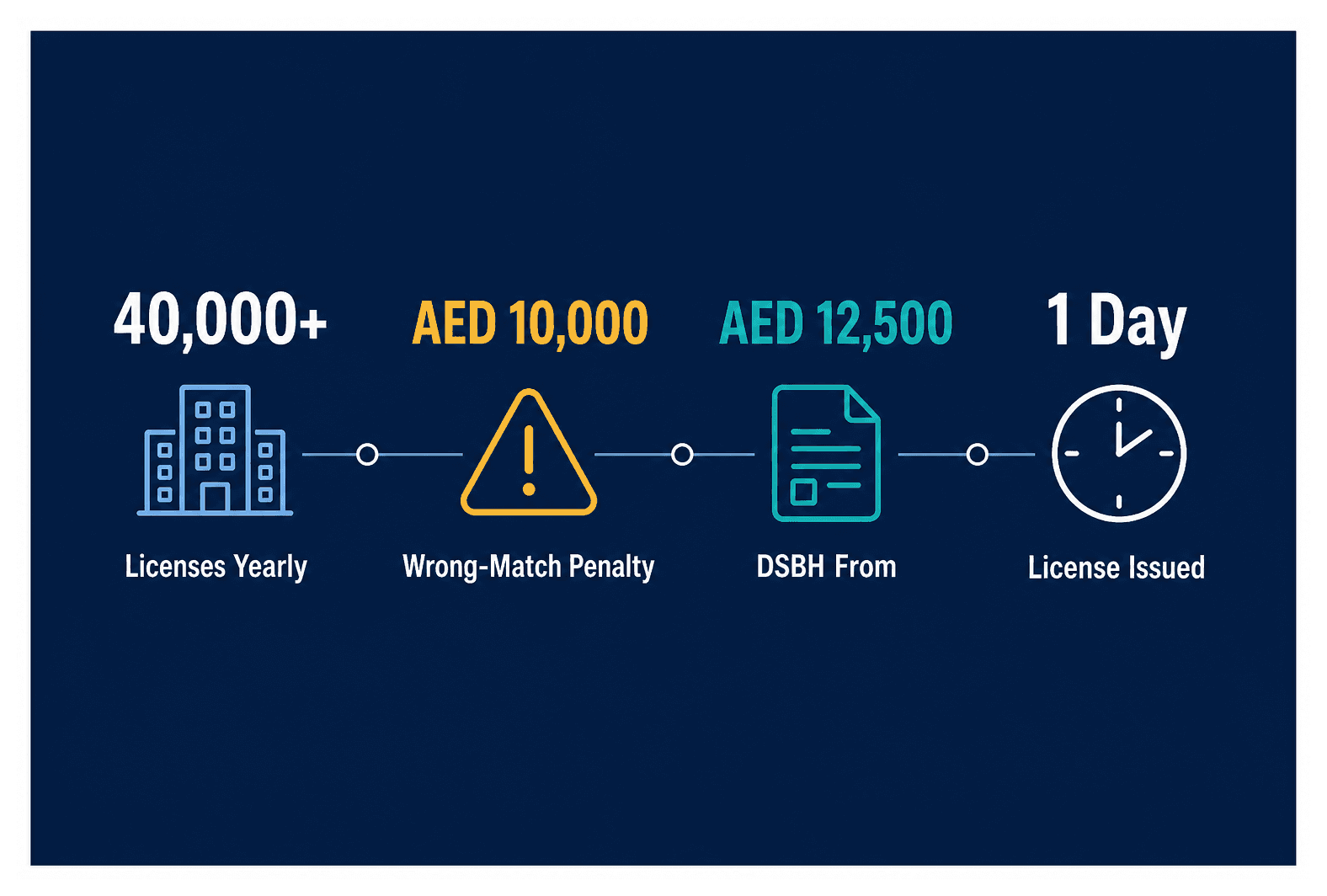
In 2026, over 40,000 new business licenses are issued in Dubai each year (Dubai Chamber, 2024), yet a significant share of first-time founders choose the wrong license category at the outset. The cost of that mistake? A minimum AED 10,000 penalty from the Federal Tax Authority (Federal Tax Authority, 2024) [1], plus amendment fees [2], a bank KYC rejection [3], and weeks of delay before you trade a single dirham [4]. Dubai South Business Hub Free Zone (DSBH), launched September 2025, issues licenses in one business day from AED 12,500 [5], with zero paid-up share capital required [6]. But that speed only works in your favour when the matching business activity dubai process is done correctly from the start.
This guide walks you through the requirements for matching your business activity in Dubai to the right license type, breaks down the costs involved, and gives you a step-by-step process to get it right the first time at DSBH.
What Is Matching Your Business Activity to the Correct License Type
Matching your business activity in Dubai means aligning what your company will actually do with the precise license category recognised by the relevant authority. The wrong match delays registration, voids insurance, and can trigger an AED 10,000 late corporate tax registration penalty from the Federal Tax Authority. It's not a bureaucratic formality, it's the legal foundation your entire business operation rests on.
Why the Activity-to-License Match Is a Legal Requirement
A license authorises only the specific activities listed on it. Trading outside those activities is an unlicensed commercial act under UAE commercial law, full stop. Here's what that means in practice:
Regulators cross-check the license activity against corporate tax registration filings. A mismatch can trigger a one-time AED 10,000 flat penalty for late or incorrect registration (Federal Tax Authority, 2024).
Banks conduct activity verification during account opening. A mismatch between the license and the stated business purpose is a common reason for rejection, not a minor inconvenience.
ISIC Revision 4, the UN's global standard adopted as a reference by UAE authorities, classifies every productive activity into a four-level hierarchy. Your license activity code maps directly to this framework (UN Statistics Division, 2008, still accurate as of 2026).
ISIC Rev.4 covers 21 top-level economic sections used by UAE and international regulators, from agriculture through to extraterritorial organisations.
Consider this scenario: a founder registering a software consultancy under a general trading license discovers the bank flags the mismatch during KYC, delaying account opening by six weeks. That's six weeks without a functional business bank account, before a single invoice is raised.
How Activity Classification Works in the UAE Framework
UAE authorities classify activities into broad license types: commercial/trading, professional/service, industrial, and tourism. Each carries its own permitted scope, and free zones maintain their own approved activity lists aligned to these types.
At DSBH, the first five activities are included in the license fee. Each activity beyond five costs AED 2,000.
The principal activity, the one generating the most value, determines the license type. Secondary activities must still appear on the license to be lawful.
An e-commerce founder selling physical goods and providing after-sales support, for example, lists both 'retail trading via electronic platforms' and 'customer support services' on one commercial license rather than obtaining two separate licenses.
DSBH does not provide bonded warehousing or customs integration. It is not a designated zone, so no designated-zone VAT or customs duty benefit applies. Free zone goods are duty-suspended, not duty-exempt.
Browse the full list of business activities at DSBH to confirm your activity is on the approved list before you go any further.
Commercial vs. Professional License: Key Differences at a Glance
Feature | Commercial License | Professional License |
|---|---|---|
Principal activity type | Buying, selling, importing, or exporting physical or digital goods | Delivering expertise, advisory, or skill-based services to clients |
Typical business examples | E-commerce retail, fitness equipment trading, wholesale distribution | Management consultancy, digital design, ICT services, marketing agencies |
Sector regulator triggers | Ministry of Economy for certain restricted goods; customs authority for import/export | DHA for healthcare; KHDA for education; NMC for media; Central Bank for financial services |
ISIC Rev.4 reference sections | Section G (Wholesale and Retail Trade); Section H (Transportation and Storage) | Section J (Information and Communication); Section M (Professional, Scientific and Technical) |
Paid-up share capital at DSBH | Zero, no bank deposit required before license issuance | Zero, no bank deposit required before license issuance |
How License Categories Are Defined in Dubai
Dubai uses four primary license categories: commercial (trading goods), professional (selling skills or expertise), industrial (manufacturing or processing), and tourism. DET governs mainland licenses; free zones issue their own licenses within the same framework. Choosing the right category before registration prevents amendment fees and regulatory delays. This is where matching business dubai requirements begins in practice.
Commercial License: Trading Goods and Products
A commercial license covers buying and selling of physical or digital goods, import and export, wholesale, and retail, including e-commerce platforms where goods are sold via the internet. Worth flagging: under ISIC Rev.4 principles adopted by UAE authorities, e-commerce is not a separate category. The activity is classified by the nature of the goods sold, not the sales channel.
A trading license in Dubai from DSBH starts from AED 12,500 and is issued in one business day.
Founders selling both goods and related services can bundle both under one commercial license if the trading activity is the principal one.
A founder importing and retailing fitness equipment online, for example, holds a commercial license listing 'sports equipment trading' and 'e-commerce retail' as activities on the same document.
Professional License: Selling Skills and Expertise
A professional license in Dubai covers consultancy, advisory, design, technology, education, healthcare, legal, and other knowledge-based services where the primary output is expertise rather than a physical product. ICT companies, marketing agencies, management consultants, and training providers all fall here.
Zero paid-up share capital is required at DSBH, making the professional license accessible to solo founders and small teams from day one.
100% foreign ownership is available for professional license holders at DSBH, and also on the mainland under UAE Commercial Companies Law. This is unrelated to designated-zone status.
A UK-based UX designer relocating to Dubai, for instance, holds a professional license listing 'digital design consultancy' and 'user experience advisory' as activities, with no share capital deposited.
Technology founders should also check the ICT license category at DSBH for activities specifically within Section J of ISIC Rev.4.
Industrial and Other Specialist Categories
Industrial licenses cover manufacturing, processing, and assembly. A contractor performing manufacturing on a fee basis is still classified under manufacturing per ISIC Rev.4 principles, it's the activity performed, not who owns the inputs, that determines classification.
Tourism licenses cover hospitality, travel agencies, and tour operations, a distinct category regulated separately from commercial and professional activities.
DSBH does not offer bonded warehousing or customs integration. Founders requiring those logistics functions should confirm their activity scope before choosing a free zone.
A founder organising contract assembly of electronics holds an industrial license even though a third-party factory owns the production line, because the principal activity is manufacturing organisation.
Regulated Activities and Dual Approval Requirements
Certain business activities in Dubai require approval from a named sector regulator in addition to the trade license. DSBH licenses the activity on the trade license document, and the relevant authority, such as the Ministry of Economy, Federal Tax Authority, or a health regulator, grants its own permit separately. Both are mandatory before trading. This is one of the most critical matching business dubai requirements that first-time founders overlook.
Which Activities Trigger a Separate Regulatory Approval
Financial services: The Central Bank of the UAE or Securities and Commodities Authority issues its own approval. DSBH licenses the activity; the named regulator approves it separately.
Healthcare: The Dubai Health Authority (DHA) issues a facility license and professional registration. Both the DSBH trade license and DHA approval are required before any clinical activity begins.
Education and training: Knowledge and Human Development Authority (KHDA) approval is required alongside the trade license for any regulated instruction activity.
Media and communications: The National Media Council (NMC) issues a sector permit separately from the trade license for publishing, broadcasting, and PR activities.
A telehealth startup, for example, holds both a DSBH professional license listing 'telemedicine services' and a separate DHA facility approval. Neither document alone permits the business to operate.
Tax Registration Obligations Tied to Your Activity
Your activity classification affects more than just which regulator you need. It directly shapes your tax obligations from day one.
VAT registration is mandatory once taxable supplies exceed AED 375,000 annually. Late registration carries an AED 10,000 penalty from the Federal Tax Authority (2024).
Corporate tax registration is required for all juridical persons. Late registration carries a one-time flat AED 10,000 penalty, not a monthly charge.
Qualifying Free Zone Person (QFZP) status under corporate tax requires four conditions: adequate substance, qualifying income, no mainland nexus beyond permitted levels, and compliance with transfer pricing rules. Never treat this as simply a 0% corporate tax rate without those four conditions confirmed.
A mismatch between your licensed activity and actual revenue streams can disqualify the preferential rate entirely.
A DSBH-licensed software company earning consultancy fees from mainland clients must assess whether that income qualifies as 'qualifying income' under the four QFZP conditions before applying the preferential corporate tax rate. Get your banking and taxation setup right from the start.
Is a DSBH license sufficient for regulated activities?
No. For regulated activities, healthcare, financial services, education, media, the DSBH trade license is a necessary but not sufficient document. The named sector regulator (DHA, Central Bank, KHDA, NMC) must issue its own approval before you begin that activity. Both documents are required simultaneously before trading.
Step-by-Step Process for Matching Your Business Activity in Dubai
To match your business activity in Dubai to the correct license: define your principal revenue-generating activity, check it against the approved activity list, identify whether a sector regulator approval is needed, select your license type, submit your application, and obtain all required permits before trading. The DSBH license is issued in one business day.
Step 1: Define Your Principal and Secondary Activities
List every revenue-generating activity your business will perform in the first 12 months.
Identify which activity generates the most value. This is your principal activity and determines the license type, following the ISIC Rev.4 top-down method.
Secondary activities that produce output for clients must appear on the license. Ancillary activities (internal accounting, transport for own use) do not need separate listing.
Use ISIC Rev.4 section descriptions as a cross-reference: Section J (Information and Communication), Section M (Professional/Scientific/Technical), or Section G (Wholesale/Retail) each point to a clear license category.
A founder running a digital marketing agency with occasional branded merchandise sales lists 'digital marketing consultancy' as the principal activity and 'branded goods retail' as secondary. The license type is professional, not commercial, because expertise generates the most value.
Step 2: Check the Approved Activity List and Identify Regulatory Requirements
Browse the DSBH business activities list to confirm your activity is approved and correctly labelled. Activity wording on the license must match the regulator's approved terminology exactly.
Flag any activity that triggers a named sector regulator approval (DHA, KHDA, NMC, Central Bank) and build that approval timeline into your launch plan.
If you need more than five activities, budget AED 2,000 per additional activity beyond the fifth.
Check your trade name availability before finalising the activity list. The name and activity must be consistent for the application to proceed.
A health and wellness coaching company checks the DSBH activity list and finds 'wellness coaching' is a professional activity requiring no DHA approval, while 'nutrition consultancy' on the same list requires a separate DHA permit. Two activities, two different timelines, both must be planned before launch.
Step 3: Submit Your Application and Obtain All Required Permits
Submit your trade license application to DSBH. The license is issued in one business day once documents are complete.
Apply to any required sector regulator immediately after license issuance. Do not begin regulated activities until both the trade license and the regulator permit are in hand.
Register for corporate tax with the Federal Tax Authority following license issuance to avoid the AED 10,000 one-time flat penalty.
If your taxable supplies are projected to exceed AED 375,000 annually, register for VAT at the same time to avoid the AED 10,000 VAT late registration penalty.
Apply for investor UAE residency visas as a separate cost. Visas are never included in the license fee and must be budgeted independently.
A sole founder applying at DSBH receives the trade license on day one, submits the NMC media permit application on day two, and completes corporate tax registration online the same week. All three steps are sequential, not simultaneous.
Cost of Getting Your Matching Business Activity Right in Dubai
A DSBH free zone trade license starts from AED 12,500, with zero paid-up share capital required. A sole founder's first-year total including one investor visa starts from AED 18,350. Each activity beyond the first five costs AED 2,000. Regulatory sector permits are priced separately by each authority. Getting the matching business activity dubai process right before submission means you pay these fees once, not twice.
DSBH License Fees and Activity Costs
Trade license from AED 12,500ces as of 2026.
First five activities are included in the license fee. Each activity beyond five costs AED 2,000.
Zero paid-up share capital is required. No funds need to be deposited in a bank account before license issuance.
DSBH launched in September 2025 and issues licenses in one business day.
A founder setting up a digital agency with seven listed activities pays the base license fee plus AED 4,000 for the two activities beyond the first five. That's a predictable, transparent cost structure, no hidden charges if you plan the activity list correctly upfront. Optional services, visas and any required third-party approvals are charged separately.
DSBH First-Year Cost Breakdown: Sole Founder vs. Two-Shareholder Company
Cost Item | Sole Founder (1 visa) | Two-Shareholder Company (2 visas) |
|---|---|---|
Base trade license | From AED 12,500 | From AED 12,500 |
Additional activities (beyond 5) | AED 2,000 per activity | AED 2,000 per activity |
Investor visa(s) | Dubai Chamber |
Frequently Asked Questions